


While matching platforms connect talent, discovering why a cofounder finding website is only the first step is essential to surviving early-stage venture growth.
The Alchemy of Alignment: Why a Cofounder finding website is Only the Beginning
In the contemporary innovation economy, the “lone wolf” myth of entrepreneurship has largely been debunked by the cold reality of longitudinal data. Recent venture statistics suggest that startups with multiple co-founders outperform solo-founder ventures significantly in terms of both revenue generation and valuation. Research indicates that founding teams deliver better results because they provide a diversity of cognitive resources and emotional support necessary to navigate the “dark forest” of early-stage growth. Consequently, establishing a venture as a collective effort is no longer just a preference; it is a strategic imperative for speed and scalability.
As this demand has grown, so too has the infrastructure for “matching.” Beyond traditional networking or hiring from one’s immediate circle, the ecosystem has seen a surge in systematic connection platforms designed to facilitate partnerships. Some of these platforms operate as specialized social networks for founders, while others are integrated into global accelerators to provide systematic connections for potential co-founders. However, a fundamental truth remains: while a Cofounder finding website can solve the problem of discovery through surface-level filters like “technical skill” or “location,” it rarely addresses the underlying psychological architecture of the team. Finding a co-founder is easy; finding the right co-founder—one whose behavioral DNA and decision-making logic harmonize with yours—is the true challenge.
Start-up team conflict prediction: Scientific Reasons Why We Should Expect Failure
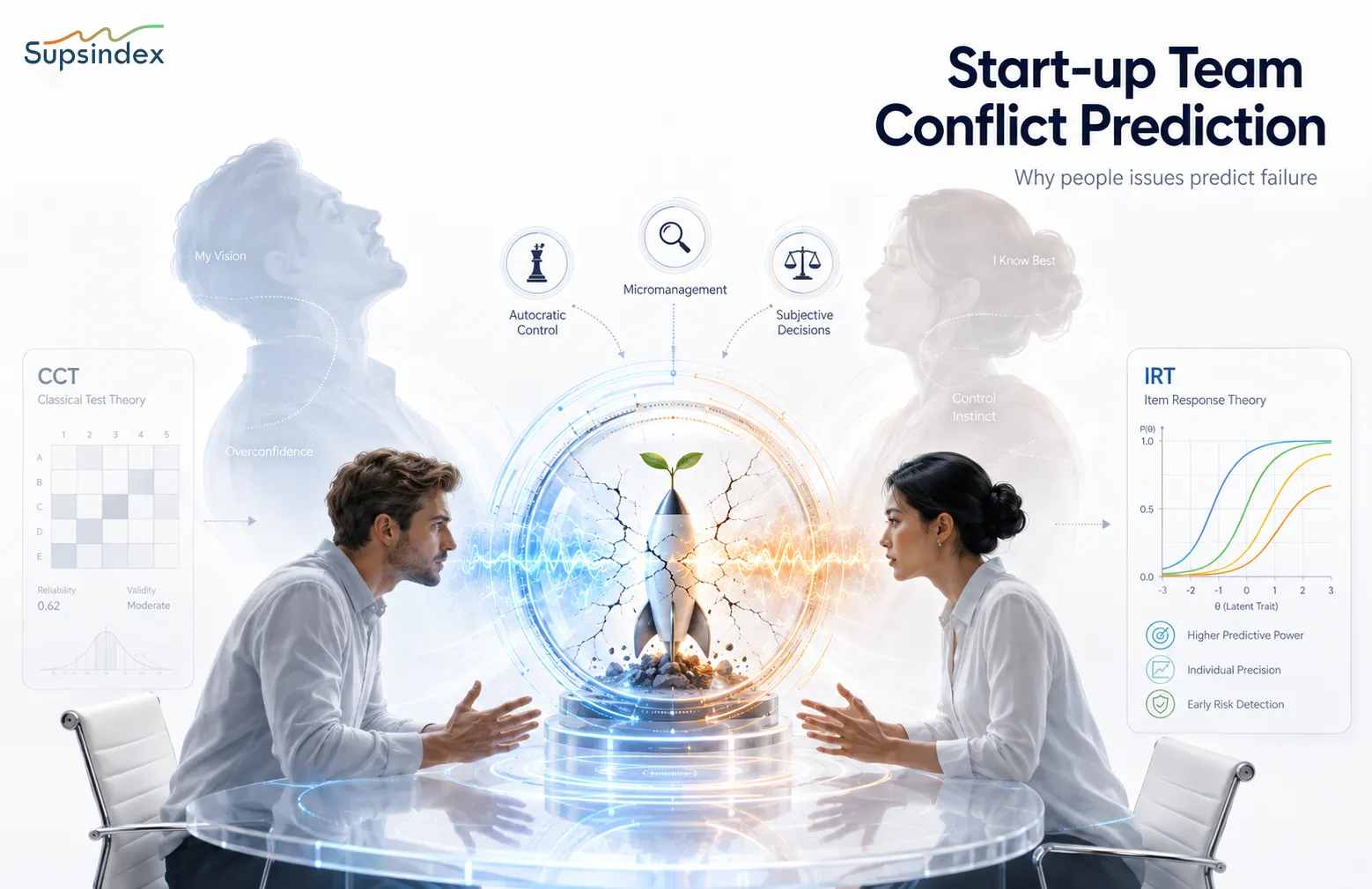
The importance of careful selection comes out clearly once we consider the fundamental reasons why start-ups fail. There is a recognized trend among many studies that the main cause of failure of start-up ventures is rarely the absence of technical or commercial viability but rather “people issues”—that is, co-founder disagreements, poor decision-making or lack of flexibility. Thus, Start-up team conflict prediction is the crucial yet neglected variable in venture investment.
The Psychological Aspect of the “Founder Effect”
To justify the importance of Start-up team conflict prediction, one needs to analyze the psychological phenomenon known as the “Founder Effect”. It refers to the overwhelming role played by the founder in his/her organization and thus is a “double-edged weapon”. On the one hand, an individual’s strong conviction is a key asset needed to initiate a start-up while, on the other hand, the lack of balance may lead to overconfidence and unwillingness to take other people’s recommendations. Once there are two or more founders with such traits, their disputes will probably result in:
- Autocratic Management Styles: Where a lack of trust leads to a “need for absolute control” over staff and partners.
- Micromanagement: Excessive involvement in operational details that erodes team trust and leads to burnout.
- Subjective Decision-Making: Relying on “gut feel” while avoiding the objective data or team input necessary for product-market fit.
The Shift from CCT to IRT
Traditionally, these attributes were analyzed using Classical Test Theory (CCT) in which all the questions have equal weight. Such approach is highly erroneous from the standpoint of scientific research in predicting team conflict in Startups because it considers a simplistic definition the same way as a highly detailed analysis. The modern field of psychometrics applies the concepts of Item Response Theory (IRT) and Thurstonian Modeling. These rigorous standards, widely applied in high-risk areas such as choosing a military officer and licensing in the medical field, let us analyze “latent utility” — the calculation of actual utility of decisions made by a startup owner.
Compatibility assessment between founders: The FEE Engine for Behavioral DNA
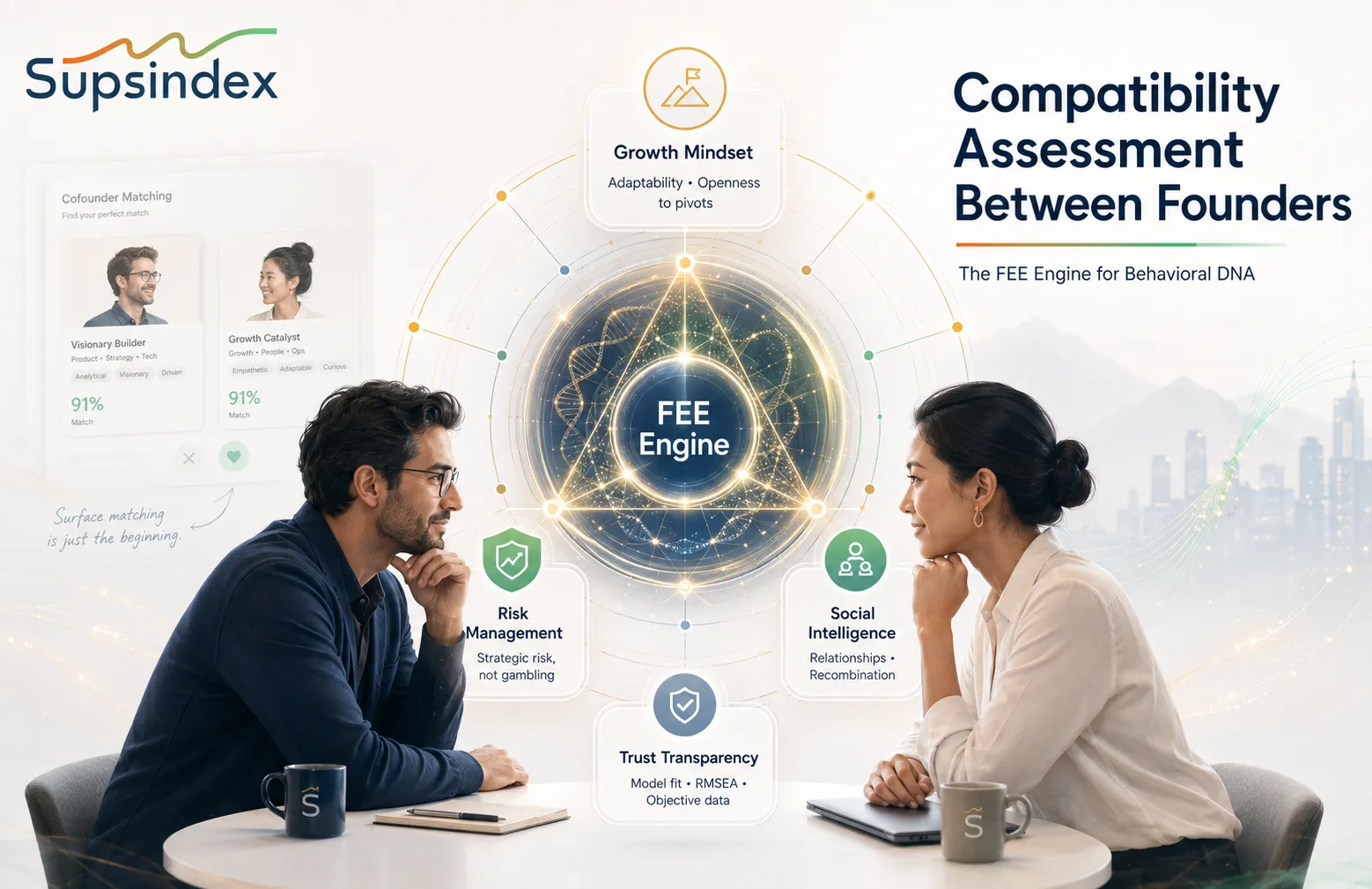
At Supsindex, we are aware that a basic cofounder matching website is just the tip of the iceberg when it comes to the problem of solving the team misalignment problem. To this effect, the FEE (Founders Entrepreneurial Evaluation) test has been developed within the framework of Assessing co-founder compatibility. While personality tests such as DISC or Myers-Briggs might produce false negative correlation (for instance, implying that a founder is not adaptable due to his priority on integrity), the FEE test relies on Thurstonian Item Response Theory and reveals actual strengths of an entrepreneur in 19 successful constructs.
Architecture of team alignment
FEE service represents a diagnostic solution for assessing team integration by delving deep into their mindspace. As a result, Assessing co-founder compatibility becomes an exact science that includes analysis of various aspects of team mentality:
- Growth Mindset and Fixed Mindset: How the team views the development of its intelligence and skills in time by means of effort. The team which shares the growth mindset is more adaptable and open to making pivots in times of volatility.
- Approach to Risk Management: Rather than ask, “Are you a risk-taker?”, we will look at the process through which the founders handle risk. The effective team takes risks strategically based on vision and experience, as opposed to gambling their way to success.
- Social Intelligence and Recombination: Assessing the team’s capacity to build high-quality relationships and their ability to combine disparate resources and personal experiences in novel ways to create value.
Solving the “Chicken-and-Egg” Problem of Trust
For many users of a Cofounder finding website, the biggest hurdle is establishing a baseline of trust with a new partner. Assessing co-founder compatibility through the FEE provides “Model Fit Transparency,” utilizing indices like RMSEA to verify that the scoring models accurately represent the underlying data structure of the team. This builds an “unprecedented efficiency” in the relationship, ensuring that every joule of human energy is deployed with maximum impact based on a foundation of objective data.
Building a resilient founding team: The FDE Flight Simulator for Unpredictability
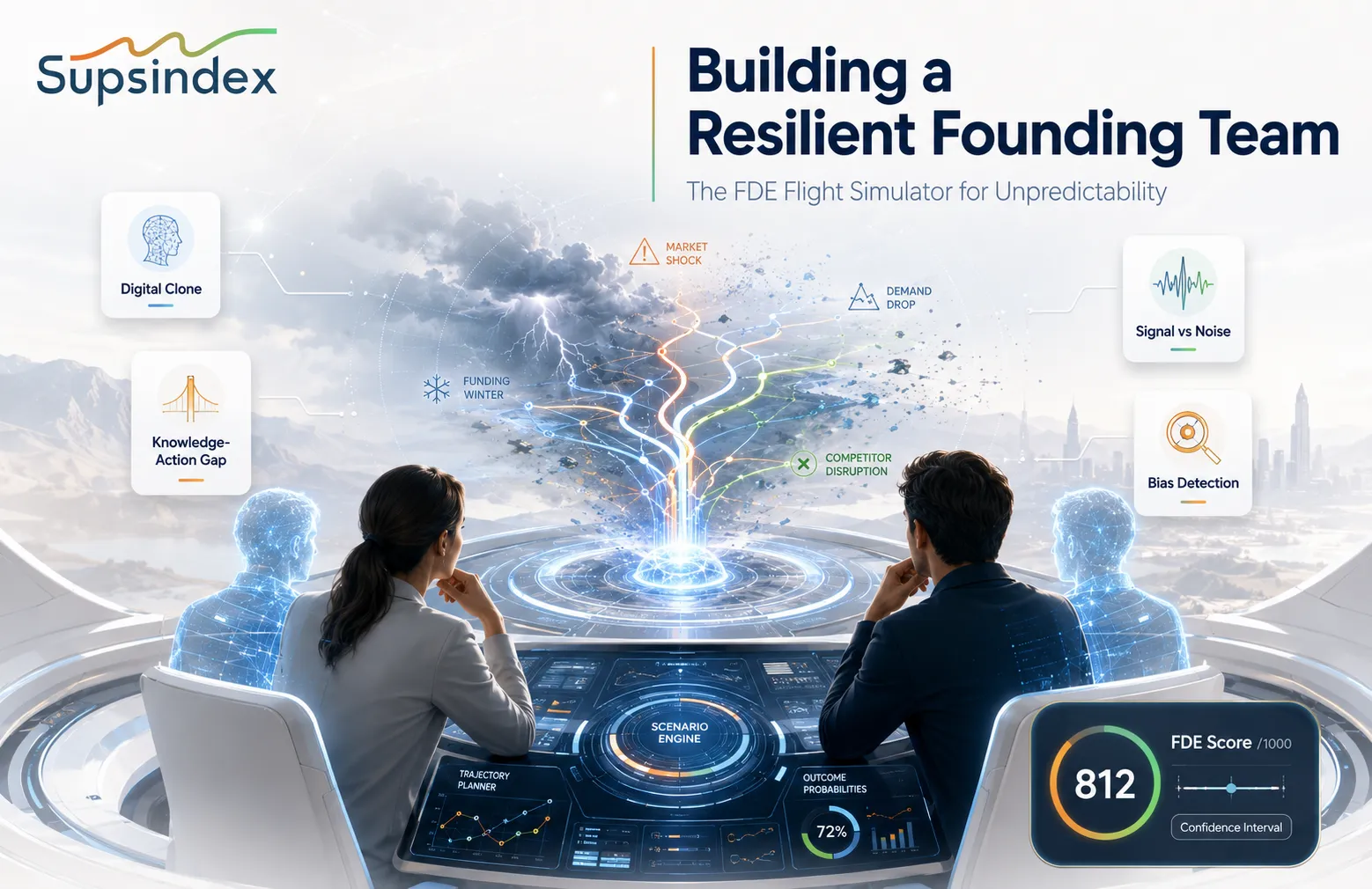
Knowledge and theoretical compatibility are merely the groundwork. The ultimate test of a startup team is how they perform when faced with the “shaggy horse” of market uncertainty. This is why Building a resilient founding team requires a transition from static reports to dynamic simulations. Our FDE (Founders’ Decision Excellence) service achieves this by immersing founders in a high-fidelity Leadership Flight Simulator.
Simulation-Based Stress Testing
To facilitate Building a resilient founding team, the FDE provides four hours of access to a “startup cockpit” where teams must navigate simulated market shocks. This approach is grounded in the Theory of Planned Behavior (TPB), which posits that behavioral intentions are shaped by attitudes, subjective norms, and perceived behavioral control. The simulator measures the “Knowledge-Action Gap”—the phenomenon where individuals know the ethical or strategic “correct” answer but fail to execute it under pressure.
The Role of the Digital Clone
A central feature of Building a resilient founding team within our simulator is the use of a Personalized Digital Clone. This AI twin is built from the founder’s own data and represents their optimal, stress-free decision-making profile. By tracking the divergence between the human founder and their digital clone during a crisis, the system reveals:
- Cognitive Derailers: Detecting susceptibility to 20 different biases, such as “Wilful Blindness” or “Rash Decision-Making,” that often derail early-stage companies.
- Executive Function and D-Prime Effectiveness: Assessing the group’s aptitude for focusing on real challenges (signal), ignoring irrelevant facts (noise), or distinguishing signal from noise.
- Resilience and Emotional Intelligence: Evaluating the level of resilience the team can maintain despite facing rejection or disputes using an evidence-based learning approach.
Impact of the Methods on Global Venture Capital
In relation to the whole ecosystem, a resilient team is built through the use of the above techniques, which would solve the challenge of the “Lack of efficiency factor in financial decisions.” Through the use of Supsindex as a way to offer investors the team’s “Score out of 1000,” as well as its Confidence Intervals, the team’s abilities would be objectively calculated. As a result, it will turn the “soft power” of the decision-makers into a globally validated measure of the team’s preparedness.
The Future of the Cofounder finding website
It is necessary to recognize that the basic truth about the creation of science and technology is that they are ultimately creations of mankind. Both successes and failures arise from the decisions and actions of men, not from market models alone. The answer for any future Cofounder finding website, therefore, lies in the adoption of a deeper integration with psychometrics.
Through taking our approach from simple “personality quizzes” to what we call the Triangulated Assessment Engine, which analyzes Cognitive Power, Behavioral Judgment, and Ecosystem Fit, we minimize the waste of human resources. As a new-founder who is using a Cofounder finding website for the first time, or as part of a Series A team that wants to maximize its potential, you have the same goal in mind.
Supsindex is not just a platform; it is a reflective surface for the architects of prosperity. Through our proprietary and patented algorithms, we empower you to understand and improve your skills while enabling investors to make smarter, more productive capital allocations. Don’t just find a partner; verify your future.
