


A solo founder can build a venture-scale startup, but solo founder success depends on whether critical gaps in judgment, delegation, finance, decision-making, and external support are identified and deliberately covered before they become company-wide bottlenecks.
The Solo Founder Risk: Can One Person Really Build a Venture-Scale Startup?
The entrepreneurial world has always had a fascination with the lone visionary: one founder with an unconventional idea, unusual conviction, and enough persistence to turn it into a company that eventually changes an industry. The narrative is attractive because it concentrates an enormously complex process into the story of one exceptional person. In reality, however, building a venture-scale startup requires far more than creating a product or identifying an opportunity. It requires simultaneous competence across strategy, finance, hiring, sales, market validation, capital allocation, leadership, regulation, operations, and decision-making under conditions where information is incomplete and mistakes can be extremely expensive.
This is where solo founder risk becomes important. The fundamental concern is not that one person is incapable of starting or even scaling a successful company. It is that when a single founder carries the strategic and operational responsibility of the venture, there is less internal redundancy when that founder has an important blind spot. In a well-constructed founding team, weaknesses can sometimes be compensated for by another founder’s knowledge, judgment, network, or behavioral style. For the solo founder, those compensating mechanisms must be created deliberately.
The question, therefore, is not simply whether solo founders succeed or fail. A more useful question is whether a solo founder can construct enough cognitive, behavioral, operational, and relational leverage around themselves to prevent their individual limitations from becoming limitations of the entire company.
Solo founding is becoming more common
This question is becoming increasingly relevant because solo founders are no longer an edge case in the startup ecosystem. Carta’s analysis of tens of thousands of U.S. companies found that the proportion of new startups with a solo founder increased from 23.7% in 2019 to 36.3% in the first half of 2025. Technology is likely contributing to this shift. Software infrastructure, cloud services, automation, generative AI, and increasingly capable AI agents allow a single person to perform work that previously required several employees or specialists.
The funding market, however, still treats solo-founded companies differently. Carta found that although solo-led companies represented roughly 30% of startups founded in 2024, they received only 14.7% of the cash raised through priced equity rounds during that year. Another Carta analysis found that 35% of companies incorporated on its platform in 2024 had a solo founder, while solo-founded companies represented only 17% of companies from that cohort that had closed a VC round by year-end. These figures do not prove that investors are correct to prefer teams, but they demonstrate that solo founder risk remains embedded in venture financing behavior.
The rise of AI is likely to make the distinction even more important. Starting a company alone is becoming easier. Whether building an enduring venture-scale organization alone is becoming equally easier is a different question.
What does the research actually say about solo founders?
The conventional startup narrative tends to present a simple conclusion: founding teams outperform solo founders because several people possess more resources, knowledge, experience, and execution capacity than one. There is considerable evidence supporting parts of that argument, but the academic literature is more nuanced than the conventional wisdom suggests.
A 2026 study published in the Strategic Management Journal examined solo founding using two datasets, including companies associated with Y Combinator and a much larger sample from Crunchbase. The researchers identified what they describe as a “solo founder disadvantage,” but importantly found that this disadvantage was partially reduced when founders possessed broad experience, deep experience, or a combination of the two. In other words, being alone did not automatically determine the outcome; the human capital carried by the individual founder materially changed the risk.
Evidence from equity crowdfunding points in a similar direction. A British Journal of Management study analyzing 1,291 campaigns across Crowdcube, Seedrs, and SyndicateRoom found that solo-founded ventures had a lower probability of completing successful initial equity crowdfunding campaigns and were subsequently more likely to fail than founder teams. The researchers estimated that solo-founder ventures in their sample exhibited a roughly 34% higher failure hazard. They attributed part of the team advantage to broader human capital and the greater likelihood of attracting professional investors who could provide additional monitoring and support.
Yet even this study emphasizes that the broader empirical record is mixed. Earlier research has sometimes found solo founders performing as well as or better than teams in particular contexts, including reward-based crowdfunding. Teams create additional resources, but they also introduce coordination costs, incentive problems, disagreement, and interpersonal conflict. This is precisely why founder headcount alone is an incomplete measure of startup readiness.
From the Supsindex perspective, this apparent contradiction is not particularly surprising. Adding founders can increase the resources available to a company, but adding people does not automatically create an effective founding system.
The co-founder paradox: more capability can also mean more friction

A strong founding team creates forms of leverage that are difficult for one individual to reproduce. Different founders can contribute different technical, commercial, financial, and relational capabilities while providing each other with psychological support and independent judgment when uncertainty is high. When those capabilities are complementary, the founding team becomes more than the sum of its members.
The opposite can also occur. A team may possess exceptional individual talent while being unable to make decisions together. Differences in risk appetite, communication style, strategic priorities, personal ambition, or conflict behavior can transform theoretical complementarity into organizational paralysis. Supsindex data illustrates this problem particularly clearly: teams displaying extreme variance in risk tolerance, such as pairing an intensely risk-seeking founder with an extremely risk-averse counterpart, showed a 2.1x higher failure hazard than teams with better-aligned risk profiles.
This is the reason Supsindex developed the Founders Engagement Efficiency (FEE) Index to examine dimensions such as co-founder compatibility, behavioral complementarity, communication, psychological safety, and collaborative decision-making. Rather than assuming that a two- or three-person founding team is inherently safer than a solo founder, FEE asks whether those individuals are capable of functioning as an effective decision-making unit when pressure increases.
The predictive evidence behind that framework is significant. Supsindex’s econometric analysis found that a one-standard-deviation increase in FEE was associated with a 17.3% reduction in the hazard of failure, with FEE emerging as the strongest individual behavioral predictor in the assessment suite. The implication is not that team size is irrelevant, but that the quality of interaction inside the team is considerably more informative than headcount by itself.
This leads to a more useful comparison. The real competition is not necessarily between one founder and two founders; it is between a venture with well-covered human risks and one with critical human risks left exposed.
Why the Penalty for Bottleneck matters more for a solo founder
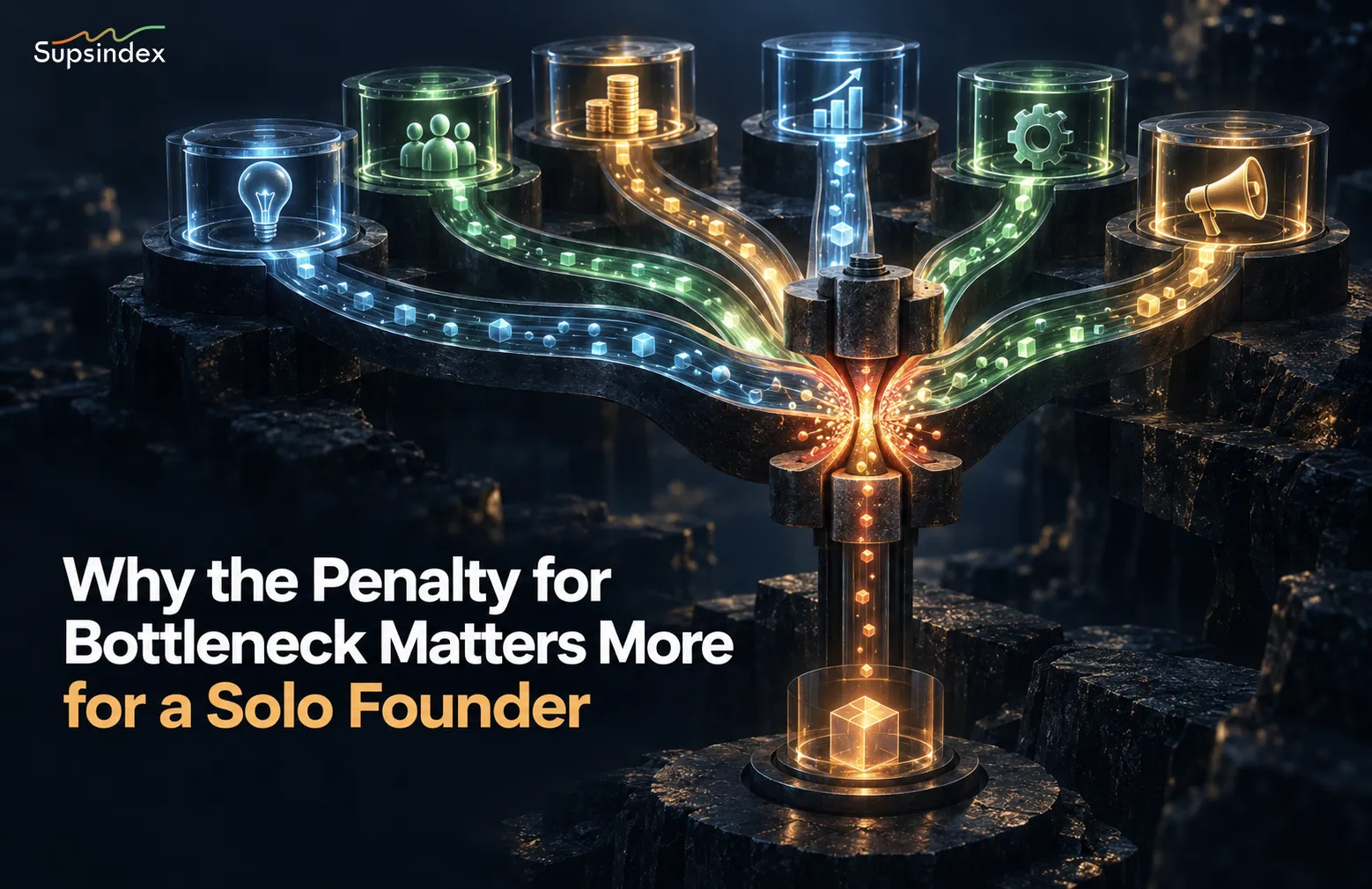
Supsindex approaches founder readiness partly through the Penalty for Bottleneck (PFB) methodology. Traditional assessment models can obscure severe weaknesses by averaging them together with strengths. A founder may score exceptionally well in product strategy, storytelling, industry knowledge, and ambition while possessing a severe weakness in financial judgment or emotional decision-making. An average score can make the overall profile appear healthy even though one capability may be sufficiently weak to jeopardize the entire venture.
PFB addresses this by treating critical capabilities more like components of an interconnected system. In such systems, the weakest important component may constrain the performance of everything around it. Supsindex therefore does not assume that ten strengths necessarily compensate for one catastrophic weakness.
This principle has particularly important consequences for solo founders. Imagine a two-founder company in which one founder has weak financial literacy but the other has extensive experience in capital management and unit economics. The first founder’s limitation remains important, but the organization has some capacity to compensate for it. Now place the same limitation inside a solo-founded company where the founder controls product, strategy, fundraising, and financial decisions. Unless an external mechanism has deliberately been introduced, the weakness is no longer merely personal; it has become systemic.
The same pattern can occur with delegation, sales, legal judgment, evidence processing, hiring, or risk calibration. The solo founder does not necessarily need to become world-class in every discipline, but they do need sufficient self-awareness to know where the dangerous gaps exist and enough organizational ability to cover them before those gaps become existential.
Delegation becomes a venture-scale capability
Many solo founders begin precisely because they are unusually capable of doing things themselves. They design the first product, speak directly with customers, create the pitch, handle the finances, manage suppliers, and make every meaningful decision. At the earliest stage, this degree of control can produce remarkable speed because communication overhead is almost nonexistent.
The problem emerges when a behavior that was useful at zero-to-one persists into a company that is attempting to move from one-to-one-hundred. The founder can gradually become what Supsindex describes as a Controlling Architect: someone whose standards and involvement were originally valuable but whose reluctance to transfer responsibility eventually prevents other people from operating independently. Instead of creating leverage, every important decision begins travelling through one person.
For a venture-scale solo founder, delegation is therefore not simply a management preference. It is an architectural requirement. The founder must be capable of defining repeatable processes, transferring reversible decisions, recruiting people with expertise greater than their own, and accepting that controlled imperfection is often more scalable than personal perfection. Supsindex’s own FPA evidence includes delegation among the types of behavioral bottlenecks that can be detected and targeted through founder development.
Financial literacy becomes a system of protection
Financial weakness is similarly dangerous because a solo founder lacks an automatic second pair of eyes. High confidence can coexist with poor understanding of cash flow, runway, unit economics, dilution, or the consequences of growth financed through inefficient capital deployment. When nobody inside the founding structure is naturally challenging those assumptions, financial problems can remain hidden until the range of available solutions becomes extremely narrow.
Supsindex describes one version of this behavior as the Ostrich Effect: the tendency to avoid uncomfortable financial information precisely when confronting it would be most valuable. In a founding team, a financially disciplined co-founder may challenge unrealistic assumptions. A solo founder must recreate that challenge through dashboards, advisors, experienced finance personnel, disciplined review processes, or other mechanisms that prevent confidence from replacing evidence.
The broader lesson applies beyond finance. Solo founders require stronger systems precisely because fewer internal people exist to notice when the founder is wrong.
Cognitive overload makes signal detection critical
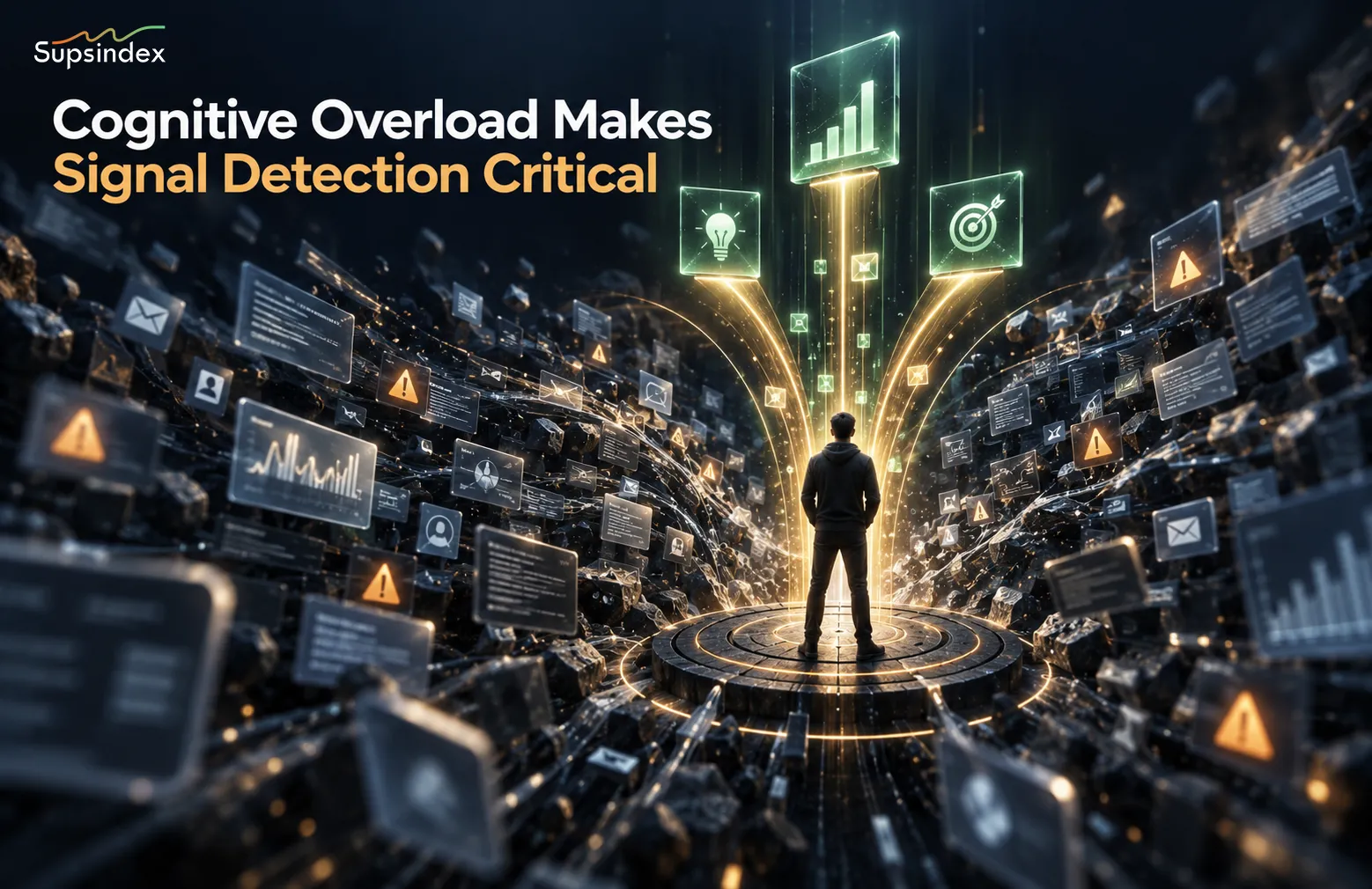
The information environment of a founder is already noisy. A solo founder experiences that problem at unusually high intensity because information from product, sales, customers, investors, hiring, competitors, marketing, regulation, and operations converges on the same individual.
The challenge is not simply processing more information. It is determining which information deserves attention. A founder can spend enormous energy responding to competitor announcements, social-media attention, press coverage, investor opinions, feature requests, and short-term fluctuations while overlooking retention, runway, contribution margin, customer concentration, or another metric that is genuinely determining survival.
This distinction between signal and noise is embedded in Supsindex’s FPA architecture. Founder readiness is not assessed merely through whether an entrepreneur recognizes business terminology; it also considers whether knowledge can be applied in context and whether meaningful signals can be distinguished from distraction.
For a solo founder, this capability becomes even more important because cognitive overload does not merely reduce productivity. It can degrade judgment across the entire company.
Intellectual humility must replace the missing internal challenger
One of the least visible advantages of a good co-founder is the ability to disagree. A strong counterpart can challenge an assumption before it becomes strategy, question a forecast before money is committed, or identify when conviction has started becoming confirmation bias.
A solo founder does not naturally receive this form of resistance. This means intellectual humility becomes unusually important. The founder must be able to separate personal identity from strategic hypotheses and recognize that abandoning an idea after receiving contradictory evidence is not weakness. It is often evidence of high-quality decision-making.
The danger is particularly acute because several traits associated with entrepreneurship can mutate under pressure. Confidence can become overconfidence, persistence can become sunk-cost behavior, attention to detail can become micromanagement, and a strong vision can become resistance to market evidence. Supsindex’s General Entrepreneurial Behavior framework is designed to examine precisely these kinds of behavioral patterns rather than relying exclusively on founders’ self-description.
For the solo founder, feedback cannot be accidental. It needs to be engineered into the company through advisors, senior employees, investors, mentors, data, and governance structures capable of challenging the founder rather than simply validating them.
Successful solo founders are usually not operationally alone
The term “solo founder” can itself be misleading. It describes an ownership and founding structure, not necessarily the way a company operates.
A capable solo founder may have no formal co-founder while surrounding themselves with senior employees, mentors, specialist advisors, fractional executives, investors, contractors, university relationships, accelerator networks, or industry partners. The legal founding structure may contain one individual, but the cognitive and operational structure surrounding that individual can be extensive.
This is where relational recombination and ecosystem awareness become important. The founder does not need to personally own every resource required by the company; they need the ability to identify, access, combine, and coordinate those resources when necessary. Supsindex’s Ecosystem Environmental Awareness (EEA) framework considers this contextual layer by assessing a founder’s understanding of the funding, regulatory, cultural, talent, and institutional environment in which the venture is operating.
Research on early startup teams reinforces the importance of these surrounding human resources. Work published in the Review of Economics and Statistics and previously circulated through the National Bureau of Economic Research found that the loss of founding-team members and important early joiners had large negative and persistent effects on startup size, productivity, and survival. The results suggest that important organizational capital becomes embodied in the people assembled around a startup and cannot always be replaced easily later.
A sophisticated solo founder therefore does not attempt to prove that one person can do everything. They become exceptionally good at constructing a system in which one founder can coordinate the capabilities of many people.
Does AI remove the solo founder disadvantage?
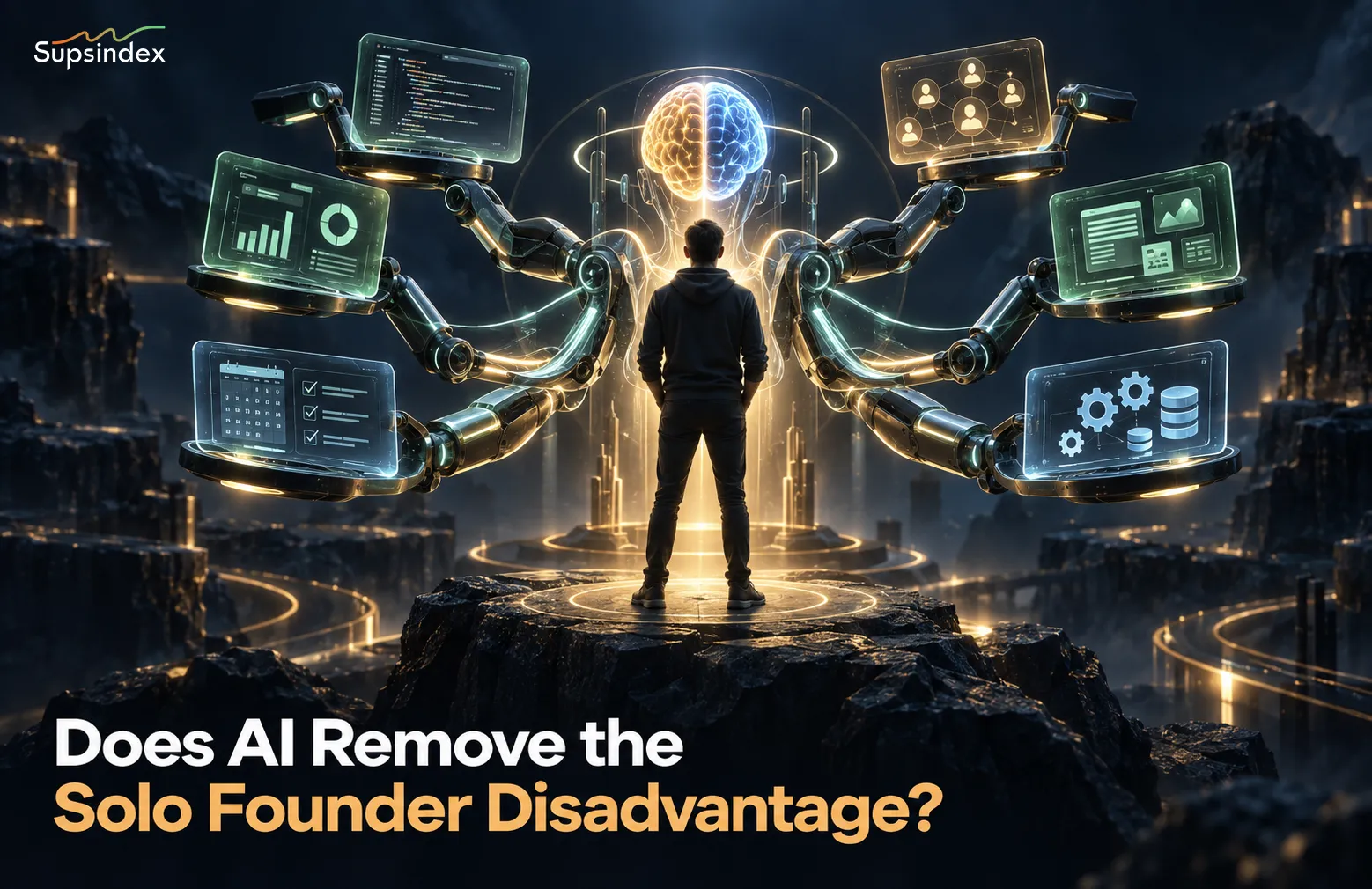
AI changes this discussion substantially because it expands the amount of operational work an individual can perform. Research, coding, customer service, analysis, content development, workflow automation, prototyping, and even parts of sales operations can increasingly be augmented or partially automated. Carta specifically identifies AI and falling company-creation costs as factors that may be contributing to the rapid growth of solo-founded businesses.
For that reason, AI can reasonably be described as a form of cognitive exoskeleton for the modern founder. It increases bandwidth and allows individuals to reach milestones that would previously have required additional employees.
However, increased bandwidth should not be confused with improved judgment. AI can create a financial model, but it cannot guarantee that the founder accepts what the model implies. It can summarize customer feedback while the founder continues to dismiss negative signals. It can automate execution while the underlying strategy remains wrong.
AI may therefore reduce the labor disadvantage of solo founding faster than it reduces the behavioral disadvantage. In some cases, it may even allow poor decisions to be executed more rapidly. The founders most likely to benefit from AI are consequently those who combine technological leverage with strong self-correction, evidence processing, and awareness of their own limitations.
How should investors evaluate solo founder risk?
Investors should resist two equally weak shortcuts. The first is automatically rejecting a company because it has one founder. The second is assuming that extraordinary charisma, technical talent, or prior success eliminates the structural risks associated with concentrated leadership.
A more useful diligence process asks where the missing counterbalances have been created. Investors should examine whether the founder possesses sufficient entrepreneurial literacy to understand the mechanics of the company, whether major capability gaps have been identified, whether delegation is occurring as complexity increases, and whether the founder has access to people capable of challenging strategic decisions. They should also consider what happens when the founder is unavailable, where financial and operational checks exist, and whether senior talent is genuinely empowered or merely executing the founder’s instructions.
Structured assessment can add another evidence layer to this process. FPA can identify applied knowledge and cognitive bottlenecks, GEB can examine behavioral patterns and decision tendencies, while EEA can indicate whether the founder understands the ecosystem in which the venture is attempting to grow. For multi-founder companies, FEE adds the relational dimension by evaluating whether the apparent strength of the team is actually supported by behavioral compatibility and functional collaboration.
This approach does not ask whether a solo founder fits an archetype. It asks whether the human system operating the startup contains identifiable, measurable points of failure.
What accelerators should look for
Accelerators and incubators face a related but slightly different challenge because their role often includes developing founders rather than simply selecting companies that already appear investment-ready. Rejecting solo founders because their current profile contains gaps can therefore eliminate founders whose weaknesses are both identifiable and highly developable.
The more useful distinction is between an exposed weakness and an unmanaged weakness. A solo founder who knows they lack financial expertise and has deliberately installed experienced financial support may present less risk than a multi-founder team whose members collectively believe they have no weaknesses. Similarly, a founder who actively seeks conflicting evidence may be safer than a superficially balanced team that avoids disagreement.
For accelerators, objective founder assessment can therefore become part of intervention design. Instead of delivering identical mentorship to every founder, the program can identify whether the most urgent issue is delegation, financial literacy, ecosystem knowledge, risk calibration, sales capability, cognitive bias, or another bottleneck and direct support toward that area. This is consistent with Supsindex’s broader view that founder readiness is developmental rather than fixed.
Can one person really build a venture-scale startup?
The evidence suggests that the answer is yes, but only with an important qualification. One individual can remain the sole founder of a venture-scale company, but a venture-scale organization cannot indefinitely operate as the extension of one individual’s personal bandwidth.
Recent research still identifies meaningful disadvantages associated with solo founding, particularly where the founder lacks broad or deep experience. Funding data also indicates that investors continue to favor teams. At the same time, the academic evidence is sufficiently mixed to demonstrate that founder count alone is not a reliable verdict. Context, human capital, early-team quality, organizational design, and the founder’s ability to compensate for missing capabilities all matter.
The Supsindex perspective is therefore less concerned with whether the number of founders is one, two, or three than with whether the company’s human architecture contains dangerous bottlenecks. A strong founding team can distribute those risks naturally, but a dysfunctional team can create entirely new ones. A solo founder lacks built-in counterbalances, but can deliberately construct them through senior talent, advisors, measurement systems, ecosystem relationships, behavioral self-awareness, and disciplined delegation.
This is ultimately what separates viable solo founding from the lone-wolf myth. The strongest solo founders are not successful because they possess every capability a venture requires. They are successful because they recognize earlier than most that they do not.
Conclusion: Solo founder risk should be measured, not assumed
The debate around solo founders has traditionally been framed as a question of preference: Is it better to build alone or to find a co-founder? The evidence suggests that this is too simplistic. Founding teams possess genuine structural advantages, but those advantages depend on the quality of the team. Solo founders face genuine concentration risk, but that risk changes substantially depending on experience, self-awareness, delegation, external relationships, and the systems surrounding the founder.
For investors, accelerators, and founders themselves, the practical implication is that solo founder risk should be measured rather than assumed. The relevant variables are not simply founder count or résumé prestige, but whether critical capabilities are present, whether dangerous weaknesses have been identified, whether decisions are challenged, and whether the organization can gradually function independently from the person who created it.
Venture scale has never meant doing everything yourself. It means building an organization capable of producing more knowledge, judgment, execution capacity, and resilience than any individual could possess alone. A solo founder can build that organization, but only when the founder stops treating independence as the same thing as self-sufficiency.
