


Founder-Market Fit vs Product-Market Fit is not a choice between people and product. This analysis examines how Founder-Market Fit, Product-Market Fit, and Ecosystem Fit work together to shape startup readiness, due diligence, and execution.
Founder-Market Fit vs Product-Market Fit: Which Comes First?
For decades, startup strategy has revolved around a familiar question: does the product fit the market? It is the right question, because no amount of founder talent can create durable demand for something customers do not need. But Product-Market Fit is not the only alignment that matters. Someone still has to interpret customer evidence, allocate capital, manage the team, navigate uncertainty, and know when the plan should change.
That introduces a second question: are these founders the right people to build this particular company? This is the territory of Founder-Market Fit (FMF). And when a startup operates inside a specific geography, regulatory system, funding environment, and business culture, a third layer appears: does the team understand the ecosystem in which it is trying to execute?
Founder-Market Fit vs Product-Market Fit is therefore not a contest between the founder and the product. PMF evaluates whether the opportunity is real; FMF evaluates whether the team is equipped to capture it. Ecosystem Fit adds the environment in which that work must happen. Together, they form a broader model of startup readiness built around product, people, and place.
Founder-Market Fit vs Product-Market Fit: The Short Answer
Product-Market Fit (PMF) is the degree to which a product satisfies meaningful demand in a market. Founder-Market Fit (FMF) is the degree to which a founder or founding team is aligned with the venture they are attempting to build through relevant knowledge, experience, judgment, behavior, networks, and commitment. They are related but not sequential milestones. At the earliest stages, FMF is often assessed before strong PMF can be measured because investors have limited operating evidence and are partly underwriting the team’s ability to discover it. PMF, however, still has to be validated by real customer behavior.
Neither one substitutes for the other. A highly capable founding team can spend years building something nobody wants, while a promising market opportunity can be wasted through poor decisions, co-founder conflict, weak financial discipline, or an inability to adapt. The strongest startup case is not PMF instead of FMF, or FMF instead of PMF. It is evidence that the product, the people, and the operating environment are increasingly aligned.
What Is Product-Market Fit?
Marc Andreessen popularized Product-Market Fit as being in a good market with a product that can satisfy that market. In practice, PMF means that a startup has moved beyond an interesting idea and found meaningful evidence that a defined group of customers values the solution. That evidence can appear through retention, recurring revenue, repeat usage, referrals, conversion, expansion, declining churn, efficient acquisition, or other behavioral and financial signals appropriate to the business model.
Product-Market Fit therefore focuses primarily on the external viability of the venture. Does a real customer problem exist? Does the product solve it well enough to change behavior? Are customers willing to pay, return, recommend, or expand their usage? Can that demand support a viable company? These questions are foundational, and founder assessment should never be used as a substitute for market validation.
The limitation appears when PMF is treated as if it explains the entire quality of a startup. Markets do not deliver clean instructions to founders. Customer signals conflict, early traction can disappear, requested features may never convert into willingness to pay, and the same dataset can support several interpretations. Product-Market Fit is partly observed in the market, but the process of finding and maintaining it is mediated by human judgment.
The Hidden Founder Variable Behind Product-Market Fit

Consider two startups with similarly promising products and comparable early traction. The first founding team speaks with customers consistently, understands its financial position, challenges its own assumptions, divides responsibility clearly, and changes course when evidence becomes strong enough. The second team is emotionally attached to its first solution, explains away weak retention, avoids uncomfortable financial information, fights over authority, and repeatedly changes direction toward whatever opportunity looks most exciting that month.
The products may begin from similar positions, but the companies are unlikely to remain there. Product-Market Fit is not simply a discovery event; it is sustained through repeated cycles of observation, interpretation, experimentation, and decision-making. A startup may fail to find PMF because the market genuinely does not care, but it can also fail because the founders misread what customers are telling them.
This is where cognitive bias becomes commercially relevant. Confirmation bias can make a team overweight evidence that supports the product, while sunk-cost attachment can turn continued investment into a substitute for learning. The question therefore expands from “Does the market want this product?” to “Can this founding team discover what the market actually wants when reality contradicts the plan?”
What Is Founder-Market Fit?
Founder-Market Fit is the alignment between a founder or founding team and the specific venture they are attempting to build. The traditional definition usually emphasizes domain expertise, professional experience, customer familiarity, relevant networks, credibility, authentic interest in the problem, and insight accumulated through direct exposure to the market. These signals matter because founders with deep domain familiarity may understand customer language, buying processes, distribution structures, industry incentives, and hidden constraints that an outsider needs years to learn.
However, experience alone is an incomplete proxy for founder capability. A resume can show that someone spent ten years in healthcare or fintech, but it cannot by itself show how that person makes decisions under pressure, reacts when evidence contradicts them, calibrates risk, manages runway, handles conflict, delegates authority, or changes strategy when conditions shift. This distinction is important because the same background can produce very different operating behavior.
Supsindex therefore treats traditional Founder-Market Fit as one layer inside a broader founder-readiness model. The expanded question is whether the founder understands the venture, behaves in a way that fits its demands, and possesses enough contextual awareness to operate where the company must compete.
Founder-Market Fit Is Contextual, Not a Universal Founder Score
There is no single ideal founder profile because entrepreneurial demands vary by industry, stage, business model, and geography. A consumer-software founder may benefit from rapid, reversible experiments with incomplete information, while a MedTech founder working with clinical evidence and regulatory approval may need much tighter limits around experimentation.
Decision speed works the same way. Moving quickly can be valuable when a decision is reversible, but much riskier when it creates regulatory exposure or commits substantial capital. A 2025 Strategic Entrepreneurship Journal study of young ventures in Ghana and Kenya reinforces this contextual view: founder regulatory focus influenced entrepreneurial orientation, while decision speed affected how that orientation translated into venture performance.
Founder-Market Fit should therefore not be reduced to the question “Is this person entrepreneurial?” A more useful question is “Does the way this person thinks, decides, learns, and operates fit what this venture actually requires?”
Founder-Market Fit vs Product-Market Fit: Key Differences
| Dimension | Product-Market Fit | Founder-Market Fit |
|---|---|---|
| Core question | Does the market want and value the product? | Is this team equipped to build, learn, adapt, and lead the venture? |
| Primary evidence | Retention, usage, revenue, conversion, churn, referrals, expansion | Domain knowledge, experience, judgment, team complementarity, decision patterns |
| Main focus | External demand and market response | Human and operational alignment |
| Early-stage role | Often still emerging and difficult to measure | Especially useful when investors have limited operating data |
| How it changes | Can strengthen or weaken as customer behavior and markets change | Can improve or deteriorate as founders learn, teams evolve, and the company scales |
Product-Market Fit and Founder-Market Fit examine different parts of the same startup system. PMF asks whether meaningful demand exists and whether the product can satisfy it. FMF asks whether the founding team has the capabilities and alignment required to discover, build, adapt, and lead the company serving that demand. PMF is primarily external and market-facing; FMF is primarily human and operational. Both are dynamic, and both can weaken as the company, market, or team changes.
The relationship is better understood as a feedback loop than a hierarchy. Founder capability influences the quality of customer learning and strategic decisions; those decisions influence the startup’s ability to discover and maintain Product-Market Fit; market evidence then forces the founders to update their beliefs, capabilities, and operating model. PMF validates demand, while FMF affects the quality of the process used to interpret and respond to that demand.
Which Comes First: Founder-Market Fit or Product-Market Fit?
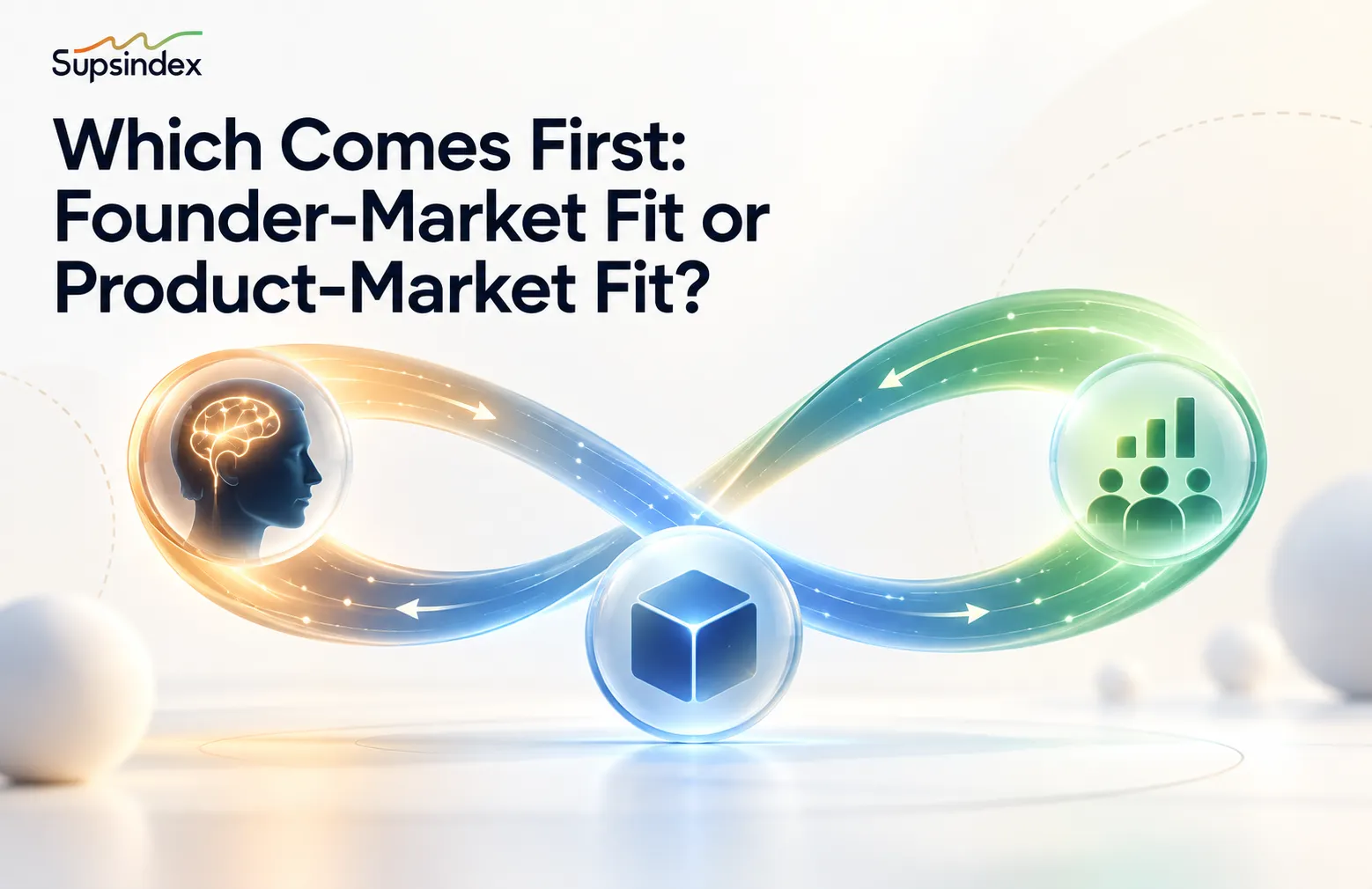
Founder-Market Fit and Product-Market Fit are not stages that always occur in a fixed order. However, FMF becomes particularly important as an assessment question before PMF has been established. A pre-seed startup may have an unfinished product, a handful of users, limited revenue, no reliable retention history, and little evidence about long-term unit economics. In that environment, investors cannot rely on mature operating data because it does not yet exist.
What investors are partly underwriting is the team’s ability to create that evidence. Can the founders learn quickly, distinguish meaningful customer signals from noise, manage capital while experimenting, recruit missing capabilities, and change direction without losing strategic discipline? At this stage, Founder-Market Fit does not prove that the startup will find PMF, but it helps investors evaluate the people responsible for searching for it.
As the company develops, the question changes. Once Product-Market Fit becomes more visible, founder fit shifts from “Can this team find a viable business?” toward “Can this team scale, defend, and adapt the viable business it found?” A founder who is highly effective while leading five people through product discovery may struggle with delegation, organizational design, or capital allocation when the company grows to 100 people. Founder-Market Fit is therefore dynamic rather than permanent.
Founder Experience Matters, but Team Composition and Behavior Matter Too
Relevant experience can accelerate pattern recognition, customer access, and credibility, but it should not become a shortcut for founder quality. An industry veteran can still struggle with adaptability, financial discipline, delegation, or conflict, while an outsider may compensate for limited domain depth through learning velocity and complementary experts.
Research on entrepreneurial teams supports treating team characteristics as substantive rather than cosmetic. A meta-analysis published in Entrepreneurship Theory and Practice combined 55 empirical samples and 8,892 observations and found significant relationships between entrepreneurial-team composition characteristics and new-venture performance. The study does not imply that one team configuration guarantees success, but it supports a more careful view of who is building the company and how those people fit together.
Behavioral Founder-Market Fit therefore concerns recurring patterns in how founders manage trade-offs such as conviction versus adaptability, growth versus runway, control versus delegation, and product vision versus customer evidence. These patterns become most visible under pressure and incomplete information.
The Missing Layer: Ecosystem Fit

Even a strong Founder-Market Fit assessment can miss an important external constraint. A founder may understand the industry and possess strong behavioral capabilities while still misunderstanding the ecosystem in which the startup must operate. This matters because software can be distributed globally, but the practical conditions of company building remain local. Funding systems, regulation, labor markets, procurement, institutional relationships, customer trust, distribution structures, and cultural expectations differ between startup ecosystems.
Research supports the importance of this context. A study of 1,652 ecosystem actors across 16 cities in nine developing and transition economies linked regulatory, cognitive, and normative institutional arrangements with differences in productive entrepreneurship. Separate research involving 223 Australian business owners found that the local business environment affected how effectively entrepreneurs translated personal resources into firm performance.
This is why Supsindex treats Ecosystem Fit as a separate layer rather than assuming that strong Founder-Market Fit automatically transfers across borders. A strategy that is rational in one market can be ineffective or costly in another because the surrounding rules, institutions, capital sources, or commercial norms have changed.
Product, People, Place: A Three-Layer Startup Readiness Model

Consider a SaaS founder who has successfully built and raised capital in the United States and then enters a new market using the same playbook. The founder may assume that funding, procurement, hiring, and distribution work similarly, while the new environment may rely more heavily on grants, corporate partnerships, local channels, different labor rules, or longer sales cycles.
Nothing in this scenario necessarily means the product is weak or the founder is unintelligent. The failure is contextual. Product-Market Fit asks whether customers value the product. Founder-Market Fit asks whether this team can build and adapt the company. Ecosystem Fit asks whether the team understands where it is trying to execute. The three layers can be summarized as Product, People, Place – a simple framework for recognizing that venture quality depends on more than any single form of fit.
What Should Investors Measure Beyond Product-Market Fit?
Founder-Market Fit expands due diligence through founder assessment without replacing traditional market analysis. Investors can examine why this founder has an advantage in the problem, what assumptions the team has changed after contradictory evidence, how decisions are made under uncertainty, whether risk behavior fits the industry, and whether co-founders provide genuinely complementary capabilities.
For cross-border companies, investors should also examine ecosystem understanding: funding structures, regulation, labor constraints, distribution channels, institutional actors, cultural expectations, and market-entry barriers. These questions do not predict success with certainty, but they make the human and contextual assumptions behind an investment more visible.
How Supsindex Expands the Founder-Market Fit Discussion
Traditional Founder-Market Fit is usually assessed through background, domain expertise, networks, customer familiarity, and commitment to the problem. Supsindex adds three structured readiness dimensions that can complement that qualitative judgment. The Founder Public Awareness (FPA) assessment examines entrepreneurial literacy, cognitive readiness, and the ability to distinguish meaningful business signals from noise. The General Entrepreneurial Behavior (GEB) assessment focuses on decision-making quality, resilience, adaptability, risk patterns, and susceptibility to behavioral and cognitive biases under entrepreneurial pressure. The Ecosystem Environmental Awareness (EEA) assessment measures familiarity and strategic fit with a target geography, including local market dynamics, regulation, cultural norms, funding conditions, and ecosystem actors.
The value of this model is not that any assessment can declare with certainty who will build a successful company. Supsindex’s Founders’ Discovery Project is explicitly designed to investigate whether cognitive, behavioral, and contextual readiness measures correspond with real-world founder decisions, execution quality, and venture outcomes over time. That distinction matters for scientific credibility: structured assessment should reduce blind spots and improve the evidence available to founders and investors, not pretend to eliminate entrepreneurial uncertainty.
Within the Founder-Market Fit vs Product-Market Fit debate, this produces a broader due-diligence question. Instead of asking only whether the founder has the right resume or whether the product shows traction, investors can examine whether the team has the knowledge to interpret the venture, the behavior to operate under pressure, and the ecosystem awareness to execute in the real environment around the company.
Founder-Market Fit FAQ
What is Founder-Market Fit?
Founder-Market Fit is the alignment between a founder or founding team and the specific venture they are trying to build. It usually includes factors such as domain expertise, relevant experience, customer understanding, networks, authentic interest, and credibility. A broader founder-readiness analysis can also examine decision-making behavior, team complementarity, cognitive strengths and blind spots, and contextual awareness.
What is the difference between Founder-Market Fit and Product-Market Fit?
Product-Market Fit evaluates whether a product satisfies meaningful customer demand. Founder-Market Fit evaluates whether the founding team is well aligned with the venture and capable of building, learning, adapting, and leading it. Put simply, PMF evaluates demand; FMF evaluates the people responsible for pursuing that demand.
Which comes first: Founder-Market Fit or Product-Market Fit?
They are not fixed sequential stages. Founder-Market Fit is often evaluated earlier because pre-seed and seed startups may not yet have enough customer or operating data to demonstrate strong PMF. Investors are therefore partly evaluating whether the founding team appears capable of discovering Product-Market Fit. PMF must still be validated through actual market behavior.
Is Founder-Market Fit more important than Product-Market Fit?
No. Strong Founder-Market Fit cannot compensate indefinitely for the absence of customer demand, and strong Product-Market Fit can still be weakened by poor execution. The strongest startup case contains increasing evidence of both founder-venture alignment and product-market alignment.
Can Founder-Market Fit change over time?
Yes. Founders can develop knowledge, improve their decision processes, recruit complementary talent, strengthen leadership skills, and learn unfamiliar markets. The company’s needs also change as it grows, so a founder who fits the discovery stage may need to evolve significantly during scaling.
What is Ecosystem Fit?
Ecosystem Fit is the alignment between the founding team and the specific environment in which the startup operates. It includes understanding local regulations, capital structures, labor markets, institutional actors, cultural norms, distribution systems, and other geography-specific factors that shape execution.
How can investors assess Founder-Market Fit?
Investors can combine founder interviews with domain evidence, customer references, analysis of past decisions, co-founder assessment, behavioral scenarios, knowledge assessment, and ecosystem-specific questions. The objective is not to remove investor judgment but to give that judgment more structured evidence.
Founder-Market Fit vs Product-Market Fit: The Better Question Is Alignment
Product-Market Fit became one of the most important ideas in startup strategy because a company ultimately needs customers who value what it creates. No founder assessment can replace that reality. But PMF alone does not tell investors who will interpret the market correctly when signals become ambiguous, protect the runway when growth slows, manage conflict when pressure increases, or adapt the company when the assumptions that produced early traction stop working.
Founder-Market Fit addresses that human layer, while Ecosystem Fit adds the local context in which founder decisions must operate. The better question is therefore not whether Founder-Market Fit or Product-Market Fit matters more. It is whether the venture is developing alignment across all three layers: a product the market wants, people capable of building and adapting it, and an environment they understand well enough to navigate.
The startup ecosystem has become increasingly sophisticated at measuring products and markets. The next step is not to replace those measurements with founder assessment, but to connect them. Product tells us whether there is an opportunity. People tell us whether this team is equipped to pursue it. Place tells us whether they understand the terrain. Strong ventures need all three.
Selected Research Sources
Andreessen Horowitz – “12 Things About Product-Market Fit” and the original Marc Andreessen framing of PMF.
Startups.com – current practitioner definition and investor-oriented framing of Founder-Market Fit.
Lanivich et al., Strategic Entrepreneurship Journal (2025) – founder regulatory focus, decision speed, entrepreneurial orientation, and young-venture performance.
Jin et al., Entrepreneurship Theory and Practice (2017) – meta-analysis of 55 empirical samples and 8,892 observations on entrepreneurial-team composition and new-venture performance.
Entrepreneurial Ecosystems in Cities: The Role of Institutions (2021) – study of 1,652 ecosystem actors across 16 cities and nine developing and transition economies.
Putting the Entrepreneur Back into Entrepreneurial Ecosystems (2020) – evidence that local business environments moderate how entrepreneurs convert personal resources into firm performance.
Supsindex Founder Public Awareness (FPA), General Entrepreneurial Behavior (GEB), and Ecosystem Environmental Awareness (EEA) documentation – current definitions of the three live founder-readiness assessment engines.
Supsindex Founders’ Discovery Project (2026) – longitudinal research initiative testing relationships between cognitive, behavioral, contextual readiness and real-world founder execution and outcomes.
