


Answering the question, “How do I know if I’m ready to launch my startup?” requires moving beyond romanticized intuition and embracing objective, data-driven readiness metrics.
How do I know if I’m ready to launch my startup? 

There is a hallowed piece of Silicon Valley folklore, whispered like a mantra in co-working spaces and accelerator bootcamps from Palo Alto to Bangalore: “To be an entrepreneur is to jump off a cliff and build a plane on the way down.” It’s a romantic, cinematic image. It evokes courage, ingenuity, and a defiant disregard for the laws of physics and finance. It is also, from a data-driven perspective, catastrophically bad advice.
However, it doesn’t mean going wild. Creating a startup on the basis of hope and enthusiasm is like buying a lottery ticket; there is no particular strategy behind it. As evidenced by the churn data of the last five years, in most cases, the casino wins. That’s why it took such an astronomical amount of $1.2 trillion dollars of capital flushed down the drain from 2019 to 2024, which is not because of brilliant ideas failing to materialize. On the contrary, about 60-70 percent of it were invested in human mistakes that could be avoided. And here comes the ultimate question – one that keeps founders awake at night and gives them nightmares on the eve of leaving their steady and well-paid jobs. This question is one that, until now, hasn’t been able to be answered scientifically: how do I know if I’m prepared to start my business?
Am I really ready to launch my startup?
Meet Laura. Laura is 28, a sharp and ambitious product manager at a moderately successful SaaS company. For two years, she has been the secret custodian of a brilliant idea—a B2B platform that solves a massive inefficiency she observes daily. She has the market research, a wireframe, and a potential co-founder. Yet, she remains paralyzed by the precipice. How does she know if her cognitive biases won’t betray her when the runway dwindles to three months? The truth is, without empirical measurement, she cannot possibly know.
Startup founder readiness metrics: Measuring if you are ready to launch a startup
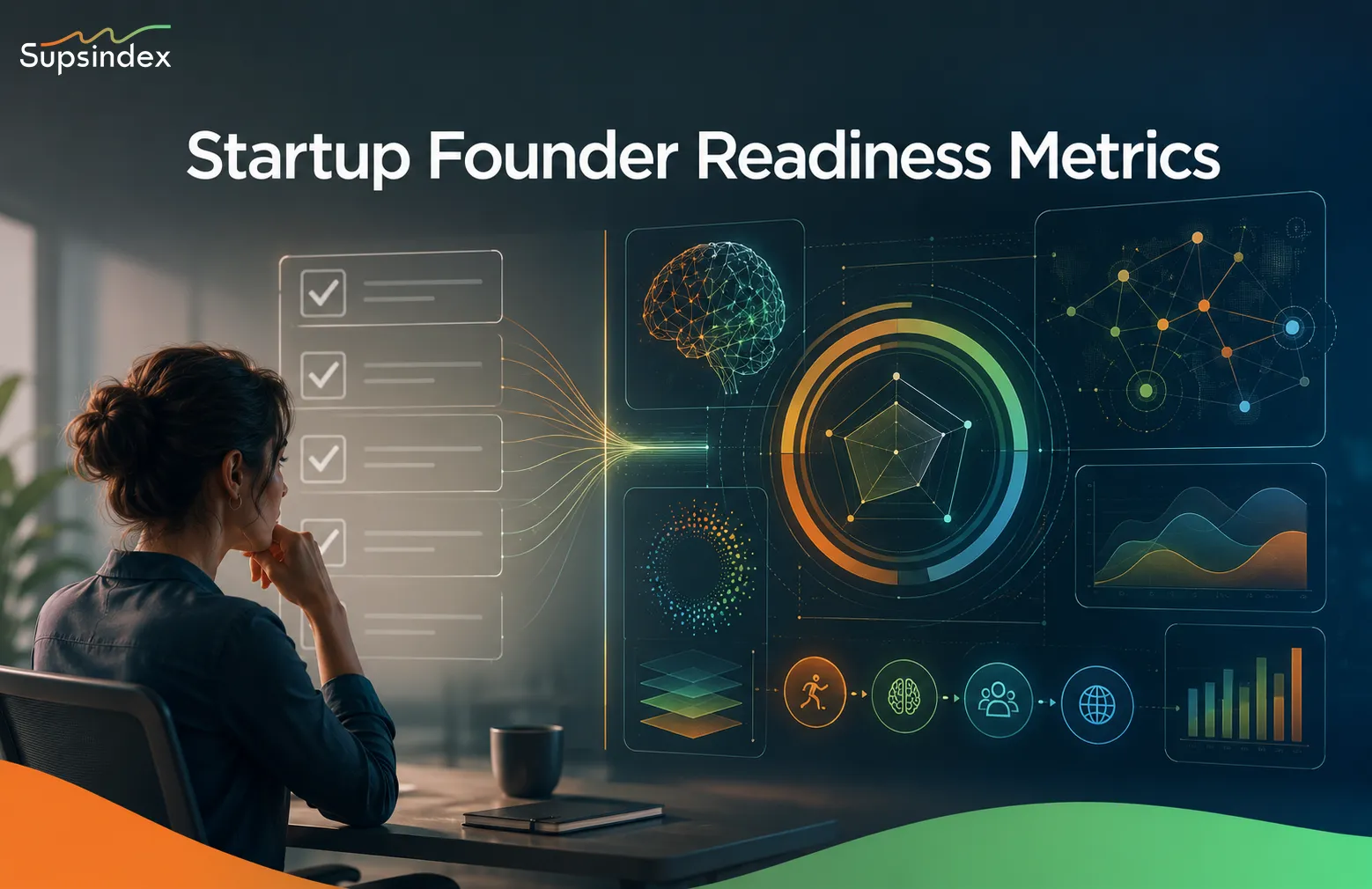
The transition from employee to founder demands a radical reconfiguration of psychological and operational reflexes. To answer this existential doubt, we must look at objective startup founder readiness metrics. These metrics form a triad of entrepreneurial viability: FPA (Founder Public Awareness), GEB (General Entrepreneurial Behavior), and EEA (Ecosystem Environmental Awareness). Together, these indices do not measure your personality; they measure your applied judgment. If your GEB report reveals a crippling susceptibility to the sunk-cost fallacy, you are not ready to launch. If your EEA score indicates a fundamental misunderstanding of local venture capital mechanics, you are not ready to launch. These metrics serve as the ultimate diagnostic mirror, reflecting the stark reality of your soft power before you risk a single dollar of capital.
How to win in pitch deck: The Pre-Flight Check before you are ready to launch your startup
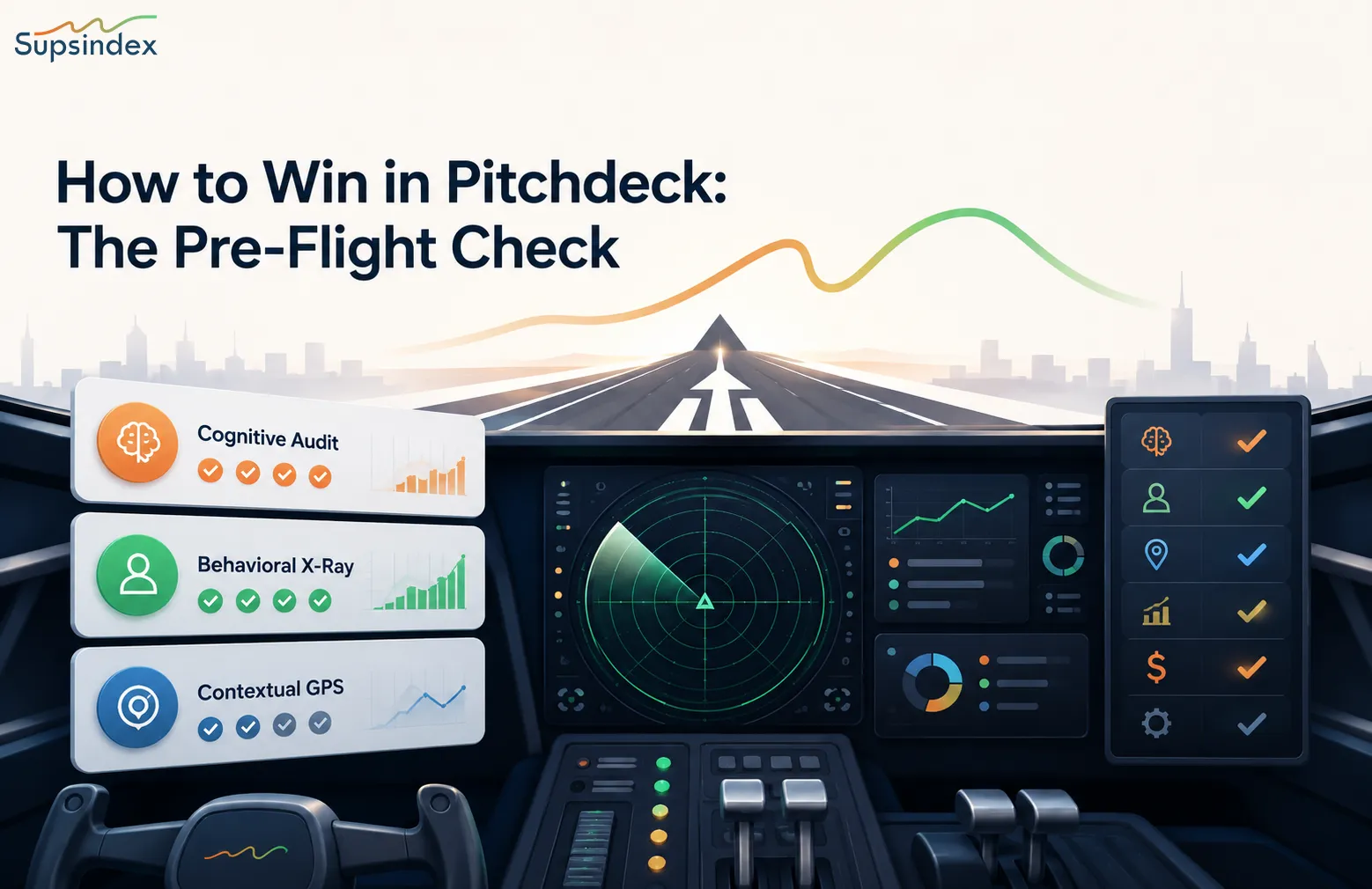
When you finally step into the boardroom, investors are no longer just looking at your TAM or your go-to-market strategy. They are looking at you. How to win in a pitchdeck today requires what we call the “Pre-Flight Check.” By embedding your Supsindex certification directly into your team slide, you fundamentally alter the power dynamic of the pitch. You provide empirical proof of your behavioral resilience and cognitive readiness. You prove that you understand your blind spots in sales and in the market. You don’t pretend to be flawless; you demonstrate that you have a rigorous, data-driven process for identifying and mitigating your flaws. You show investors that you have already stress-tested the most critical component of the business: the human leadership system.
Conclusion: The Courage to Be Measured When You Are Ready to Launch Your Startup
The entrepreneurial journey is, and always will be, a leap. But it does not have to be a blind one. The most common and devastating startup failure reasons are not external market shocks or competitive ambushes; they are the internal, unexamined cognitive biases and behavioral patterns of the founding team.
The defining trait of the next generation of successful founders will not be their charisma or their pedigree, but their courage to be measured. They will understand that in an economy of scarce capital, the unexamined founder is an unacceptable risk. They will have the intellectual humility to seek out their own blind spots and the discipline to address them. The answer to the question, “How do I know if I’m ready to launch my startup?” is simple: you are ready when you have stopped asking the question as a matter of feeling and started answering it as a matter of data.
The scientific frameworks and simulation-based assessments required to begin this journey of deep, objective self-discovery are no longer theoretical. For founders ready to move beyond guesswork, the tools to build a data-driven flight plan for their venture are now within reach.
