


To eliminate capital waste and accurately measure founder resilience, the venture ecosystem must embrace the power of global startup indices.
Global startup indices
In the modern world, where we face an enormous and ever-increasing volume of data across various economic, social, cultural, and political domains, the concept of the “index” has emerged as a vital analytical tool. Indexes do not merely simplify vast datasets; they enable deeper comparison, benchmarking, and strategic foresight by transforming complex, multidimensional realities into a single, actionable metric. From the earliest iterations of the Dow Jones Transportation Average in 1884—created by Charles Dow and Edward Davis Jones to gauge whether the railroad market was advancing or declining—to the comprehensive Human Development Index (HDI) introduced by the United Nations Development Programme in 1990, the history of indexes reflects humanity’s relentless effort to quantify, predict, and ultimately manage complex trends. The HDI, for example, successfully shifted global discourse by measuring well-being through life expectancy, education, and per capita income, proving that a rigorously designed index can redefine how we perceive development itself.
In the business world, and particularly within the high-stakes arena of venture capital, the necessity for robust measurement frameworks is undeniable. Indexes act as a reference point that investors and analysts use to gauge performance against a specific market baseline. For a public market investor, an index like the S&P 500 provides a reliable thermometer of economic health. It operates on transparent, mathematical principles such as market-capitalization weighting, ensuring that larger companies appropriately influence the index’s movement, thereby reflecting the true state of the market.
However, when we transition from the heavily regulated, data-rich environment of public equities to the volatile, opaque realm of early-stage ventures, a stark disparity becomes apparent. The realm of entrepreneurship remains, in many ways, a low-index world. While public markets benefit from real-time pricing and decades of historical earnings data, the startup ecosystem is driven by human agency, volition, and cognitive capabilities operating under conditions of extreme uncertainty. The imperative to develop and refine Global startup indices is not merely an academic exercise; it is an economic necessity dictated by the profound capital inefficiencies that currently plague the innovation economy. Global startup indices are the crucial missing link needed to translate the qualitative “soft power” of founders into quantifiable, predictive data.
Startup selection process by global Indices 
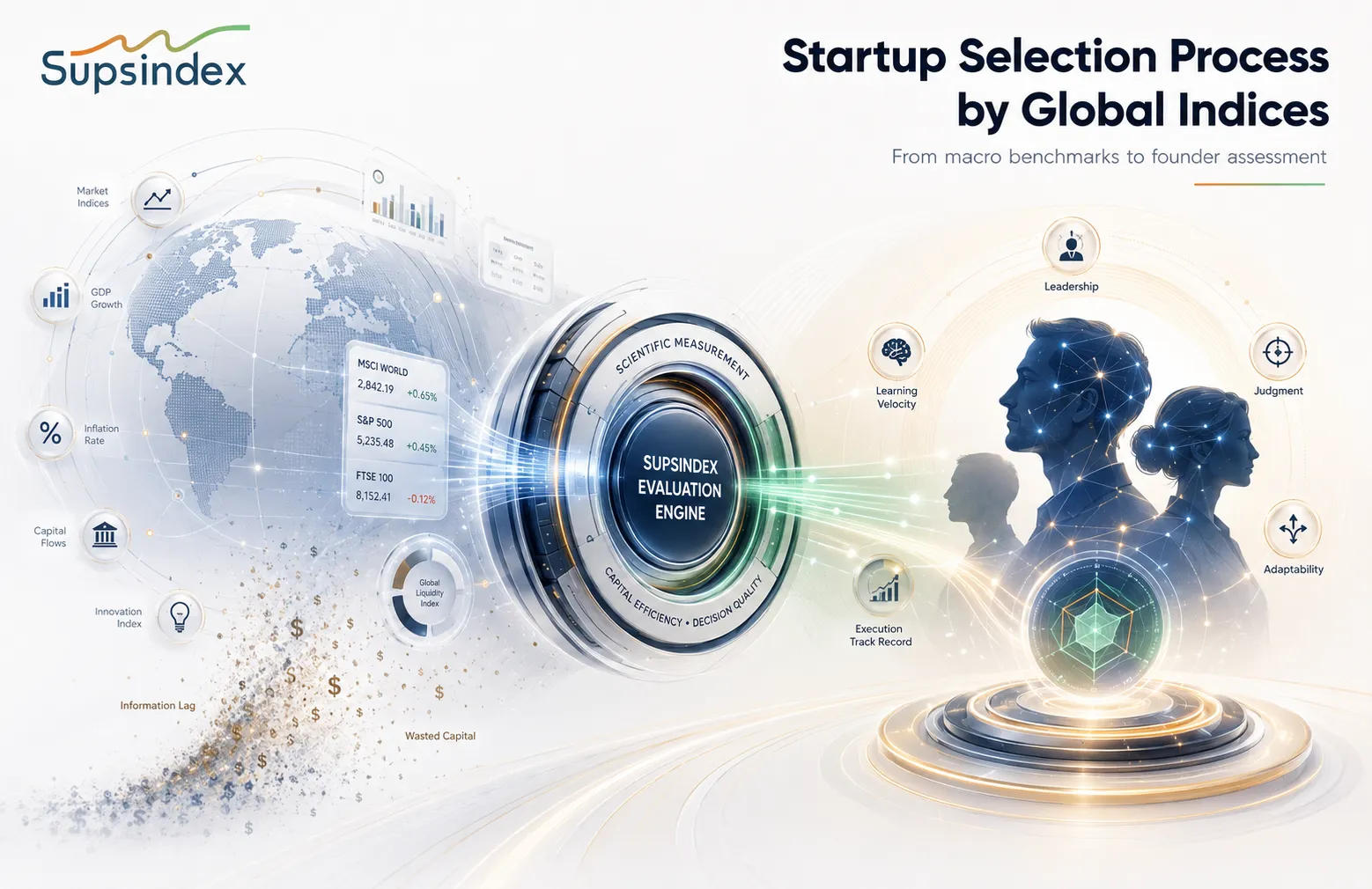
To appreciate the extent and significance of such evolution, one has to analyze first the systems which presently prevail in the area. Traditionally, the selection criteria of Startups according to global Indices were always lagging metrics, based on macroeconomic statistics, overall volumes of funding, or even post mortem analysis of failure. Efforts to measure ecosystems have existed, but there has been little effort to measure individuals working within them.
Global startup indices on the macro level, for example, Global Entrepreneurship Monitor (GEM) or Global Entrepreneurship and Development Index (GEDI), provide useful information despite being rather general. GEM, founded in 1999, is an initiative measuring entrepreneurship activity and attitudes towards business, applying instruments such as Adult Population Survey in order to determine Total early-stage Entrepreneurial Activity (TEA) index. GEDI takes a more comprehensive approach and uses “Penalty for Bottleneck” technique to reveal deficiencies in national institutional framework for Startups. It rests on the assumption that the effectiveness of a system can be determined only by the performance of its weakest link; thus, high scores in terms of human capital become irrelevant if institutional framework does not allow entrepreneurs to fully use this potential.
This leads us to the heart of the systemic issue in the existing Startup selection process of global Indices. In the six-year period between 2019 and 2024, which includes a dramatic boom and bust cycle driven by the ten years of ZIRP (zero interest-rate policy), roughly $1.7 trillion dollars have been invested in startups worldwide. But according to meticulous decomposition and post mortems, up to $700 billion to $1.2 trillion of these investments were pure “wasted capital”—without returning even the principal amount invested. It has become the accepted norm in the industry that this staggering level of failure and loss can only be due to the necessary risks associated with the venture capital power law.
According to loss decomposition models, however, a full 60% to 70% of that loss is unnecessary waste. This wastage occurs due to avoidable deficiencies in the founder and team capabilities. Startups don’t just “run out of cash.” That is the ultimate consequence. The reasons for these failures, on the other hand, are all forms of Direct Founder/Team Errors: poor market validation, flawed unit economics, dysfunctional leadership, incapability to pivot, and cognitive biases.
The traditional approach to Startup selection by indices around the world has failed to take into account these subtle dynamics because it has been going about things entirely in the wrong direction. The traditional emphasis placed on previous accomplishments, the scale of the potential target audience for the product being developed, or the pedigree of the founders means that the real-life behaviors of the people behind the scenes have been largely overlooked. Those who use this old-fashioned approach to selecting Startups by global indices risk becoming victims of the phenomenon known as “due diligence compression,” whereby due diligence is replaced by less precise but more convenient measures like charisma or slickness of presentation.
In order to make the leap from an inefficient “fueling of capital” to an extremely efficient “catalyzing of capital,” a radical rethink in the approach to Startup selection by global indices is needed. This involves making a fundamental shift from seeing failures as an inextricable part of innovation to seeing assessment as ongoing scientific measurement of human judgment.
Decentralized startup index studio
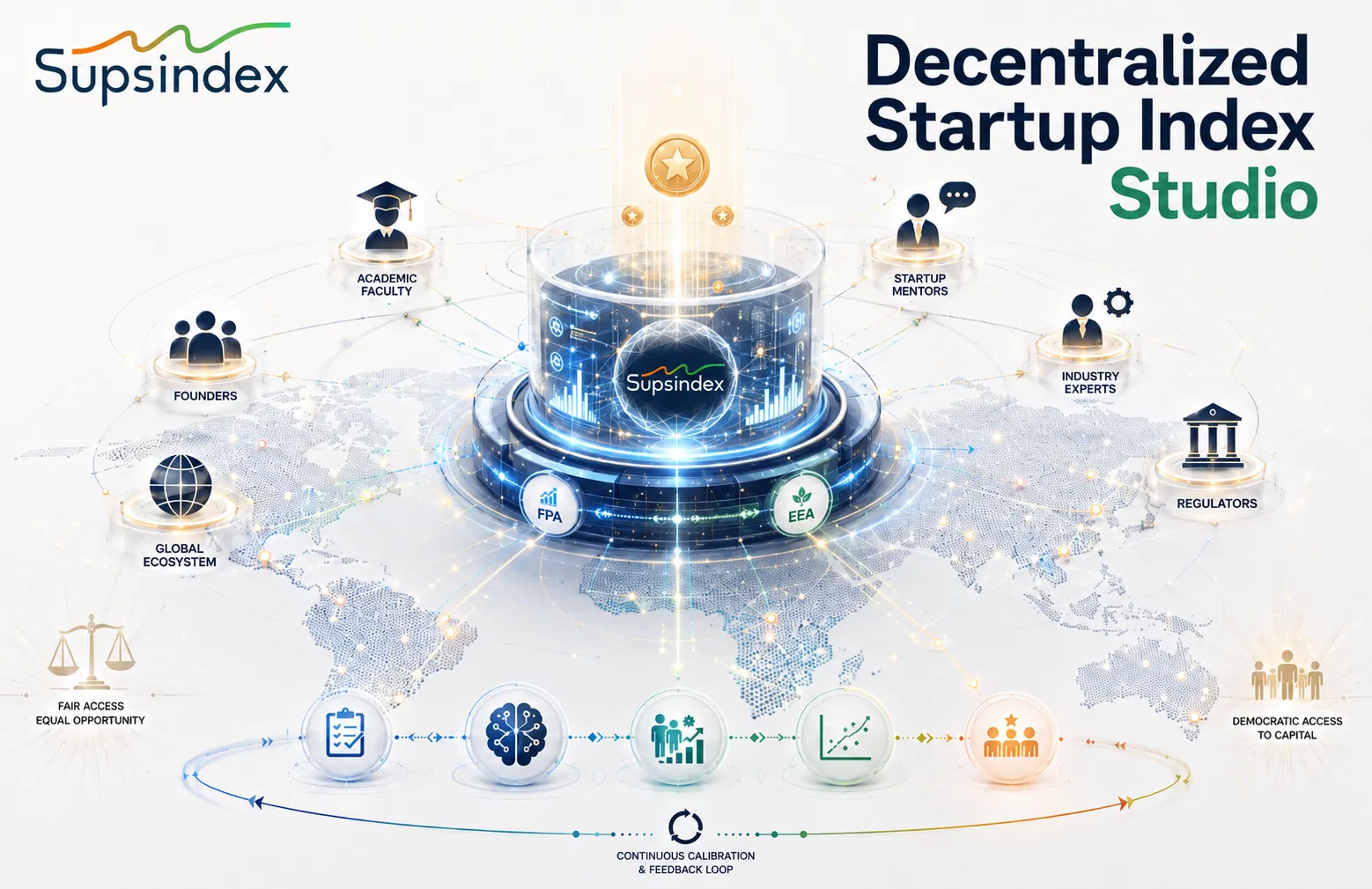
But it is precisely here, at the very frontier of this extremely important revolution, that the concept of the Decentralized startup index studio arises. It is taken for granted in various fields of study including sociology, economics, and organizational psychology that in the last few decades, there was no way at all of measuring such aspects of human behavior, endurance, ethics, and flexibility under extraordinary conditions of stress. The consequence of this has been an entrepreneurial setting in which superficial measurements and intuition guide everything.
However, today’s combination of groundbreaking advances in psychometrics, artificial intelligence, big data about behavior, and causal machine learning has changed all this. Unlike the rigid and inherently limited models of evaluation of the past, which have been static and prone to bias, a Decentralized startup index studio represents an evolving, crowdsourced network that maps the complex cognitive and behavioral traits of founders in various geographies and industries. With a Decentralized startup index studio, the ecosystem ensures that the metrics used to measure the entrepreneurs keep up with their innovations.
Such an ideology is embraced by Supsindex since it builds continuous feedback loops in the very architecture of Supsindex. The creation of psychometric tools in a decentralized startup index studio is a highly participatory and open process. Academic faculty, experienced startup mentors, industry experts, and regulators continuously scrutinize, criticize, and improve upon the algorithms being used. In order to accurately measure “Ecosystem Environment Awareness” (EEA), the algorithms must have constant updates regarding the state of venture capital locally, changing labor laws, and industry-specific regulations in over 55 different industries for startups.
Moreover, a decentralized startup index studio is not only able to circumvent the traditional “chicken and egg” problem of multi-sided platforms but actually embraces it through using the mechanism of tokenomics (such as the Supex token). By creating incentive-based programs like the Fundraising Competency Guide (FCG), the platform promotes crowdsourced innovations by actively encouraging participants to engage in building the platform and improving upon psychometric assessments.
It facilitates a constant process of calibrating tools like the FPA module such that the questions asked are geared towards assessing their level of practical thinking, prioritization skills, and ability to comply under different scenarios. The decentralized nature ensures that the resulting tools have scientific validity, predictability, and reliability across different geographical contexts ranging from the highly developed Silicon Valley area to developing countries in the Global South. In effect, the decentralized startup index studio facilitates the democratization of access to capital by making sure founders’ capabilities are tested irrespective of their closeness to power centers.
Startup index creation platform
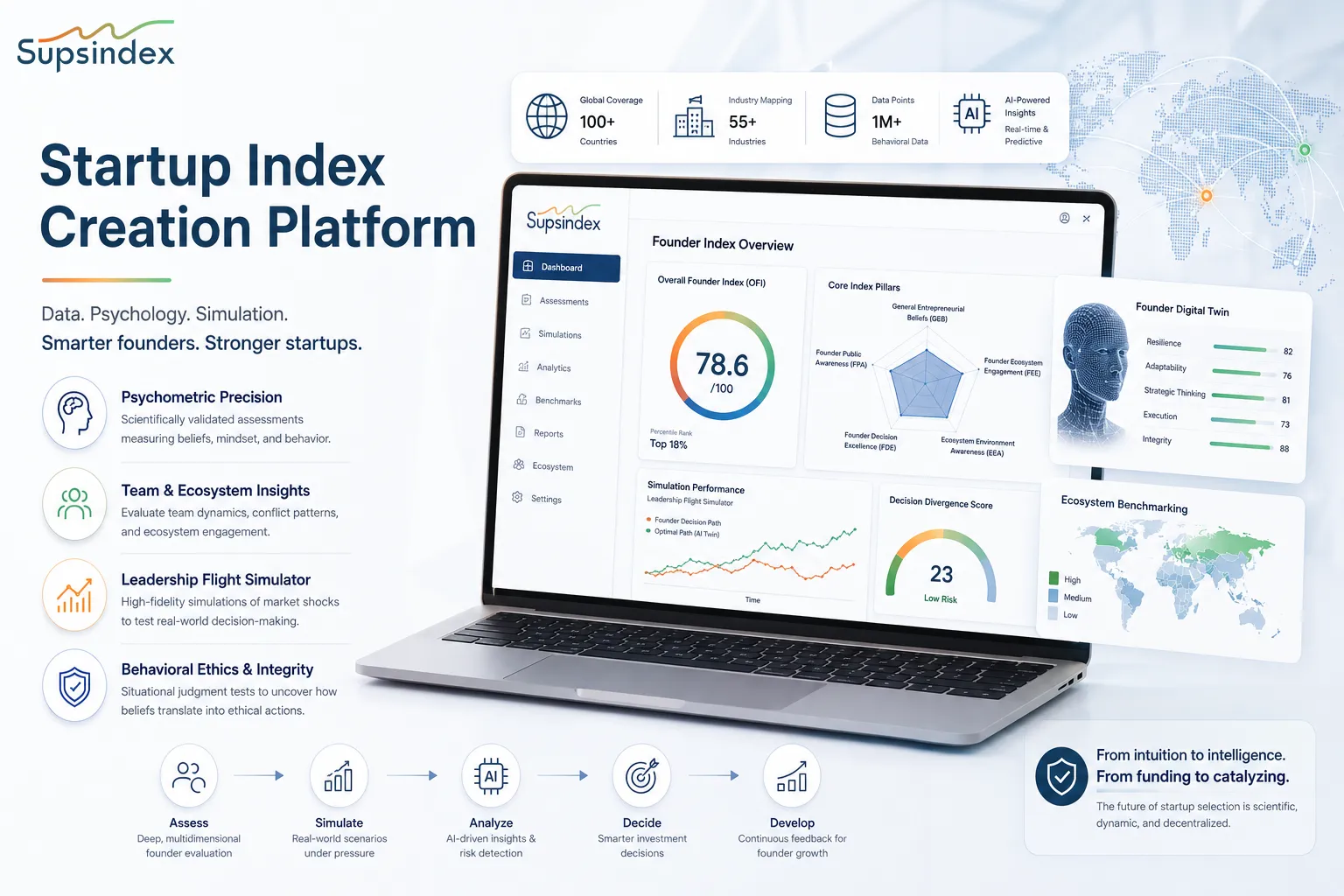
The technological driver behind this systematic process is the Startup index creation platform. It poses an important question, one that needs to be asked: how come the global entrepreneurship environment remained in a low-index world when considering the human capital factor? Is it possible that the industry failed to consider such a crucial matter, or have they lacked the means necessary due to technical limitations? The truth remains that despite all efforts from the industry to assess the founders of startups, these attempts have been confined to static personality tests, such as the Myers-Briggs or DISC. Although they may provide some level of information in office settings, these static personality tests are inadequate when considering their inability to assess entrepreneurship performance in the face of mounting pressure caused by an expiring runway.
A new-age Startup index creation platform can make a difference in this regard. It will function as a dynamic database of human behavioral data combined with an analytical engine able to synthesize complex data streams in order to deliver high-value insights. As opposed to linear, isolated, and easily manipulated evaluations, a Startup index creation platform will use psychometric assessments based on reliability, validity, and standardization.
It quantifies a founder’s General Entrepreneurial Beliefs (GEB), separating fixed mindsets—which view talents as static—from growth mindsets, which embrace continuous learning and view failures as crucial data. It evaluates Founder Ecosystem Engagement (FEE), meticulously measuring the psychological safety, conflict resolution patterns, and asymmetric risk profiles within the founding team. As research demonstrates, “pursue-withdraw” conflict patterns in co-founder relationships are particularly destructive; a sophisticated Startup index creation platform identifies these toxic cycles before they lead to team implosion.
Most Viewer, a truly revolutionary Startup index creation platform moves beyond declarative knowledge through the use of advanced simulation, specifically the Leadership Flight Simulator. Just as we would never allow a pilot to fly a commercial jet based purely on multiple-choice theoretical exams, we should not entrust millions of venture capital dollars to founders without testing their applied decision-making in high-fidelity, high-pressure environments. By immersing entrepreneurs in simulated market shocks, shifting competitor landscapes, and diminishing runways, the Startup index creation platform tracks the divergence between the human founder’s stress-induced decisions and the optimal path charted by an AI-driven Digital Twin.
This momentous shift—from measuring what founders aspirationally claim on a survey to assessing how they actually behave under duress—represents a quantum leap in the scientific fidelity of venture capital allocation. The platform accounts for behavioral ethics, recognizing that the “knowledge-action gap” is real; founders may know the ethical choice but succumb to self-serving bias, incrementalism, or obedience to authority when faced with extreme resource scarcity. By utilizing Situational Judgment Tests (SJTs) within the Startup index creation platform, we gain realistic insight into how deeply held beliefs actually manifest as operational behaviors.
Conclusion: A Call to Ecosystem Leaders
The embedding of modern psychometrics, behavioral metrics, and AI-based simulations into the DNA of the startup ecosystem is not just a trend, but an inevitable scientific advancement. The era of subjectivity, intuition, and gut feeling, where anything is possible, has run its course for those seeking to establish sustainable and scalable value. There is overwhelming evidence to support the point that effective team dynamics, objectively quantified abilities of founders, and cognitive flexibility are the strongest failure mitigating factors.
It is time to face facts: the “Founder Effect,” which creates the initial visionary spark and provides the drive for launching and running a business, can quickly transform into authoritative management style, subjectiveness, and blindness to emerging problems once the company scales. Global startup rankings with robust behavior science basis can serve as a mirror showing what is really going on.
This is the moment when leaders of entrepreneurial ecosystems, global startup secretaries, macro ecosystem architects, managing partners of big venture funds need to seize a unique, unprecedented, historic opportunity. You are in possession of the resources, the means, and the strategic obligation to lead the change in question. Have you invested enough time and money into relying on your gut feeling and incomplete risk assessment? Engagement with modern analytical methods is not only a step forward, but an absolute necessity that will determine absolute winners and losers of the coming wave of innovation.
We invite you to elevate the global discourse on human capital. Global startup indices must evolve to capture the true, internal drivers of success. By fully embracing comprehensive evaluation models, sophisticated investors can identify specific capability gaps within a founding team prior to investment. They can then provide hyper-targeted support—shifting their fundamental methodology from the antiquated practice of founder-picking to the far more robust strategy of founder-developing.
As we navigate this increasingly complex and rapidly accelerating economic landscape, it is time to establish a new gold standard. To understand precisely how to objectively measure soft power, align co-founder dynamics, and harness the power of collective intelligence for sustainable venture growth, we encourage you to explore the business plan and scientific framework developed by the Supsindex platform. Let us leave the era of guessing behind, mitigate the squandering of human potential, and build the future of venture capital on a foundation of objective data and scientifically realized human capability.
