


By objectively quantifying human capital risk, we are effectively de-risking deep tech and demonstrating exactly how Supsindex aligns founder soft power with the ambitious goals of the EIC Work Programme 2025.
De-risking Deep Tech: How Supsindex Aligns Founder Soft Power with the EIC Work Programme 2025
There is a fundamental shift taking place in the landscape of European innovation. As announced with the release of EIC Work Programme 2025, the European Union will be investing a whopping €1.4 billion in game-changing, non-bankable innovations for Europe. The capital investment marks an essential step towards Horizon Europe’s objective of narrowing down the dangerous gap between scientific experimentation and scale-up – crossing TRL 4 to 9.
However, as hundreds of millions of euros pour in advanced technology, synthetic biology, quantum computing, and artificial intelligence, there still exists one huge blind spot in due diligence processes: human capital risk. As much as the traditional structures are equipped to rigorously test intellectual property rights and financial viability of projects, they do not manage to quantify the execution capability of teams behind them.
Based on the analysis presented in the Venture Capital Churn Report, over $1.7 trillion was invested by the venture capital market in a period ranging from 2019 to 2024, with $1.2 trillion of this investment being entirely squandered away. The most shocking conclusion that can be drawn from the five years’ research is that as much as 70% of that money went down the drain due to founders’ mistakes.
In order to realize the ambitious objectives set out in the EIC Work Programme 2025, however, ecosystem builders, policymakers, and founders have to overcome the problem of subjective perception. Supsindex is here to solve this pressing issue: by creating a scientifically-based, non-biased, and objectively comparable assessment system of a founder’s readiness, Supsindex helps turn the qualitative, hard-to-measure aspects of an entrepreneur’s soft power into measurable decision-grade metrics.
The Key Problem Facing the EIC 2025 Initiative

Deep technology startups follow development paths that involve enormous capital requirements, lengthy regulatory approval processes, and massive non-linearity. EIC Accelerator focuses on SMEs that represent very risky and immature propositions for conventional commercial banking. Therefore, when an EIC evaluation committee assesses a business plan, what they actually evaluate is the ability of a founding team to cope with enormous psychological pressure, develop an optimal pivot strategy, and manage capital efficiently amidst absolute ambiguity.
Methods such as reviewing resumes, unstructured interviews, and generic personality indicators applied in this context are time-consuming, ambiguous, expensive, hard-to-interpret, and prone to cognitive biases. For first-time founders, university spin-outs, or immigrants entering the market in a foreign country, this method creates a significant barrier since while they may have exceptional expertise in their field, they often have no proven operating experience in the ecosystem.
Supsindex solves this issue by providing a scientifically-proven system that allows for the objective assessment of three critical aspects of founder’s capability:
- Cognitive Power: Can the founder correctly structure high-stakes business problems and filter out market noise?
- Behavioral Judgment: Will the founder make sound, ethically grounded decisions under intense commercial and psychological duress?
- Ecosystem Fit: Does the founder truly understand the rules, institutional structures, and hidden constraints of the target market?
The Triangulated Assessment Engine
The current state of the Supsindex platform relies on a mathematically rigorous, three-pronged testing architecture live on its Web App. Each index functions as a specialized diagnostic engine, producing an individual Test Explanatory Report that serves as an un-fakeable “entrepreneurial passport” for founders engaging with elite stakeholders like the EIC.
                [ SUPSINDEX ASSESSMENT ENGINE ]
                             / | \
                            /  |  \
                           /   |   \
                          /    |    \
                         v     v     v
                     +-----+ +-----+ +-----+
                     | FPA | | GEB | | EEA |
                     +-----+ +-----+ +-----+
                        |       |       |
                        |       |       +--> Context Engine
                        |       +----------> Behavioral Engine
                        +------------------> Cognitive Engine
1. Founder Public Awareness (FPA) Index: The Cognitive Engine

The FPA Index is a knowledge engine designed to assess the entrepreneurial literacy and executive signal detection of its founder. Featuring a total of 75 questions (of which 50 are general questions pertaining to entrepreneurship/business, while the remaining 25 are context-specific), the FPA makes sure that any academic inventor is equally knowledgeable about their business as its demands dictate.
Contrary to a typical quiz where questions are simply scored as correct or incorrect, the FPA incorporates the use of probabilistic psychometrics, whereby a 2-Parameter Logistic (2PL) Item Response Theory (IRT) model is used to score questions based on thousands of data points:
$$P(X_{ij} = 1 | \theta_i) = \frac{1}{1 + e^{-\alpha_j(\theta_i – \beta_j)}}$$
Where:
$\theta_i$ represents the latent entrepreneurial capability of founder $i$.
$\beta_j$ represents the empirical difficulty parameter of question $j$.
$\alpha_j$ is the discrimination parameter, measuring how effectively the question separates elite performers from underprepared applicants.
Also, the FPA incorporates Signal Detection Theory to determine a founder’s D-Prime ($d’$) ability. Through the inclusion of highly technical but irrelevant “distractor questions” from a commercial standpoint, the behavioral engine is able to test a founder’s ability to distinguish between what matters and vanity measurements and outdated concepts.
2. General Entrepreneurial Behavior (GEB) Index: The Behavioral Engine
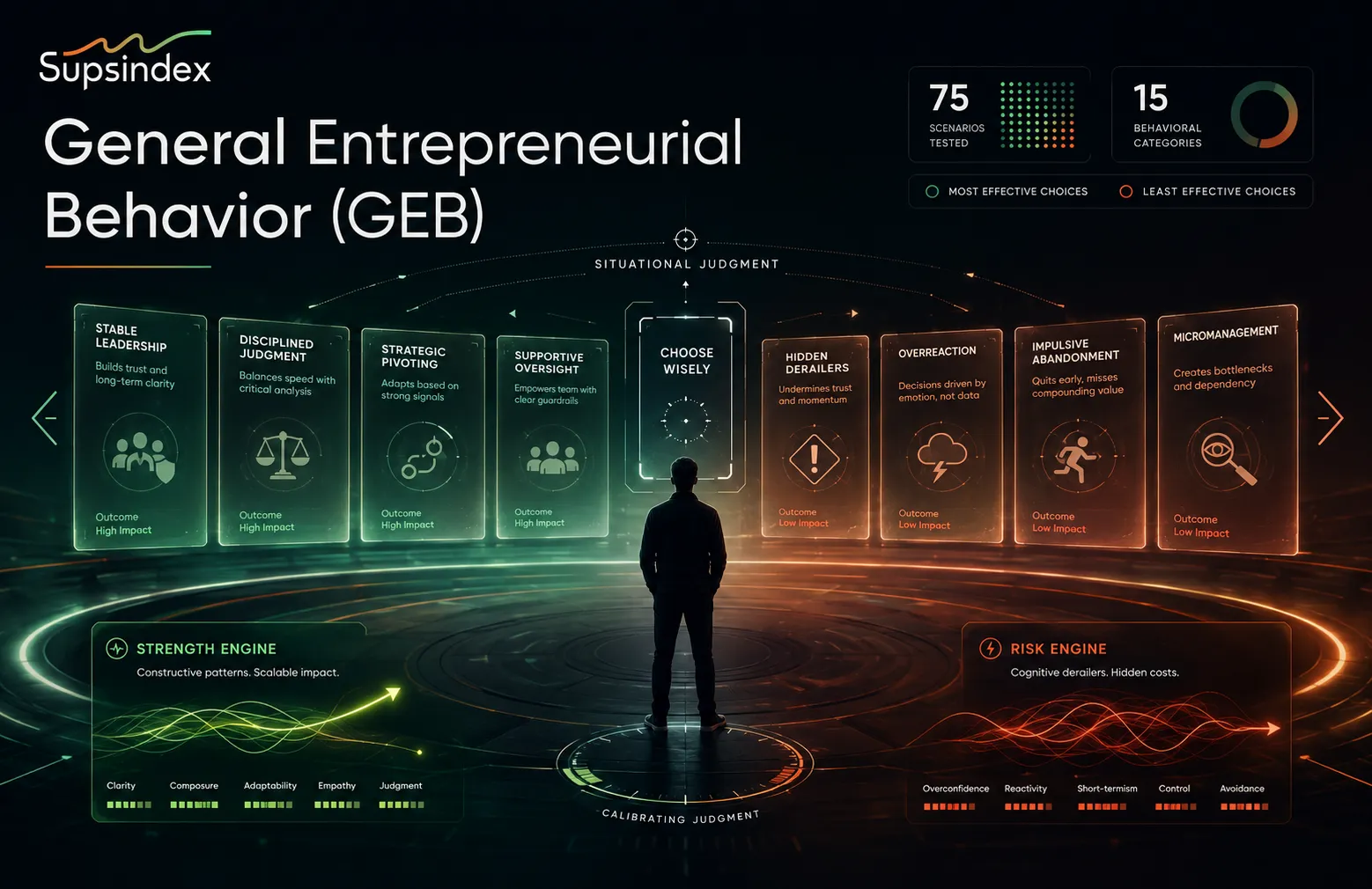
Startups fail not because the entrepreneurs lack motivational zeal; startups crumble when entrepreneurs make predictable behavioral mistakes during the process. Rather than asking about their personality through flawed and manipulable self-reported questionnaires, the GEB puts the entrepreneur into 75 very specific situational judgment scenarios.
In order to overcome the Ipsative Bias present in the standard measures where high scores on one construct will automatically diminish scores on another, the GEB uses Thurstonian Item Response Theory. Founders have to make a decision throughout 15 behavioral categories on what would be the Most Effective and the Least Effective action to undertake in any given scenario.
Here is how GEB profiling works:
- The Strength Engine: Evaluates 19 strengths that are crucial for entrepreneurial success, among which are opportunity awareness and determination.
- The Risk Engine: Assesses the presence of 20 different cognitive derailers. Each distractor is designed to be extremely virtuous in nature (“helpful checking in” vs. “micro-managing”).
3. Ecosystem Environmental Awareness (EEA) Index: The Context Engine
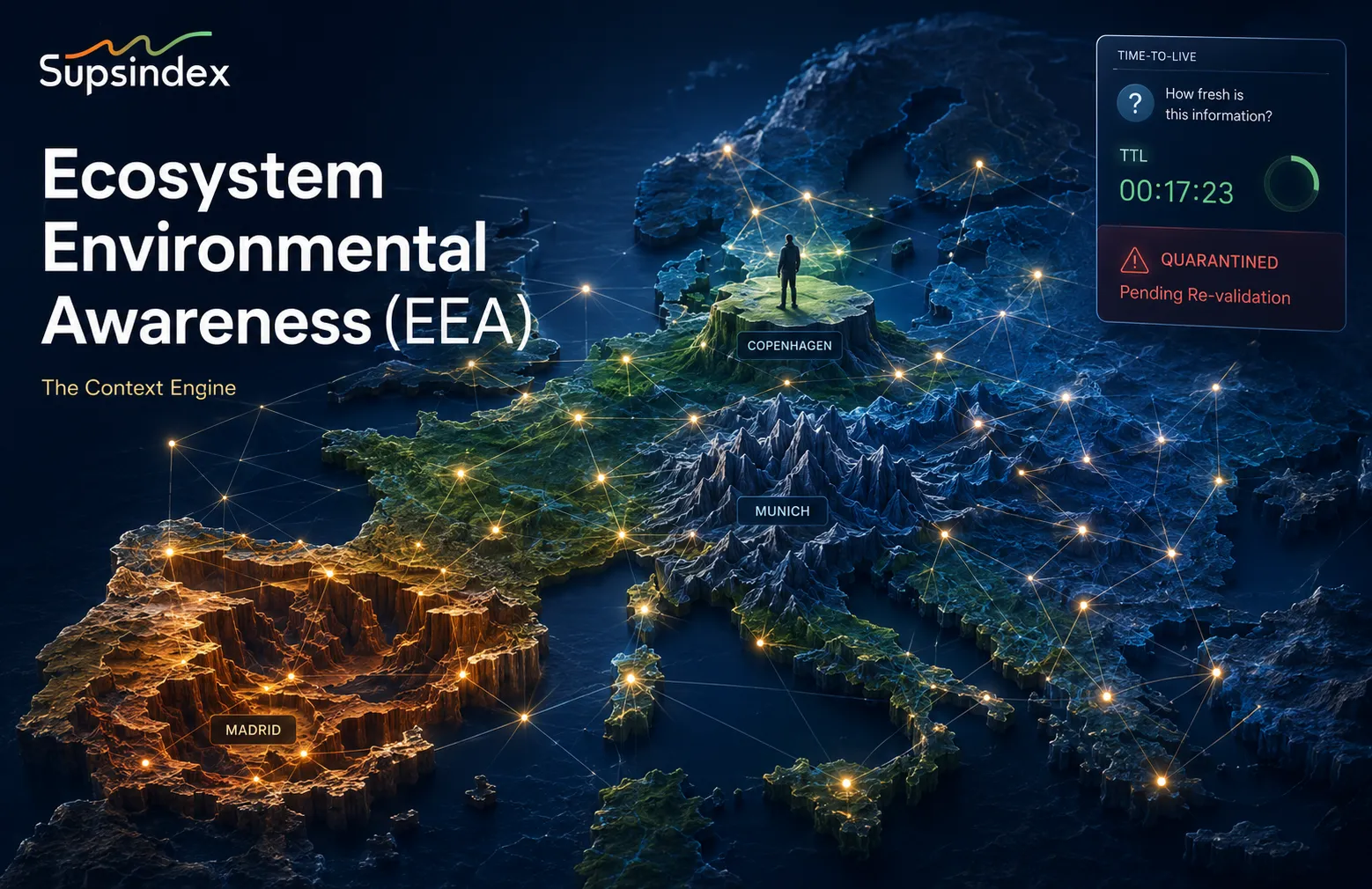
For businesses receiving funds from the EIC, cross-border expansion and market integration in Europe will be an obligation for scaling. But even a top-notch founder who knows the ins and outs of startups in Copenhagen can fail completely when faced with the regulations, culture, and institutions of Madrid or Munich. That’s what makes the EEA Index the contextual intelligence engine that evaluates the readiness of a founder in terms of “street smarts” and market-specificity in more than 15 ecosystems and 55+ industries.
To ensure absolute fairness while evaluating various geographies, the EEA applies Anchor Item Equating. For every localized deck, at least 20% of questions are universal anchors. If the localized regulatory environment is inherently more complex for the test-taker, the engine automatically adjusts the variables so that 800/1000 indicates the same mastery level no matter the location. Structural integrity of the questionnaire is maintained through the Time-to-Live (TTL) measure, whereby any question impacted by fast-changing regulations stays quarantined until re-validation by the international network of 357 faculty members of Supsindex.
Comparison between Indices
Understanding how well such services fit into the EIC framework is possible by evaluating their standard services as described below:
| Feature / Metric | FPA Index DOCX | GEB Index DOCX | EEA Index DOCX |
|---|---|---|---|
| Main Emphasis | Cognition, business acumen, and filtering of signals. | Decision making skills, resilience, and bias immunity. | Dynamics of local market, regulations, and institutional behavior. |
| Question Format | 75 Questions (50 General and 25 Contextual). | 75 Situational Judgement Items. | 40 Questions (20 General and 20 Industry). |
| Primary Approach | 2PL Item Response Model and Signal Detection. | Thurstone IRT (Forced Choice Models). | Anchor Question Equating and TTL Freshness. |
| Expected Time Required | 65-80 Minutes. | 60-70 Minutes. | 35-40 minutes |
| Validity Structure | Dynamic (2-5 years depending on industry growth). | Fixed (5 years depending on behavioral stability). | Dynamic (2-5 years depending on industry growth). |
| Distinction Criteria | Placement in Q1 (top 25% compared to peer group). | Placement in Q1 (top 25% compared to peer group). | A correct answer rate greater than 75%. |
Benefits for the EIC Ecosystem
The use of Supsindex services offers tremendous value to both independent deep tech startups and high-level organizational decision-makers responsible for allocating innovation budget money.
For Deep-Tech Founders: Access to the Capital Passport
In applying for the EIC Accelerator program, founders can use the results of Supsindex analysis to change the entire evaluation process. Instead of having to make self-claims, a founder with Investable Grade results (in the top 25%) is able to prove his/her results using third-party certificates based on psychometrics.
- Eliminating Narrative Bias: An elite academic researcher who lacks a corporate background can prove their baseline entrepreneurial literacy (FPA) and psychological resilience (GEB) definitively, evening the playing field against veteran serial entrepreneurs.
- De-risking International Scale-Up: Showing high distinction in the EEA Index demonstrates to EIC jury members that the company is fully prepared to expand across European borders without falling victim to costly regional regulatory traps.
- Actionable Self-Correction: Founders who land in Quartile 2 (High Potential) or Quartile 3 (Developing) receive a detailed, 20+ page diagnostic roadmap. This highlights precise blind spots (such as an unconscious vulnerability to confirmation bias or a misunderstanding of enterprise sales cycles), enabling them to realign their team composition or seek targeted mentorship before submitting their final EIC proposal.
Institutional Stakeholders & EIC Evaluators: Countering Capital Churn
To European Commission and associated national innovation bodies, the overriding aim is to ensure that taxpayer money results in maximum sustainable economic growth while keeping project failure rates to a minimum. This high-risk, high-reward process can be efficiently accomplished using the Supsindex intelligent dashboards:
“Standard assessments give valuable general information—but they can never cover the complex abilities that only your institution cares about. The way out? Your own Dedicated Requested Index (DI). This turns your own unique criteria for selecting projects into a tailor-made assessment index designed and owned by Supsindex.”
Using Supsindex’s DI method allows operators within institutions to collaborate on creating customized assessment parameters perfectly tailored to any particular call—for example, assessing “capital efficiency in deep tech” or “interdisciplinary coordination ability.” This ensures unrivaled structural efficiency in large-scale government programs:
- Optimized Portfolio Screening: Partner programs can mandate or incentivize applicants to provide an affiliation code during testing. This securely links individual Test Explanatory Reports to the partner’s dashboard, immediately flagging high-risk operational profiles before capital is allocated.
- Ecosystem Human Capital Reports: By aggregating large-scale, anonymized assessment data, policy leaders can access macro-level intelligence reports. These analyses pinpoint systemic capability gaps across entire cities, countries, or sectors, allowing governments to design evidence-based training programs and fine-tune national innovation agendas.
Assessment Ethics and Operational Security

To maintain absolute institutional credibility, Supsindex enforces a strict Proctoring Policy that guarantees the validity of every generated score. The testing environment requires full-screen locked mode, continuous webcam and microphone monitoring, single-monitor connections, and the complete ban of virtual machines, remote-desktop software, or VPNs. Artificial intelligence paired with selective human review monitors for behavioral anomalies, ensuring that results are entirely resistant to external manipulation or plagiarism.
Simultaneously, the platform addresses deep ethical imperatives to eliminate the historical systemic biases found in conventional business hiring tools:
- Adverse Impact Mitigation: Supsindex continuously subjects its question bank to Differential Item Functioning (DIF) analysis using Mantel–Haenszel statistics. If any question inadvertently advantages an individual based on gender, ethnicity, or socioeconomic background while holding underlying ability constant, it is systematically quarantined and purged.
- Cultural Response Correction: The comparative, forced-choice mechanics of the Chancellor IRT model neutralize cultural communication styles—such as the tendency toward uniform high self-ratings found in certain regions—focusing strictly on actual decision-making capability.
- Local Item Dependence Control: Real-world business crises are naturally intertwined. To prevent the artificial score inflation that occurs when questions are grouped into cases, Supsindex leverages Testlet Response Theory (TRT) to statistically adjust for item dependence, protecting the mathematical precision of the final score.
The Path Forward: Co-Creating the Future of Venture Analytics
As the global innovation economy drives toward data-driven accountability, the reliance on gut feelings, charismatic pitches, and legacy credentials must come to an end. The EIC Work Programme 2025 demands an operational standard where capital waste is intentionally mitigated, and human genius is systematically maximized.
Through the Supsindex Index Studio, academic institutions, specialized venture funds, and regulatory authorities are invited to collaborate within an open, governed measurement ecosystem. By co-creating new specialized indices, sharing valid data, and translating real-world patterns of venture failure into predictive analytics, this collective infrastructure ensures that European founders are not just visionary dreamers—but resilient, context-aware builders fully equipped to lead the next industrial era.
