

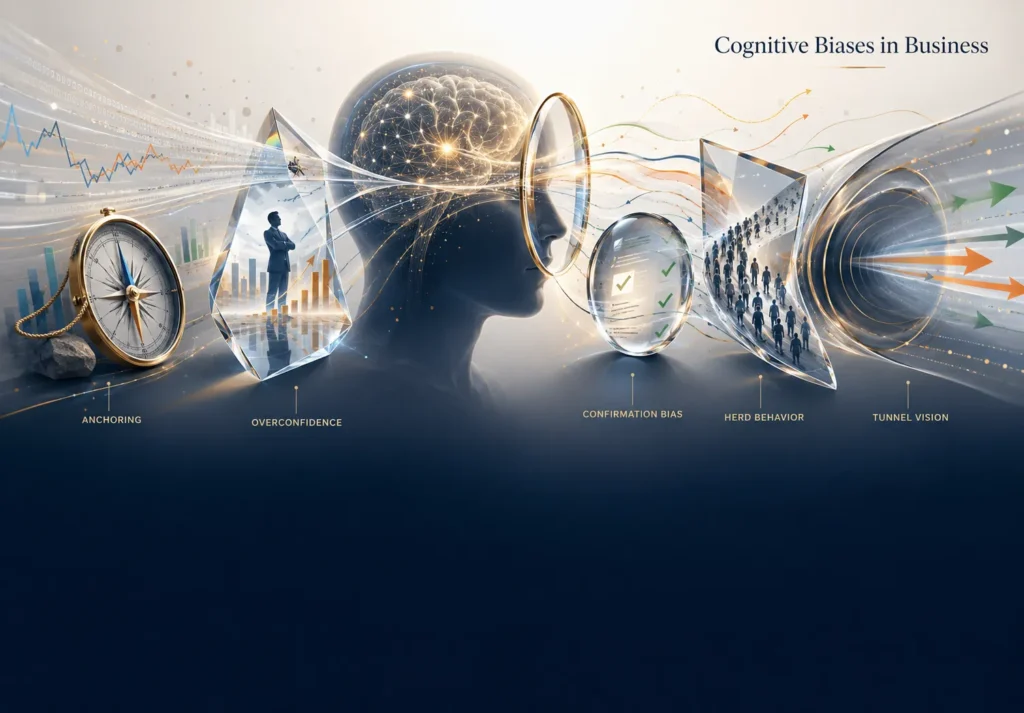
Identifying and mitigating the most common cognitive biases in business is the ultimate baseline for strategic survival, transforming how founders make high-stakes executive decisions under stress.
Common cognitive biases in business
The human mind is an instrument of astonishing power, capable of composing symphonies, designing interplanetary probes, and constructing intricate philosophical systems. Yet, this same instrument is riddled with systematic, predictable flaws in its reasoning. These are not random errors but deep-seated cognitive biases—evolutionary shortcuts that, while efficient for ancestral survival, become perilous liabilities in the complex, high-stakes environment of modern business. For the entrepreneur, whose primary role is to make a series of critical decisions under conditions of extreme uncertainty, these biases are not academic curiosities; they are the silent architects of failure.
The venture ecosystem is a testament to this reality. An analysis of the period between 2019 and 2024 reveals that of the trillions of dollars in deployed venture capital, a staggering amount was lost in ventures that failed to return capital. Post-mortem analyses consistently show that 60-70% of these failures stem directly from founder-related factors—flawed judgments, dysfunctional team dynamics, and a fatal disconnect from market realities. These are not failures of passion or ambition; they are failures of cognition. Understanding the common cognitive biases in business is therefore not just an intellectual exercise; it is a prerequisite for building a more resilient and capital-efficient innovation economy.
The Architecture of Error: Why We Are Built to Fail 
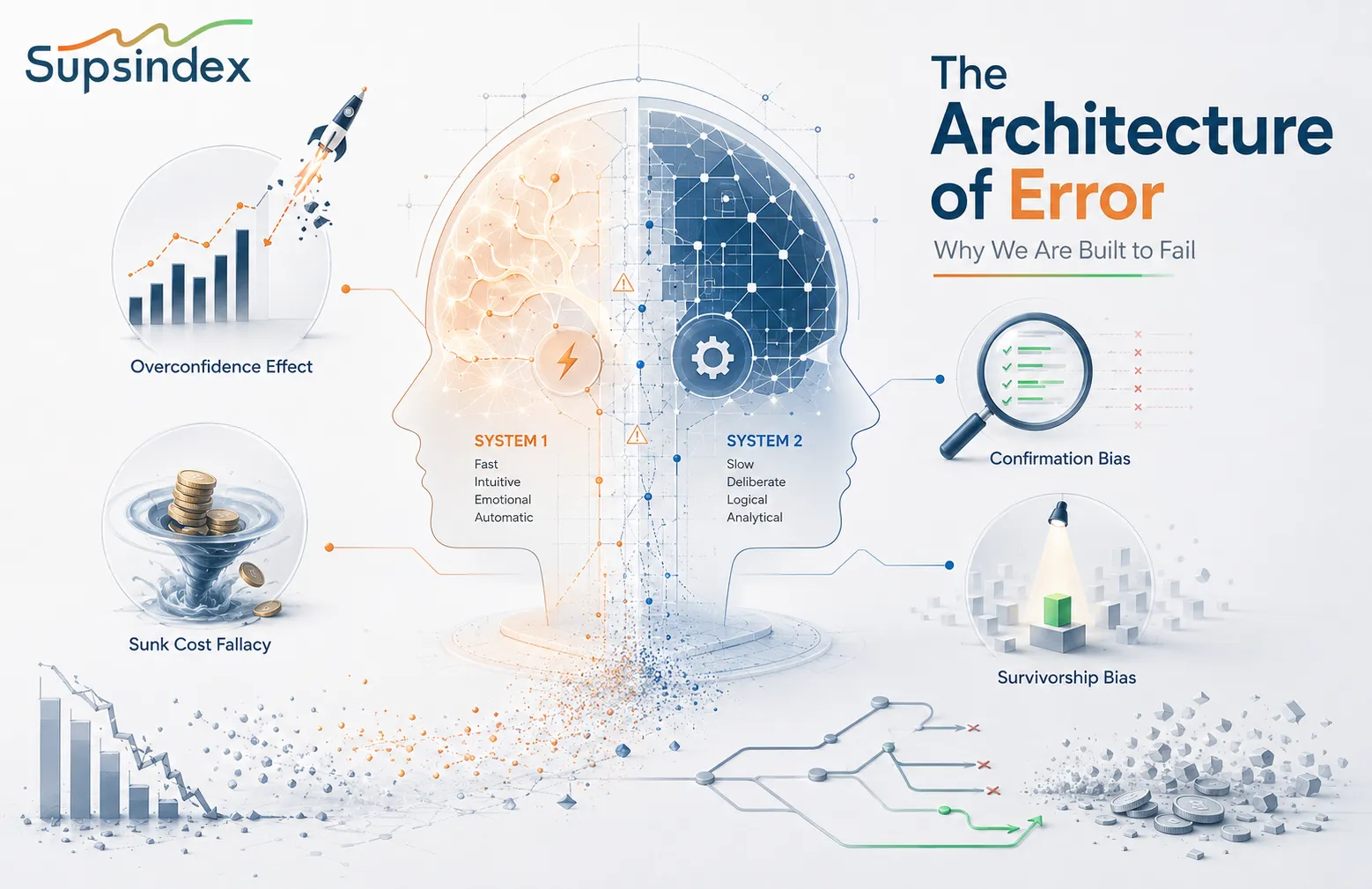
To grasp the common cognitive biases in business, one must first appreciate the dual-process model of the mind, most famously articulated by Nobel laureate Daniel Kahneman. Our brain operates on two systems: System 1 is fast, intuitive, and emotional, handling the vast majority of our daily decisions automatically. System 2 is slow, deliberate, and logical, engaged only when we encounter a problem that requires conscious effort. Cognitive biases are, in essence, the default settings of System 1. They are heuristics that allow us to make rapid judgments without engaging the metabolically expensive machinery of System 2.
In an ancestral environment, these shortcuts were invaluable. A rustle in the grass was more safely interpreted as a predator (a false positive) than as the wind (a potential false negative). In the modern business world, however, this same mechanism leads to catastrophic errors. The entrepreneur, constantly facing time pressure, incomplete data, and immense stress, is uniquely susceptible to relying on the flawed instincts of System 1.
Here are some of the most pernicious biases that form the bedrock of entrepreneurial failure:
- The Overconfidence Effect: This is the mother of all biases in entrepreneurship. It is the pervasive and well-documented tendency for individuals to have excessive confidence in their own answers, abilities, and judgments. It shows itself in an overoptimistic assessment of the appeal of one’s own product, an overly pessimistic assessment of how strong competition is, and unrealistically optimistic deadlines for achieving objectives. The planning fallacy, which is similar to overconfidence but not quite identical to it, makes a founder believe that he or she will be able to accomplish everything much more quickly than is feasible.
- Confirmation Bias: The human brain does not operate as a scientist by trying to disprove itself but operates as a lawyer, trying to find proof to bolster its own claims. Confirmation bias refers to the inclination of looking for, interpreting, and remembering only the information that supports one’s prior opinions. For example, when a company is founded by a person obsessed with their innovation, the mind will automatically focus on the ten customers who adore the product rather than those hundred who have no interest in it. Such confirmation biases give rise to the main cause of failure in start-ups – lack of market demand.
- The Sunk Cost Fallacy: This refers to the phenomenon where people remain wedded to an ineffective strategy simply because they have spent a lot of time and/or money and/or effort in executing that strategy. For example, a founder who spends a year and $500,000 to develop a particular feature finds it hard to drop the feature despite the facts showing that it is not wanted by the users. It would be difficult for him/her to accept that he/she wasted all those resources for nothing, so he/she invests more and hopes to make up for the lost ground.
- Survivorship Bias: The entrepreneurial landscape is littered with the stories of its victors—the Zuckerbergs, Musks, and Jobs. Survivorship bias is the logical error of concentrating on the people or things that “survived” a process and inadvertently overlooking those that did not because of their lack of visibility. Founders study the outliers and attempt to emulate their strategies (e.g., “move fast and break things”), failing to recognize that for every one company that succeeded with that approach, thousands more used the exact same playbook and failed. This leads to the adoption of high-risk strategies that are only rational for those who have already won the lottery.
The common cognitive biases found in businesses are not simply bugs in the human operating system; rather, they are integral parts of our system, which when applied in a business startup scenario lead to the same failing behaviors of startup founders.
Startup founder behavioral pattern: Cocktail of biases under stress
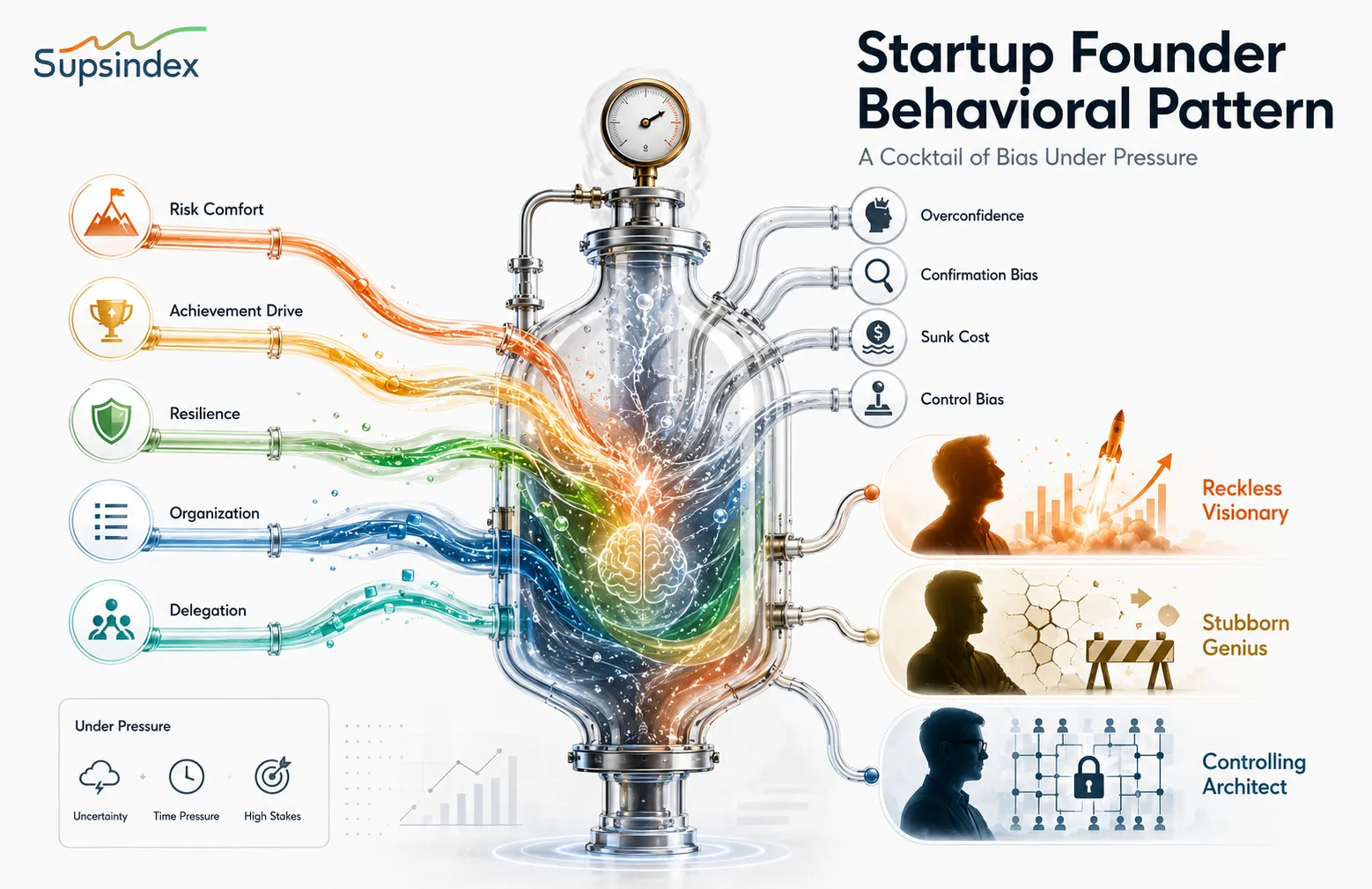
The startup ecosystem provides ideal conditions for cognitive biases to take root. From feeling pressured to appear confident when meeting investors to the emotional connection to the founder’s “baby” and the many decisions that need to be taken each day, it all adds up to create the need for the founder to rely on the unreliable System 1 brain. This leads to the typical behavioral pattern of a startup founder being a cocktail of such biases. Consider the 12 Behavioral Codes identified in Supsindex’s scientific framework for the General Entrepreneurial Behavior (GEB) assessment. These codes, such as Comfort with risk, Achievement Drive, and Ability to delegate, represent core behavioral propensities. When combined with cognitive biases, they create predictable archetypes:
- The Reckless Visionary: A founder with high Comfort with risk and a strong Achievement Drive is a powerful combination. However, when paired with the Overconfidence Effect, it becomes a recipe for disaster. This founder will raise a massive seed round and immediately scale their team, convinced of their inevitable success, long before achieving product-market fit. They mistake motion for progress and burn through their capital with breathtaking speed.
- The Stubborn Genius: A founder with high Resilience and persistence is often celebrated for their “grit.” But when this trait is combined with Confirmation Bias and the Sunk Cost Fallacy, it becomes a liability. This founder will refuse to pivot away from a failing product, interpreting market indifference not as a signal to change course, but as a challenge to their will. Their persistence becomes a destructive force, dragging the company down with them.
- The Controlling Architect: A founder who is highly Organized and has a strong sense of Responsibility seems like an ideal leader. However, if they also have a low Ability to delegate, often driven by a cognitive bias that they are uniquely capable of doing the work correctly, they become a micromanager. They cannot let go, creating a bottleneck that stifles innovation and drives away talented employees who crave autonomy.
This interaction between underlying behaviors and cognitive biases forms the unique and often destructive startup founder behavioral pattern. Recognizing this pattern is the first step, but self-diagnosis is notoriously unreliable. This necessitates the creation of an objective founder bias detector.
Founder bias detector: Why You Can’t Grade Your Own Homework
However, there is something inherently ironic about the nature of cognitive biases. According to the Dunning-Kruger effect, the least competent people are actually those who feel most confident in their ability. Indeed, it is only when a person becomes more competent that he/she realizes how little he/she knows.
It means that no one can debug his/her own mind by utilizing the same mental operating system. That is why the classic questionnaire-based bias detection method is not going to provide accurate results. If the user asks him/herself a question such as “Are you overconfident?”, he/she is sure to give a socially acceptable answer. He/She is simply incapable of being honest when reporting his/her traits.
What makes Supsindex’ GEB bias detector different is the fact that it uses behavior-based criteria to determine whether the individual is vulnerable to cognitive biases. For example, the user will never be asked “Are you a good listener?”. Instead, there will be a number of hypothetical situations that are meant to elicit a specific kind of behavior.
This is the main reason why the SJT format should be considered. Rather than asking “What would you do if…?”, an SJT asks the user to select one of the possible actions from a list of equally flawed choices. Unlike the traditional questionnaire, an SJT does not require much time and effort since it does not take too long to pick one of the offered answers.
Such approach lies at the heart of Supsindex’ GEB assessment. It is based not on the users’ self-reports, but rather on simulated behavior-based criteria. By asking the founder to decide which of the actions described in a certain entrepreneurial scenario are the most effective and least effective, the tool manages to bypass self-reports. The Thurstonian Item Response Theory is used to detect cognitive derailers.
Entrepreneurial cognitive bias test: The Science of Revealing What’s Hidden
Creating an authentic cognitive bias test for entrepreneurship is a difficult psychometric task. It has to go beyond a mere listing of biases. It has to be a dynamic process that tests how these biases show themselves in actual tradeoffs. The Supsindex GEB approach succeeds at this using its “Dual-Engine Behavioral Analysis”:
Strength Engine: The strength engine is where the assessment evaluates 19 positive constructs related to entrepreneurship, for example Opportunity Recognition, Strategic Persistence, and Recombination (ability to bring together diverse elements). These constructs correlate positively with the 12 codes of behavior.
The Risk Engine (The Bias Detector): This forms the basis of the test for cognitive biases of entrepreneurs. It tests an individual’s vulnerability to 20 typical cognitive derailers. The important thing to note here is that the wrong choices made in this situation do not stand out as being wrong.
For example, a scenario might test for a Micromanagement bias. The ineffective option might be framed as “Providing hands-on support to ensure the team meets its goals.” A novice or biased founder selects this because it sounds virtuous and responsible. An experienced, effective founder rejects it because they recognize it as a behavior that erodes autonomy and signals a lack of trust.
By consistently avoiding these socially desirable but strategically flawed options, a founder demonstrates a preference for effectiveness over appearances. The test measures their ability to make the hard, correct decision, not the easy, popular one. This is how a true entrepreneurial cognitive bias test works. It doesn’t ask if you are biased; it creates an environment where your biases are revealed through your choices.
This methodology allows for a nuanced profile that connects a founder’s strengths to their risks. A founder might score high on Achievement Drive (a strength) but also high on Overconfidence Bias (a risk). This data point is not a verdict; it is a vital diagnostic. It tells the founder, their co-founders, and their investors that while their ambition is a powerful asset, it must be tempered with rigorous data and external feedback to prevent it from becoming a destructive force.
Conclusion: The Unexamined Founder is Not Worth Funding
The history of venture capital is a story of betting on people. Yet, for too long, the methods for evaluating those people have been stuck in the dark ages of intuition and subjective judgment. The data is now overwhelmingly clear: the common cognitive biases in business are not minor personality quirks; they are systematic, predictable, and the leading cause of the multi-trillion-dollar capital churn in the startup ecosystem.
The most successful founders of the next decade will not be those who are free of bias—no human is. They will be those who possess a radical self-awareness, who understand their own cognitive architecture, and who build systems and teams to mitigate their innate flaws. They will be the ones who have the courage to submit themselves to a rigorous, objective entrepreneurial cognitive bias test, not as a pass/fail exam, but as a critical tool for continuous growth.
For the ecosystem at large—investors, accelerators, and mentors—the implication is stark. To continue allocating capital based on charisma and a gut feeling is no longer just inefficient; it is a dereliction of fiduciary duty. The technology to move beyond this paradigm now exists. We can measure the invisible. We can simulate the pressures of a crisis before it arrives. We can detect the behavioral patterns that lead to failure before they incinerate millions of dollars. The unexamined founder is a risk that is no longer worth taking.
To understand the scientific methodologies that can quantify these behavioral patterns and provide a clear, data-driven picture of your own decision-making architecture, exploring the frameworks developed at Supsindex may prove to be a crucial first step.
