


An AI-native founder can use artificial intelligence to build with smaller teams and far greater execution speed. But AI-native founder readiness still depends on judgment, risk calibration, customer insight, and the ability to evaluate AI-generated decisions.
AI-Native Founders Are Building Faster. But Are They Better Founders?
The economics of starting a company are changing. A founder who once needed separate engineers, designers, researchers, marketers, and operations specialists to move from an idea to an early product can now use generative AI to write code, build prototypes, research markets, create campaigns, analyze data, automate workflows, and coordinate increasingly capable AI agents. This is not simply a productivity upgrade; it is a new operating model in which very small teams can attempt work that previously required much larger organizations.
The early data is striking. AWS’s 2026 Global Startup Trends study, based on more than 3,400 founders and senior startup leaders across 20 countries, reported that AI-native startups in its sample were growing at an average annual rate of 156%, compared with 65% for startups overall, while reaching billion-dollar valuations faster and with smaller teams. Stripe Atlas has documented a parallel shift in company formation: 63% of C corporations formed through Atlas in Q2 2026 were solo-founded, the highest share in its dataset. These findings do not prove that AI creates better founders, but they do show that the cost, speed, and staffing assumptions of early company building are being reset.
That distinction matters because entrepreneurship is not an output-maximization contest. AI can increase how much a founder can produce, but founders still have to decide which customer matters, which problem deserves attention, which evidence should change the strategy, where scarce capital should go, and when apparently productive activity is actually a distraction. AI-native founders are gaining unprecedented execution leverage. The harder question is whether they are developing the judgment required to use that leverage well.
Are AI-Native Founders Better Founders? The Short Answer
An AI-native founder is a founder who integrates artificial intelligence deeply into how a company is built and operated, using AI across development, research, analytics, marketing, operations, decision support, and increasingly multi-agent workflows. This can make a small team extraordinarily productive, but higher execution velocity does not automatically mean higher founder capability. A better founder still needs customer judgment, strategic prioritization, risk calibration, financial discipline, self-awareness, team leadership, and the ability to challenge both human and machine-generated assumptions. In simple terms, AI expands leverage; founder readiness determines whether that leverage is pointed in the right direction.
Why AI-Native Startups Are Building Faster
Software development provides one of the clearest examples of AI-driven acceleration. In a controlled experiment involving 95 professional developers, GitHub found that participants using Copilot completed a defined coding task 55% faster than those who worked without it. For an early-stage startup, improvements of that magnitude can compress experimentation cycles, reduce the cost of an MVP, and allow a founder to test more ideas before increasing headcount.
The productivity story is not universal, however. METR’s 2025 randomized controlled trial found that experienced open-source developers working on mature repositories they already knew well took 19% longer when early-2025 AI tools were available, even though the developers believed they had become faster. METR’s February 2026 update suggested that newer tools were probably providing more acceleration, but it also cautioned that selection effects made the size of that improvement difficult to estimate confidently. The practical lesson is that AI productivity depends on the task, the user, the workflow, and the quality of integration.
For founders, this nuance matters even more because entrepreneurial productivity cannot be measured by output alone. Generating a feature faster is valuable only if the feature matters; producing ten strategies is useful only if the founder can identify which one deserves action. AI lowers the cost of execution, which means the scarce resource increasingly moves upstream: deciding what is actually worth executing.
The Cognitive Offloading Risk: When AI Starts Replacing Judgment
AI Can Raise the Baseline While Making Startups More Similar
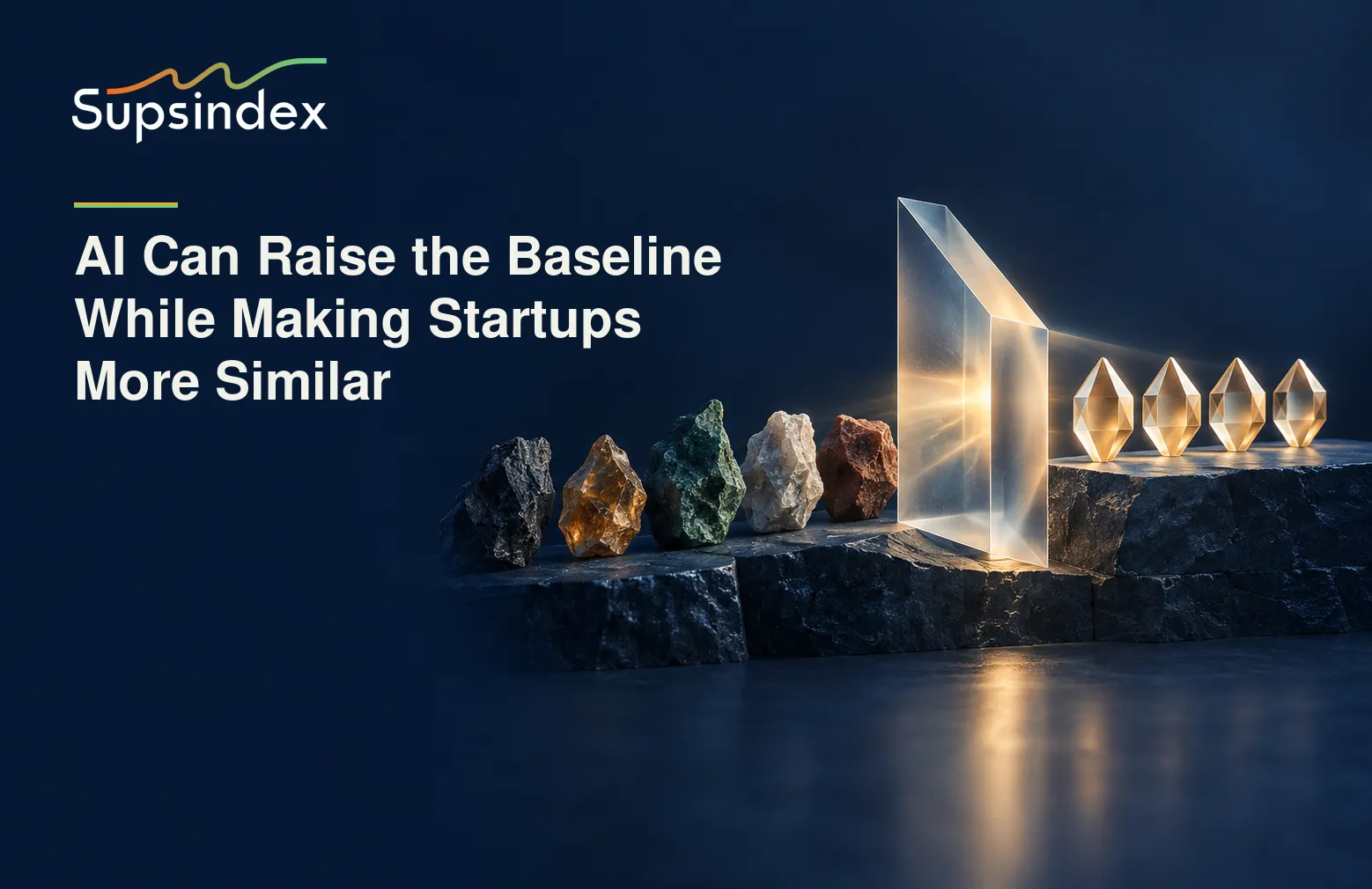
The idea that generative AI simply produces “average” thinking is too simplistic. Research published in Nature Human Behaviour found that participants using ChatGPT could produce ideas rated as more creative on average than those generated without AI assistance. Generative AI can therefore raise the baseline quality of ideation.
The trade-off appears at the collective level. A later analysis in Nature Human Behaviour found that while ChatGPT-assisted brainstorming improved average individual creativity, the overall pool of ideas became less diverse. For startups, that matters. If thousands of founders use similar frontier models to ask similar questions about SaaS positioning, MVP features, pricing, go-to-market strategy, or marketing copy, the average quality of those outputs may rise while the strategies themselves become more homogeneous.
This changes where advantage comes from. When competent drafts, analyses, code, and strategies become abundant, differentiation depends more heavily on proprietary context, customer proximity, selection, rejection, and the ability to combine ideas in ways a model cannot infer from generic information. AI may raise the floor of execution while increasing the premium on original judgment. When generation becomes abundant, judgment becomes the bottleneck.
The Productivity Trap: Building More Is Not the Same as Making Progress
AI coding environments make building unusually rewarding because ideas can become visible artifacts almost immediately. A founder can spend an afternoon adding features, redesigning onboarding, or automating an internal process and finish the day with tangible proof of activity. The danger is that a startup may become more productive while learning less.
Consider a founder who spends ten hours building an internal tool that a $50-per-month SaaS product already solves. The work may be technically impressive, but if those ten hours should have gone into customer discovery, pricing, distribution, fundraising, or a critical partnership, the founder has improved local efficiency while weakening company-level effectiveness. Before generative AI, technical difficulty naturally killed some low-priority ideas. AI removes much of that friction, which makes prioritization more important rather than less important.
The same problem appears when founders become extremely productive individual contributors. AI can help one person code, design, research, write, analyze, and automate at remarkable speed, but a startup does not necessarily need its founder to become its busiest employee. It needs the founder to identify the highest-leverage problems and allocate attention accordingly. AI can make strategic avoidance look productive, which is why the important question is shifting from “Can we build this?” to “Now that we can build almost anything quickly, what is actually worth building?”
From Prompt Engineering to Agentic Orchestration

The first wave of generative AI made prompt engineering look like a defining skill. For founders, that definition is already becoming too narrow because AI work is shifting from a person asking one model for an answer toward networks of agents, tools, workflows, data sources, evaluation layers, and human interventions.
The more durable capability is agentic orchestration. In practical terms, agentic orchestration means managing AI systems in a way that resembles managing a distributed team: the founder defines the objective, decomposes the work, selects the right model or agent, establishes quality standards, monitors the process, corrects deviations, and decides where human accountability must remain. Microsoft’s 2026 Work Trend Index describes a similar shift from direct production toward directing, supervising, and orchestrating AI-supported work.
This changes what AI literacy means for startup founders. A strong AI-native founder understands what can be automated safely, where errors will compound, which inputs are sensitive, how outputs will be evaluated, and when a workflow has technically completed the task while missing the business objective. Human-in-the-loop design is not a failure of automation; it is a deliberate decision about where human judgment creates enough value that removing it would increase risk.
AI Does Not Remove the Human Risks Behind Startup Execution
Better tools do not remove the human realities of entrepreneurship. Startup failure remains multi-causal, with recurring problems around capital, Product-Market Fit, timing, unit economics, and team execution. CB Insights’ 2026 analysis of more than 400 venture-backed shutdowns found these patterns repeatedly appearing across failed companies and noted that running out of capital is often the final visible outcome rather than the original cause.
Founder decisions can shape many of these outcomes without being their sole cause. AI can accelerate a well-designed experiment, but it can accelerate an incorrect hypothesis just as easily. It can automate a disciplined process or scale a broken one. Greater execution velocity therefore amplifies whatever sits upstream of execution, including the quality of the founder’s judgment.
The same boundary is visible in team dynamics. Research summarized by Harvard Business Review has highlighted how interpersonal rifts and power struggles can ultimately force founders apart. No agent architecture automatically resolves unclear authority, uneven workload, resentment around equity, incompatible decision styles, or a gradual loss of trust. AI can reduce headcount, but it cannot automate trust or behavioral alignment.
AI Does Not Automatically Create Ecosystem Intelligence
AI-native company building can create an illusion that execution has become geographically frictionless. Founders in different countries may have access to the same frontier models, developer tools, cloud platforms, and research capabilities, but the environments in which companies operate remain local. Regulation, funding structures, procurement, employment law, distribution, business culture, and institutional gatekeepers still vary significantly across ecosystems.
AI can help a founder research these differences, but information access is not the same as contextual judgment. A model can summarize a regulation without understanding how companies actually navigate the institutions around it. It can identify investors without fully understanding the trust networks that determine access, and it can translate language without automatically translating business culture. Code is increasingly global, but company building remains stubbornly contextual.
For AI startup founders, ecosystem awareness can become even more important because the cost of acting has fallen. A team can deploy capital, launch products, and enter markets faster than before, which means contextual mistakes can also compound faster. AI reduces the friction of action; it does not automatically improve the wisdom of where or how to act.
AI Can Amplify Founder Bias Instead of Correcting It
Generative AI can expand access to information, but it can also become a sophisticated confirmation machine. A founder who is emotionally attached to a product can ask a model for reasons the market is about to grow, arguments explaining why rejecting customers do not yet understand the product, or a strategic case for continuing with the existing direction. The model can provide persuasive support for each request without ever forcing the founder to confront the possibility that the underlying assumption is wrong.
In that scenario, AI has not corrected confirmation bias; it has made the rationalization more articulate. The same mechanism can reinforce overconfidence, sunk-cost attachment, novelty bias, optimistic forecasting, and avoidance of bad news. More information does not automatically produce better judgment when the founder controls which questions are being asked.
Strong AI-native founders therefore use AI adversarially as well as productively. A strategy generated by AI should also be attacked by AI. Market validation should be paired with questions about what evidence would prove the market unattractive, and a fundraising narrative can be stress-tested by asking the model to behave like an investment committee searching for reasons to reject the company. AI becomes more valuable when it increases exposure to contradictory hypotheses rather than merely increasing confidence.
Quality Control Is Becoming a Core AI-Founder Skill
As AI takes over more production, the ability to define and recognize quality becomes more valuable. Microsoft’s 2026 Work Trend Index found that AI users ranked quality control of AI output and critical thinking as the two human skills becoming most important as AI assumes more work. The same report found that 86% of surveyed AI users treat AI output as a starting point rather than a final answer and remain responsible for the thinking.
For founders, this changes the nature of competence. A good AI-native founder must recognize when an answer sounds convincing but lacks context, when an agent has technically completed a task but missed its commercial purpose, when automation is creating efficiency without customer value, and when execution speed is beginning to compromise quality. As output becomes cheaper, evaluation becomes a strategic function.
The strongest AI-native founder may therefore not be the person who generates the most. It may be the person who rejects the most intelligently: the founder who knows which output should be discarded, which recommendation deserves more evidence, which workflow needs human intervention, and which apparently productive activity should stop.
What Makes a Strong AI-Native Founder?
There is not yet strong evidence that AI-native founders are inherently better founders simply because they integrate more AI into their companies. What the available evidence does show is that AI-native startups can operate differently: they can build with smaller teams, automate more work, shorten experimentation cycles, and in some cases achieve unusually high revenue efficiency and growth. AWS’s 2026 findings are an important signal of that operating model, but they are company-level evidence rather than proof that AI itself improves founder judgment.
Stripe Atlas offers a useful warning against confusing access with excellence. As solo founding reached an all-time high in its dataset, the performance gap between typical and exceptional solo-founded startups widened sharply. Among solo-founded Atlas companies, median first-six-month revenue fell 23% year over year in 2025 while top-decile revenue rose 19%. More people may be capable of forming and operating a company alone, but that does not mean more people are equally capable of building a great company.
A strong AI-native founder combines technological leverage with disciplined human judgment. They verify important outputs, remain close to real customer behavior, understand where human accountability must remain, use AI to challenge rather than merely validate their assumptions, and resist the temptation to build simply because building is cheap. The most useful test is not how many AI tools a founder uses; it is what happens to the quality of the founder’s decisions when AI gives them more power.
What Should Investors Assess in an AI-Native Founder?
For investors, “uses AI” is rapidly becoming too broad to function as a meaningful signal. AI-native due diligence should focus on how the founder governs AI leverage: how important outputs are verified, whether the team can distinguish activity from traction, whether agent workflows have clear evaluation and escalation rules, and whether the founder knows when automation is inappropriate.
Investor assessment should also examine whether AI has strengthened or weakened the founder’s contact with reality. Does automation create more time for customer conversations, or has the founder automated themselves away from direct customer evidence? Is AI used to expose alternative hypotheses or mainly to confirm existing beliefs? Does the founder understand the local regulatory, funding, and cultural environment, or are generic model outputs substituting for ecosystem knowledge? The emerging due-diligence equation is therefore not simply AI capability; it is AI leverage combined with founder judgment.
How Supsindex Approaches AI-Native Founder Readiness
Supsindex treats AI capability as an important new layer of the founder environment, not as a substitute for the underlying capabilities required to navigate entrepreneurship. Its General Entrepreneurial Behavior (GEB) framework focuses on decision-making quality, resilience under pressure, adaptability, resource management, and susceptibility to cognitive and behavioral biases. The Ecosystem Environmental Awareness (EEA) framework examines whether founders understand the local market, regulatory, cultural, and institutional context in which they intend to operate.
That distinction becomes more important as AI increases execution velocity. A founder with strong judgment can use AI to compress experimentation, remove low-value work, improve research, and operate a remarkably lean company. A founder with weak judgment can use the same technology to overbuild, reinforce poor assumptions, automate flawed processes, pursue more distractions, and scale the wrong strategy sooner. AI capability therefore belongs alongside founder knowledge, behavioral judgment, and ecosystem awareness rather than replacing them.
The goal of founder assessment in an AI-native era should not be to identify who uses the most advanced tools. It should be to make a more consequential question measurable: does AI improve the quality of the founder’s operating system, or does it merely increase its speed?
AI-Native Founder FAQ
What is an AI-native founder?
An AI-native founder integrates artificial intelligence deeply into company building and operations rather than treating AI as an occasional productivity tool. This can include AI-assisted development, research, analytics, marketing, automation, decision support, and multi-agent workflows. The defining characteristic is not simply AI usage but the extent to which AI changes how the startup allocates work, makes decisions, and operates with a lean team.
Are AI-native founders better founders?
Not automatically. AI can increase productivity, reduce the cost of experimentation, and allow smaller teams to execute more work, but founder quality still depends on judgment, customer understanding, strategic prioritization, risk calibration, adaptability, team dynamics, and the ability to evaluate AI output critically. AI can amplify a strong founder’s capabilities, but it can also accelerate a weak founder’s mistakes.
Are AI-native startups growing faster?
Recent evidence suggests that some are. AWS’s 2026 study of more than 3,400 founders and startup leaders reported substantially higher average annual revenue growth among AI-native startups in its sample, along with smaller teams and faster paths to large valuations. These are aggregate findings and do not imply that every AI-native startup will outperform or that AI adoption alone causes superior growth.
Does AI always make startup founders more productive?
No. AI productivity depends on the task, the user, and the workflow. GitHub found a 55% speed improvement in one controlled coding experiment, while METR’s early-2025 study found experienced developers working on familiar mature repositories were 19% slower with AI tools. METR’s later update suggested that newer tools may be improving developer speed but also cautioned that measurement remains difficult. For founders, the more important question is whether additional output advances the company rather than simply increasing activity.
What is agentic orchestration?
Agentic orchestration is the ability to coordinate AI agents, models, tools, and human input around a larger objective. It involves defining goals, distributing tasks, setting quality standards, monitoring results, correcting failures, and deciding when a human needs to intervene. For founders, it represents a shift from being skilled at asking individual models questions to being skilled at designing and supervising AI-enabled operating systems.
Can AI replace founder judgment?
No current evidence supports treating AI as a substitute for founder judgment. AI can expand analysis, generate alternatives, automate execution, and expose founders to perspectives they may not have considered, but the founder remains responsible for determining objectives, evaluating evidence, allocating resources, managing human relationships, and accepting the consequences of major decisions.
AI as a Cognitive Exoskeleton
The most capable AI-native founders will probably not be the people who outsource the greatest amount of thinking. They will be the people who understand which thinking can safely be accelerated and which thinking must remain their responsibility. AI is useful to imagine as a cognitive exoskeleton: it can increase the strength and reach of the operator, but it cannot choose the destination or determine whether the direction is correct.
AI can make coding faster, but the founder still decides what deserves to be built. It can generate a strategy, but the founder still evaluates whether the assumptions are true. It can coordinate agents, but the founder defines the objective. It can process enormous quantities of information, but someone still has to determine which information matters. A five-person AI-native startup may increasingly produce the output once associated with a much larger organization, but that does not automatically give those five people stronger judgment, healthier relationships, deeper self-awareness, better risk calibration, or greater knowledge of the ecosystem around them.
AI-native founders are unquestionably becoming faster builders. Whether they become better founders will depend on what they do with that speed. The winners of the AI-native era will not simply generate more output; they will convert technological leverage into better learning, better decisions, more intelligent allocation of attention, and ultimately better outcomes. Speed is becoming cheaper. Judgment is becoming more valuable.
Selected Research Sources
AWS Global Startup Trends Report (2026) — data on AI-native startup growth, team size, and time to billion-dollar valuation.
Stripe Atlas (2026) — data on solo-founded C corporations and widening performance dispersion among solo founders.
GitHub Copilot Productivity Research — controlled experiment measuring developer task-completion speed.
METR Developer Productivity Research (2025–2026) — randomized study and follow-up on AI-assisted software development productivity.
Microsoft Research, CHI 2025 — study of generative AI, critical-thinking effort, confidence, verification, and task stewardship.
Nature Human Behaviour (2024–2025) — research on AI-assisted creativity and the diversity trade-off in brainstorming.
Microsoft Work Trend Index 2026 — data on quality control, critical thinking, human agency, and agentic work.
CB Insights Startup Failure Analysis (2026) — recurring failure patterns across venture-backed startup shutdowns.
Harvard Business Review (2024) — research discussion on co-founder rifts, power struggles, and founder relationship breakdown.
