


A pivot should follow meaningful evidence, not discomfort, hype, panic, or sunk costs. The real founder skill is knowing when persistence is still producing learning and when the original plan has stopped responding to reality.
When Should a Founder Pivot? The Psychology of Knowing When to Quit the Original Plan
A founder’s ability to persist through uncertainty is one of entrepreneurship’s most celebrated qualities. Startups rarely develop exactly as planned, early customers are difficult to interpret, products frequently require several iterations, and some ideas that initially appear weak become valuable only after the market has had enough time to understand them. If founders abandoned their plans whenever progress became uncomfortable, many promising companies would disappear before they had a chance to learn.
The opposite mistake can be just as destructive. A founder can continue financing a hypothesis long after the available evidence indicates that something fundamental is wrong. Weak retention becomes “customers needing more education.” Poor unit economics become a temporary scaling problem. Repeated rejection becomes proof that the market is not yet sophisticated enough. What originally looked like conviction gradually becomes an expensive refusal to update.
This is why the question “When should a founder pivot?” is psychologically harder than it first appears. Founders are not simply evaluating data. They are evaluating something they may have spent years building, publicly defending, raising money around, and integrating into their personal identity.
At the other extreme, founders can pivot too easily. A new competitor launches a feature, an investor suggests a different market, an AI trend becomes popular, or a single prospective customer requests something unexpected, and the entire roadmap changes again. Constant adaptation can look sophisticated while preventing the startup from learning anything conclusively.
The real skill is therefore not pivoting quickly. It is knowing what evidence deserves to change the plan.
What does a pivot actually mean?
The term “pivot” is often used so loosely that almost any strategic adjustment qualifies. Changing a landing page, revising pricing, testing another acquisition channel, or shipping a new feature may represent experimentation without constituting a fundamental pivot.
Recent entrepreneurship research has tried to make the distinction clearer. A 2026 systematic review covering 66 peer-reviewed articles characterizes pivoting as a fundamental reorientation of a venture’s core strategy, value proposition, or organizational identity in response to disconfirmed beliefs, typically through an iterative learning process. The review also distinguishes different forms of pivoting, including opportunity-driven and survival-oriented pivots. Academy of Management Journals
That distinction matters because founders should not redesign the company every time an experiment fails.
A pricing adjustment might be an iteration. Changing the customer segment might be a customer pivot. Moving from direct sales to a platform model could represent a channel or business-model pivot. Abandoning the original problem entirely is a far deeper strategic change.
The magnitude of the decision should therefore correspond to the strength of the evidence.
Persistence is valuable—until it stops being learning
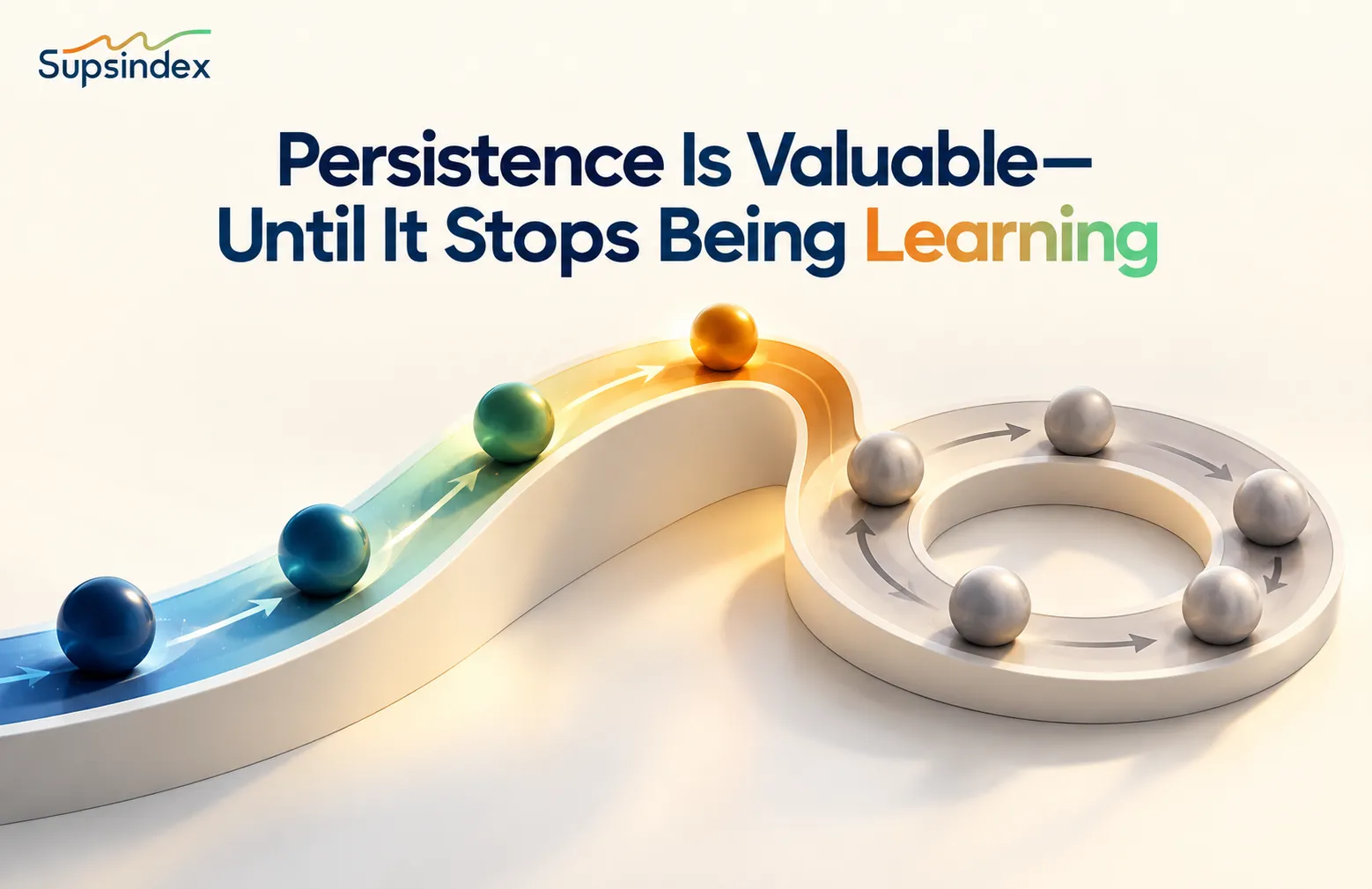
The startup world frequently treats persistence as an unconditional virtue. “Never give up” is emotionally powerful advice, but strategically it is incomplete.
Persistence is valuable when the founder continues experimenting toward a meaningful objective despite friction, delayed results, or temporary setbacks. It becomes dangerous when the same founder continues repeating or financing an invalidated hypothesis primarily because changing direction would feel like admitting defeat.
Supsindex distinguishes these states through epistemic humility. A founder can remain extremely committed to solving a problem while remaining less attached to the particular solution currently being tested. The mission may remain stable even as the strategy evolves.
This difference can be expressed simply:
Healthy persistence says, “The problem is worth solving, so we will keep learning.”
Destructive persistence says, “Our original answer must eventually work because we have already committed to it.”
Research on lean venture development reaches a similar conclusion. Learning frameworks recommend setting explicit learning milestones that help entrepreneurs decide whether incremental improvement is producing sufficient progress or whether a more substantial pivot is justified. The same literature notes that accumulated investment creates sunk costs that make perseverance psychologically easier than abandoning the current direction. Springer Link
The decision is therefore partly strategic and partly psychological.
The sunk cost trap: when yesterday’s investment controls tomorrow’s decision
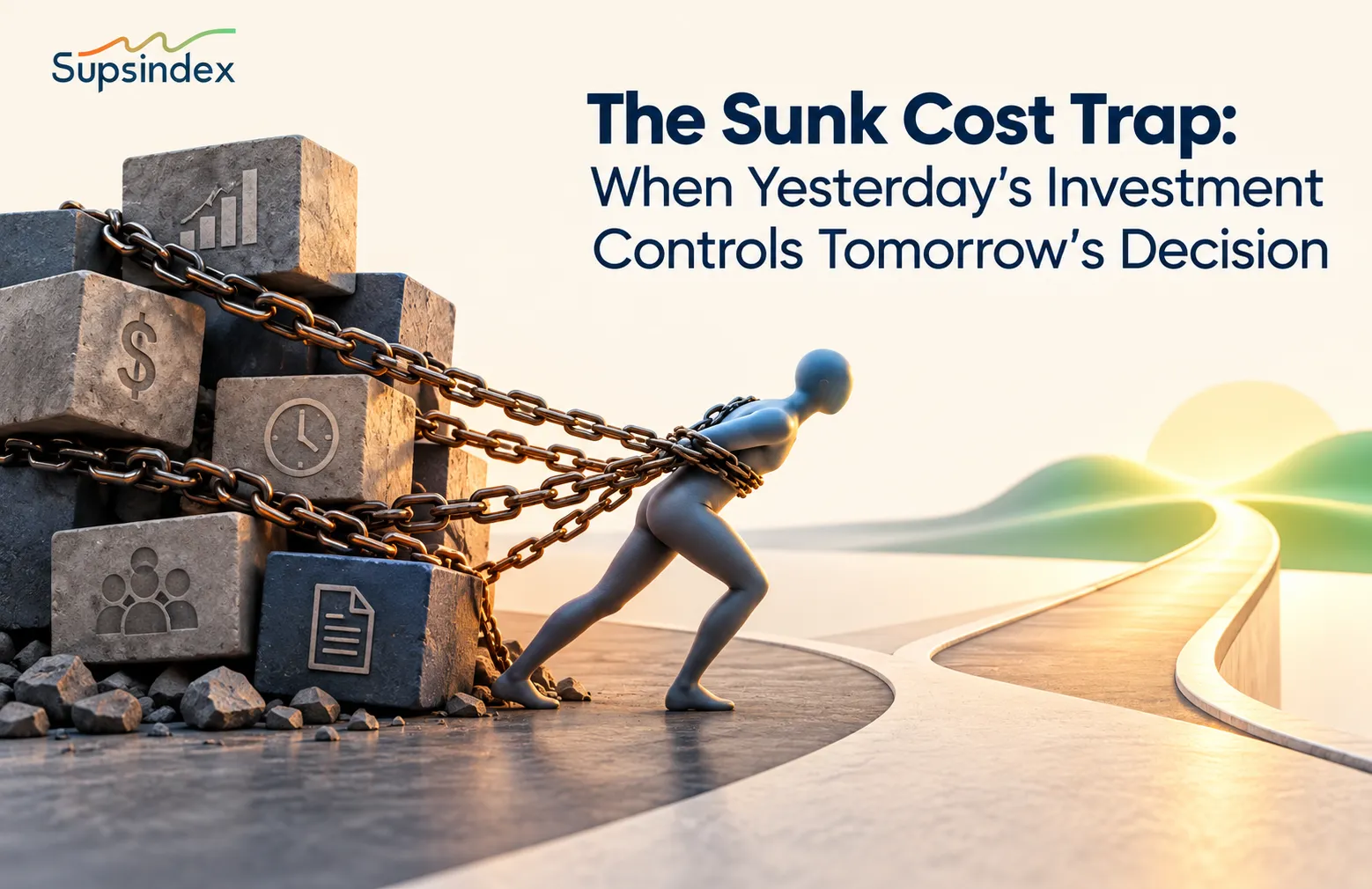
A rational pivot decision should depend largely on the future: given everything we now know, is continuing this strategy the best use of our remaining capital, time, and attention?
Founders often make a different calculation.
They remember the two years already spent developing the product, the money invested in the architecture, the employees who joined because of the original mission, the customers promised a particular roadmap, and the pitch delivered repeatedly to investors. Abandoning the plan makes those previous investments feel wasted.
This is the sunk cost fallacy, and in entrepreneurship it can become an escalation-of-commitment mechanism.
The founder continues spending not because the next dollar has the highest expected value, but because stopping would force them to psychologically acknowledge what has already been lost.
Within Supsindex’s GEB framework, strong grit combined with sunk-cost susceptibility and confirmation bias can create what it describes as the Stubborn Genius pattern. The founder possesses characteristics that would ordinarily be valuable—persistence, resilience, conviction—but those strengths are no longer being recalibrated by evidence.
This is an important feature of founder assessment: strengths cannot always be evaluated independently from the conditions surrounding them.
Extreme persistence is not automatically elite persistence.
Sometimes it is simply an efficient mechanism for extending a bad decision.
Founder identity makes pivoting harder than changing a spreadsheet
There is another reason founders struggle to abandon original plans: the idea may have become part of who they are.
Research in the Academy of Management Journal examined how founders respond to external feedback and found that revision is affected not only by information but also by founders’ psychological ownership of their ideas. When an idea becomes closely associated with a founder’s self-concept, feedback demanding revision can generate identity-based resistance. Academy of Management Journals
Related research involving 64 new-venture teams found that negative feedback directed toward the venture’s core identity could reduce founders’ willingness to pivot, while previous entrepreneurial experience appeared to help founders overcome this identity trap. Academy of Management Journals
This helps explain why some pivot conversations become unexpectedly emotional.
A board member may believe they are saying:
“The evidence no longer supports this customer segment.”
The founder may hear:
“The company you have spent three years creating was a mistake.”
Once those two messages become psychologically indistinguishable, objective strategic revision becomes much harder.
Epistemic humility is valuable because it separates them again.
A hypothesis can fail without the founder being a failure.
Confirmation bias can make a failing strategy look alive
Sunk cost keeps founders attached to past investment. Confirmation bias helps them construct evidence supporting continued investment.
Imagine a product with poor overall retention but five extremely enthusiastic users.
A calibrated founder asks why the five users behave differently from everyone else and whether that difference reveals a viable segment worth testing.
A confirmation-biased founder treats those five users as proof that the product works while dismissing hundreds of disengaged customers as irrelevant.
The problem is not using qualitative evidence. Early-stage companies often have small datasets, and unusually enthusiastic customers can provide extremely valuable information. The problem is applying asymmetric standards: supportive evidence is accepted easily while contradictory evidence must clear an increasingly high bar.
Supsindex describes the advanced version of this problem as visionary blindness. The founder stops using the market to challenge the thesis and starts using selected market information to defend it.
This is closely related to a point Supsindex already makes in its Founder-Market Fit analysis: founders can misread what customers are telling them when confirmation bias causes them to overweight supportive evidence or when sunk-cost attachment turns continued investment into a substitute for learning. supsindex
At that stage, the startup still appears data-driven.
It is simply choosing which data is allowed to matter.
The Ostrich Effect delays pivots by hiding the trigger
A founder cannot respond appropriately to information they refuse to examine.
This is where information avoidance becomes strategically significant.
Supsindex describes the Ostrich Effect as a pattern in which uncomfortable information—particularly financial or performance information—is avoided because confronting it threatens the founder’s confidence or preferred interpretation of the company.
Runway reviews become less frequent. Churn cohorts are ignored while total registrations are celebrated. Cash-flow forecasts use increasingly optimistic assumptions. Unit economics are postponed until “after scale.” The founder does not consciously decide to destroy the company; they gradually construct an information environment in which the evidence requiring a pivot arrives too late.
This creates a crucial distinction.
Some startups pivot too late because the evidence itself emerges late.
Others pivot too late because the evidence existed but the organization did not allow it to influence the founder.
The second problem is fundamentally behavioral.
Signal detection: the pivot decision depends on knowing what matters
Founders face another challenge: not every negative signal warrants changing direction.
A competitor receiving funding is information, but it is not automatically evidence that the startup’s strategy is wrong. A customer complaining about one feature may matter, or that customer may simply be a poor fit. One weak month of growth may indicate a structural problem, seasonal noise, or an execution failure that does not require changing the business model.
The ability to distinguish meaningful information from distraction is therefore central to pivot timing.
Supsindex approaches this through Signal Detection Theory within FPA. The relevant concept is \(d’\), or D-prime sensitivity: the ability to distinguish meaningful signal from noise rather than simply accumulating information.
Applied to startup strategy, a strong pivot signal might include persistent cohort-retention weakness, repeatable evidence that the intended customer does not experience the problem strongly enough, structurally unsustainable unit economics, inability to convert validated demand into a viable revenue model, or regulatory conditions that fundamentally alter the economics of the opportunity.
Noise might include temporary social-media attention, an isolated enthusiastic user, one investor’s personal preference, competitor publicity, or a short-lived industry trend.
The distinction matters in both directions. Founders with weak signal discrimination may miss a necessary pivot, but they can also pivot because of noise.
Pivoting too much can be another form of poor judgment
The conventional pivot story usually focuses on stubborn founders who change too slowly.
The opposite founder can be equally dangerous.
Supsindex tracks a pattern associated with novelty bias or neophilia, in which founders become disproportionately attracted to new ideas, technologies, markets, or strategies. They repeatedly experience the excitement of discovering a new direction while failing to complete the less exciting work required to validate the previous one.
This is sometimes called Shiny Object Syndrome.
A competitor launches an AI feature, so the roadmap becomes AI-first. A new vertical begins receiving venture funding, so the company moves toward that industry. An investor suggests enterprise sales, so the founder abandons the self-service model before the original acquisition experiment has produced meaningful evidence.
The organization becomes extremely adaptive in appearance and remarkably poor at learning.
New research on startup acceleration captures this tension well. Strategic responsiveness and willingness to pivot can reflect learning agility, but frequent or poorly justified pivots may instead signal lack of strategic coherence, reactive decision-making, and insufficient commitment to generating evidence from prior experiments. Excessive pivoting can also confuse stakeholders and undermine execution consistency. Springer Link
A pivot should therefore produce accumulated learning rather than reset the company’s memory.
Not every pivot needs to be permanent
Another useful distinction is between a structural pivot and a temporary adaptation.
Research published in 2024 examined temporary pivots made in response to external shocks and found that temporary strategic changes can function as mechanisms for perseverance when they are intentionally reversible and aligned with the venture’s longer-term strategy. Springer Link
This matters because founders often frame decisions too absolutely.
The options are not always:
“Continue exactly as planned”
or
“Abandon the original model forever.”
A startup facing a temporary capital constraint, supply-chain interruption, regulatory delay, or unusual market shock may adopt an interim strategy without changing the venture’s fundamental thesis.
The first step in a good pivot decision is therefore diagnosing what level of the strategy has actually failed.
Has the problem changed?
Has the customer changed?
Has the value proposition failed?
Is pricing wrong?
Is the acquisition channel wrong?
Has the business model failed?
Or is the underlying model viable while the current execution needs improvement?
A pivot should solve the layer that failed rather than unnecessarily dismantling layers that remain supported by evidence.
Pre-commitment helps founders make decisions before emotion takes over
One of the most effective ways to improve pivot decisions is to establish decision rules while the founder is still psychologically detached from the outcome.
Before launching an experiment, the startup can define what would constitute meaningful success, insufficient evidence, or disconfirmation.
For example:
“If retention remains below our agreed threshold after three controlled iterations, we trigger a formal strategy review.”
Or:
“If the customer acquisition economics remain outside the sustainable range after testing the three highest-probability channels, we reconsider the target segment rather than simply increasing spend.”
The specific threshold depends on the business and should not be copied mechanically. What matters is agreeing to the logic before seeing the results.
Supsindex refers to these mechanisms as operational forcing functions or quantitative circuit breakers.
They reduce the founder’s ability to rewrite the definition of success after substantial resources have already been committed.
This does not mean the rule must execute a pivot automatically. New evidence may legitimately change the interpretation. Instead, crossing the threshold should force a structured review that cannot simply be postponed because the conclusion feels uncomfortable.
Cooling-off periods solve the opposite problem
Pre-commitment also helps founders who pivot too quickly.
A founder receiving a major piece of negative news can experience an understandable urge to act immediately. A large customer leaves, a competitor raises a huge round, or an investor strongly criticizes the strategy, and the founder wants to demonstrate decisiveness by changing direction overnight.
Supsindex recommends a different forcing function for this pattern: a cooling-off period, such as a pre-agreed 24-hour delay before major strategic changes or capital-allocation decisions.
The purpose is not to create bureaucracy.
It is to distinguish urgency from emotional reactivity.
A genuine strategic problem will usually still exist after the founder has slept, reviewed the evidence, consulted the team, and examined alternatives.
Panic often does not survive the same process.
The founding team can either improve or corrupt the pivot decision
A pivot is rarely only an individual psychological event when multiple founders are involved.
One co-founder may want to preserve the current plan while another believes the evidence demands immediate change. That difference can be valuable because it forces the team to examine competing interpretations.
It can also become destructive.
Supsindex’s FEE framework identifies risk-tolerance asymmetry as a particularly important team variable. Its internal data associates extreme differences in founder risk tolerance with a 2.1× higher failure hazard, suggesting that behavioral differences that appear complementary on paper can become damaging when the team lacks effective decision mechanisms.
Pivot discussions can expose precisely this asymmetry.
A highly risk-tolerant founder may interpret a pivot as another exciting opportunity. A highly risk-averse founder may resist abandoning the known path because the alternative contains additional uncertainty.
Neither instinct should automatically determine strategy.
The team needs shared evidence thresholds, explicit decision rights, and a process capable of separating strategic disagreement from relational conflict.
Without those systems, “Should we pivot?” can rapidly become “Which founder controls the company?”
Stress reveals whether founders actually follow their own logic
Founders are often quite good at describing rational decision processes in calm conditions.
The harder question is whether they still use those processes when runway is falling and the next board meeting is three days away.
This is one reason Supsindex extends behavioral evaluation into Founder Decision Excellence (FDE) and its Leadership Flight Simulator. Public Supsindex documentation describes FDE as an assessment of judgment, composure, and strategic clarity under simulated high-pressure conditions, with human decisions compared against a personalized digital benchmark. supsindex
Within a pivot scenario, the simulation can introduce deteriorating customer metrics, liquidity pressure, competitor moves, or other evidence that challenges the existing strategy. The relevant behavioral question is whether the founder integrates that evidence appropriately, ignores it because of sunk-cost attachment, or overreacts through an impulsive strategic shift.
According to Supsindex pilot data provided for this article, an approximately 300-founder simulation sample found that founders whose decision divergence exceeded one standard deviation were 2.4 times more likely to make severe strategic errors in practice, including delayed pivots and premature scaling.
That figure should be understood as a Supsindex internal pilot finding rather than a general statistic about all startup founders. Its practical importance lies in the underlying principle: the gap between what founders believe about their decision-making and how they behave under pressure may itself contain valuable information.
A practical pivot framework: Persist, Modify, Pivot, or Stop
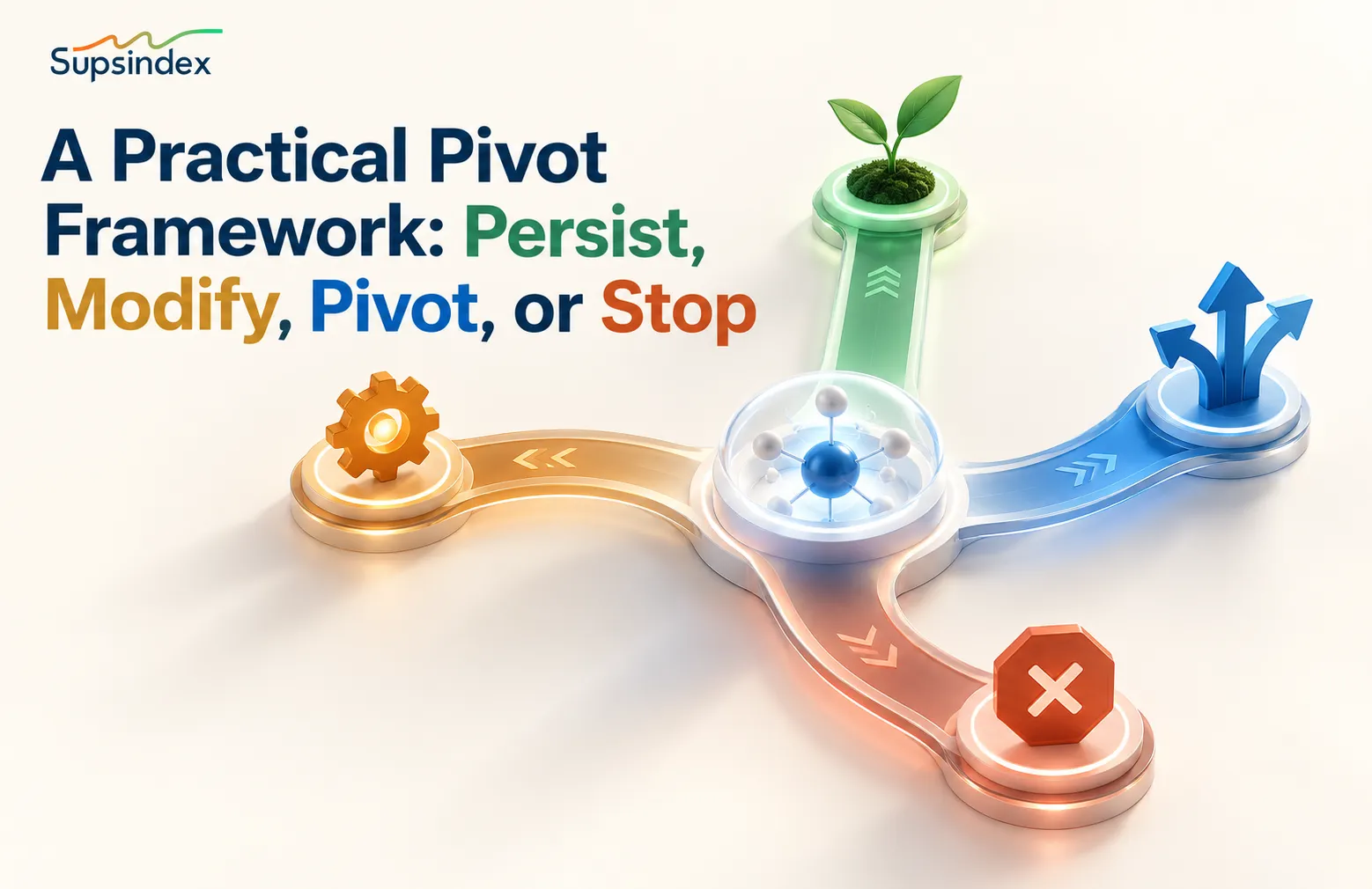
One weakness in the usual pivot discussion is that it presents only two choices: pivot or persevere.
Founders often have at least four.
Persist
Persistence makes sense when the core hypothesis remains plausible, evidence is still genuinely incomplete, leading indicators are improving, and the startup has enough runway to complete the experiment properly.
Difficulty alone is not evidence that the strategy has failed.
Modify
Sometimes the thesis is sound but one component is not. Pricing, onboarding, positioning, channel strategy, product scope, or customer targeting may need adjustment without requiring a fundamental reorientation.
This is experimentation, not necessarily a pivot.
Pivot
A genuine pivot becomes appropriate when accumulated evidence materially disconfirms an important assumption while another evidence-supported direction offers a more plausible route toward the mission.
A pivot should ideally contain a new hypothesis, not simply an escape from the old one.
Stop
Occasionally the evidence does not support perseverance or a credible new direction.
Founders and investors sometimes avoid this fourth option because “pivot” sounds more entrepreneurial than “stop.” But repeatedly relabeling failure as another pivot can consume capital without increasing information.
Stopping an invalid experiment can itself be high-quality execution.
Investors should ask what would change the founder’s mind
Investors and boards often make pivot conversations worse by entering with conclusions rather than questions.
“You need to pivot” can immediately turn the discussion into a contest between investor authority and founder conviction.
A stronger approach starts with falsifiability.
What evidence would cause the founder to reconsider the current plan?
What metric would indicate that the strategy is working?
What result would indicate that it is not?
Were those thresholds defined before the latest results arrived?
Which observations currently support perseverance, and which contradict it?
What alternative hypothesis would the proposed pivot actually test?
A founder unable to describe any evidence that would change their mind may no longer be demonstrating conviction. They may be protecting an unfalsifiable belief.
Conversely, a founder who changes strategy whenever an investor disagrees may not be demonstrating coachability. They may lack a coherent decision architecture.
The board’s role is not to maximize pivots.
It is to improve calibration.
Accelerators should teach learning velocity rather than pivot frequency
Accelerators face a similar problem. Programs commonly celebrate founders who “move fast,” but speed can mean very different things.
A founder who runs disciplined experiments, abandons invalid assumptions, and rapidly incorporates learning is moving fast.
A founder who changes strategy every two weeks because every mentor gave different advice is simply moving.
Programs should therefore measure learning velocity, not directional volatility.
This includes whether founders formulate explicit hypotheses, define relevant metrics, execute sufficiently informative experiments, accurately interpret outcomes, and retain what they learn when the next strategy is tested.
Research on “fail fast and learn fast” similarly emphasizes that failure becomes useful when it produces sensemaking and organizational learning rather than simply generating repeated failure. Springer Link
The purpose of an accelerator should not be to convince founders to pivot.
It should be to improve their ability to know when a pivot is justified.
Growth mindset does not mean changing direction constantly
The language of growth mindset is useful here, but it can also be misunderstood.
A growth-oriented founder does not automatically accept every piece of criticism or constantly abandon existing strategies. The relevant quality is the ability to treat outcomes as information rather than as verdicts on personal worth.
This creates psychological room for genuine strategic choice.
If the evidence supports continuing, the founder can continue without needing constant external approval.
If the evidence supports changing direction, the founder can pivot without experiencing the decision as humiliation.
The crucial capability is the separation of identity from hypothesis.
“My strategy was wrong” and “I am incapable” are different statements.
Once founders genuinely believe that, they become much harder to trap through sunk costs.
The best pivot preserves learning even when it abandons the plan
The word “quit” can make pivoting sound like erasing everything that came before.
A good pivot should do the opposite.
Customer interviews should inform the new segment. Failed acquisition experiments should narrow future channels. Product usage should reveal which problem customers actually care about. Technical work may become infrastructure for the next model. Relationships built during the first strategy may provide distribution or partnerships later.
This is why pivoting is better understood as a form of structured learning than as strategic surrender.
Recent research reinforces this interpretation. The 2026 systematic review of pivot scholarship explicitly includes experiment-based learning among the major ways the literature conceptualizes pivoting. Academy of Management Journals
The worst pivot discards the old plan and starts another guess.
The best pivot converts the old plan into evidence.
So, when should a founder pivot?
There is no universal churn threshold, revenue number, or number of failed experiments that tells every founder when to pivot.
The decision depends on stage, business model, market structure, runway, product category, sales cycle, regulation, and the assumptions being tested.
But the psychological standard can be clearer.
A founder should seriously consider a pivot when meaningful evidence repeatedly disconfirms a core strategic assumption, incremental changes fail to produce sufficient learning or improvement, and a plausible alternative hypothesis emerges that better explains what the market is showing.
They should resist pivoting when the evidence remains genuinely incomplete, when short-term noise is being mistaken for structural failure, or when the urge to change direction is driven mainly by novelty, panic, competitive hype, or external pressure.
The critical question is therefore not simply:
“Is this strategy working?”
It is:
“What would we believe about this strategy if we had not already invested our money, identity, reputation, and time into it?”
That question removes much of the psychological baggage from the decision.
Conclusion: Great founders are committed to the mission, not imprisoned by the first plan
Entrepreneurship requires conviction because uncertainty is unavoidable. Founders need enough persistence to continue when evidence is incomplete and enough independence to pursue opportunities that other people initially fail to understand.
But conviction becomes dangerous when it makes a strategy impossible to falsify.
Supsindex’s framework treats pivot quality as a founder decision-making problem involving grit, confirmation bias, sunk costs, signal detection, adaptability, risk calibration, team dynamics, and behavior under pressure. Those capabilities determine whether a founder interprets failure as information or as an attack on identity.
The solution is not to encourage more pivots.
It is to encourage better-timed pivots.
That means defining evidence before emotion enters the room, distinguishing signal from noise, separating the founder’s identity from the current hypothesis, stress-testing important decisions, creating operational forcing functions, and preserving enough intellectual humility to admit when the market has taught the company something new.
Sometimes the most courageous founder decision is to continue despite everyone else’s doubt.
Sometimes it is to abandon the plan that once felt certain.
Founder judgment is knowing which moment you are actually in.
