


The Ostrich Effect is a dangerous cognitive bias that causes otherwise brilliant founders to subconsciously ignore critical financial data and metrics.
By Sarvesh, Co-Founder of ZA.. (Prop / Digital Currency Trading)
Mumbai, India
April 2025. That’s when we launched. My co-founder and I had been grinding in the shadows of Mumbai’s financial district for months, building a prop trading platform for digital currencies. I’m a cybersecurity guy by degree. A trader by instinct. I’ve spent years staring at candlesticks, order books, and exploit vectors.
By April, we had our MVP. A small but loyal user base. A seed round that didn’t embarrass us. On paper, I was winning.
But inside my head? Absolute chaos.
I was snapping at my co-founder over coffee. Ignoring our dashboard for days at a time. Telling myself that “gut feel” was more important than the numbers. I felt like a fraud wearing a trader’s jacket.
A friend mentioned Supsindex was offering initial calibration assessments. I rolled my eyes. More tests? But I booked one anyway. What did I have to lose? Sleep? I’d already lost that.
The Report That Stopped Me Cold: Diagnosing the Ostrich Effect
I took the bundle—FPA, GEB, EEA. About three hours of questions that felt like they were peeling back layers I didn’t know I had.
A few days later, my reports landed.
The overall scores were… fine. But then I saw the breakdown that mattered.
- Finance: 35%
- Data Analytics: 25%
- Self-Efficacy: 85%
I stared at those three numbers for a long time. How could I believe in myself so much (85%) while actively failing at the two things that keep a startup alive?
I’m a trader. I analyze markets for a living. Or so I told myself.
Then I read the diagnosis.
The Ostrich Effect.
Information avoidance. Subconsciously pushing away negative financial data or complex metrics that contradict my intuition. The report didn’t just call me out. It named the exact behavior.
“Ignoring burn rate reports. Delaying the setup of analytics dashboards. Focusing on vanity metrics rather than unit economics.”
It was like someone had been living inside my head for the past six months. I had delayed our analytics setup. I had stopped checking our actual runway because it made my chest tight. I told myself it was “strategy.” The report called it what it was: avoidance.
The Real Damage I Wasn’t Seeing from the Ostrich Effect
The hardest part was admitting the report was right.
Back when we were just two guys with a whiteboard, my intuition worked. But the moment real money appeared—the moment we had actual users and actual burn—my “gut” became a liability.
I wasn’t ignoring the data because I was lazy. I was ignoring it because I was scared. Scared that the numbers would tell me I wasn’t as smart as I thought. Scared that my co-founder would see the gaps.
And that fear was quietly destroying us.
Runway depletion without warning. Inability to pivot because I had no real numbers to pivot on. A Series A that would never happen if I couldn’t speak financial fluently.
The report connected two dots I had refused to see: high self-efficacy + low financial fluency = a founder who hides from the truth while believing he’s invincible.
What I’m Doing About the Ostrich Effect (And No, I’m Not Fixed)
That was two months ago. I’m still not “cured.” But I’m different.
First, I forced myself to build a real analytics dashboard. Not next week. The same week. I made myself look at our burn rate every single morning. Even when it hurt.
Second, I hired a part-time finance advisor—not to “help,” but to force me to review numbers I would otherwise avoid. I told my co-founder the truth. Showed him the 35% score. Laughed about it. Then asked him to call me out every time I said “I have a feeling about this” instead of “here’s the data.”
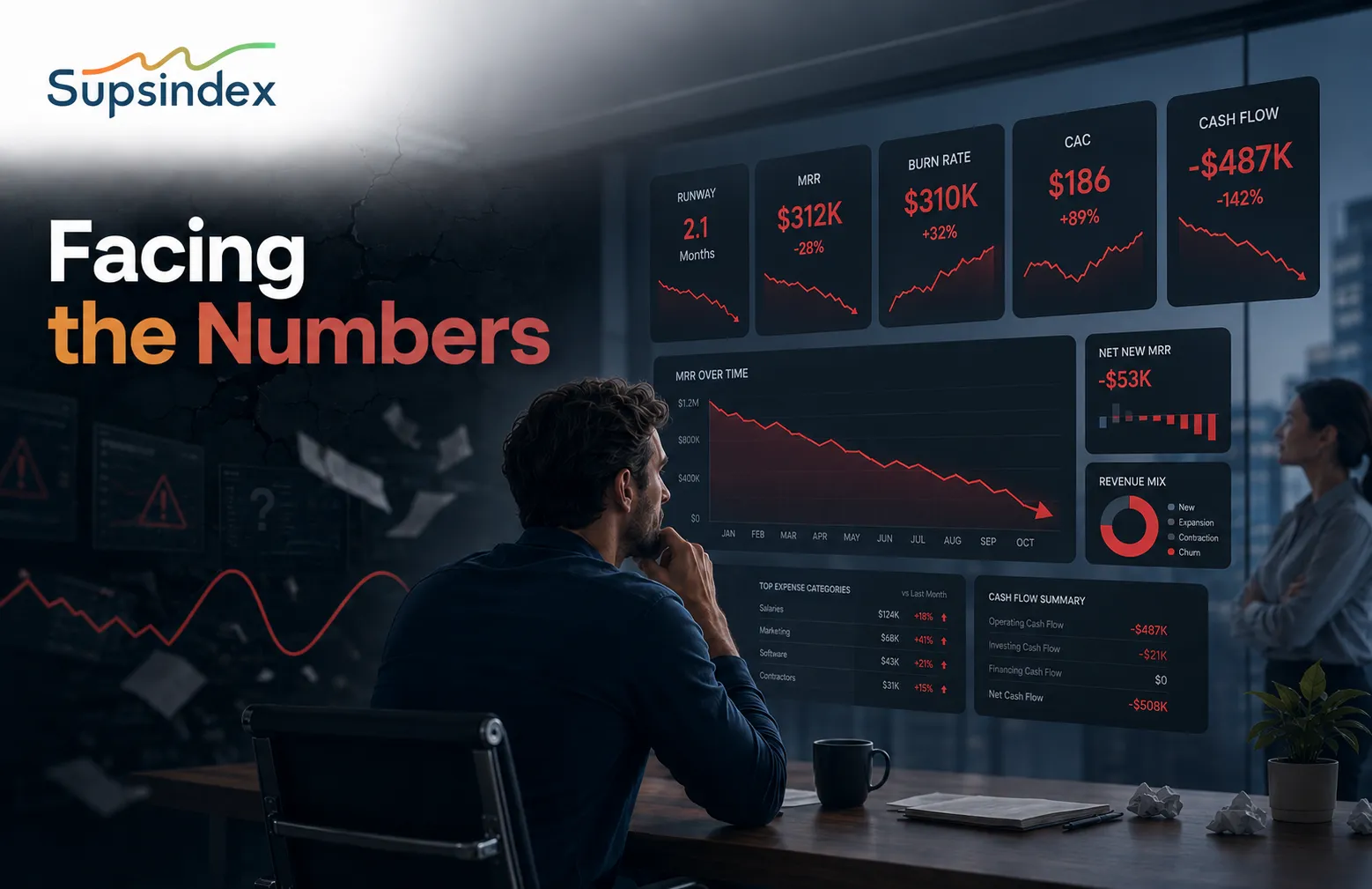
Third, I started small. Every Monday, I pull three metrics: runway, MRR, and customer acquisition cost. I write them down. Even if they’re ugly. Especially if they’re ugly.
The Ostrich Effect doesn’t disappear overnight. But last week, I caught myself about to close our financial model without checking the cash flow projection. And I stopped. I opened it. I looked.
That’s not failure. That’s growth.
If You’re Feeling What I Felt: Cure the Ostrich Effect
You don’t need a test to tell you you’re avoiding something. Your body already knows—the tight chest when you open the bank account, the way you suddenly find email very interesting when someone mentions unit economics.
But the test did tell me exactly where to look. Not “you’re a bad founder.” Not “you’re not cut out for this.”
Just: here’s the crack. Here’s why it’s there. Here’s how to start sealing it.
If you’re a founder who believes in yourself but secretly fears the numbers? Take the assessment. Be ready for a low score in Finance or Analytics. Be ready to feel exposed. Then be ready to finally look at the dashboard.
Supsindex Note: Sarvesh is the co-founder of ZA.., a Mumbai-based prop trading platform for digital currencies. He is currently learning to love spreadsheets one ugly number at a time.
