


From Researcher to Founder: Readiness for University Spinouts
A scientific discovery can demonstrate remarkable technical potential without yet establishing a viable business opportunity. A laboratory prototype may perform exceptionally under controlled conditions, a patent may protect an important invention, and a research team may have years of relevant expertise. Yet commercializing that technology requires additional evidence: someone must need the solution, a viable route to market must exist, and a team must be capable of developing and delivering it.
This is where researcher-to-founder readiness becomes important.
The transition from academic research to entrepreneurship is not simply a change in professional identity. It involves understanding the commercial, legal, financial, and institutional conditions surrounding an innovation, then determining what capabilities and resources are required to bring it into practical use.
Researchers approach this transition from diverse backgrounds. Some already have experience working with industry, building teams, or commercializing intellectual property. Others may need support in unfamiliar areas such as enterprise procurement, venture financing, or regulatory planning. Readiness should therefore be evaluated through demonstrated capabilities and evidence, not assumptions about a person’s academic background.
Within the Supsindex framework, researcher-to-founder readiness is not treated as a separate personality type or standalone assessment index. Instead, it can be examined through entrepreneurial knowledge, behavioral judgment, and ecosystem awareness, alongside the technology’s maturity and evidence of market demand.
For university researchers and technology-transfer teams, the central question is not merely whether the research is scientifically promising. It is whether the innovation has a credible commercialization pathway—and whether the people responsible for that pathway understand what must happen next.
1. What Does Researcher-to-Founder Readiness Mean?
Researcher-to-founder readiness is the capability to translate a research-based innovation into a viable commercial initiative by identifying customer needs, understanding intellectual-property rights, navigating regulatory and institutional requirements, assembling an appropriate team, and making informed decisions under uncertainty.
This definition connects several dimensions that are often examined separately.
Technical maturity concerns whether a technology works and how reliably it performs in relevant conditions. Commercial readiness concerns whether the technology addresses a meaningful problem for an identifiable customer or beneficiary. Founder readiness concerns whether the individuals leading the effort can evaluate opportunities, coordinate resources, and make informed operating decisions.
These dimensions overlap, but they are not interchangeable.
Technology Readiness Levels (TRLs), commonly associated with NASA and subsequently adapted across numerous research and innovation programs, provide a structured way to describe technical maturity. The scale generally progresses from foundational research toward demonstrated and operational systems.
However, a high TRL does not automatically establish market demand, appropriate pricing, intellectual-property access, or a viable business model. Likewise, an innovation at an early technical stage may have substantial commercial potential, provided that its technical uncertainties, development costs, and route to adoption are understood.
Universities already recognize these distinctions. Cambridge Enterprise outlines a commercialization journey that considers the status of an innovation, its potential applications, intellectual property, and possible routes such as licensing or creating a spinout. The MIT Technology Licensing Office similarly describes business planning, technology licensing, and the development resources required to commercialize university-based inventions.
For researchers considering entrepreneurship, the practical objective is to identify which uncertainties are scientific, which are commercial, and which concern the team’s capacity to execute.
2. The University Spinout Pathway: Six Questions Before Launch
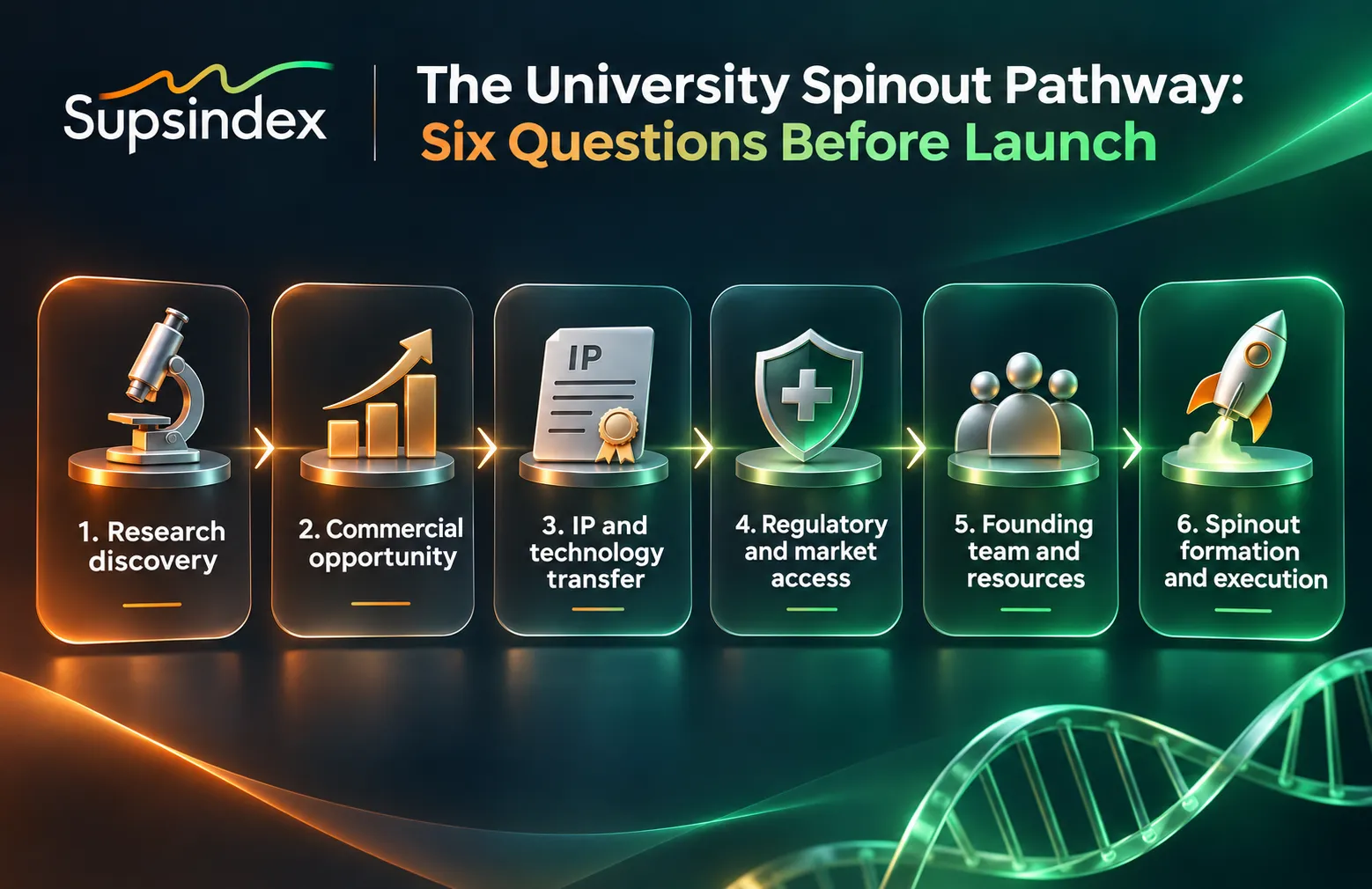
A university spinout is a company formed to develop or commercialize technology or intellectual property originating from academic research. The exact definition, ownership arrangements, and institutional requirements vary by university and jurisdiction.
Importantly, forming a company is not the only route for research commercialization. A technology may reach users more effectively through licensing to an existing business, joint development with an industry partner, research collaboration, or another knowledge-transfer arrangement.
The following six-stage pathway offers an educational framework for assessing whether a research team is ready to pursue a spinout and what evidence it needs at each stage.
| Stage | Key readiness question | Evidence to investigate |
|---|---|---|
| 1. Research discovery | What has been demonstrated, and what technical uncertainty remains? | Reproducible results, prototype performance, technical limitations |
| 2. Commercial opportunity | Who experiences the problem, and why would they adopt or pay for the solution? | Customer interviews, workflow observations, pilot commitments |
| 3. IP and technology transfer | Who controls the relevant IP, and which commercialization route is appropriate? | Invention disclosures, ownership review, license or option terms |
| 4. Regulatory and market access | What approvals, standards, infrastructure, or procurement requirements affect deployment? | Regulatory pathway analysis, compliance plans, buyer requirements |
| 5. Founding team and resources | Does the team have access to the commercial, technical, and operational capabilities required? | Responsibility map, skills-gap analysis, financing and development plan |
| 6. Spinout formation and execution | Is a new company the justified route, and what milestone should be achieved next? | Business case, licensing arrangements, funded development plan, customer pilot |
This is a decision framework, not a mandatory sequence. Customer discovery may begin while the technology remains in an early laboratory stage, and intellectual-property questions often need attention before researchers publish or disclose commercially sensitive findings.
The stages should inform one another. Unexpected customer feedback may change the intended application of a technology, while an unfavorable licensing requirement or regulatory burden may change the preferred commercialization model.
Commercialization Starts With Customer Evidence
One of the most consequential transitions in research commercialization is moving from demonstrating what a technology can do to understanding what prospective users need it to do.
A technically impressive invention may solve a real problem, but its initial commercial application is not always obvious. The end user, purchasing decision-maker, and organization funding implementation may also be different parties.
For example, a university team developing an advanced industrial sensor may initially emphasize superior measurement accuracy. Interviews with prospective manufacturing customers might reveal that integration with existing equipment, calibration time, and maintenance costs matter more to purchasing decisions than an incremental improvement in laboratory accuracy.
The scientific achievement remains meaningful. What changes is the team’s understanding of the commercial problem.
This is why customer discovery should investigate existing workflows, purchasing constraints, alternative solutions, and the consequences of leaving the problem unresolved. Positive comments about an invention are useful exploratory signals, but they are weaker evidence of demand than a defined pilot, a purchasing commitment, or a completed commercial transaction.
The U.S. National Science Foundation’s I-Corps program provides an institutional example of this approach. It supports scientists and engineers in investigating commercial opportunities through experiential learning and direct engagement with potential customers and industry stakeholders.
For researchers, customer discovery is not a rejection of scientific reasoning. It is another form of disciplined inquiry in which assumptions are tested against evidence from an unfamiliar environment.
3. Intellectual Property and Technology Transfer: Who Can Commercialize the Research?
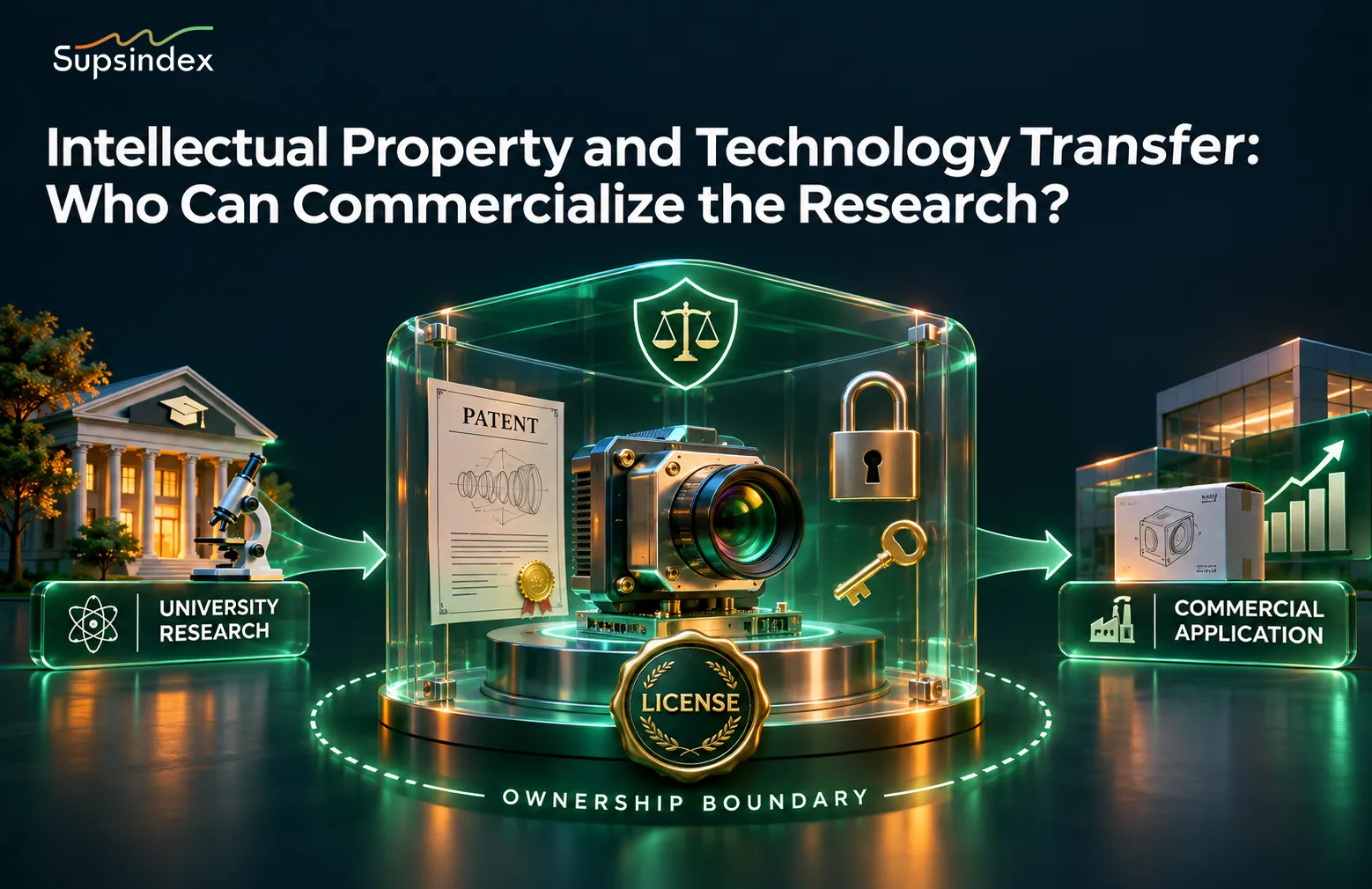
Intellectual property is a central consideration in university spinouts because the inventor of a technology is not necessarily the sole owner of the rights needed to commercialize it.
Ownership can depend on university policies, employment agreements, research sponsorship, funding conditions, collaboration contracts, and applicable national law. Different rights may also apply to patents, software, datasets, designs, materials, and know-how.
Before forming a spinout, the research team should work with the relevant technology-transfer office (TTO) to establish the applicable ownership and commercialization arrangements.
The review should distinguish background IP, which existed before the proposed company or project, from newly developed IP and improvements that may arise during subsequent research or commercial work. It should identify relevant inventors and contributors, determine whether ownership or license rights are needed, and examine any obligations arising from research grants or institutional agreements.
A spinout may receive a license to use university-owned technology rather than owning that technology outright. The terms can address exclusivity, permitted applications, geographical scope, royalties, milestones, sublicensing, and rights to future improvements.
Oxford University Innovation explains that a spinout using university-owned IP needs the appropriate rights to exploit it. The MIT Technology Licensing Office likewise describes licensing as a means of enabling companies to develop university inventions commercially.
Teams should also distinguish ownership from freedom to operate. Holding a patent or securing a university license does not necessarily establish that a product can be manufactured and sold without infringing third-party rights.
These issues require qualified legal and technology-transfer advice. No founder assessment can independently determine patent validity, resolve ownership disputes, or replace a jurisdiction-specific freedom-to-operate analysis.
The commercialization decision should therefore remain open until the team understands whether licensing to an established company, collaborating with an industry partner, or creating a spinout offers the most credible route to impact.
4. Regulatory Readiness and Ecosystem Navigation
Many research-based ventures operate in industries where commercialization depends on more than product performance and customer demand.
Medical technologies, diagnostics, biotechnology, energy systems, financial infrastructure, and certain AI applications can face complex approval, safety, data-protection, or procurement requirements. The applicable rules depend on the product’s intended use, customer group, and target jurisdiction.
A team developing a medical device, for example, may need to investigate classification, conformity assessment, clinical evidence, quality-management requirements, and post-market responsibilities. An enterprise software spinout may instead encounter information-security assessments, data-processing agreements, integration requirements, and lengthy purchasing procedures.
In both cases, regulatory and procurement considerations can affect product design, development budgets, commercial timelines, and financing needs.
This means that ecosystem awareness is part of commercialization readiness. Researchers need not personally master every legal or regulatory detail, but the founding team must recognize relevant obligations, obtain specialist support, and incorporate those constraints into realistic plans.
Access to funding also differs by location. Depending on eligibility and the type of research, teams may explore university proof-of-concept funds, national innovation programs, research commercialization grants, industry partnerships, angel capital, or venture investment.
The appropriate sequence depends on which uncertainties need to be resolved. Non-dilutive research funding may support technical validation, while customer-funded pilots can generate commercial evidence. Equity financing may be suitable when a company has a credible growth pathway and requires resources beyond the scope of available grants or customer contracts.
For university spinouts, understanding how these options interact is often as important as identifying the funding sources themselves.
5. Building a Founding Team Around the Work That Must Be Done
A researcher does not necessarily need to become the company’s CEO, and a successful academic spinout does not always require a separate commercial co-founder.
The more useful question is whether the founding team has access to the capabilities required for its chosen commercialization pathway—and whether responsibilities are clearly assigned.
A research-based venture may need leadership across technical development, product management, customer discovery, regulatory planning, finance, partnership development, and commercial execution. Some responsibilities can be performed by existing founders; others may be assigned to employees, specialist advisers, interim executives, or institutional partners.
The composition should follow the venture’s needs rather than assumptions about academic or commercial backgrounds.
For instance, a researcher with extensive industry collaboration experience may already understand customers and procurement systems. Another may wish to focus on scientific leadership while an experienced operator manages commercialization. Neither arrangement is inherently superior.
What matters is whether important responsibilities remain uncovered.
Team assessment should also consider how decisions are made when scientific, commercial, and financial priorities conflict. A research lead may reasonably want additional experimental evidence before deployment, while a commercial lead may face customer deadlines or runway constraints. These perspectives can complement one another when the team has clear decision rights and a constructive process for resolving disagreements.
Supsindex’s Penalty for Bottleneck (PFB) principle provides a useful developmental perspective: an important weakness should not disappear simply because other capabilities are strong. For a university spinout, unclear IP rights, absent regulatory expertise, or inadequate cash management may constrain progress even when the underlying technology is exceptional.
The appropriate response is not automatically to replace the founder. It may be to provide targeted education, introduce a specialist, revise team responsibilities, or establish operational safeguards.
A practical development plan should translate these needs into observable actions. Within the first ninety days, a team might complete its IP review, validate a target customer segment, appoint an accountable commercial lead, establish a financing forecast, and document the relevant regulatory pathway.
Each milestone should be assessed through completed work, not merely the founder’s confidence that progress has been made.
6. How Supsindex Approaches Researcher-to-Founder Readiness
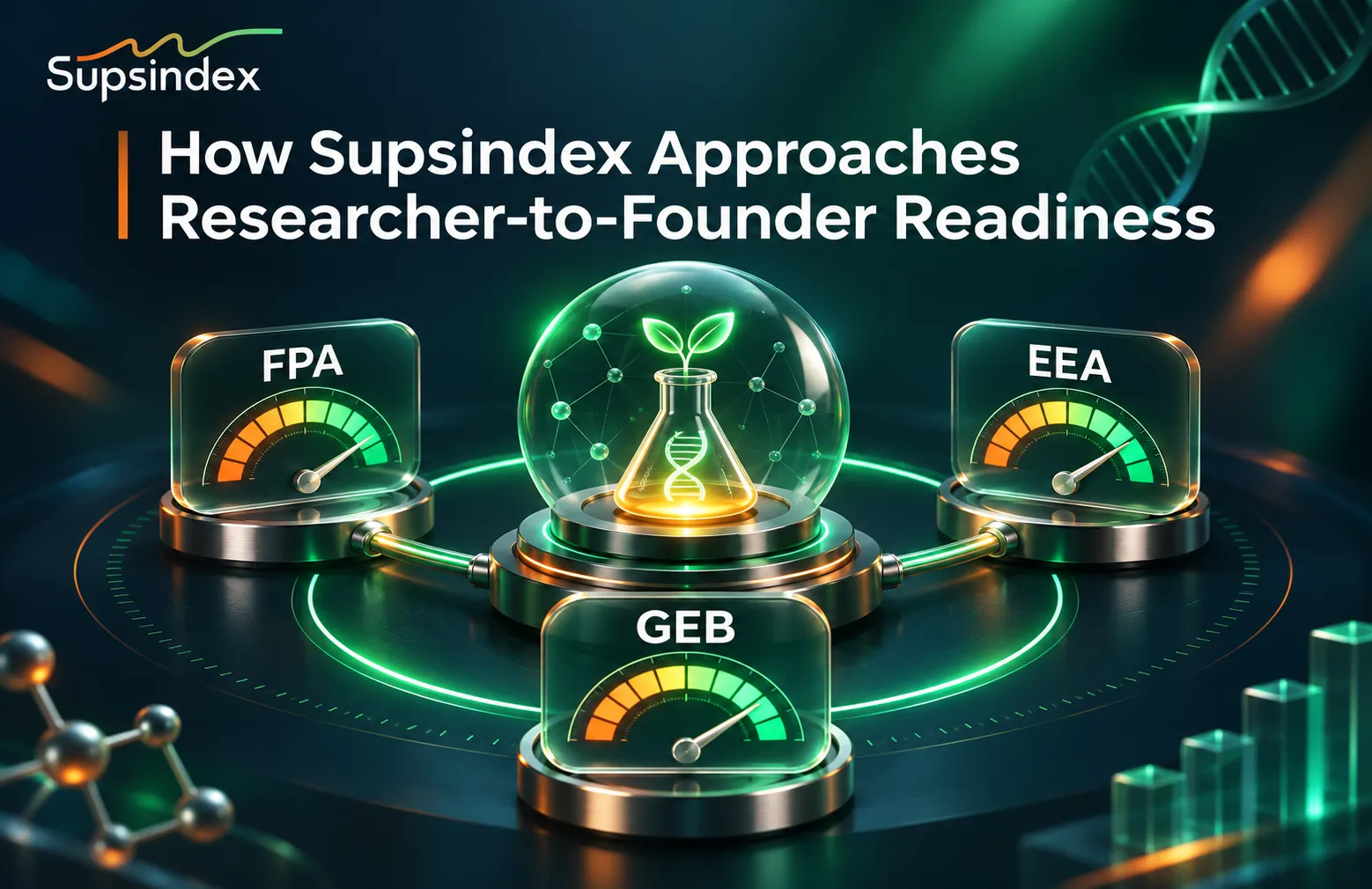
Supsindex approaches founder readiness as a multidimensional assessment problem. For university researchers, its existing assessment framework can help identify development needs that are not fully captured by publications, patents, technical demonstrations, or conventional pitch evaluations.
The two most directly relevant dimensions are Founder Public Awareness (FPA) and Ecosystem Environmental Awareness (EEA).
FPA: Entrepreneurial Knowledge Beyond Technical Expertise
The FPA assessment evaluates entrepreneurial knowledge and applied business reasoning. For a researcher considering a spinout, relevant areas include customer validation, financial literacy, unit economics, governance, and practical commercialization decisions.
The objective is not to assume that researchers lack these skills. It is to identify which skills are already present and which may need development.
A scientist who understands equity dilution, cash runway, and enterprise procurement may be well prepared for several commercial responsibilities. Another researcher may have strong technical capability but need additional guidance in financial forecasting or market validation.
These differences should be addressed through the individual’s results and operating context rather than a generic academic-founder profile.
EEA: Understanding the Environment Around the Innovation
The EEA assessment examines familiarity with a founder’s target entrepreneurial ecosystem. Its framework covers country-specific conditions, including funding, talent, regulation, market access, and support infrastructure, alongside industry-specific considerations.
For research-based ventures, this perspective is relevant to navigating technology-transfer institutions, public funding programs, specialist talent markets, regulatory authorities, and commercial partnerships.
A university spinout entering the Swiss biotechnology ecosystem may need different institutional knowledge from a software research team commercializing in Ireland or an industrial technology team operating in Türkiye.
EEA is designed to reflect those contextual differences. However, its cross-country benchmarking and anchor-item architecture should not be presented as conclusive proof of complete measurement equivalence across all jurisdictions. Further empirical calibration is required to substantiate strong cross-border comparisons.
GEB: Exploring Judgment Under Uncertainty
The General Entrepreneurial Behavior (GEB) assessment adds a different perspective through situational judgment scenarios involving competing priorities, uncertainty, and operational pressure.
This can inform developmental discussions about how founders evaluate alternatives, respond to contradictory evidence, and balance persistence with adaptation.
However, an answer to a hypothetical scenario does not establish how someone will behave in an actual commercialization crisis. GEB findings should be interpreted alongside observed behavior and should not become automatic judgments about a researcher’s leadership potential.
Index Studio: Specialized Research and Assessment Collaboration
Some universities or technology-transfer offices may need more specialized instruments than general founder assessments can provide. For example, a program could seek to examine academic spinout commercialization readiness, translational research capabilities, or industry-specific founder development needs.
Supsindex’s Index Studio provides a governed framework through which researchers and institutional partners can propose and co-develop assessment indices.
The associated Dedicated Requested Index model offers a route for exploring institution-specific measurement requirements, with scientific design, faculty review, and empirical validation forming part of the development process.
This should be understood as an opportunity for research and instrument development, not evidence that a university-spinout readiness index has already been validated and deployed.
Similarly, Supsindex’s existing assessments are not substitutes for TTO due diligence, technical performance testing, legal review, or formal regulatory evaluation. Their appropriate role is to provide supplementary information about the human and contextual dimensions of commercialization readiness.
A Fictional Example: From Laboratory Prototype to Commercial Pilot
Consider a university research team that has developed an optical sensor capable of identifying defects in a specialized manufacturing process.
Initial laboratory results are promising, and the researchers believe the technology could improve quality control. The prototype has been demonstrated under controlled conditions, and the team is considering launching a spinout.
Before incorporation, the researchers begin interviewing prospective industrial customers. The conversations reveal that sensor accuracy matters, but installation time, compatibility with existing production equipment, and ongoing calibration costs are major purchasing concerns.
The team also discovers that the relevant technology was developed using university resources under a sponsored research agreement. It therefore consults the university’s technology-transfer office to establish ownership, disclosure obligations, and possible licensing terms.
Rather than immediately building a commercial product, the team selects a narrower application and arranges a limited technical evaluation with an industrial partner. The evaluation will test not only sensor performance but also installation requirements and the customer’s willingness to proceed with a commercial pilot.
A capability review identifies three priorities: clearer financial modeling for the development period, dedicated responsibility for industrial customer relationships, and specialist advice regarding relevant product standards.
The researchers decide to continue technical development while assigning commercial discovery to a designated team member and seeking external regulatory guidance.
This scenario is entirely fictional and illustrates an evidence-based commercialization pathway rather than an actual Supsindex assessment result.
The important outcome is not that the team immediately establishes a company. It is that the researchers can now identify what they know, what remains uncertain, and which evidence would justify the next investment of time and capital.
A decision to license the technology instead of creating a spinout could be equally successful if it offers a more appropriate route to commercialization.
Frequently Asked Questions About Researcher-to-Founder Readiness
What is researcher-to-founder readiness?
Researcher-to-founder readiness describes the capabilities and resources needed to translate academic research into a viable commercial initiative. It includes customer evidence, entrepreneurial knowledge, intellectual-property arrangements, regulatory awareness, team capabilities, and access to relevant ecosystem support.
Does a university researcher need business experience to start a spinout?
Not necessarily. Relevant commercial capabilities may already exist within the research team or can be developed through training, mentoring, partnerships, and additional team members. The critical issue is whether the venture has access to the capabilities required for its next stage.
What is the difference between technology readiness and founder readiness?
Technology readiness describes the maturity of a technical solution. Founder readiness concerns the people responsible for evaluating commercial opportunities, managing resources, making decisions, and coordinating execution. A technically mature invention does not automatically establish a viable business or a sufficiently prepared founding team.
Who owns the intellectual property in a university spinout?
Ownership depends on institutional rules, employment and collaboration agreements, research funding, and applicable law. A spinout may need a license to university-owned IP rather than an outright transfer of ownership. The relevant technology-transfer office and qualified legal advisers should establish the specific arrangements.
Is creating a university spinout always the best commercialization strategy?
No. Licensing technology to an existing company, forming an industry partnership, or pursuing other research-transfer arrangements may be more appropriate depending on development needs, market conditions, funding requirements, and the research team’s objectives.
How can universities assess the readiness of academic founders?
Universities can combine technical and commercial evidence with structured assessments of entrepreneurial knowledge, situational judgment, and ecosystem awareness. Such assessments should complement—not replace—IP review, customer discovery, regulatory due diligence, and human-led evaluation of the founding team.
Conclusion: Scientific Readiness and Founder Readiness Are Complementary
A university research breakthrough creates an opportunity to generate practical value, but commercializing that discovery requires more than demonstrating technical feasibility.
Research teams must identify meaningful customer problems, understand the rights surrounding their inventions, investigate regulatory and market-access requirements, and organize the capabilities needed to deliver a solution outside the laboratory.
These requirements do not imply that academic researchers are inherently less prepared for entrepreneurship. Readiness varies across individuals, teams, industries, and commercial contexts. The most useful evaluation identifies specific gaps and connects them to practical interventions.
Supsindex’s FPA and EEA assessments offer complementary perspectives on entrepreneurial knowledge and ecosystem awareness, while GEB can support discussions about judgment under uncertainty. For universities pursuing specialized measurement research, Index Studio provides a framework for exploring tailored assessment development.
Ultimately, the central question is not whether a researcher can become a founder. It is whether the proposed commercialization pathway is supported by sufficient technical, market, institutional, and human evidence.
A promising discovery demonstrates what may be technically possible. Founder readiness helps determine whether the team is prepared to make that possibility useful in the real world.
Explore the Supsindex FPA Assessment, the EEA Assessment, or Index Studio to learn more about entrepreneurial capability assessment and research collaboration.
References and Further Reading
- Cambridge Enterprise — The Journey of a University Idea. University commercialization pathways and technology-transfer considerations.
- Oxford University Innovation — How OUI Supports Founders. Guidance on spinout formation, university permissions, financing, and legal documentation.
- Oxford University Innovation — What Happens to IP?. IP licensing and commercialization rights.
- MIT Technology Licensing Office — Entrepreneurs & Startups. Commercializing university-based technologies.
- U.S. National Science Foundation — I-Corps. Experiential customer discovery and research commercialization training.
- Cambridge Enterprise — Intellectual Property FAQs. Institutional IP ownership and invention disclosure guidance.
- Supsindex — Founder Development: Turn Assessment Results Into a 90-Day Action Plan.
- Supsindex — Index Studio.
