


Customer Discovery Without Confirmation Bias: Questions That Test Your Startup Idea
Customer discovery works when founders test their assumptions instead of collecting agreement. These neutral questions, evidence logs, and decision rules help separate real market demand from confirmation bias.
One of the most dangerous sentences a startup founder can hear is also one of the most encouraging: “That sounds like a great idea.”
It feels like validation. Someone understands the problem, likes the proposed solution, and appears enthusiastic about the possibility of using it. The founder leaves the conversation more confident, adds the feedback to a pitch deck, and begins planning the next product milestone.
But the customer has not purchased anything, changed their behavior, committed resources, or demonstrated that the problem is important enough to solve.
They have simply expressed an opinion.
This distinction sits at the center of effective customer discovery. Startups do not fail only because founders neglect to speak with customers. They can also fail because founders conduct dozens of interviews while unintentionally collecting the evidence they want to hear.
The problem is confirmation bias: the tendency to seek, interpret, and remember information that supports an existing belief while giving less attention to evidence that challenges it.
For founders, this bias becomes especially powerful because the idea under investigation is often their own. They have invested time, money, professional reputation, and personal identity into making it succeed. Discovering that customers do not care about the original problem can therefore feel less like a research finding and more like a personal rejection.
Supsindex approaches customer discovery as a founder-readiness capability rather than simply a product-development activity. The relevant question is not whether the founder knows how to conduct an interview. It is whether they can distinguish genuine market evidence from reassuring noise, challenge their own assumptions, and change direction when the results contradict their expectations.
The most useful customer discovery questions are consequently not designed to make people like a startup idea.
They are designed to discover whether the problem exists, how customers already respond to it, and what evidence would justify investing in a solution.
Why Confirmation Bias Is So Dangerous in Customer Discovery
Early-stage founders operate under unusual conditions. They must make consequential decisions while reliable information is scarce, their initial customer base is small, and the economic viability of the business remains uncertain.
Under those circumstances, positive feedback can become disproportionately influential.
A founder may interview fifteen prospective customers and hear enthusiastic comments from three. Those three conversations become the foundation of the company narrative. The twelve people who expressed indifference are dismissed as poor customer fits, insufficiently informed participants, or people who failed to understand the vision.
Nothing has been fabricated. The founder genuinely received positive feedback.
The mistake lies in how the evidence was selected and interpreted.
Supsindex’s research framework connects this behavior to broader patterns of founder overconfidence, strategic rigidity, and premature scaling. Its internal analysis of startup failure and venture capital losses emphasizes the importance of founder and team decision-making errors, including failures to recognize weak demand before committing substantial capital.
The wider startup literature reinforces the commercial importance of validating demand. CB Insights‘ March 2026 analysis examined 431 venture-backed companies that shut down after 2023, finding identifiable failure explanations for 385 of them. Poor product-market fit appeared in 43% of those cases, making it one of the most frequently reported underlying problems.
That finding does not establish that confirmation bias caused every product-market-fit failure. It does demonstrate why the distinction between perceived customer interest and genuine market demand deserves serious attention.
Poor discovery can create a chain reaction. Weak evidence is interpreted as validation. Validation becomes justification for building. Building creates sunk costs. Sunk costs increase resistance to changing direction. Eventually, founders may spend additional capital defending a hypothesis that was never adequately tested.
At that point, customer discovery has failed at its most important purpose: helping the company learn before expensive decisions become difficult to reverse.
The Mom Test: Ask About Reality, Not Your Idea

Supsindex explicitly recommends The Mom Test, developed by Rob Fitzpatrick, as a foundational methodology for reducing biased customer interviews.
The central insight is simple: people often give founders misleadingly positive feedback, even when they are trying to be supportive rather than dishonest.
Imagine asking a close friend whether they would use an application that makes personal budgeting easier. They may say yes because the idea sounds useful, because they like you, or because agreeing costs them nothing.
Now ask what they did the last time they struggled to manage their finances.
Did they download a budgeting application? Pay an accountant? Build a spreadsheet? Spend several hours reconciling transactions? Or did they simply ignore the problem because it was not important enough to justify doing anything?
The second conversation produces considerably more useful information.
The Mom Test encourages founders to focus on the customer’s actual life, previous actions, current difficulties, and existing decisions rather than presenting a proposed solution and requesting approval.
This does not mean founders should never show customers a prototype or conduct usability research. Those activities become useful at different stages. It means that problem discovery should not be contaminated by repeatedly introducing the founder’s preferred answer before understanding the customer’s situation.
The distinction also complements the Lean Startup approach, particularly its emphasis on validated learning and repeated Build-Measure-Learn cycles.
A startup should treat an important assumption as something to investigate rather than something to defend. Its experiments should produce information that affects whether the company continues, changes direction, or stops investing in the current hypothesis.
Leading Questions vs. Neutral Customer Discovery Questions
The wording of an interview question can determine the quality of the evidence it produces.
Leading questions make agreement easy. Neutral questions make actual behavior visible.
Consider the following comparisons.
| Leading question to avoid | Neutral question to ask instead |
|---|---|
| Would you use an app that makes managing your finances easier? | Tell me about the last time you struggled to manage your finances. |
| Don’t you think our software would save you time? | Walk me through your current process. Which step takes the most time? |
| Would you pay €20 per month for this feature? | What have you previously paid or budgeted to solve this problem? |
| How much do you like our product idea? | Which alternatives have you already tried, and why? |
| Wouldn’t automation make your team more productive? | Which activities does your team currently perform manually, and how long do they take? |
| Do you agree that existing tools are too complicated? | Which tools are you using today? Tell me about the last difficulty you experienced with them. |
| Would an AI assistant solve this problem for you? | How did you handle the most recent occurrence of this problem? |
| Which of these five features would you want first? | What happens when you cannot complete this task using your current tools? |
| Would your company switch if we built a better solution? | When did your company last change vendors, and what triggered that decision? |
| Would you recommend our platform to your colleagues? | Have you recommended or introduced any tools for this task before? What happened? |
| Is this one of your biggest business problems? | What were the three most costly operational problems you dealt with last month? |
| Could you see your team adopting this immediately? | What approvals, integrations, training, or purchasing steps were required the last time your team adopted a new tool? |
The neutral questions share a common characteristic: they ask for examples that already exist.
They also give customers permission to contradict the founder’s assumptions.
A customer may reveal that the problem occurs only once every six months. They may say that the current workaround is inexpensive and reliable. They may have no purchasing authority, or the internal procurement process may make adopting a new vendor almost impossible.
These responses can feel discouraging, but they are exactly the information an early-stage startup needs.
The Most Important Customer Discovery Questions Investigate Five Things
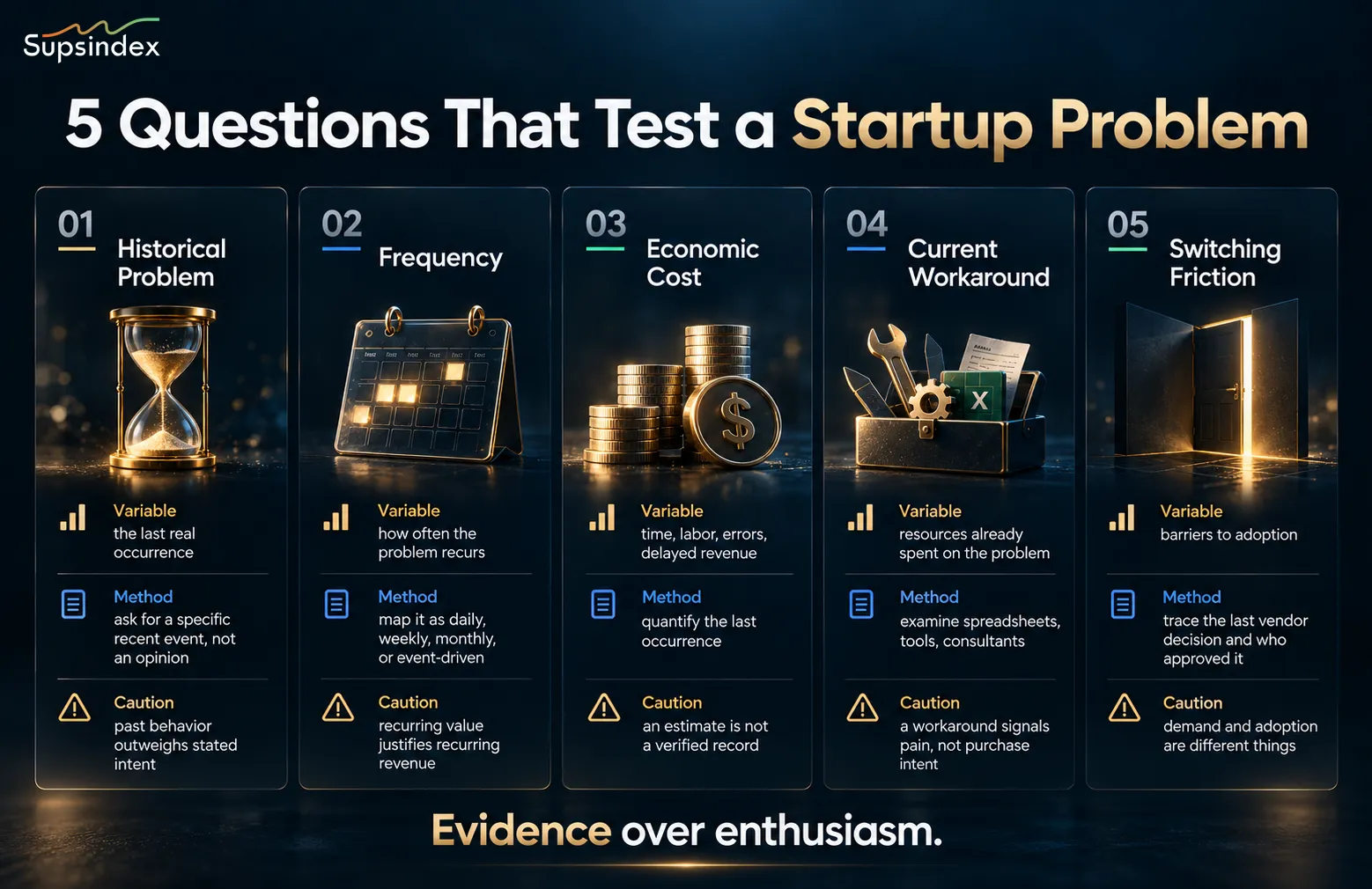
Although interview questions should adapt to the product and customer segment, Supsindex’s recommended approach concentrates on five areas: the historical problem, its frequency, its economic consequences, existing alternatives, and switching friction.
What Happened the Last Time?
The strongest starting point is often a specific recent event.
Instead of asking whether a customer experiences a problem, ask when it last happened and what occurred.
Suppose the founder is investigating software for finance teams that manage multi-currency invoices.
A useful opening question would be:
“Can you walk me through the last time your team had to reconcile invoices across multiple currencies?”
The customer may describe several software systems, manual currency conversions, spreadsheet reconciliation, and delays during the monthly financial close.
The founder can then investigate each part of that process without suggesting that the proposed product is the answer.
The goal is to reconstruct reality rather than obtain an endorsement.
How Often Does the Problem Occur?
A severe problem that happens frequently may deserve more attention than an equally frustrating problem that occurs once a year.
Frequency helps establish the problem’s operational significance.
Founders should investigate whether the issue occurs daily, weekly, monthly, during specific business events, or only under unusual circumstances.
This distinction matters because the commercial case for a recurring subscription often depends on recurring value.
A customer who experiences a problem every working day may justify a very different solution from one who needs assistance twice a year.
What Does the Problem Cost?
Financial impact creates another layer of evidence.
A customer may describe an issue as frustrating but have never measured its consequences.
Useful discovery questions investigate time spent, labor allocated, errors created, delayed revenue, lost opportunities, or direct expenditure.
For the finance-team example, the founder might ask:
“How much time did reconciliation require during the last monthly close, and which team members were involved?”
A customer describing fifteen hours of specialist work provides more decision-relevant information than one simply saying that the process is annoying.
However, founders should distinguish between customer estimates and independently verified costs. An estimate of fifteen hours is worth recording, but it is not the same as observing a timesheet or financial record.
How Is the Customer Solving It Today?
Existing workarounds are among the most useful signals in customer discovery.
If customers have built spreadsheets, purchased overlapping software, hired consultants, created manual operating procedures, or developed internal scripts to manage a problem, they have already allocated resources toward solving it.
That investment suggests the problem matters enough to generate action.
It does not automatically prove they will purchase a new product.
The existing workaround may be cheap, familiar, or sufficiently effective. Replacing it could create more organizational risk than the proposed solution removes.
This is why founders should investigate both the workaround and its limitations.
What Would Make Switching Difficult?
Customer demand and customer adoption are not the same thing.
Someone may dislike their existing system while being unable to replace it.
B2B startups encounter this frequently. A team may need security approval, data migration, legal review, procurement authorization, budget allocation, and several months of implementation work before adopting new software.
A founder who interviews only the end user may incorrectly conclude that strong frustration guarantees commercial demand.
The full purchase process is part of the market.
A useful question is:
“Tell me about the last time your organization purchased a tool like this. Who participated in that decision, and how long did the process take?”
Customer discovery should reveal not only whether the problem exists but also whether a practical path to adoption exists.
Why Compliments Are Weak Evidence

Not all customer feedback deserves equal influence on a startup decision.
Supsindex recommends evaluating discovery through an evidence hierarchy, separating opinions from observable behavior and commercial commitments.
| Evidence tier | Examples | Appropriate interpretation |
|---|---|---|
| Weak: Opinions and hypothetical intent | Compliments, likes, stated willingness to pay, enthusiasm about proposed features | Useful for understanding perceptions, but insufficient to establish purchasing demand |
| Moderate: Observed problems and existing workarounds | Repeated pain points, documented time loss, manual processes, internal spreadsheets, prior searches for solutions | Evidence that a problem exists and has operational significance; further commercial testing is needed |
| Strong: Actual commitments and behavior | Purchases, deposits, paid pilots, completed migrations, real product usage, repeat purchases, retention | Stronger evidence of customer commitment, subject to verification and continued observation |
This hierarchy has important implications for product development.
A customer saying “I would pay €50 for this” has not made a financial trade-off. Their statement may still help the founder understand perceived value or pricing expectations, but it should not count as a completed purchase.
A customer who has already spent €4,000 trying to solve the same problem has demonstrated a different level of urgency.
A customer who signs and pays for a pilot provides stronger evidence still.
Even then, a single paid pilot does not prove sustainable product-market fit. It establishes a specific form of willingness to commit resources, while retention, repeat usage, and acquisition economics must be tested over time.
For this reason, Supsindex treats unsupported positive statements as non-validating evidence when founders decide whether to commit significant capital.
The purpose is not to dismiss what customers say.
It is to avoid confusing what customers say with what they do.
Confirmation Bias Often Hides Inside Apparently Rational Analysis
Founders rarely describe themselves as biased.
They are more likely to believe that they have carefully evaluated customer feedback and reached a reasonable conclusion.
The danger is that confirmation bias can operate inside the evaluation process itself.
A founder may describe weak conversion as a messaging problem rather than a demand problem. They may treat negative feedback as evidence that a customer was outside the intended persona, even when that customer matched the original targeting criteria.
They may reinterpret repeated rejection as proof that the market requires more education.
Sometimes these explanations are correct.
The problem is when they become impossible to falsify.
Supsindex’s behavioral framework identifies several patterns that can interfere with customer discovery.
Visionary Blindness occurs when commitment to a product becomes so closely tied to the founder’s identity that disconfirming market evidence is increasingly dismissed.
Sunk Cost Fallacy encourages continued investment because substantial time or money has already been spent.
The Stubborn Genius combines exceptional persistence with confirmation bias, making a founder more likely to interpret market indifference as a reason to work harder rather than reconsider the hypothesis.
The Reckless Visionary may scale an inadequately validated model because achievement drive and high risk tolerance overshadow evidence quality.
At the opposite extreme, Novelty Bias can cause a founder to change direction after every interview, preventing any hypothesis from being tested thoroughly.
These patterns illustrate why customer discovery requires more than interviewing technique.
It also requires intellectual humility, emotional discipline, and a system for recording evidence independently from the founder’s preferred conclusion.
The Customer Discovery Evidence Log
An effective discovery process should leave behind something more useful than a collection of meeting notes.
Supsindex recommends a structured 12-field Customer Discovery Evidence Log that records what was investigated, who supplied the information, what evidence emerged, and what decision should follow.
The objective is to make the reasoning auditable.
Another co-founder, mentor, or investor should be able to examine the record and understand why the startup reached its conclusion without relying entirely on the interviewer’s memory.
Reusable 12-Field Evidence Log Template
| Field | What to record |
|---|---|
| 1. Session ID & Date | Unique interview reference and date of collection |
| 2. Customer Segment | Participant role, industry, organization size, and relevant persona |
| 3. Recruitment Channel | Whether the participant came from cold outreach, a customer network, referral, or another source |
| 4. Hypothesis Tested | The specific assumption the conversation was designed to investigate |
| 5. Interview Question Asked | Exact wording of the discovery question |
| 6. Observed Evidence | Verbatim statements, documented behavior, spending, and observed actions |
| 7. Evidence Tier | Weak, moderate, or strong based on the type and credibility of evidence |
| 8. Problem Severity & Frequency | How costly or disruptive the issue is and how often it occurs |
| 9. Disconfirming Signals | Contradictions, objections, alternative explanations, indifference, and adoption barriers |
| 10. Evidence Alignment | Supports, contradicts, or remains inconclusive for the original hypothesis |
| 11. Confidence Level | High, medium, or low confidence based on evidence quality, sourcing, and repetition |
| 12. Next Operational Action | Continue discovery, run an experiment, revise the hypothesis, pivot, or stop |
The fields are deliberately connected.
A positive quote without a documented hypothesis has limited meaning. A severe problem without a clear customer segment may not support a coherent business model. A strong commitment from a participant recruited through an unusually favorable relationship may require additional independent validation.
Recording these details helps prevent founders from turning an isolated observation into an unsupported market-wide conclusion.
A Worked Example: A Finance Automation Startup
Consider a fictional startup developing automation software for mid-market B2B finance teams.
Its initial hypothesis is:
“Finance managers at mid-market SaaS companies lose more than ten hours per month reconciling multi-currency invoices and have already committed resources to solving the problem.”
The founder interviews a VP of Finance at a SaaS organization employing approximately 120 people.
During the conversation, the participant describes a custom Excel workflow used during monthly financial close. Their team reportedly spent €4,200 during the previous quarter improving the workaround and continues to allocate approximately fifteen hours per month to manual reconciliation.
That sounds encouraging.
However, the participant also explains that adopting an external finance application requires security and IT approval, which can take approximately six months.
A founder seeking validation may remember the €4,200 and fifteen hours while ignoring the six-month purchasing barrier.
A structured evidence log records both.
Example Evidence Log Entry
| Field | Recorded observation |
|---|---|
| Session | DISC-2026-10-04-03 |
| Segment | VP of Finance, mid-market SaaS, approximately 120 employees |
| Recruitment | Cold LinkedIn outreach |
| Hypothesis | Monthly reconciliation creates over ten hours of work and measurable expenditure |
| Question | “Walk me through how you handled multi-currency reconciliation last month.” |
| Evidence | Participant reported fifteen hours of monthly manual work and €4,200 spent last quarter on an internal workaround |
| Tier | Moderate; historical expenditure reported but not independently verified |
| Severity & Frequency | 4/5 severity; recurring monthly |
| Disconfirming signal | Vendor adoption may require a six-month IT approval process |
| Alignment | Supports problem significance; challenges assumptions about fast adoption |
| Confidence | Medium pending repetition across independent participants and verification |
| Next action | Test whether a low-integration pilot can provide value without creating the full vendor-approval burden |
The example shows why discovery is not simply about determining whether the problem is real.
The founder has identified evidence supporting problem severity while discovering a separate constraint that could undermine the proposed commercial model.
That second finding may be more important to the next product decision than the first.
Five Safeguards That Make Evidence Logs More Reliable
The most useful evidence log is not necessarily the one with the largest number of entries. It is the one least vulnerable to selective interpretation.
Supsindex recommends several operational safeguards.
1. Require a Disconfirming Evidence Field
Every interview record should explicitly address observations that challenge the hypothesis.
If no contradiction was observed, the founder should record that fact without inventing an objection.
This requirement forces the interviewer to look beyond encouragement and examine whether the conversation genuinely tested the original assumption.
An evidence record should not be considered complete merely because it contains positive findings.
2. Separate Observation from Interpretation
Direct quotes, observed behavior, and documented transactions should remain separate from the founder’s conclusions.
For example:
Observation: “The participant reported spending fifteen hours on reconciliation last month.”
Interpretation: “The customer may be willing to pay for automation.”
The first statement is evidence about a reported event. The second is a hypothesis requiring further testing.
Blending them together allows founder assumptions to acquire the appearance of verified facts.
Where interviews are recorded, obtain appropriate consent and protect participant information. Quotes and business details should be stored or anonymized according to applicable privacy obligations.
3. Use Independent Review for Important Interviews
When a discovery finding could justify major investment, a second team member should review the transcript independently.
Comparing interpretations can reveal where one founder assigned excessive importance to ambiguous comments or overlooked contradictory details.
Formal agreement metrics can be useful for larger research programs, but a small startup does not need an elaborate statistical review system for every interview.
The essential safeguard is independent interpretation before a high-stakes decision.
4. Identify Politeness and Hypothetical Praise
Comments such as “interesting idea” or “I’d definitely try that” should be explicitly identified as weak evidence unless accompanied by observable behavior.
Supsindex’s recommended approach assigns no validating weight to unsupported compliments when testing whether customers have demonstrated actual demand.
Such statements may inform messaging or suggest questions for later experiments, but they cannot substitute for customer action.
5. Define Success Before Seeing the Results
Perhaps the strongest safeguard is pre-commitment.
Before interviewing customers, the founder should establish what evidence would support, challenge, or invalidate the current assumption.
Otherwise, success criteria can move whenever the results become uncomfortable.
A founder who originally required evidence of actual expenditure should not suddenly declare the market validated because participants expressed enthusiasm.
Changing the hypothesis may be appropriate.
Changing the standard secretly after seeing the evidence is not.
Riskiest Assumption Testing: Test What Could Kill the Idea
The next step is deciding what to investigate first.
Many founders begin by researching whatever is easiest to ask about. They collect opinions on visual design, potential features, brand names, or general perceptions of a problem.
These findings can be useful later, but they may not address the assumptions that determine whether the startup should exist.
Supsindex complements The Mom Test with Riskiest Assumption Testing (RAT).
The idea is to identify the assumption that would cause the greatest damage if it were false and test it before committing substantial resources.
For a B2B financial automation startup, the riskiest assumption may not be that reconciliation is frustrating.
It may be that enough organizations experience the problem severely enough to pay for another software platform and overcome the practical difficulty of adopting it.
Testing customer preference before confirming that basic commercial assumption can lead to unnecessary development.
A strong discovery hypothesis should therefore be specific, observable, and falsifiable.
Instead of:
“Finance teams need better reconciliation software.”
Use:
“At least 60% of finance managers in our defined target segment experienced more than ten hours of monthly reconciliation work during the last quarter and committed time or money to a workaround.”
That statement gives the team something concrete to investigate.
It also creates a genuine possibility that the evidence will prove the assumption wrong.
How Many Customer Interviews Are Enough?
There is no universal interview count that validates every startup idea.
Qualitative discovery is useful for identifying recurring problems, understanding processes, revealing constraints, and generating hypotheses. It is not automatically a statistically representative market survey.
Supsindex’s proposed operational framework uses short discovery sprints and quantitative circuit breakers to prevent founders from interviewing indefinitely without reaching a decision.
One illustrative rule is to review the current problem hypothesis after fifteen well-targeted interviews across two relevant subsegments if fewer than 30% produce moderate or strong evidence.
Another example is requiring a predetermined share of participants to report meaningful resource expenditure before advancing to a more expensive experiment.
These are pre-committed managerial decision rules, not universal statistical standards.
The appropriate threshold depends on customer heterogeneity, how severe the problem must be to support the business model, what evidence is available, and how costly the next experiment would be.
A rare but extremely expensive problem affecting a small number of enterprise buyers may justify further investigation even when only a minority of interviewees experience it.
Conversely, a consumer startup built around high-frequency use may require evidence across a substantially broader population.
The central principle is not that fifteen interviews create certainty.
It is that founders must eventually make a disciplined decision rather than continuously collecting anecdotes until a favorable one appears.
When Is Customer Evidence Strong Enough to Build an MVP?
The decision to build should reflect the strength of the available evidence and the cost of the proposed experiment.
For early discovery, Supsindex recommends distinguishing three levels of action.
Weak evidence should lead to further investigation. Compliments, hypothetical buying intentions, and general enthusiasm may justify exploring a problem, but they do not ordinarily justify substantial development expenditure.
Moderate evidence should lead to inexpensive experiments. Repeated pain points, current workarounds, or measurable operational costs can justify a landing-page test, manual concierge service, structured prototype, or carefully designed pilot proposal.
Strong evidence can justify a more substantial MVP investment. Deposits, paid pilots, actual purchases, or documented switching behavior provide a stronger foundation for committing development resources.
Even strong evidence should be interpreted within its limits.
A signed pilot agreement with explicit success criteria demonstrates a meaningful organizational commitment. It does not necessarily demonstrate long-term retention.
A letter of intent may be useful, but its evidentiary strength depends on whether it creates a binding commitment or merely expresses non-binding interest.
A paid MVP can establish willingness to purchase, while repeat usage and sustainable customer economics require additional observation.
Validated learning therefore develops in stages.
The purpose of customer discovery is to justify the next experiment, not to declare every important question permanently answered.
How Supsindex Evaluates Confirmation Bias in Founders
Customer discovery is not only a market-research process. It also depends on the founder’s ability to interpret evidence.
Supsindex examines this capability through several complementary assessment frameworks.
FPA: Recognizing Signal Rather Than Noise
The Founder Public Awareness (FPA) index evaluates entrepreneurial knowledge and cognitive readiness, including market-discovery reasoning and the interpretation of business information.
Its methodology incorporates Signal Detection Theory, including the concept of (d’), or D-prime sensitivity.
In statistical signal detection, sensitivity concerns the separation between meaningful signal and noise, commonly evaluated through hit rates and false-alarm rates.
Within Supsindex’s assessment design, this concept is relevant when founders must distinguish commercially important information from distracting or misleading alternatives.
For example, a founder may need to recognize that repeated customer retention is more informative about sustained product use than isolated praise for a landing page.
A stronger signal-discrimination result can indicate better performance on the assessment’s relevant tasks. It should not, by itself, be interpreted as proof that every subsequent customer discovery decision will be correct.
The business application is straightforward: the founder must learn to assign evidence a weight proportionate to what it actually demonstrates.
GEB: Identifying the Behavioral Patterns Behind Selective Interpretation
The General Entrepreneurial Behavior (GEB) index evaluates behavioral decision patterns through forced-choice situational judgment scenarios.
Its Risk Engine examines potential derailers such as confirmation bias, overconfidence, sunk-cost behavior, and resistance to adaptation.
These tendencies are particularly relevant when customer feedback contradicts the founder’s original hypothesis.
A founder may intellectually understand why neutral interviews matter but still rationalize negative evidence once the company has invested heavily in a particular product direction.
GEB is intended to help reveal that difference between knowing the correct principle and preferring a particular response under pressure.
The distinction matters because effective customer discovery requires both knowledge and the willingness to use that knowledge when the conclusion is uncomfortable.
FDE: Stress-Testing Decisions When the Evidence Becomes Uncomfortable
Supsindex’s Founder Decision Excellence (FDE) framework extends the assessment of judgment into simulated entrepreneurial crises.
A founder may face deteriorating retention, contradictory customer research, competitive threats, or pressure to continue funding a weak product hypothesis.
The relevant question becomes whether they use the evidence to update their strategy or spend additional effort searching for information that supports the original plan.
The proposed Leadership Flight Simulator and Digital Clone comparison framework are intended to examine these decisions under simulated pressure.
Such simulations may help identify development priorities, but simulation performance should be distinguished from demonstrated real-world predictive outcomes.
FCG: Building Customer Discovery Capability Over Time
Founder discovery skills can improve.
A founder who initially conducts leading interviews may learn to ask more neutral questions, document contradictions, evaluate purchasing barriers, and establish decision thresholds before deploying capital.
Through the broader Founder Continuous Growth (FCG) framework, Supsindex aims to support longitudinal assessment of capability development rather than treating a single assessment as a permanent judgment.
The goal is not simply to become more knowledgeable about customer discovery.
It is to become more capable of recognizing when market evidence should change an actual business decision.
A 30-Day Customer Discovery Plan
A structured discovery sprint can prevent customer research from becoming an endless series of conversations with no clear conclusion.
The following 30-day plan adapts Supsindex’s recommended approach into a reusable operating schedule.
| Timeline | Main objective | Expected deliverable |
|---|---|---|
| Days 1–5 | Define three falsifiable hypotheses and pre-committed decision criteria | Discovery brief and neutral interview guide |
| Days 6–10 | Recruit relevant participants beyond the founder’s supportive network | Participant list and 12-field evidence log |
| Days 11–22 | Conduct interviews and record past behavior, workarounds, and disconfirming evidence | Completed interview evidence records |
| Days 23–27 | Compare findings across segments and evaluate evidence strength | Evidence synthesis and circuit-breaker review |
| Days 28–30 | Decide whether to proceed, modify, pivot, or stop | Written decision with supporting evidence |
Days 1–5: Define What Would Make the Idea Wrong
The sprint begins with hypotheses rather than interviews.
The founding team should identify three particularly important assumptions: whether the problem is sufficiently significant, whether the intended customer experiences it, and whether customers already commit meaningful resources toward solving it.
Each assumption needs a specific form of supporting and contradictory evidence.
The team then defines what it will do if the results fall below expectations.
This matters because the founder is usually least emotionally defensive before the evidence arrives.
The same period should be used to write a neutral interview guide focused on recent experiences, current workflows, costs, existing alternatives, and purchasing decisions.
Days 6–10: Recruit Beyond the Friendly Network
Discovery quality depends heavily on whom the founder interviews.
Friends, mentors, investors, and supportive community members may be useful for initial exploration, but they can introduce additional social pressure to respond positively.
Supsindex recommends deliberately recruiting relevant market participants outside the founder’s immediate network, with an illustrative sourcing target of approximately 80% independent participants.
This percentage is a bias-control guideline, not a universal requirement.
Relevance matters more than coldness alone. A carefully selected warm introduction to an actual purchasing decision-maker may provide more useful information than an unrelated person recruited through cold outreach.
The goal is to avoid constructing a participant pool that exists primarily to encourage the founder.
Days 11–22: Interview and Record Without Rewriting the Evidence
During the interview phase, each conversation should focus on actual customer history.
A founder should ask for specific examples, follow the customer’s process, and investigate the existing financial and operational consequences.
The proposed solution should not dominate the opening conversation.
After each interview, the founder records the exact questions, relevant observations, evidence tier, problem severity, and contradictory findings.
Entries should be completed promptly to reduce reliance on memory.
When findings become strategically significant, independent transcript review can help identify interpretive disagreements among founding team members.
The purpose is to create a dataset that can challenge the original hypothesis rather than simply reinforce it.
Days 23–27: Look for Patterns, Not Favorite Quotes
The synthesis phase is where founders are most vulnerable to selective interpretation.
One unusually enthusiastic participant can overshadow ten indifferent conversations.
To counter this, the team should compare observations across the predefined customer segments, track how frequently important behaviors appeared, identify repeated workarounds, and document purchasing constraints.
Weak evidence should remain visible in the dataset, but it should not be counted as proof of commercial demand.
The team should also examine whether important patterns differ across participant sources. If positive feedback appears almost exclusively among friendly contacts, that difference deserves investigation.
This is where pre-committed decision rules become valuable.
If the evidence falls below the agreed threshold, the team should conduct a formal review instead of simply extending the interview period until it receives a more favorable response.
Days 28–30: Make a Decision Based on What Was Learned
The discovery sprint should conclude with a written decision.
Four outcomes are particularly useful.
Proceed to a Low-Cost MVP or Paid Pilot
When meaningful customer problems are repeatedly documented and credible evidence of commitment exists, the startup may be ready for a controlled product experiment.
The objective should be to test the next riskiest assumption rather than immediately build the complete solution.
Modify the Value Proposition
Sometimes the underlying problem is validated while the proposed solution is not.
Customers may want a simpler workflow, a different integration model, a lower-friction service, or a product addressing a narrower part of the problem.
The founder should preserve the learning while changing the proposed approach.
Pivot the Customer Segment
The initial target audience may show little urgency while another group demonstrates substantially stronger demand.
This can justify investigating a different customer segment, provided the new direction emerges from meaningful evidence rather than opportunistic enthusiasm.
Stop the Current Hypothesis
Sometimes interviews repeatedly reveal that the problem is infrequent, inexpensive, already adequately solved, or insufficiently important to support a viable business.
If well-designed experiments continue to contradict the core assumption and no credible alternative emerges, stopping can be the most disciplined decision.
Abandoning an unsupported hypothesis is not the same as abandoning entrepreneurship.
It is refusing to spend more capital protecting a belief that the market has not supported.
What Investors and Accelerators Should Look for in Customer Discovery
The quality of customer discovery also matters to the institutions evaluating startups.
A pitch deck stating that “we interviewed fifty customers and 90% liked the idea” sounds impressive but may reveal very little about genuine demand.
The more useful question is how the research was conducted.
Were the participants selected from a relevant customer segment? Did the questions encourage agreement? Did customers describe actual past events? Did the founder record objections? Were existing alternatives investigated? Did the company obtain any meaningful commercial commitments?
And perhaps most importantly:
What did the founder change after the interviews?
A team that conducted twelve interviews, discovered a critical switching barrier, and redesigned its initial customer strategy may demonstrate stronger learning discipline than one that conducted a hundred interviews without changing any meaningful assumption.
Investors and accelerators should therefore examine evidence quality, not just interview volume.
A transparent evidence log can make that evaluation more credible by exposing the reasoning behind product and market decisions.
Frequently Asked Questions About Customer Discovery
What are the best customer discovery questions?
The best questions focus on specific past experiences, current workflows, measurable problems, existing alternatives, previous expenditure, and purchasing barriers. Questions such as “Tell me about the last time this happened” generally reveal more useful evidence than asking whether someone likes a proposed idea.
How do you avoid confirmation bias in customer interviews?
Use neutral wording, recruit participants beyond supportive networks, define falsifiable hypotheses before interviews, separate observed facts from interpretation, record contradictory evidence, and establish decision rules before examining the results.
How many customer interviews should a startup conduct?
There is no universal number. An initial sprint of 10–20 carefully selected interviews can be useful for exploring patterns, but the appropriate sample depends on customer diversity, problem complexity, evidence quality, and the cost of the next decision. Interview counts alone do not establish market validation.
Is positive customer feedback enough to validate a startup idea?
No. Positive feedback can help reveal perceptions and potential interest, but stronger evidence comes from existing workarounds, documented spending, paid pilots, actual purchases, meaningful product usage, and repeat behavior.
What is a customer discovery evidence log?
An evidence log is a structured record of customer interviews and related observations. It connects each hypothesis with the questions asked, responses received, supporting and contradictory evidence, confidence level, and next action.
When should a founder pivot after customer discovery?
A pivot becomes worth considering when repeated, credible evidence contradicts a core hypothesis and a more promising alternative can be tested. The decision should rely on predefined criteria and meaningful patterns rather than one discouraging interview or an isolated customer opinion.
Conclusion: The Best Customer Interview May Be the One That Proves You Wrong
Customer discovery is often presented as a way to build confidence before launching a startup.
Its deeper purpose is to improve the quality of uncertainty.
A founder begins with assumptions about who experiences a problem, how severe that problem is, what existing solutions fail to provide, and whether customers will commit resources to something better.
Interviews should transform those assumptions into evidence.
Sometimes the evidence supports the idea. Sometimes it reveals that the target segment is wrong. Sometimes it identifies a purchasing obstacle that changes the business model. Occasionally, it demonstrates that the founder should stop before spending substantial time or capital.
All of these outcomes can represent progress.
Supsindex approaches customer discovery as a capability involving entrepreneurial knowledge, signal discrimination, behavioral self-awareness, and evidence-based decision-making.
The Mom Test provides a practical interview discipline. Lean Startup methodology creates a structure for turning learning into experimentation. Riskiest Assumption Testing helps founders investigate the questions that matter most. The evidence log ensures that contradictory information is preserved rather than quietly forgotten.
Together, these practices help reduce the chance that a founder mistakes customer politeness for commercial demand.
The objective is not to eliminate conviction.
Founders need conviction to build anything meaningful.
The objective is to ensure that conviction remains open to revision when the available evidence changes.
Because the strongest customer discovery process is not the one that makes a founder feel right.
It is the one that makes the next startup decision more informed—even when the evidence says the original idea was wrong.
More Information and Further Reading
Founders interested in measuring their ability to interpret market evidence can explore the Supsindex Founder Public Awareness (FPA) assessment, which examines entrepreneurial knowledge and signal discrimination, alongside the General Entrepreneurial Behavior (GEB) assessment, which examines behavioral tendencies and potential decision-making derailers.
For more on the relationship between founder judgment and market evidence, see Founder-Market Fit vs. Product-Market Fit and Founder Overconfidence: The Hidden Startup Risk Behind Conviction.
External methodological references include The Mom Test by Rob Fitzpatrick, the Lean Startup principles, and CB Insights’ 2026 analysis of startup failure.
