


What Is a Situational Judgment Test? A Founder Decision Example
A situational judgment test helps founders examine decisions when evidence is incomplete and pressure is high. This educational example explores a competitor’s 40% price cut, four responses, and the reasoning behind Supsindex GEB scenarios.
A competitor suddenly cuts its prices by 40%. Two enterprise customers pause their purchasing decisions, your sales team wants an immediate response, and your startup has only seven months of runway remaining. As the founder, you must decide whether to reduce prices, increase marketing spending, investigate the situation, or continue with the existing strategy.
Each response has potential consequences, and the pressure to act quickly makes the decision more difficult. Reducing prices could protect customer relationships but weaken margins. Increasing marketing expenditure might defend market visibility while accelerating cash burn. Doing nothing preserves resources but risks overlooking a meaningful competitive threat.
This is the type of dilemma used in a Situational Judgment Test (SJT), an assessment method that presents realistic situations and asks participants to evaluate possible responses. Rather than relying exclusively on statements about personal characteristics, SJTs examine how people interpret situations, assess competing priorities, and identify appropriate courses of action.
For entrepreneurs, this approach is particularly relevant because building a startup involves making decisions under uncertainty, often without enough time or information to evaluate every possibility. A founder may describe themselves as adaptable, financially disciplined, or resilient, but those descriptions do not establish how effectively they can evaluate a difficult business situation.
This guide explains how a situational judgment test for founders works through one practical example. It also examines how Supsindex incorporates SJTs into its General Entrepreneurial Behavior (GEB) assessment, what researchers have learned about this testing method, and why a single response should never be treated as a definitive judgment of entrepreneurial ability.
What Is a Situational Judgment Test?
A Situational Judgment Test is an assessment method that presents a realistic problem and asks respondents to evaluate or select possible actions. SJTs are widely used in organizational assessment, professional selection, and leadership development because they allow evaluators to examine judgment in situations relevant to a particular role.
According to the U.S. Office of Personnel Management, SJTs are considered low-fidelity simulations. They describe a situation and ask respondents to choose among potential responses, but they do not require participants to perform the actual task in a real working environment.
An SJT may describe an employee conflict, an ethical dilemma, an operational crisis, or a resource-allocation decision. The respondent might be asked to identify the best and worst responses, rate the effectiveness of different actions, or indicate what they would personally be most likely to do.
The wording of the question matters. Researchers distinguish between knowledge-oriented instructions, which ask what someone should do, and behavioral-tendency instructions, which ask what they would do. Research by McDaniel and colleagues found that knowledge-oriented SJTs tend to show stronger relationships with cognitive ability, whereas behavioral-tendency instructions tend to relate more closely to personality characteristics.
A founder assessment using the first format primarily provides information about the respondent’s understanding of effective actions in a given situation. That understanding may be relevant to entrepreneurship, but it cannot automatically establish that the founder would behave identically during a real crisis involving employees, customers, and financial consequences.
A Founder Decision Example: Your Competitor Cuts Prices by 40%
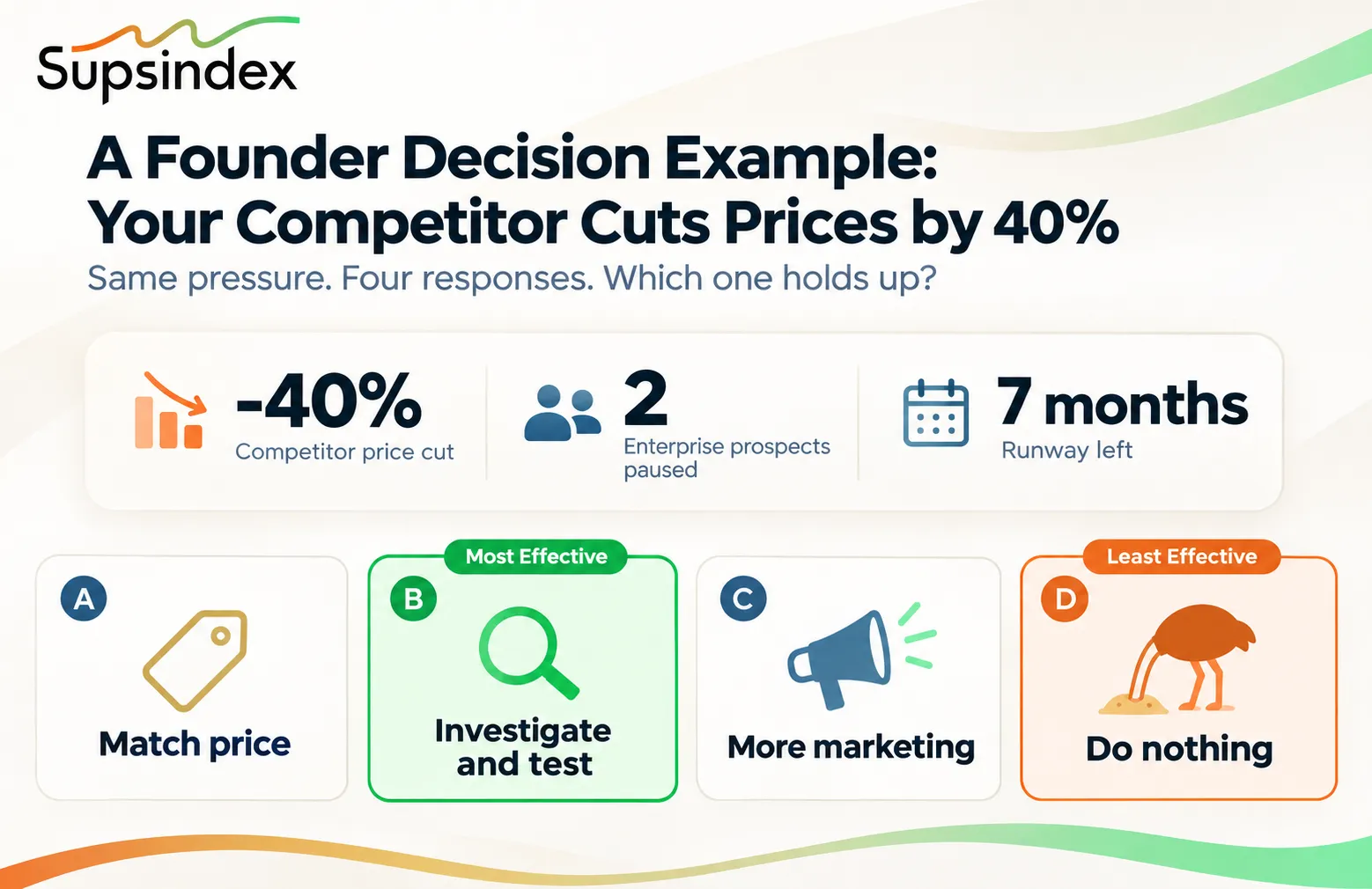
Consider a fictional B2B SaaS startup selling workflow automation software to enterprise customers. The company has achieved early commercial traction but remains financially constrained, with approximately seven months of cash runway.
A major competitor announces a 40% price reduction. Within a week, two enterprise prospects pause contract negotiations to reconsider their options. The Head of Sales believes the startup should immediately match the competitor’s prices, arguing that delay could result in lost deals and weaker market positioning.
However, the company has not yet established whether the paused prospects are responding primarily to price, missing product features, procurement concerns, or uncertainty about the startup’s long-term viability.
Illustrative Educational Scenario — Based on Supsindex GEB Assessment Principles.
This scenario was created for educational purposes. It is not a live Supsindex assessment question or a psychometrically calibrated test item.
Question: Which action would be the most effective, and which would be the least effective under these circumstances?
| Option | Possible founder response |
|---|---|
| A | Immediately match the competitor’s 40% price reduction to protect market share and prevent further sales losses |
| B | Investigate why prospects paused, examine the financial implications, and test a targeted commercial response before committing to a broad change |
| C | Increase marketing expenditure to strengthen the company’s visibility and counter the competitor’s announcement |
| D | Maintain the existing strategy without investigating the competitor’s actions or the concerns of paused prospects |
Before reading the analysis, consider which option you would select as the most effective response and which you would identify as the least effective.
The purpose is not simply to identify an attractive-sounding answer. It is to examine whether the decision addresses the actual problem, accounts for financial constraints, and responds proportionately to the available evidence.
Which Response Is Most Effective, and Why?
Under the conditions described, Option B is the strongest response. The founder recognizes that the competitor’s price reduction represents a possible commercial threat but does not assume that matching prices is necessarily the correct solution. Instead, the proposed action focuses on identifying the reason prospects have paused their decisions, evaluating the company’s unit economics, and testing a limited response before making a broad financial commitment.
This approach reflects a combination of analytical discipline, adaptability, and awareness of uncertainty. The founder remains responsive to the competitive environment without allowing the urgency of the situation to replace evidence-based reasoning. With only seven months of runway, preserving financial flexibility is especially important, and a targeted experiment may provide useful information without exposing the entire customer base to an unnecessary discount.
Option A is more complicated than it initially appears. Matching prices might protect individual deals, and discounting is not inherently a poor strategy. However, immediately reducing prices by 40% without examining contribution margins, customer lifetime value, and the reasons for stalled negotiations could significantly weaken the startup’s financial position. Under the stated conditions, the response is premature because the founder has not established that price is the primary problem.
Option C demonstrates a different risk. Increasing marketing expenditure may appear proactive, but greater visibility does not necessarily address the reasons enterprise buyers are hesitating. If customers are concerned about product functionality, implementation requirements, or long-term supplier reliability, additional advertising could increase acquisition costs without improving conversion. The decision might become appropriate later, but the current evidence does not justify it as the first response.
Option D is the least effective choice in this illustrative scenario because it explicitly avoids investigating an emerging threat. Maintaining a strategy can be reasonable when evidence supports doing so, but refusing to examine changed customer behavior removes the possibility of making an informed adjustment. This choice resembles information avoidance, sometimes called the Ostrich Effect, in which uncomfortable evidence is ignored rather than evaluated.
The distinction between Options A and D is worth emphasizing. Immediate price matching creates a risk of active financial harm, while deliberate inaction creates a risk of strategic blindness. Depending on additional facts, either could have especially severe consequences. For this educational example, D is designated the least effective because it rules out even investigating the problem, but a genuine SJT item would require expert review and empirical testing before establishing its scoring key.
The broader lesson is that effective situational judgment depends on the information available, the trade-offs involved, and the company’s operating constraints—not on choosing an action that appears universally correct.
What Does This Scenario Reveal About Founder Judgment?
The competitor scenario illustrates how different choices may reflect different approaches to uncertainty and operational pressure. A respondent favoring immediate discounting may prioritize short-term competitive defense, while another choosing increased marketing may focus on visibility and acquisition. Someone who selects investigation and controlled testing places greater emphasis on understanding the problem before allocating resources.
These interpretations are useful for discussing decision-making, but they are not individual diagnoses. Selecting Option A does not prove that someone is chronically impulsive, just as selecting Option B does not establish that they are consistently resilient or financially disciplined.
An SJT response represents a judgment made within a particular hypothetical situation. Its meaning depends on the clarity of the scenario, the plausibility of the options, the respondent’s interpretation, and the scientific quality of the scoring system.
This is also why situational judgment should be distinguished from self-description. A conventional self-report item might ask a founder whether they remain calm during competitive pressure. The founder could agree strongly, whether because the statement reflects their usual behavior or because they want to present themselves positively.
An SJT instead asks the respondent to evaluate concrete actions and their consequences. That provides a different form of evidence, but it does not eliminate response distortion or establish what the person would actually do when experiencing real financial or interpersonal stress.
The most meaningful conclusions emerge from consistent patterns across multiple well-designed scenarios, interpreted alongside independent observations of founder behavior.
How Does Supsindex Use Situational Judgment Tests in GEB?
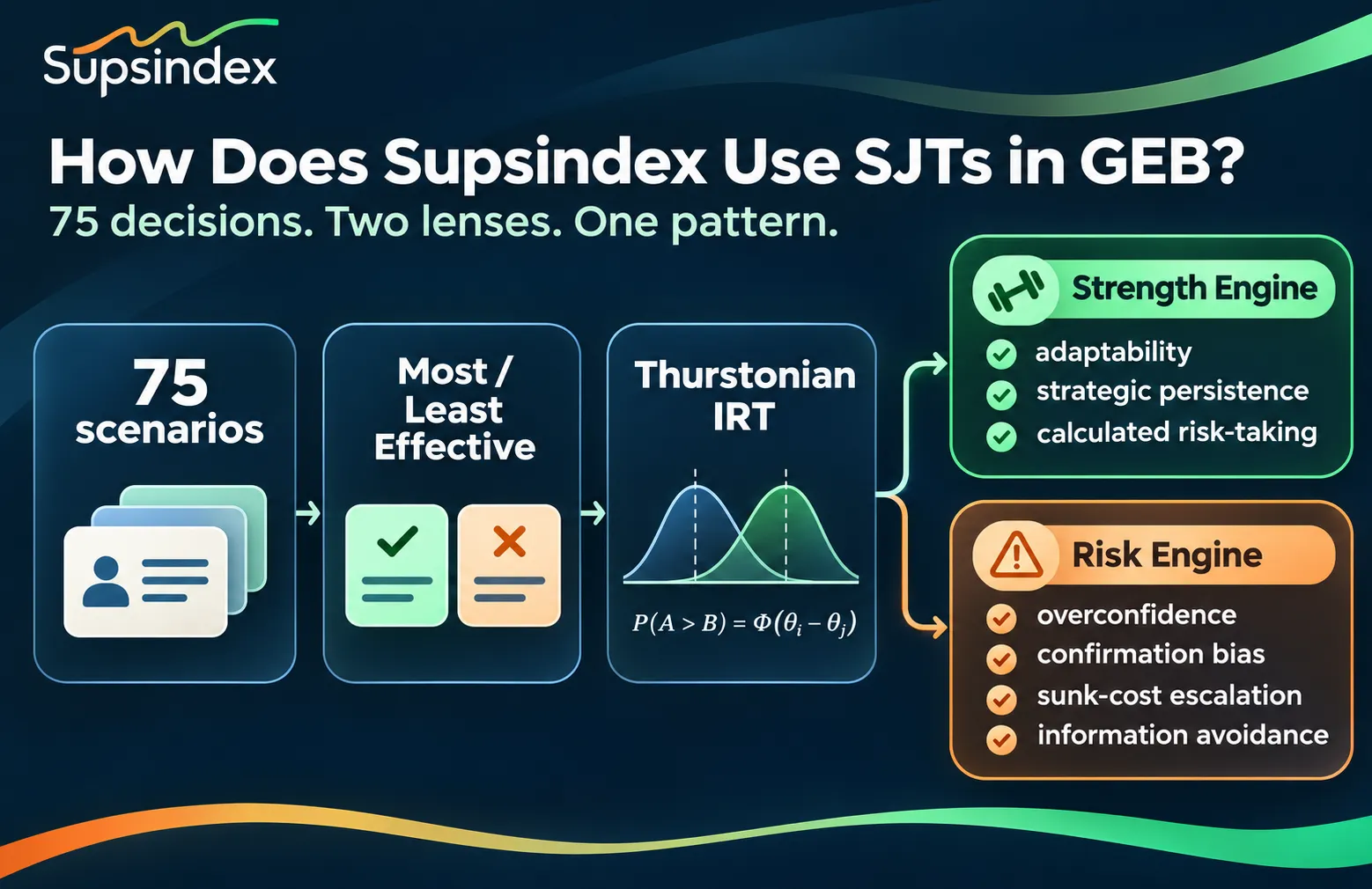
Supsindex incorporates SJTs into its General Entrepreneurial Behavior (GEB) assessment, which is designed to examine entrepreneurial judgment through situations involving uncertainty, competing priorities, and operational constraints.
The assessment contains 75 forced-choice SJT scenarios. In each situation, founders identify the Most Effective and Least Effective responses from the available options. The scenarios address behavioral categories such as resilience, adaptability, resource management, ethical judgment, and strategic decision-making.
Supsindex’s framework combines expert-reviewed response benchmarks with a statistical approach known as Thurstonian Item Response Theory (T-IRT). Rather than treating the assessment exclusively as a series of independent right-or-wrong questions, Thurstonian modeling examines comparative choice patterns to estimate underlying response tendencies.
This methodology is intended to address limitations associated with conventional ipsative forced-choice scoring, where selecting one option can mechanically restrict scores on other dimensions. Under appropriate model assumptions and calibration conditions, Thurstonian IRT can support more interpretable comparisons between respondents.
Within GEB, the results contribute to two complementary analytical perspectives. The Strength Engine examines constructive dimensions such as adaptability, strategic persistence, and calculated risk-taking, while the Risk Engine examines potential behavioral derailers, including overconfidence, confirmation bias, sunk-cost escalation, and information avoidance.
The framework also includes socially desirable distractors: choices that may sound cooperative, responsible, or decisive but overlook an important operational consequence. GEB’s Safety Score is intended to provide additional information about responses to these types of options.
These mechanisms should be understood as components of the assessment design, not as automatic proof that each underlying behavioral trait has been measured without error. In particular, choosing an expert-preferred response demonstrates judgment within the assessment conditions; it does not necessarily show that the respondent would implement that choice under real-world pressure.
Why a Single Answer Cannot Define a Founder

The distinction between individual responses and overall assessment patterns is essential. A founder might select an ineffective option because they interpreted the scenario differently, assumed information that was not explicitly stated, or overlooked an important constraint. One answer cannot reliably distinguish between these possibilities.
GEB evaluates the broader pattern across 75 scenarios rather than assigning a fixed psychological label based on one choice. The purpose is to identify areas that may deserve further reflection, mentoring, or behavioral development.
For example, if multiple scenarios indicate difficulty responding to contradictory information, that pattern may support a conversation about information avoidance or overconfidence. The founder could then compare the finding with actual decision histories and introduce safeguards where appropriate.
Even a full assessment should not be interpreted as a permanent description of personality or a guarantee of future business performance. Its value depends on the strength of the supporting evidence and how responsibly the results are used.
What Does Scientific Research Say About SJTs?
Situational Judgment Tests have an established research history, particularly in organizational and employment assessment. A 2001 meta-analysis by McDaniel and colleagues examined 102 validity coefficients involving 10,640 participants and reported a corrected association of approximately 0.34 between SJT scores and relevant job-performance criteria.
This finding supports the usefulness of appropriately designed SJTs in certain workplace contexts, but it does not mean that an SJT predicts performance with 34% accuracy. The reported value is a correlation estimate, and its relevance depends on the assessment, population, and outcome being examined.
A subsequent 2007 meta-analysis found that response instructions influence what SJTs measure. Questions asking respondents to identify effective actions tend to capture somewhat different information from questions asking what respondents would personally do. This is particularly important for Supsindex because GEB uses Most Effective and Least Effective instructions.
Research also identifies limitations involving scenario ambiguity, cultural interpretation, response distortion, and the difference between simulated judgment and real-world execution. An option that appears ineffective in one business context may be reasonable under different financial or organizational constraints.
These findings justify using SJTs as structured tools for examining situational judgment, while reinforcing the need for instrument-specific validation.
What Evidence Exists for Supsindex GEB?
Supsindex’s Scientific Catalog describes a preliminary partner evaluation involving 75 founders across three startup-ecosystem organizations in the United Kingdom, Türkiye, and the United Arab Emirates.
Within that evaluation, GEB demonstrated 58.7%–70.6% pairwise agreement with partner rankings based on existing observations of founder behavior. This was lower than the agreement reported for FPA, Supsindex’s entrepreneurial knowledge assessment.
The preliminary evaluation also identified issues requiring further investigation, including score compression and limitations in differentiating between respondents. These findings informed subsequent assessment refinement and supported a preference for using GEB results in mentoring and developmental applications rather than as a standalone screening or rejection mechanism.
The trial evaluated agreement with existing partner judgments. It did not determine whether GEB scores predict later startup survival, future fundraising, or actual founder execution.
Supsindex’s Founder Discovery FD-01 research protocol is intended to investigate relationships between baseline assessment results and subsequent entrepreneurial execution through longitudinal observation. The study’s planned design includes 300 founders across five startup programs and approximately six months of follow-up. These are research targets, not completed predictive findings.
Consequently, general SJT research should not be presented as proof that Supsindex GEB can predict individual startup success. The two forms of evidence must remain clearly distinguished.
How Can Founders Use SJT Insights to Improve Their Decisions?

The practical value of a situational judgment exercise comes from examining the reasoning behind a choice rather than simply discovering the preferred answer.
Return to the competitor price-reduction scenario. Imagine that your first instinct was to match the competitor’s prices because the sales team feared losing two important contracts. Instead of treating that reaction as evidence of a fixed personality weakness, investigate which assumptions drove it.
Perhaps you assumed the prospects paused exclusively because of price. Perhaps you believed the company could recover lost margins through increased sales volume. Or perhaps the urgency of the competitor announcement made immediate action feel safer than careful investigation.
Each assumption can be tested against commercial evidence.
A founder can practice this discipline through a short strategic reflection exercise.
Applying the Framework: Your Strategic Audit
Use the original scenario and answer four questions before choosing your response:
- Competing priorities: What matters most right now—retaining customers, protecting margins, preserving runway, or responding to competitive pressure? Which priorities genuinely conflict?
- Missing information: What do you need to know about the paused prospects, customer acquisition economics, and competitor positioning before committing resources?
- Trade-offs: What would each action cost, and which commitments could be reversed if the initial assumption proves incorrect?
- Disconfirming evidence: What customer behavior or financial result would demonstrate that your preferred response is not working?
These questions encourage founders to examine their reasoning before making an operational commitment. They are also useful during investor discussions, leadership meetings, and founder-development sessions because they make assumptions visible rather than allowing decisions to rest entirely on confidence or intuition.
A practical next step is to maintain a Founder Decision Journal. Before making an important strategic choice, record the initial assumption, available evidence, alternatives, expected outcome, and review date. When the result becomes available, compare it with the original reasoning rather than reconstructing the decision after knowing what happened.
For founders who repeatedly react too quickly to competitive threats, a pre-committed cooling-off period or spending-approval rule may help prevent unnecessary strategic changes. Those struggling with information avoidance could introduce a weekly review of customer churn, cash runway, and other uncomfortable but essential operating indicators.
Supsindex’s developmental approach also emphasizes targeted behavioral commitments over broad personality labels. A founder might spend thirty days practicing evidence-based commercial decisions, review the resulting decision records with a mentor, and use subsequent assessment findings to explore whether the relevant weaknesses are becoming less prominent.
The purpose is not to memorize the preferred responses to hypothetical questions. It is to strengthen the habits that support better decisions when the answers are uncertain.
Short Glossary: Situational Judgment Testing
| Term | Definition |
|---|---|
| Situational Judgment Test (SJT) | An assessment presenting realistic situations and asking respondents to evaluate or choose possible actions |
| Forced Choice | A response format requiring selection between alternatives, such as the most and least effective options |
| Thurstonian IRT | A statistical modeling approach used to estimate underlying response tendencies from comparative choices |
| Socially Desirable Distractor | An option that appears attractive or responsible but may be ineffective under the scenario’s constraints |
| Knowledge–Action Gap | The difference between knowing an appropriate response and reliably carrying it out in practice |
| Cognitive Derailer | A recurring judgment tendency or bias that may interfere with effective decisions |
Frequently Asked Questions About Situational Judgment Tests for Founders
What is a situational judgment test for founders?
A situational judgment test for founders presents hypothetical startup challenges and asks participants to evaluate possible actions. It can examine judgment involving leadership, uncertainty, resource allocation, ethical decisions, and competing operational priorities.
How is an SJT different from a personality test?
Personality assessments generally describe broad traits or behavioral tendencies, while an SJT asks respondents to evaluate actions within a specific situation. The two approaches may measure overlapping constructs, but they use different formats and can support different interpretations.
Does an SJT have right and wrong answers?
Many SJTs use expert-developed scoring benchmarks to identify more and less effective responses. However, the quality of an answer depends on the scenario’s information, the scoring design, and the intended construct. Some options may be partially defensible, particularly when important contextual details are missing.
Can someone prepare for a situational judgment test?
Founders can develop relevant judgment by learning to analyze trade-offs, evaluate evidence, understand business fundamentals, and reflect on actual decisions. Memorizing publicly disclosed test items is not an appropriate substitute for developing those capabilities and can undermine assessment integrity.
Does GEB measure what a founder will actually do under pressure?
GEB evaluates responses to structured entrepreneurial scenarios. These responses may provide information about judgment and potential behavioral patterns, but they do not establish how someone will behave in every real-world crisis.
Can one SJT response identify a founder’s weaknesses?
No. One response is insufficient to diagnose a recurring behavioral tendency or predict startup performance. Meaningful interpretation requires multiple appropriately designed items, valid scoring methods, and additional evidence about the founder’s actual behavior.
Are Situational Judgment Tests scientifically validated?
SJTs have a substantial research base supporting their usefulness in certain organizational contexts. However, validation applies to specific instruments, populations, and intended uses. The general scientific literature does not automatically establish the predictive validity of a particular founder assessment.
Conclusion: Better Founder Judgment Begins With Better Questions
Entrepreneurship is shaped by decisions made under uncertainty. Founders frequently face situations where multiple actions appear reasonable, information is incomplete, and the consequences of a poor choice can be significant.
Situational Judgment Tests provide a structured way to examine how people evaluate these competing actions. They move beyond general statements about personality by presenting relevant problems and requiring respondents to consider practical alternatives.
The competitor price-reduction scenario illustrates this distinction. Matching prices, increasing marketing expenditure, investigating the underlying problem, and maintaining the existing strategy all carry different implications. Under the stated conditions, investigating customer concerns and financial consequences before committing to a broad response offers the strongest decision-making approach.
However, choosing that answer does not prove that a founder will behave identically during a real crisis. The scientific value of an SJT depends on its design, scoring, reliability, and supporting validation evidence.
Supsindex’s GEB assessment applies this methodology through 75 forced-choice entrepreneurial scenarios, using comparative judgment modeling to examine potential strengths and behavioral risks. Its results are intended to support founder development, mentoring, and more informed reflection rather than provide deterministic predictions of startup success.
Ultimately, the value of an SJT is not simply identifying which response sounds correct. It is learning to examine the assumptions, trade-offs, and evidence that make one action more appropriate than another.
A founder’s judgment is not defined by a single decision. It is reflected in the quality of reasoning they apply across difficult decisions—and their willingness to improve that reasoning over time.
Explore the Supsindex GEB Assessment to learn more about entrepreneurial situational judgment, or read the General Entrepreneurial Behavior Test Guide for an overview of its assessment structure and developmental applications.
Scientific References and Further Reading
- U.S. Office of Personnel Management — Situational Judgment Tests. Overview of SJT formats, applications, and measurement characteristics.
- McDaniel, M. A., et al. (2001) — Use of Situational Judgment Tests to Predict Job Performance: A Clarification of the Literature. Journal of Applied Psychology, 86(4), 730–740.
- McDaniel, M. A., Hartman, N. S., Whetzel, D. L., & Grubb, W. L. III (2007) — Situational Judgment Tests, Response Instructions, and Validity: A Meta-Analysis. Personnel Psychology, 60(1), 63–91.
- Ployhart, R. E., & Ehrhart, M. G. (2003) — Be Careful What You Ask For: Effects of Response Instructions on the Construct Validity and Reliability of Situational Judgment Tests. International Journal of Selection and Assessment.
- Supsindex Assessment Criteria. Founder assessment methodology and a public description of competitive-shock scenarios.
- Supsindex Scientific Catalog. Preliminary partner evaluation, GEB measurement architecture, and Founder Discovery FD-01 research framework.
