


How to Evaluate a New Market Before Expanding Your Startup
Startup market entry requires more than a promising economy: founders must validate local customer demand, size the reachable market, resolve regulatory barriers, and decide whether to enter, pilot, or delay.
Expanding into a new market can unlock customers, partnerships, talent, and growth opportunities that are difficult to access in a startup’s home country. However, international expansion also introduces unfamiliar competitors, purchasing behaviors, regulations, and operational costs. A business model that performs well in one environment may struggle in another, even when the underlying product remains unchanged.
The most common mistake is treating an attractive market as an accessible one. Founders may see strong economic growth, a large population, or increasing venture capital investment and conclude that expansion is justified. Yet these indicators reveal little about whether local customers will purchase their product, how difficult those customers will be to reach, or whether the startup can operate profitably under local conditions.
A reliable startup market entry strategy requires more than market-size estimates and encouraging conversations. Founders need evidence of customer demand, an understanding of competitive and regulatory barriers, realistic financial projections, and clear criteria for deciding how much capital to commit.
This guide provides a practical framework for evaluating a new country or regional market before expansion. It combines customer discovery, bottom-up market sizing, operational due diligence, and controlled experimentation into three possible decisions: Enter, Pilot, or Delay. A worked example involving a fictional German B2B SaaS startup considering expansion into Ireland illustrates how to apply the framework using official country data.
1. Validate Local Demand Before Assuming Your Product Will Sell
A startup’s success in its home market is useful evidence, but it does not guarantee similar customer behavior elsewhere. The problem your product solves may exist internationally, while the urgency, purchasing process, acceptable price, and available alternatives differ significantly.
Consider a B2B software company that sells directly to department managers in Germany. In another country, similar purchases might require approval from centralized procurement teams, security reviews, or additional budget holders. The product could be valuable, yet the sales cycle might become substantially longer. If the startup enters the market using its existing acquisition assumptions, it may exhaust its expansion budget before closing enough contracts.
Local demand validation should therefore begin with customer behavior rather than opinions about the product. The Mom Test approach is useful because it emphasizes specific past experiences, existing problems, and previous spending instead of hypothetical promises. Rather than asking whether someone would buy a new compliance platform, a founder should investigate how the organization currently manages compliance, what the process costs, and whether it has already paid to solve the problem.
A practical starting point for a B2B startup is 15–20 structured discovery interviews across at least two relevant customer sub-segments. This is a recommended exploratory baseline, not a statistically sufficient sample or a universal requirement. Founders should continue interviewing when important differences emerge between customer groups or when the original assumptions remain unresolved.
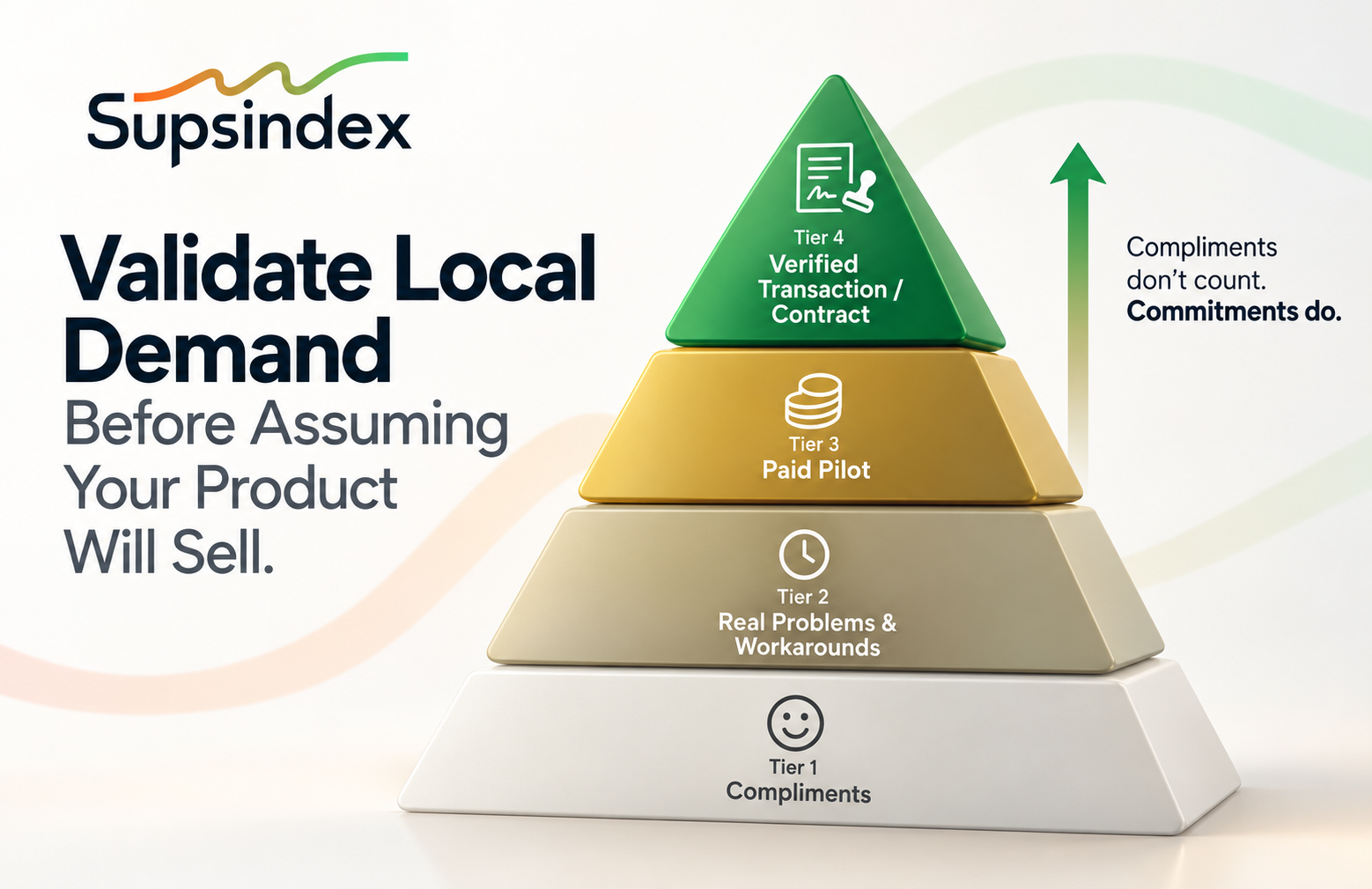
The strongest early signals are behaviors that involve meaningful commitment. Customers may already be paying a competing provider, investing employee hours in inefficient workarounds, or allocating budget to address the problem. These observations are more informative than compliments or survey enthusiasm, although they still require further validation before a major expansion.
Separate Interest From Commercial Evidence

Supsindex’s Founder Execution Measurement System (FEMS) research framework distinguishes several levels of evidence. Founders can apply a simplified version when evaluating local demand.
| Evidence level | Example | Recommended interpretation |
|---|---|---|
| Tier 1: Weak | Compliments, positive survey responses, hypothetical purchase interest | Useful for exploration, insufficient to justify expansion spending |
| Tier 2: Moderate | Documented operational problems, existing workarounds, measurable time lost | Justifies further customer discovery or a limited experiment |
| Tier 3: Strong | Paid pilots, deposits, actual purchases, budget-backed commercial commitments | Supports a stronger case for commercial viability |
| Tier 4: Independently verified | Audited transactions, validated retention records, enforceable contractual commitments | Provides stronger confirmation of particular commercial facts |
A signed letter of intent can be useful evidence, but its strength depends on whether it contains binding obligations, a committed budget, and meaningful commercial terms. A non-binding expression of interest should not be treated as equivalent to a paid contract.
For an early-stage B2B SaaS expansion, a reasonable validation objective might be securing three paid pilots or comparably credible commercial commitments before establishing a permanent local operation. The appropriate threshold depends on contract value, industry, procurement complexity, and the cost of conducting a pilot.
Founders should also identify the single assumption most likely to invalidate expansion. This is the principle behind Riskiest Assumption Testing (RAT). If the main uncertainty is willingness to pay, test pricing and commercial commitments. If the main risk is a six-month procurement cycle, investigate the approval process before hiring a sales organization. If regulatory permission is uncertain, resolve that question before beginning activities that legally require authorization.
The objective is to establish that the market contains customers who experience a meaningful problem, can be reached economically, and have a credible reason to purchase the proposed solution.
2. Calculate the Market You Can Actually Reach

Market size is one of the most frequently misunderstood indicators in startup expansion. A country may have a large economy and thousands of businesses, but only a small proportion may fit the startup’s ideal customer profile.
Traditional market-sizing presentations often begin with Total Addressable Market (TAM), narrow it into Serviceable Available Market (SAM), and estimate Serviceable Obtainable Market (SOM). These concepts are useful, but they become misleading when founders apply arbitrary capture percentages to broad industry figures without evaluating local purchasing conditions.
A more defensible approach starts with the number of identifiable customers who meet specific criteria. These criteria might include company size, industry, regulatory exposure, existing technology, budget capacity, and geographic accessibility. The founder then estimates how many of those organizations can realistically be reached through available channels and what they are likely to pay.
For example, if a startup identifies 400 qualified companies in a target market and validates an annual contract value of €12,000, its initial serviceable revenue opportunity would be approximately €4.8 million annually. If it can realistically acquire 5% of those companies over two years, the corresponding revenue scenario would be 20 customers generating €240,000 in annual recurring revenue.
The distinction matters: the total value of qualified customers describes the potential market, while the expected conversion rate describes a commercial scenario—not the market’s entire size.
Competition, Switching Costs, and Distribution
Estimating the number of potential customers is only the beginning. Founders must also determine whether customers have sufficient motivation to change providers and whether the startup can reach decision-makers.
Competitive research should include direct competitors, established enterprise vendors, internal solutions, and manual workarounds. A startup may outperform an incumbent on product functionality but still struggle because the existing provider is integrated into critical workflows or offers contractual guarantees that are difficult to replace.
Switching costs deserve particular attention. They may include data migration, employee retraining, procurement approval, implementation delays, or the risk of interrupting existing operations. A product that offers modest savings may not justify a difficult migration, even if customers acknowledge its advantages.
Distribution creates another constraint. Some markets are accessible through remote sales, digital acquisition, or product-led onboarding. Others depend heavily on local partners, specialist resellers, industry relationships, or formal procurement channels. A market becomes significantly less attractive when acquiring customers requires more time and capital than the startup can support.
Founders should therefore evaluate their accessible opportunity across four dimensions: problem severity, commercial reachability, competitive friction, and unit economics. These dimensions provide the basis for an illustrative Market Accessibility Score.
| Market Accessibility Dimension | Weight | Core evaluation question |
|---|---|---|
| Demand severity | 25% | Do customers experience an urgent, measurable problem? |
| Commercial reachability | 25% | Can the startup access buyers through realistic channels? |
| Competitive friction | 25% | Can customers switch without prohibitive costs or resistance? |
| Unit economics | 25% | Can acquisition costs and sales cycles support profitable growth? |
Each dimension can be rated from 0 to 100, producing a preliminary score. For internal planning, 75–100 may indicate stronger accessibility, 50–74 suggests further validation, and below 50 signals major commercial concerns.
This scorecard is a proposed founder planning tool inspired by Supsindex’s contextual assessment principles, not a separately validated Supsindex psychometric index. Its thresholds are illustrative and should be adapted to the business. Most importantly, a favorable average must never override a critical legal or financial barrier.
3. Investigate Regulatory and Operational Barriers Before Committing Capital
Demand and competition determine whether a market offers a commercial opportunity. Regulation, infrastructure, talent, and financing determine whether the company can pursue that opportunity responsibly.
Before expanding, founders should investigate company-registration requirements, tax obligations, employment rules, data protection, sector-specific licenses, contractual requirements, and relevant consumer or commercial legislation. The exact scope depends on the product and how the business intends to operate.
For instance, a SaaS startup selling across European Union countries may already operate under a shared GDPR framework, but it must still examine customer-data processing, contractual responsibilities, local employment obligations, and the location of any third-country service providers. A FinTech company may require specific financial authorization, while a HealthTech startup could face additional medical-device or clinical compliance requirements.
Operational feasibility requires similar attention. Founders need to understand local salary expectations, availability of specialist employees, payment infrastructure, customer-support requirements, banking arrangements, and the accessibility of potential distribution partners. Government grants and investor networks may be relevant, but founders should verify eligibility rather than treating a country’s publicly announced startup funding as money automatically available to foreign entrants.
A useful due-diligence process covers nine areas:
| Due-diligence area | What founders should verify |
|---|---|
| Corporate structure | Incorporation, branch registration, reporting, and governance obligations |
| Industry regulation | Required licenses, approvals, certifications, and product restrictions |
| Data protection | Privacy obligations, processing agreements, security, and international transfers |
| Employment | Hiring rules, compensation, payroll, social contributions, and termination requirements |
| Taxation | Corporate tax, VAT, applicable incentives, and cross-border tax exposure |
| Payments and infrastructure | Banking, payment processing, cloud infrastructure, connectivity, and currency risks |
| Distribution | Local partners, resellers, procurement gatekeepers, and customer-access channels |
| Capital | Funding availability, investor expectations, eligibility criteria, and financing needs |
| Talent | Relevant technical, commercial, legal, and operational expertise |
Separate Critical Blockers From Manageable Constraints
Not every obstacle carries the same strategic weight. Some problems, such as adapting marketing language or identifying a local implementation partner, can be addressed during a limited pilot. Others may make commercial entry unlawful or financially unsustainable.
A startup cannot compensate for a missing mandatory license by demonstrating exceptional customer demand. Similarly, a company with four months of cash runway cannot safely commit to an expansion strategy requiring a six-month sales cycle unless it has additional financing or a credible way to sustain the effort.
This is where Supsindex’s Penalty for Bottleneck (PFB) principle becomes useful. Rather than relying on a favorable average across all readiness categories, founders should identify weaknesses severe enough to constrain the entire expansion.
If local market demand is strong but an essential regulatory requirement remains unresolved, the decision should be delayed or limited to activities legally permitted during the validation stage. If customer acquisition economics remain uncertain, the founder may conduct a capped experiment rather than establish a permanent sales operation.
A market is not ready for entry simply because most indicators are positive. Critical barriers must be resolved independently.
4. Choose an Entry Strategy That Matches the Evidence
Once the commercial and operational environment is understood, the founder must decide how to approach the market. Opening a subsidiary is only one option and is often unnecessary during early validation.
Remote selling can provide an inexpensive starting point for software businesses that can legally serve customers across borders. Local referral partnerships may be more effective where buyer trust and established professional relationships influence procurement. Distributors and value-added resellers can help companies requiring local installation, support, or logistics, while licensing arrangements may suit businesses that depend on specialized intellectual property or regulated local operations.
Establishing a subsidiary provides greater direct control over employees, contracts, and local operations, but it also creates additional financial and administrative responsibilities. Founders should pursue this model when commercial evidence and operational requirements justify the added commitment, not simply because having an international office appears attractive.
The correct strategy depends on how much control the startup needs, which activities it is legally permitted to perform, the cost of reaching customers, and the speed at which credible demand can be established.
For an early-stage SaaS company, a sixty-day pilot involving remote customer discovery, a limited acquisition campaign, and a small number of paid commercial experiments may provide more actionable evidence than immediately hiring a local team.
The pilot must have a defined budget, measurable outcomes, and conditions for stopping. Otherwise, an experiment can gradually become an uncontrolled expansion.
5. The Enter, Pilot, or Delay Market Entry Decision Framework

After completing the research, founders need a clear decision. Supsindex’s contextual readiness principles can be translated into a practical framework that considers six dimensions: customer demand, accessible market, regulatory feasibility, local resources, unit economics, and execution readiness.
The central rule is that critical legal and financial requirements must be treated as mandatory gates. A strong score in customer demand cannot compensate for a market in which the company cannot legally operate or finance the expected sales cycle.
| Decision | Required conditions | Recommended action |
|---|---|---|
| ENTER | Strong commercial evidence, required legal permissions, viable unit economics, sufficient financing, and a credible distribution strategy | Commit to a phased commercial launch, scaling expenditure against measurable milestones |
| PILOT | Promising demand and no prohibition on the proposed test, but important commercial or operational assumptions remain unresolved | Run a limited, budget-capped experiment with clear success and stop conditions |
| DELAY | Critical regulatory barriers, insufficient financing, weak demand evidence, or unacceptable downside exposure | Preserve capital and resolve the primary constraint before reconsidering entry |
For B2B SaaS, a pilot might target three paid customer commitments, a sufficiently attractive CAC payback period, and a defined conversion threshold. These are planning benchmarks rather than universal requirements. For businesses with longer procurement cycles or regulatory approval processes, a useful pilot may instead validate technical feasibility, procurement eligibility, or committed purchasing budgets.
Founders should also establish explicit circuit breakers. If customer interviews repeatedly reveal no meaningful problem or existing workaround, the company may need to revisit its target segment. If prospects express enthusiasm but refuse meaningful commercial commitments, the founder should investigate willingness to pay rather than treating positive comments as validation. If expected acquisition costs exceed the company’s capacity to finance the sales process, further expansion spending should stop.
A decision of Delay should not be interpreted as a permanent rejection of the market. It means the opportunity has not yet met the conditions required for responsible entry. A successful pilot can change that decision, provided the new evidence resolves the original uncertainties.
Worked Example: Should a German HRTech Startup Expand Into Ireland?
Consider CertiFlow AI, a fictional German B2B SaaS company offering employee onboarding and compliance-documentation software. The company has early customers in Germany and is evaluating Ireland as its first international market.
Ireland is a useful example because it has a substantial business ecosystem, official market data, established investment institutions, and a regulatory environment that combines EU-wide rules with country-specific operational requirements.
According to Ireland’s Central Statistics Office, the country recorded 410,205 active enterprises in 2024, including 4,835 medium-sized businesses employing 50–249 people. The information and communication sector accounted for 20,366 active enterprises across all company sizes. These statistics establish the scale and composition of the broader business environment, but they do not directly identify how many organizations would purchase CertiFlow’s product.
Ireland’s startup ecosystem also demonstrates investment activity. Enterprise Ireland reported supporting 198 startups and investing €32.9 million during 2025. These figures provide useful economic context, although the agency’s primary role is supporting Irish enterprises rather than guaranteeing financial support to foreign companies entering the market.
Step 1: Estimate the Accessible Customer Base
CertiFlow initially targets mid-market technology companies with meaningful employee onboarding requirements, recurring compliance documentation, and sufficient budgets for specialist software.
For a preliminary model, the company assumes that 850 Irish businesses might fit its initial customer profile. This is a fictional planning assumption, not a verified CSO count. The company must establish the actual figure through industry databases, company registers, qualified prospect lists, and customer research.
If the startup can validate an annual contract value of €12,000, the illustrative revenue opportunity across those 850 accounts would be €10.2 million per year. Acquiring approximately 5% of this group over two years—42 customers—would generate around €504,000 in annual recurring revenue.
| Market sizing component | Illustrative estimate |
|---|---|
| Potential qualifying accounts | 850 |
| Annual contract value | €12,000 |
| Modeled annual revenue opportunity | €10.2 million |
| Target customers acquired in 24 months | 42 |
| Potential ARR after acquisition | €504,000 |
The calculation is useful for testing commercial assumptions, but it does not establish that those customers are accessible or willing to pay. The 850-account list, achievable sales conversion, and contract value must all be validated before the figures can support a major capital commitment.
Step 2: Examine Competition and Customer Demand
CertiFlow’s next task is to determine how Irish employers currently manage onboarding and compliance. Some organizations may use established HR software, others may rely on internal systems, and smaller businesses may continue using manual processes.
A proposed discovery phase would include 15–20 interviews with Irish HR managers, compliance personnel, and procurement decision-makers. The interviews would examine existing workflows, implementation barriers, vendor relationships, and historical spending. Rather than asking whether the product sounds attractive, the team would investigate which specific problems have already caused organizations to allocate time or money.
The company would then test a narrow offer with qualified prospects, seeking three paid pilots or other commercially meaningful commitments. It would also examine whether purchasing decisions require local references, security documentation, or formal procurement approval.
These findings would help determine whether CertiFlow has identified a genuinely accessible customer segment rather than merely a large group of theoretically relevant organizations.
Step 3: Investigate Irish Regulation and Local Operations
CertiFlow’s regulatory analysis begins with GDPR, because its software handles employee-related personal information. Germany and Ireland are both within the European Economic Area, so transferring personal data between them does not automatically require Standard Contractual Clauses under GDPR’s rules for transfers to third countries. However, the company must still address appropriate lawful processing, controller and processor responsibilities, data security, retention, and any transfers to service providers outside the EEA.
Ireland’s Data Protection Commission provides guidance on international transfers, including when Standard Contractual Clauses may be relevant.
If CertiFlow uses AI features that influence recruitment, worker evaluation, or other regulated employment decisions, it must also assess whether the EU AI Act imposes additional requirements. Applicability depends on the actual functionality and legal classification of the system; simply marketing software as AI-powered does not automatically place it within a particular risk category.
Corporate structure also requires evaluation. A German company may be able to test commercial demand without immediately incorporating an Irish subsidiary, depending on the nature of its activities. Establishing an Irish branch or permanent local presence can create additional registration, tax, and reporting obligations. Ireland’s Companies Registration Office provides the relevant branch-registration framework.
For financial planning, Ireland generally applies a 12.5% corporation tax rate to qualifying trading income, while in-scope large multinational groups are subject to separate minimum-tax rules. The company should also examine VAT, employment costs, and the eligibility requirements for any tax incentives. These matters require professional review of the actual proposed operating structure rather than reliance on headline tax rates.
Step 4: Compare the Cost of a Pilot With Full Expansion
Instead of establishing a local office immediately, CertiFlow prepares two alternative budgets.
| Expense category | Fictional budget |
|---|---|
| 60-day pilot | €35,000 |
| Legal and data-protection review | €8,000 |
| Customer discovery and localization | €5,000 |
| Targeted sales and outreach | €15,000 |
| Pilot implementation and contingency | €7,000 |
| Subsequent 12-month expansion | €180,000 |
| Local commercial hire and associated costs | €95,000 |
| Partnerships, events, and acquisition | €45,000 |
| Corporate, accounting, and operational setup | €25,000 |
| Additional contingency | €15,000 |
These figures are hypothetical company estimates rather than observed Irish market-cost benchmarks. They allow founders to compare the financial commitment required for initial validation with the substantially larger investment associated with establishing a sustained market presence.
A critical concern emerges when the company evaluates its runway. Suppose CertiFlow has only four months of available cash runway, while local enterprise prospects indicate that contracts may take six months to close.
Under PFB logic, the company’s financing horizon becomes a potentially decisive constraint. Even promising demand cannot justify a full launch if the startup is unlikely to remain adequately funded through the purchasing cycle.
A tightly scoped pilot may still be reasonable if its €35,000 cost is specifically funded, does not jeopardize the existing business, and can generate valuable evidence within sixty days. However, the company should not interpret that pilot as proof that it can finance a six-month commercial sales process.
Step 5: Make the Final Decision
Based on the preliminary evidence, CertiFlow should choose PILOT—subject to funding and legal safeguards, rather than immediately committing to full market entry.
The initial experiment should verify the size of its reachable customer segment, establish whether Irish employers have an urgent purchasing need, test acquisition channels, and seek credible commercial commitments. The team should document the assumptions being tested and review the results against predefined thresholds.
A successful pilot would strengthen the case for a broader launch, but CertiFlow would still need adequate financing to support the local sales cycle. If the company cannot fund the pilot without threatening its existing runway, the appropriate decision changes to DELAY until additional capital or a lower-cost validation method becomes available.
This illustrates why market attractiveness and market-entry readiness must be evaluated separately. Ireland may offer a relevant commercial opportunity, yet the startup’s current financial position could make immediate expansion inappropriate.
The country is not necessarily the problem. The timing, evidence, and execution capacity may be.
Market Entry Checklist: What to Verify Before Expanding
Before approving expansion spending, a founder should be able to answer the following questions with documented evidence.
| Evaluation area | Essential question | Status |
|---|---|---|
| Customer demand | Have local customers demonstrated a meaningful problem through past behavior or commercial commitments? | Pass / Test / Blocked |
| Customer segment | Can we identify and reach a specific group of qualified buyers? | Pass / Test / Blocked |
| Market opportunity | Is bottom-up accessible revenue sufficient to justify expansion costs? | Pass / Test / Blocked |
| Competition | Do we understand incumbent advantages, switching costs, and our differentiation? | Pass / Test / Blocked |
| Regulation | Can all proposed activities be conducted legally, with required authorizations? | Pass / Test / Blocked |
| Local resources | Can we access the necessary talent, partners, infrastructure, and expertise? | Pass / Test / Blocked |
| Unit economics | Can customer acquisition, retention, and payback support viable growth? | Pass / Test / Blocked |
| Financing | Can the company fund the sales cycle and survive the downside scenario? | Pass / Test / Blocked |
| Entry model | Have we selected the lowest-cost workable approach for the current stage? | Pass / Test / Blocked |
| Decision safeguards | Are pilot milestones, spending limits, and stop conditions documented? | Pass / Test / Blocked |
The checklist is not intended to produce a falsely precise numerical answer. A failed mandatory legal or financing gate should trigger a delay even if every other category looks attractive. Uncertain but testable commercial assumptions should lead to a limited pilot, while strong evidence across the critical dimensions can justify a staged market entry.
Founders should preserve the original assessment and revisit it as new information becomes available. This creates a documented rationale for entering a market, testing an opportunity, or postponing investment.
How Supsindex EEA Supports Market Entry Decisions
Supsindex’s Ecosystem Environmental Awareness (EEA) assessment can support this process by helping founders identify gaps in their understanding of a particular country’s entrepreneurial environment.
The framework examines five general ecosystem dimensions—funding, talent, regulation, market access, and infrastructure—alongside five dynamic industry-specific areas covering sector regulations, value chains, technology trends, competition, and specialized customer segments.
EEA is therefore complementary to commercial due diligence rather than a substitute for it. A founder may perform strongly on the assessment yet still need to validate customer willingness to pay, confirm legal requirements, or secure sufficient financing. Conversely, identifying weaknesses in ecosystem knowledge can reveal specific areas that deserve investigation before expansion.
Supsindex’s use of contextual assessment methodology is intended to make these knowledge gaps more relevant to the founder’s country, industry, and operating environment. Its broader scientific model also emphasizes identifying critical bottlenecks rather than allowing strong performance in some areas to conceal serious weaknesses elsewhere.
Founders who want to examine their understanding of the target ecosystem can explore the Supsindex EEA assessment and the Founder’s Guide to Ecosystem Environmental Awareness.
Frequently Asked Questions About Startup Market Entry
How do you evaluate a new market before expanding a startup?
Start by validating local customer demand, estimating the accessible market through bottom-up customer counts, examining competition and distribution, and reviewing regulatory and operational requirements. Then test unit economics, financing capacity, and execution readiness before deciding whether to enter, pilot, or delay.
How many customer interviews are needed before entering a new country?
For many early-stage B2B startups, 15–20 focused interviews provide a useful initial discovery baseline. However, this is not a statistical guarantee or universal threshold. Regulated industries and complex enterprise markets may require additional customer, procurement, and regulatory stakeholder research.
Is a large TAM enough to justify international expansion?
No. A large Total Addressable Market does not establish that customers can be acquired economically. Founders should evaluate their realistic customer segment, purchasing behavior, switching costs, competitive position, and available distribution channels.
When should a startup delay entering a market?
Expansion should be delayed when the company lacks required legal permissions, cannot finance the expected sales cycle, has insufficient demand evidence, or faces a critical operational constraint that cannot be addressed safely through a limited experiment.
What is the difference between market research and market validation?
Market research describes the environment, including customer segments, competitors, regulations, and industry conditions. Market validation tests whether specific customers experience the proposed problem and will make meaningful commitments to the solution. Both are necessary, but neither replaces the other.
Conclusion: Expand When the Evidence Supports the Decision
Successful startup expansion requires more than identifying an attractive country or estimating a large market opportunity. Founders must establish that local customers experience a meaningful problem, understand how those customers make purchasing decisions, determine whether competitors and operational barriers can be overcome, and verify that the company has sufficient resources to execute the strategy.
A practical market-entry evaluation combines customer discovery, commercial experimentation, bottom-up market sizing, regulatory due diligence, and disciplined financial planning. It also distinguishes manageable uncertainties from barriers that make immediate expansion inappropriate.
The Enter, Pilot, or Delay framework turns this information into a decision. Strong evidence and cleared critical requirements can support a staged launch. Promising opportunities with unresolved assumptions justify limited experiments. Serious legal, financial, or demand-related constraints require postponement until the underlying problems are addressed.
Ireland’s business environment illustrates why this distinction matters. Official statistics can demonstrate the scale of an economy and the activity of its startup ecosystem, but they cannot establish whether one particular company has a viable path to acquiring customers. That conclusion requires company-specific evidence.
The best market to enter is not necessarily the largest or fastest-growing. It is the market where customer demand, commercial accessibility, regulatory feasibility, and execution capacity align.
Before committing to your next market, evaluate not only where your startup could grow, but where it is genuinely prepared to compete.
Explore Supsindex EEA to identify potential gaps in your understanding of the ecosystem you plan to enter.
Official Sources and Further Reading
- Central Statistics Office — Business in Ireland 2024 — Enterprise population, company sizes, and industry composition.
- Enterprise Ireland — Startup Investment and Support in 2025 — Government-backed startup investment and support figures.
- Ireland’s Companies Registration Office — Requirements for registering branches of foreign companies.
- Irish Data Protection Commission — GDPR requirements for international transfers of personal data.
- Ireland’s Department of Enterprise — EU AI Act — Regulatory guidance on artificial intelligence.
- Irish Revenue — Corporation Tax — Official corporate tax framework.
- IDA Ireland — Inward investment support for foreign businesses evaluating Ireland.
