


To eliminate systemic capital waste and optimize the innovation pipeline, institutional leaders must adopt the rigorous metrics and methodology of the Supsindex framework for startup grant allocation.
Startup Grant Allocation: Metrics, Methodology, and the Supsindex Framework
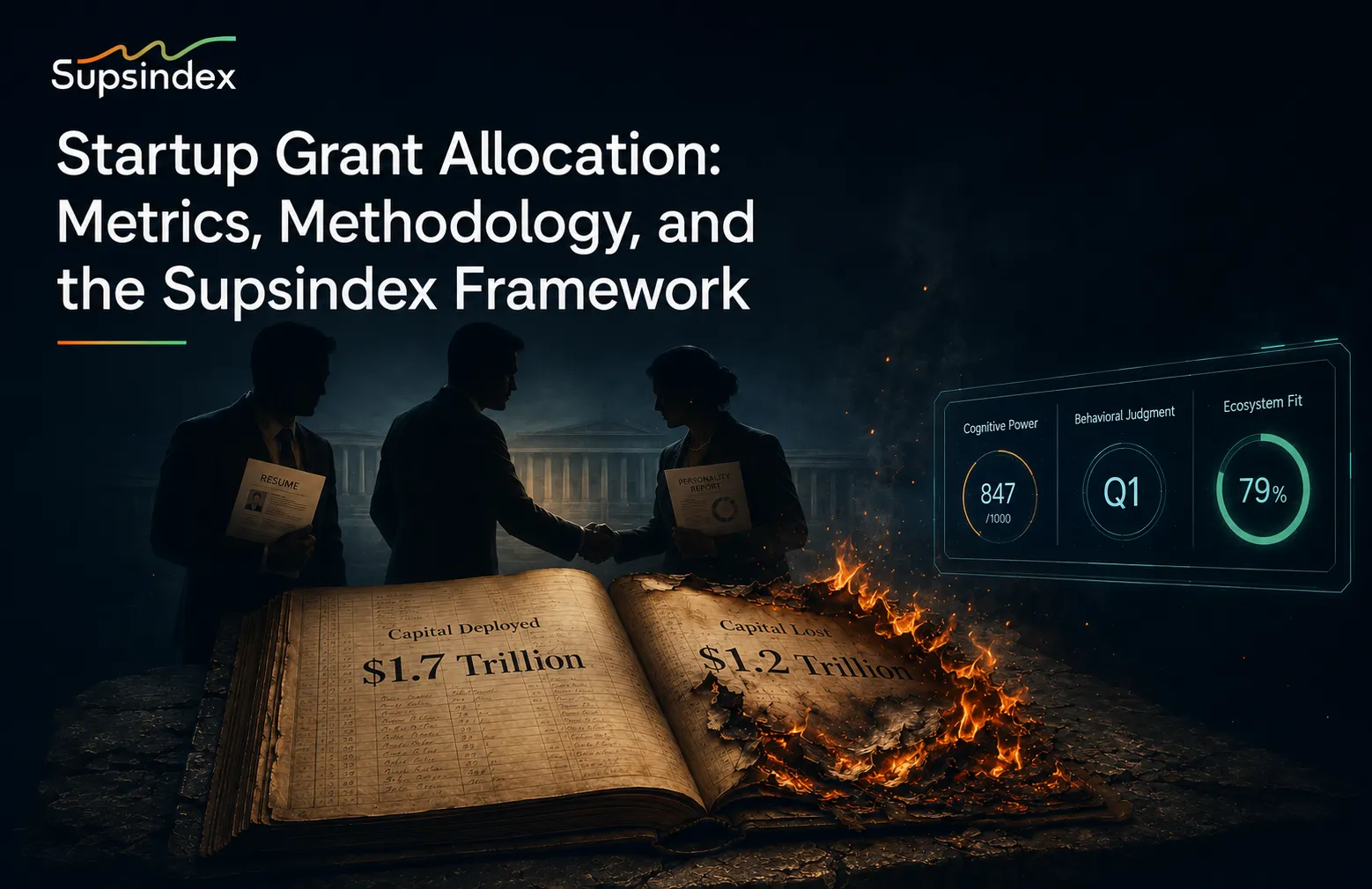
The deployment of financial capital within early-stage innovation ecosystems has historically resembled an art form rather than a rigorous science. Governments, accelerators, and institutional grant allocators distribute billions of dollars annually based on qualitative signals: the eloquence of a pitch, the prestige of a founder’s academic pedigree, or the speculative upside of a raw technology.
However, empirical macroeconomic data exposes a staggering reality. Between 2019 and 2024, the global venture ecosystem witnessed over $1.7 trillion deployed, yet an astronomical $1.2 trillion of that capital was entirely lost to venture churn. Crucially, industrial post-mortems reveal that 60% to 70% of these catastrophic failures stem not from unviable technology or market absence, but from direct human missteps, behavioral vulnerabilities, and operational misalignment within the founding team.
To build a sustainable innovation economy, institutional gatekeepers must transition from static, easily manipulated selection heuristics to a standardized, psychometrically validated framework. Traditional underwriting methods—such as resume screenings, unstructured interviews, and generic personality tests—are slow, opaque, expensive, and profoundly biased. They fail to evaluate the one element that dictates the velocity and survival of a startup: the non-technical human capabilities, or “Soft Power,” of the founding team’s execution system.
At Supsindex, we have engineered the solution. By treating founder capability as a measurable, objective, and multi-dimensional continuum, we provide public policy leaders and private asset managers with the analytical tools required to optimize capital deployment and safeguard public funds.
The Quantifiable Architecture of Founder Soft Power
When evaluating human capital at the genesis of a firm, observers frequently fall into the trap of treating entrepreneurial talent as a monochromatic trait. In reality, what we define as founder capability is a complex web of cognitive literacy, behavioral resilience, and hyper-local contextual awareness. To systematically govern grant allocation, the Supsindex framework deconstructs this human variable into distinct, mathematically isolatable pillars.
                ┌────────────────────────────────────────┐
                │        FOUNDER SOFT POWER DNA          │
                └───────────────────┬────────────────────┘
                                    │
         ┌──────────────────────────┼──────────────────────────┐
         ▼                                                                                                     ▼                                                                                                   ▼
┌─────────────────┐        ┌─────────────────┐        ┌─────────────────┐
│ COGNITIVE POWER │        │BEHAVIORAL ENERGY│        │  ECOSYSTEM FIT  │
│   (Knowledge    │        │   (Resilience   │        │  (Regulations,  │
│  & Discretion)  │        │   & Strategy)   │        │  Norms, Sales)  │
└─────────────────┘        └─────────────────┘        └─────────────────┘
The first dimension of this architecture is cognitive readiness. An entrepreneur may possess a revolutionary vision, but if they lack foundational entrepreneurial literacy—the capacity to distinguish between vanity signals and deep operational metrics—the enterprise will falter under capital stress.
This is particularly visible in programs like the EXIST Programme (Germany), which focuses heavily on funding university turnouts and academic spin-offs. While candidates within the EXIST Programme (Germany) possess world-class technical and scientific intelligence, their commercial execution capabilities remain unproven.
How Supsindex Safeguards the Mission: We make the goals of the EXIST Programme (Germany) substantially safer and more efficient by injecting an objective layer of cognitive power screening. Instead of assuming academic aptitude translates to business survival, Supsindex evaluates a research team’s capacity to synthesize strategic economic inputs, manage cap table dynamics, and filter out operational noise before public funds are unlocked. This ensures that brilliant scientific breakthroughs are paired with the foundational business literacy required to scale.
The second dimension is behavioral judgment under pressure. The timeline of a venture is characterized by continuous volatility and high-stakes trade-offs. Founders do not fail because they lack motivation; they fail because of predictable cognitive traps—such as escalation of commitment, micromanagement biases, and overconfidence derailers—that manifest during market friction. Supsindex moves past self-reported personality profiles, which suffer from systemic inflation, and maps how a mind operates when forced to choose between competing, sub-optimal actions in a crisis simulation.
Finally, human capability must be evaluated relative to its environment. Contextual environmental awareness is the metric that captures this reality, quantifying a founder’s understanding of hyper-local compliance frameworks, institutional gatekeepers, and cultural execution norms. True equity and efficiency are achieved only when we recognize that human performance is context-dependent, and that soft power must be calculated in tandem with the environmental topography the startup intends to navigate.
Probabilistic Psychometrics and the Mitigation of Venture Capital Churn

To elevate allocation frameworks beyond superficial score-counting, we at Supsindex integrate advanced measurement sciences that eliminate subjective error and bad-actor manipulation. Classical testing theories treat every assessment item with equal weight, a methodology that fails when applied to the complex, non-linear realities of entrepreneurship. Our frameworks utilize probabilistic psychometrics to construct models that weight items based on empirical performance, isolate genuine competence from coached responses, and mathematically adjust for variable ecosystem difficulties.
A premier instrument in this domain is our two-parameter logistic (2PL) Item Response Theory (IRT) model. Rather than calculating a raw percentage of correct answers, the Supsindex model evaluates an individual’s underlying latent ability ($ \theta $) by modeling the probability of a correct response as a function of both item difficulty ($ \beta $) and item discrimination ($ \alpha $).
$$P(X_{ij} = 1 | \theta_i, \alpha_j, \beta_j) = \frac{1}{1 + e^{-\alpha_j(\theta_i – \beta_j)}}$$
In this mathematical framework, the difficulty parameter ($ \beta $) is derived empirically from historical data, meaning founders are heavily rewarded for resolving strategic problems that confound the vast majority of their peers. Concurrently, the discrimination parameter ($ \alpha $) establishes how tightly a specific question correlates with long-term venture survival.
Probability of Success (P)
  1.0 ┼─────────────────────────── / ─── High Discrimination (a_j)
      │                           /
  0.5 ┼─────────────────────────┼───────
      │                        /   │
  0.0 ┼───/───────────────────/────┼────► Latent Ability (θ)
                              b_j (Difficulty Parameter)
This rigorous computational approach is precisely what macro-scale funding platforms like Horizon Europe (European Union) require. As the EU’s flagship initiative for research and innovation, Horizon Europe (European Union) dispatches massive financial packages to highly complex, deep-tech concepts. The sheer volume of applications makes manual, deeply qualitative due diligence highly inefficient and prone to administrative bottlenecking.
How Supsindex Safeguards the Mission: We introduce unprecedented efficiency to Horizon Europe (European Union) by deploying our 2PL IRT modeling at the top of the funnel. Because our system isolates true latent capability from rehearsed, grant-writer-coached responses, it acts as an un-fakeable operational operational shield. By filtering out high-risk human execution profiles before long-form technical reviews even begin, we drastically compress administrative timelines, slash underwriting costs, and ensure public capital is directed exclusively toward high-probability management teams.
Furthermore, traditional self-assessment tools suffer from severe impression management and ipsative bias, where applicants select choices that position them in a socially optimal light. To circumvent this, Supsindex behavioral simulation systems utilize Thurstonian Item Response Theory combined with situational judgment scenarios. Instead of asking a founder if they consider themselves “resilient,” our framework drops them into a realistic corporate crisis and requires them to select both the most effective and least effective operational path. This forced-choice comparative structure allows our algorithms to recover the founder’s latent utility values without introducing artificial negative correlations between crucial traits.
De-risking Allocation Frameworks through Triangulated Assessment Systems
When implementing institutional grant programs, relying on a singular data vector introduces unacceptable systemic risk. Cognitive brilliance means nothing if paired with severe behavioral fragility; conversely, high psychological resilience cannot compensate for total ignorance of local regulatory and financial constraints. To insulate capital from these multi-faceted failure points, Supsindex deploys a multi-dimensional approach: triangulated assessment systems.
| Assessment Pillar | Core Evaluation Metric | Psychometric Methodology | Strategic Value for Allocators |
|---|---|---|---|
| Cognitive Power | Entrepreneurial literacy, signal-from-noise filtering capability. | 2PL Item Response Theory & Signal Detection Theory ($d’$). | Mitigates early-stage operational errors and strategic blindness. |
| Behavioral Judgment | Crisis decision quality, resilience, cognitive bias immunity. | Thurstonian Forced-Choice Modeling. | Minimizes founder-driven churn, team fractioning, and panic responses. |
| Ecosystem Fit | Contextual execution fluency, regulatory and compliance acumen. | Anchor Item Equating & Time-to-Live (TTL) Data Controls. | De-risks geographic scaling and cross-border capital deployment. |
The orchestration of this triangulated system begins with the calculation of a founder’s cognitive signal detection capability. Utilizing Signal Detection Theory, our system introduces specific, technically attractive but completely irrelevant distractor variables into the evaluation framework. We then map the founder’s $ d’ $ (D-prime) sensitivity index, assessing their exact mathematical capacity to separate vital strategic signals from background market noise.
Simultaneously, the behavioral layer of the Supsindex system operates as an internal risk engine. By mapping 19 positive behavioral constructs against 20 distinct cognitive derailers—such as overconfidence, sunk cost fallacies, and confirmation biases—our framework provides a clear visualization of how a founding team will perform under capital constraints.
This level of granular, multi-layered human data is vital for highly strategic, growth-focused agencies like Enterprise Singapore (Singapore). Tasked with positioning Singapore as a global node for technology and enterprise, Enterprise Singapore (Singapore) frequently funds startups destined for rapid international expansion and cross-border market entry.
How Supsindex Safeguards the Mission: Expansion into foreign markets exponentially multiplies operational friction. We make the international scaling missions of Enterprise Singapore (Singapore) safer by evaluating “Ecosystem Fit” via Anchor Item Equating. By benchmarking local founders against global performance data, Supsindex determines if a team possesses the contextual agility and compliance fluency required to survive foreign regulatory landscapes. If a team shows exceptional technical capability but severe blind spots in cross-border execution, our data allows Enterprise Singapore (Singapore) to condition funding on targeted operational interventions, safeguarding outbound capital.
The Paradigm Shift from Intuitive Due Diligence to Evidence-Based Governance
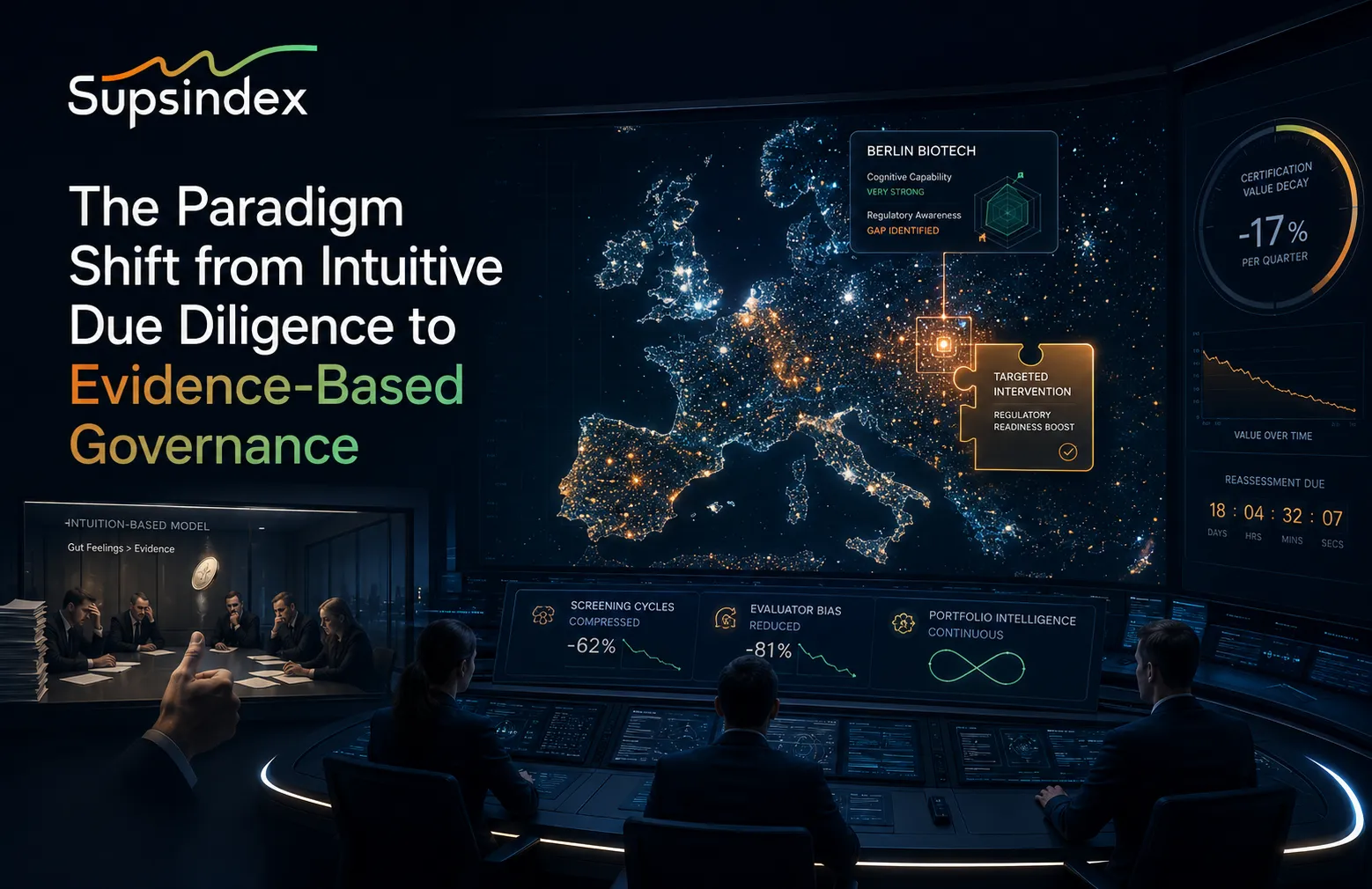
The historical reliance on unstructured pitch competitions and subjective committee reviews has fundamentally distorted the innovation economy. Human intuition is remarkably susceptible to bias; it frequently mistakes charm for competence, homophily for synergy, and theatrical presentation for operational execution capability.
The establishment of standardized human-capital indices prompts a shift toward evidence-based governance. By converting raw psychometric data into standardized quartile rankings—ranging from Investable Grade (Q1) to Foundational (Q4)—the ecosystem gains an un-biased, universally legible language for evaluating founder capability.
    [legacy model]                               [modern paradigm]
  Subjective Pitching                       Triangulated Assessment
           │                                                                │
          ▼                                                             ▼
   Intuitive Bias                       Supsindex 2PL IRT Ability Modeling
           │                                                                 │
          ▼                                                              ▼
High Capital Churn (60-70%)                  Evidence-Based Governance
When institutional allocators embrace evidence-based governance, the entire anatomy of a funding lifecycle undergoes a transformation. Rather than forcing founders to expend hundreds of hours drafting speculative financial projections, the application engine begins with a rigorous, proctored assessment environment. Advanced AI proctoring, browser restriction protocols, and behavioral rhythm tracking ensure that the data collected represents the unassisted capability of the human system being evaluated. This immediately compresses early-stage screening cycles by up to 60%, allowing public funds to process thousands of applicants simultaneously while entirely mitigating human evaluator bias.
Furthermore, this systematic shift enables macro-scale portfolio intelligence that was previously impossible to collect, presenting an immense opportunity for regional networks like EU Innovation Hubs (e.g., EIC/EIT focus). These hubs, including the European Innovation Council (EIC) and European Institute of Innovation and Technology (EIT), are explicitly designed to nurture regional talent and drive pan-European systemic innovation.
How Supsindex Safeguards the Mission: When thousands of regional founders are continuously mapped across standardized indices, Supsindex provides EU Innovation Hubs (e.g., EIC/EIT focus) with aggregated, macro-level human capital reporting. For instance, our data can reveal to an innovation hub that while its local biotech cluster ranks in the top decile globally for cognitive power, it scores dangerously low on regulatory ecosystem awareness. This predictive insight allows policymakers to efficiently design targeted educational modules or structural support networks, transforming regional funding from a defensive rescue mechanism into an offensive, data-backed development pipeline.
┌────────────────────────────────────────────────────────┐
│          SAPINDEX ELEVATED PORTFOLIO METRICS           │
├────────────────────────────┬───────────────────────────┤
│ Macro-Level Tracking       │ Identifies regional gaps  │
│                            │ and structural risks      │
├────────────────────────────┼───────────────────────────┤
│ Dynamic Decay Coefficients │ Weights rankings based on │
│                            │ active, real-time data    │
└────────────────────────────┴───────────────────────────┘
Crucially, our philosophy at Supsindex recognizes that human capability is a living, evolving system rather than a static credential. In a hyper-velocity technological economy, knowledge decays rapidly, regulations shift, and behavioral patterns alter under the weight of market scaling.
Our framework resolves this by applying dynamic validity decay coefficients to our certifications. A founder’s index certificate is weighted at maximum value upon completion, but decays over a multi-year window based on the evolutionary velocity of their industry vertical. This mechanism obligates founders to commit to continuous reassessment and self-evolution, while ensuring that the allocator’s data pipeline remains perfectly aligned with active, real-world competence.
Optimizing the Innovation Pipeline
The empirical evidence is clear: the historical methods of distributing early-stage capital have extracted a monumental toll on global innovation. To preserve capital, accelerate technological breakthroughs, and build an equitable ecosystem, the global innovation economy must adopt a standardized approach to human-capital measurement. The analytical models and psychometric frameworks pioneered by Supsindex provide the precise, un-biased tools required to transform capital underwriting. For institutions, accelerators, and policy leaders dedicated to maximizing the return on every dollar deployed, exploring our comprehensive testing methodologies is the definitive next step toward building a resilient, evidence-backed innovation economy.
