


Mastering the dynamics of Mentor matching in accelerators: threats and opportunities is the ultimate key to mitigating human-centric venture failure and unlocking scalable startup growth.
Mentor matching in accelerators: threats and opportunities
The global venture capital ecosystem has recently undergone a profoundly sobering reckoning. Between the years 2019 and 2024, an estimated $1.7 trillion in venture capital was deployed into the startup ecosystem, yet retrospective, data-driven analyses reveal a staggering capital inefficiency: between $700 billion and $1.2 trillion of that constituted “wasted capital” that utterly failed to return the principal investment. Even more alarming is the causal decomposition of this colossal failure. It was not primarily macroeconomic headwinds, sudden regulatory shifts, or unpredictable “force majeure” events that incinerated this wealth. Instead, an estimated 60% to 70% of these losses were directly attributable to preventable human-centric factors: co-founder conflict, flawed decision-making under intense stress, and profound cognitive blind spots. To stem this hemorrhage of capital and human potential, the global economy relies heavily on incubators and accelerators. These institutions serve as the vital gatekeepers and developers of early-stage talent. Yet, they face a monumental, often paralyzing bottleneck when executing their training programs with accepted startup founders, making the discussion around Mentor matching in accelerators: threats and opportunities one of the most critical dialogues in modern venture capitalism.
This operational challenge typically bifurcates into two distinct domains: the delivery of foundational educational pedagogy and the assignment of dedicated, one-on-one mentors. Regarding the first challenge, the industry has largely stabilized. Accelerators and incubators possess highly capable planners who design robust, comprehensive curricula. The pedagogical approach is usually deployed uniformly across the entire cohort, ensuring that every founder receives a baseline education in market sizing (TAM/SAM/SOM), unit economics, and go-to-market strategies. However, the theoretical classroom is only half the battle. The true crucible of an accelerator program lies in its dedicated mentorship—and this is precisely where the real trouble begins. The vast complexities surrounding Mentor matching in accelerators: threats and opportunities become glaringly apparent when program directors attempt to pair a specific, highly nuanced team with a specific mentor in a way that actually alters the venture’s trajectory.
The first fundamental problem is diagnostic: which mentor should be assigned to which team, and at what specific stage, based on the founder’s existing operational faults or latent knowledge gaps? The second problem is navigational: how should the mentor know exactly which areas the entrusted team needs more intensive training in? Naturally, the default mechanism for resolving these issues is the direct conversation between mentors and founding teams. But we must ask ourselves with scientific skepticism: is this method accurate? The resounding, data-backed answer is no. Direct conversations are hopelessly compromised by psychological phenomena such as the Dunning-Kruger effect, where individuals with low ability at a task grossly overestimate their competence. Furthermore, founders operating in high-stakes environments are heavily incentivized to project an idealized version of themselves, a phenomenon known as impression management or social desirability bias. Consequently, relying on unstructured conversations to execute the parameters of Mentor matching in accelerators: threats and opportunities practically guarantees a misaligned pairing, ultimately squandering the accelerator’s resources and the startup’s potential. Understanding the full scope of Mentor matching in accelerators: threats and opportunities requires us to acknowledge that traditional intuition is a statistically invalid instrument in this high-risk arena.
How to match mentors to founders 
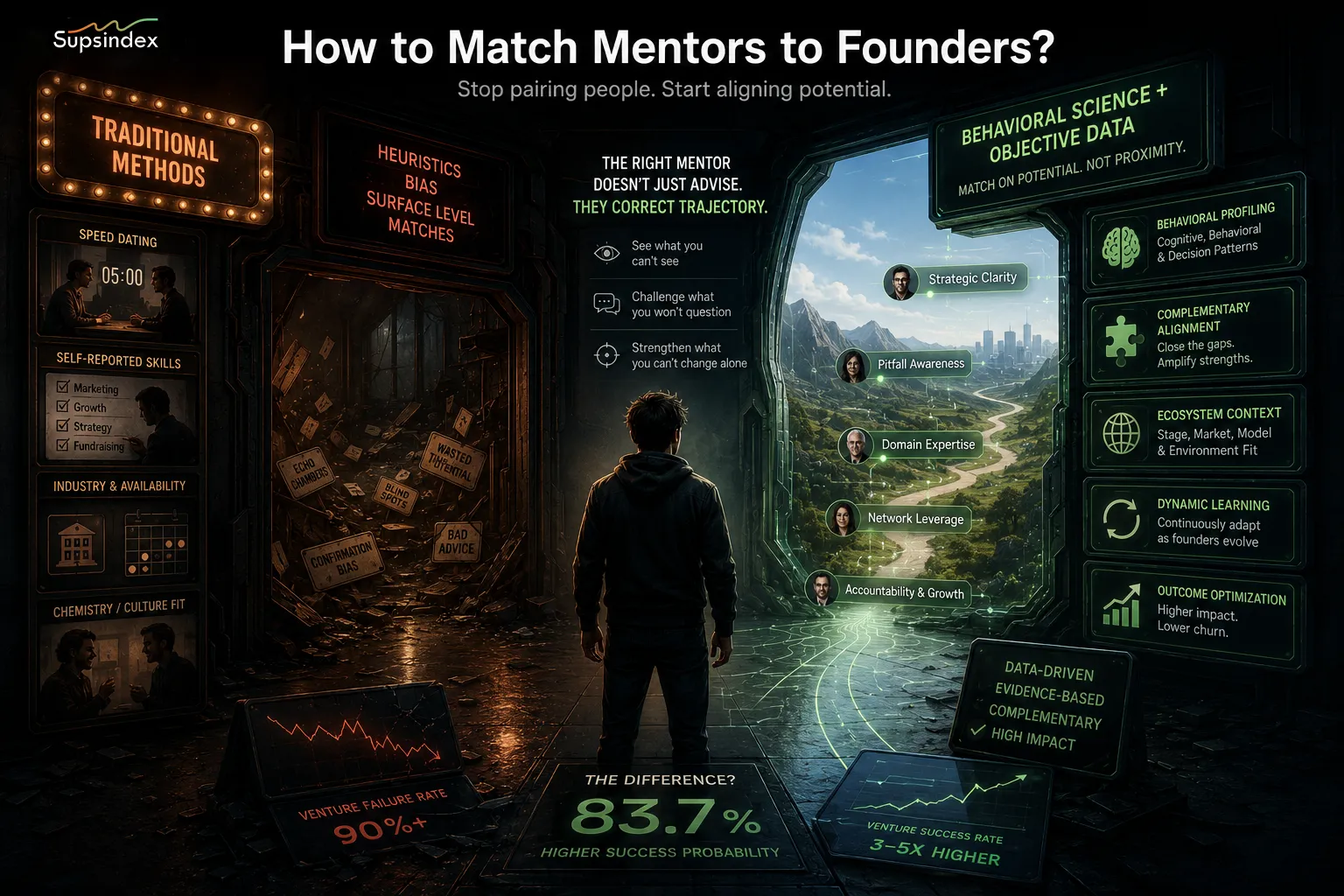
The question of how to match mentors to founders is perhaps the most critical operational dilemma facing modern incubation programs. A deep, critical examination of how program managers currently solve this problem reveals a landscape dominated by heuristics, proximity bias, and superficial software solutions. Currently, the prevailing methods for deciding how to match mentors to founders fall into a few predictable and unscientific categories. The most common approach in many high-profile accelerators is the “speed dating” model, wherein founders and mentors engage in rapid-fire, five-to-ten-minute conversations to gauge “chemistry” or “culture fit.” This method is an exercise in performative charisma rather than a rigorous assessment of complementary skills. It optimizes for extroversion and storytelling prowess, completely ignoring the latent behavioral traits—such as structural resilience, cognitive flexibility, and ethical judgment under pressure—that actually determine a startup’s survival through the “dark forest” of early-stage growth.
When accelerators attempt to digitize this process, they often turn to generic enterprise software platforms. Tools widely utilized in the corporate HR space are frequently retrofitted to automate the matching process. However, a critical critique of these platforms exposes their fundamental inadequacy for the volatile startup ecosystem. These systems primarily match participants based on self-reported skills, industry tags, and calendar availability. They rely heavily on ipsative data, where the founder manually inputs what they believe they need. If a founder lacks financial fluency but is blissfully unaware of this deficit—a cognitive trap known as the “Ostrich Effect,” where individuals subconsciously push away complex metrics that contradict their intuition out of fear—they will never organically request a finance-oriented mentor. Instead, they will request a mentor who validates their existing biases, perhaps someone in marketing to help them aggressively scale a fundamentally flawed, unprofitable business model. Therefore, utilizing self-reported, uncalibrated data to dictate how to match mentors to founders is equivalent to letting a patient diagnose their own illness and prescribe their own medication.
Furthermore, traditional approaches to determining how to match mentors to founders fail utterly to account for the “Founder Effect.” The very traits that allow a founder to launch a company—intense conviction, decisive leadership, and an unusually high tolerance for risk—can rapidly devolve into autocratic management, subjective decision-making, and willful blindness as the company attempts to scale. If an accelerator relies on human intuition to pair a highly dominant, risk-seeking founder with a similarly aggressive, “move-fast-and-break-things” mentor, the resulting echo chamber will only accelerate the startup’s demise. The mentor, lacking objective data on the founder’s underlying psychological architecture, will likely offer generic advice that fails to address the root cognitive derailers. It is abundantly clear that the legacy methodologies defining how to match mentors to founders are not merely inefficient; they are actively detrimental. By reinforcing blind spots and optimizing for likability rather than capability, these outdated methods contribute directly to the venture capital churn that plagues the global innovation economy.
Mentor allocation strategy
To break free from the constraints of subjective alignment, incubators must adopt a rigorously scientific mentor allocation strategy. This transition requires moving away from intuition-based, conversational pairing to an evidence-based framework powered by advanced psychometric measurement and artificial intelligence. This is precisely where the individual test reports generated by the Supsindex platform offer a revolutionary, systemic solution. By utilizing advanced psychometric methodologies such as Thurstonian Item Response Theory (IRT), Supsindex eliminates the distortion of self-reporting and mathematically recovers the latent utilities of a founder’s decision-making process. This provides accelerators with the empirical, bias-free foundation necessary to construct a truly predictive and highly effective mentor allocation strategy.
A data-driven mentor allocation strategy begins with a comprehensive, multi-dimensional assessment of the founding team before they ever step foot in a classroom or meet a potential mentor. The Supsindex framework triangulates this capability through three core indices that replace guesswork with granular analytics. First, the Founder Public Awareness (FPA) index acts as a cognitive engine, measuring the founder’s entrepreneurial literacy and signal-detection ability. Utilizing a 2-Parameter Logistic (2PL) IRT model, it objectively reveals whether a founder actually understands the mechanics of go-to-market strategies, unit economics, and legal compliance, while weeding out those who merely memorize startup jargon. Second, the General Entrepreneurial Behavior (GEB) index operates as a behavioral judgment engine, placing founders in high-pressure situational judgment tests to map their resilience, ethical grounding, and susceptibility to fatal cognitive biases. Third, the Ecosystem Environmental Awareness (EEA) index acts as a contextual intelligence engine, quantifying the founder’s localized knowledge of regulatory frameworks, talent pools, and regional capital landscapes.
Armed with this tripartite, deeply empirical data, an accelerator’s mentor allocation strategy transforms from a game of chance into a precise, targeted intervention. For example, if the GEB report reveals that a brilliant, highly capable technical founder suffers from a severe “Novelty Bias”—characterized by 100% curiosity and risk tolerance but only 55% operational discipline, leading them to constantly pivot and abandon working prototypes for shiny new technological trends—the optimal mentor allocation strategy is absolutely clear. This founder does not need a visionary mentor who will encourage further disruption and chaotic exploration; they need a highly disciplined, execution-focused operator as a mentor who can enforce operational guardrails and teach the mechanics of sustainable scaling. Similarly, if the FPA report highlights a critical deficit in financial and legal hygiene, coupled with an overconfidence bias, the team can immediately be matched with a mentor possessing deep expertise in corporate governance and runway mathematics, thereby preempting a catastrophic cash flow crisis. By leveraging the depth of Supsindex reports, the mentor allocation strategy becomes a surgical instrument, addressing the precise, verified vulnerabilities of the human capital before they metastasize into terminal business failures.
Structured mentor matching tools
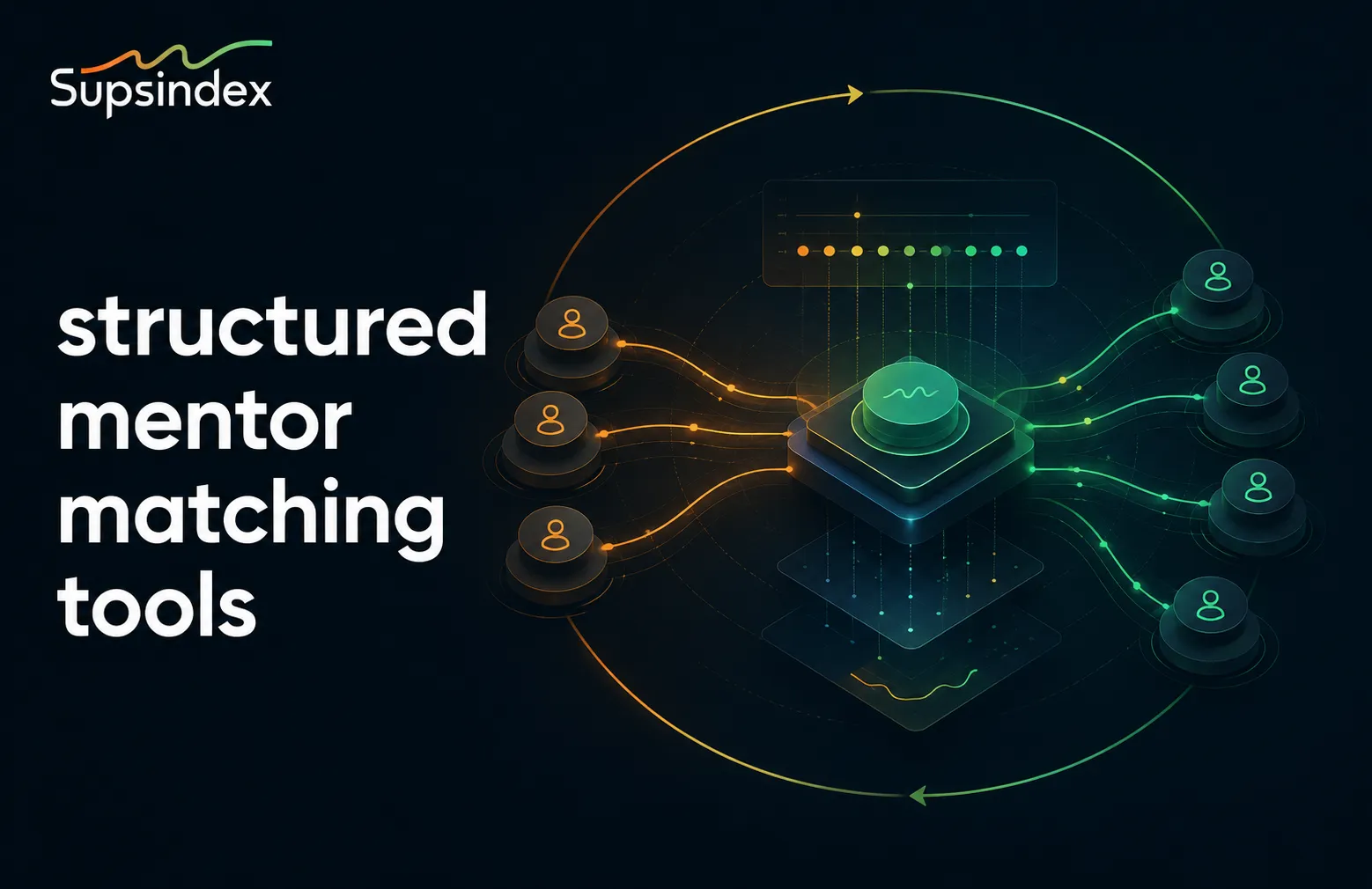
The implementation of advanced psychometrics paves the way for the deployment of truly structured mentor matching tools that govern the entire lifecycle of the incubation process. The defining characteristic of these next-generation structured mentor matching tools is their capacity for longitudinal, continuous measurement. If startup founders take these rigorous, objective tests at both the beginning and the end of the accelerator course, the resulting data unlocks a highly sophisticated, closed-loop feedback system. This before-and-after testing paradigm is the cornerstone of the Founder Continuous Growth (FCG) index, which scientifically tracks a founder’s ability to learn, adapt, and evolve their decision-making capacity over time. Without this temporal measurement, an accelerator is effectively blind to its own efficacy.
Deploying these structured mentor matching tools provides incubators and accelerators with three profound, interconnected advantages. First, the initial baseline test dictates exactly which mentors can be selected depending on the team’s specific, empirical needs, entirely eliminating the reliance on charismatic interviews and subjective chemistry reads. Second, these structured mentor matching tools provide the assigned mentor with an exact, personalized syllabus from day one. The mentor no longer has to spend the first four crucial weeks of a short acceleration program blindly probing for weaknesses or delivering generic lectures that fail to resonate. The Supsindex diagnostic report acts as an explicit roadmap, detailing precisely what issues the mentor should prioritize in their training sessions. Whether the focus must be on mitigating the sunk-cost fallacy, improving toxic co-founder communication through the FEE (Founders Engagement Efficiency) insights, or addressing a fundamental misunderstanding of Customer Acquisition Cost (CAC), the targeted training begins immediately with laser-like precision.
The third, and perhaps most transformative, advantage of these structured mentor matching tools is realized during the end-of-course assessment. Based on the macro-level aggregated reports generated by Supsindex, program directors can definitively measure the delta of improvement for each founder and the cohort as a whole. It will become empirically clear in which areas the teams experienced exceptional growth and in which areas they stagnated or even regressed. This longitudinal data directly and unapologetically identifies the root of any operational problem within the cohort. If a founder shows zero growth in operational execution despite being matched with an operations mentor, the data forces a critical evaluation: either the wrong mentor was assigned (a failure of the matching algorithm), the mentor’s specific guidance was ineffective, or the accelerator’s overarching pedagogy for that subject matter is fundamentally flawed. In systems modeling, this reflects the “Penalty for Bottleneck” principle—identifying the exact constraint holding the system back. By utilizing true structured mentor matching tools, accelerators transition from a culture of assumed value to a culture of proven, verifiable impact, holding both the founders and the institution itself accountable for continuous, measurable improvement.
Conclusion: The Vanguard of Venture Development
When incubators and accelerators adopt this scientific, data-driven approach to human capital, the impact on the cohort’s success rate is profound and immediate. We must continuously remind ourselves of the sobering reality that 60% to 70% of startup losses are driven by direct founder error. By systematically identifying cognitive blind spots, behavioral derailers, and ecosystem ignorance before capital is deployed, and by pairing founders with mentors explicitly equipped to neutralize those specific vulnerabilities, accelerators can dramatically compress the failure curve. This is not merely an academic exercise in psychology; it is an absolute economic imperative for survival in a tightening venture market.
A cohort of startup founders guided by objective data and precisely matched mentorship will navigate the unforgiving landscape of the innovation economy with superior resilience and strategic clarity. They will avoid the unforced errors of premature scaling, toxic co-founder conflict, and willful financial blindness. For the incubator or accelerator, the macro-level impact on the portfolio is transformative. By increasing the survivability and capital efficiency of their admitted teams, these institutions elevate their own Return on Investment (ROI), solidify their reputation as premier talent developers, and attract significantly higher-quality applicants and follow-on investors in subsequent cycles. The transition from intuition to empirical measurement is the only sustainable path forward.
To ensure that your institution is operating at the absolute vanguard of venture development, it is time to abandon the archaic tools of the past. If you are ready to objectively measure the soft power of your applicants, construct highly predictive mentorship alignments, and transform your accelerator’s portfolio through the power of collective intelligence and applied psychometrics, we invite you to explore the specialized diagnostic assessments and customized institutional dashboards available through the Supsindex platform today.
