

Answering the critical question of how to get funded for my startup requires founders to move beyond traditional metrics and objectively prove their team’s resilience to investors.
How to get funded for my startup?
Imagine yourself as a venture capitalist in the year 2026. The desktop screen on your laptop is cluttered with dozens of pitches. Most of them look similar. All of them promise some kind of “exponential growth,” “disruption” and “multi-billion dollar TAM”. They are polished, well-prepared, and convincing. However, they are no different from any other presentation on a similar topic. What makes matters even worse – we are working through a brutal economic period. The days of zero interest rates belong to history, and recent geopolitical tensions, such as a war between the Trump-backed Israel and Iran, have pushed the rate of inflation to unprecedented levels. Capital is expensive and scarce. Then you see something different. One of the slides in a pitch deck contains something unfamiliar: “Human Capital Due Diligence”. There are multiple validated metrics on the cognitive readiness, behavior resiliency, and ability of the team members to make quality decisions under pressure. It is a verifiable and scientific audit of the exact system you have been evaluating subjectively until now.
In this economic reality, the key question that reverberates everywhere sounds increasingly louder: how do I get funds for my startup? The answer here is not in crafting an extra convincing pitch or in estimating your TAM better than others. No, it should be something else. Something that is able to answer the investor’s most burning question objectively: are you, as a founder, capable of executing once reality differs from initial estimates?
Key points of a pitch deck
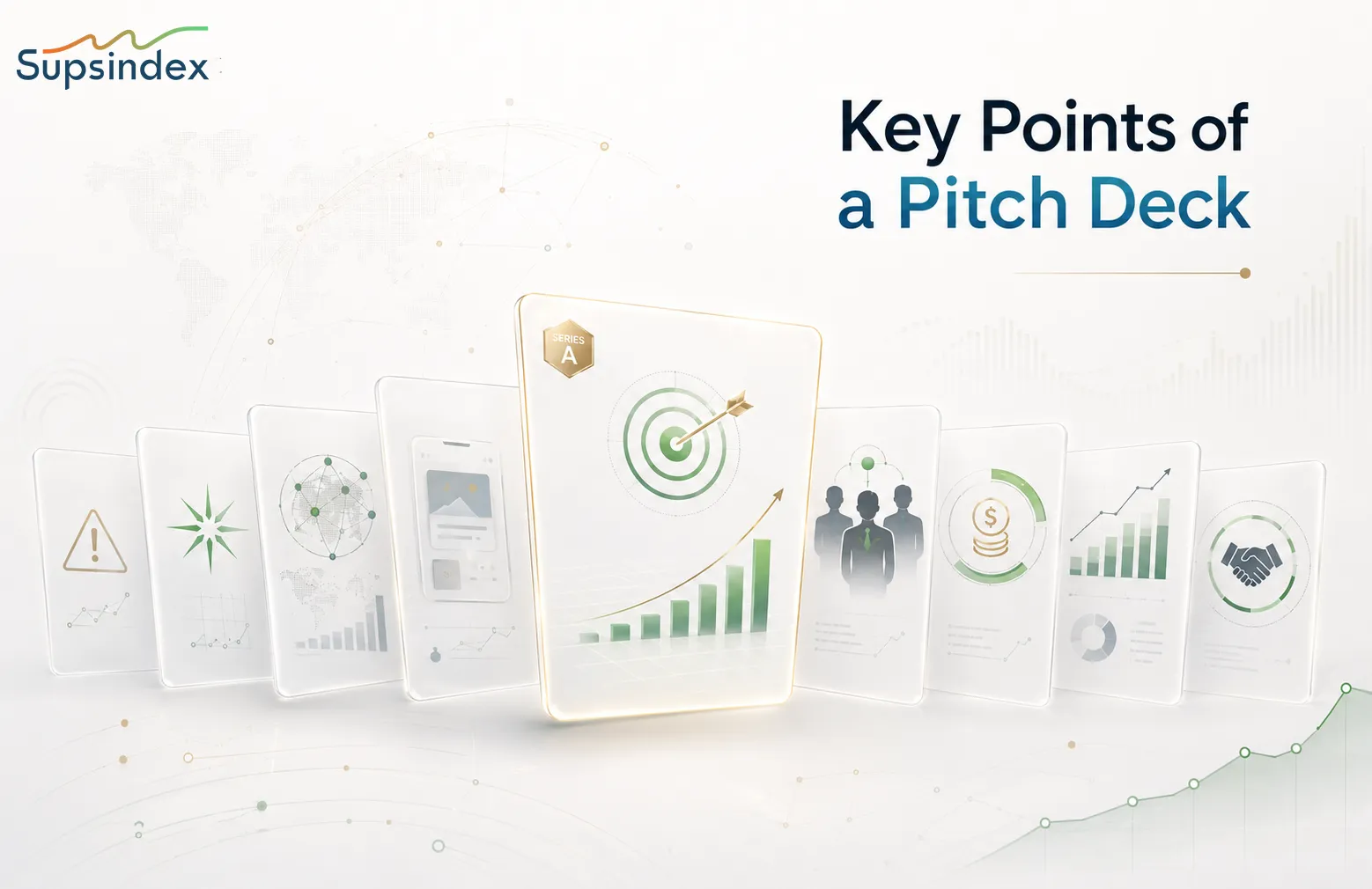
A pitch deck prepared for the Series A financing is quite different from the one that a startup uses in the process of seed or pre-seed funding rounds. It requires a different set of slides as well as a different focus. However, certain elements cannot be left out of the presentation. These are considered the most important points in a pitch deck:
- The Problem – a burning issue faced by the target customer segment;
- The Solution – how the problems mentioned above could be solved effectively by means of your product or service;
- Market Size – the estimation of the total addressable market;
- The Product – demonstration of the product itself (including links to a live demo);
- Traction – metrics that prove how fast your venture is growing (e.g. MRR, customer growth chart with hockey stick-shaped curve, churn)
For a founding team that has navigated the treacherous waters of the pre-seed and seed stages, the pitch deck for a Series A round evolves. It is no longer a document of pure vision; it must be a testament to execution. The playbook for the most important points in a pitchdeck is well-established and, for good reason, has become standardized. It is the narrative skeleton upon which you build your case for investment.
First, you must articulate the Problem with visceral clarity. It must be a “hair-on-fire” issue for a specific customer segment, not a minor inconvenience. This is immediately followed by the Solution, your elegant and compelling answer to that problem. Then comes the evidence of scale: the Market Size (TAM, SAM, SOM), demonstrating that this is not a niche hobby but a venture-scale opportunity. The Product slide showcases what you have built, often with a live demo link, proving you can execute.
Crucially, at this stage, Traction is non-negotiable. This is where you separate yourself from the dreamers. Metrics like Monthly Recurring Revenue (MRR), user growth charts (with the “hockey stick” curve), and customer retention data are the lifeblood of a post-seed deck. The Team slide follows, traditionally featuring smiling headshots and logos from prestigious universities and former employers. The Business Model explains how you make money, focusing on unit economics like LTV (Lifetime Value) and CAC (Customer Acquisition Cost). Finally, the Financials project future growth, and The Ask states precisely how much capital you need and what milestones it will unlock.
These are, without question, the most important points in a pitchdeck. They represent the “what” of your business. They are necessary. But in the harsh light of 2026, they are no longer sufficient.
There is a glaring omission in this traditional structure. It meticulously details the vehicle (the business) but says almost nothing objective about the pilot (the founder). The “Team” slide, with its reliance on pedigree as a proxy for capability, is the weakest link. Investors know this. They know that a brilliant plan executed by a dysfunctional team is worthless. They know that a founder prone to cognitive biases can steer a company with perfect product-market fit straight into the ground. The traditional pitch deck presents a static photograph of a business at a single moment in time. But investors are not funding a photograph; they are funding a motion picture, and they have no way of knowing if the directors are capable of handling the plot twists that are sure to come.
Readiness assessment for fundraising
The venture capital ecosystem is built on a power-law distribution, where a few massive successes pay for a multitude of failures. This model has always accepted a high failure rate as the cost of innovation. However, the data reveals a story not of strategic risk, but of systemic waste. Analysis of the 2019-2024 funding cycle shows that of the $1.7 trillion deployed, as much as $1.2 trillion was lost in ventures that failed to return capital. The most damning finding is that 60-70% of these failures were caused by preventable, human-centric factors: co-founder conflict, flawed decision-making, and a lack of self-awareness. This is the “Founder Effect” in its most destructive form.
In today’s economic climate, this level of waste is no longer tolerable. The inflationary pressures stemming from geopolitical shocks have tightened capital markets to a breaking point. Investors are now forced to make fewer, higher-conviction bets. This environment demands a new layer of due diligence, a rigorous readiness assessment for fundraising that goes beyond the business model and interrogates the capabilities of the founding team itself.
This is where the concept of a “Founder Readiness Index” becomes a strategic imperative. For investors, such an index would provide a standardized, objective tool to measure the “soft power” of a founding team—their cognitive, behavioral, and contextual fitness for the entrepreneurial journey. It would transform the subjective “gut feel” of founder assessment into a data-driven science, allowing VCs to de-risk the human element and invest with renewed confidence. For first-time founders, who lack the credibility of a prior exit, a strong performance on a validated readiness assessment for fundraising would provide the objective proof of capability needed to level the playing field. It allows them to compete on demonstrated potential, not on the strength of their alumni network.
The absence of such a standardized assessment has been a structural weakness in the venture ecosystem for decades. In the current high-inflation, risk-averse world, it has become an existential threat. A comprehensive readiness assessment for fundraising is the mechanism through which investor confidence can be rebuilt, allowing capital to flow more efficiently to the founders who are not just passionate, but demonstrably prepared.
How to get a startup ready for investment
For a founding team staring into this abyss, the path forward can seem daunting. The old advice—”build a great product,” “show traction”—is still true, but it’s incomplete. The new imperative is to de-risk the human component of your venture. The question of how to get a startup ready for investment is now synonymous with the question, “How do we prove we are an elite, resilient, and self-aware team?”
This requires an act of profound corporate and personal introspection. It means turning the same analytical rigor you apply to your product roadmap and market analysis inward, upon yourselves. This is an internal due diligence process, a stress test of your team’s core capabilities before you ask an external party to invest millions. This is how to get a startup ready for investment in 2026.
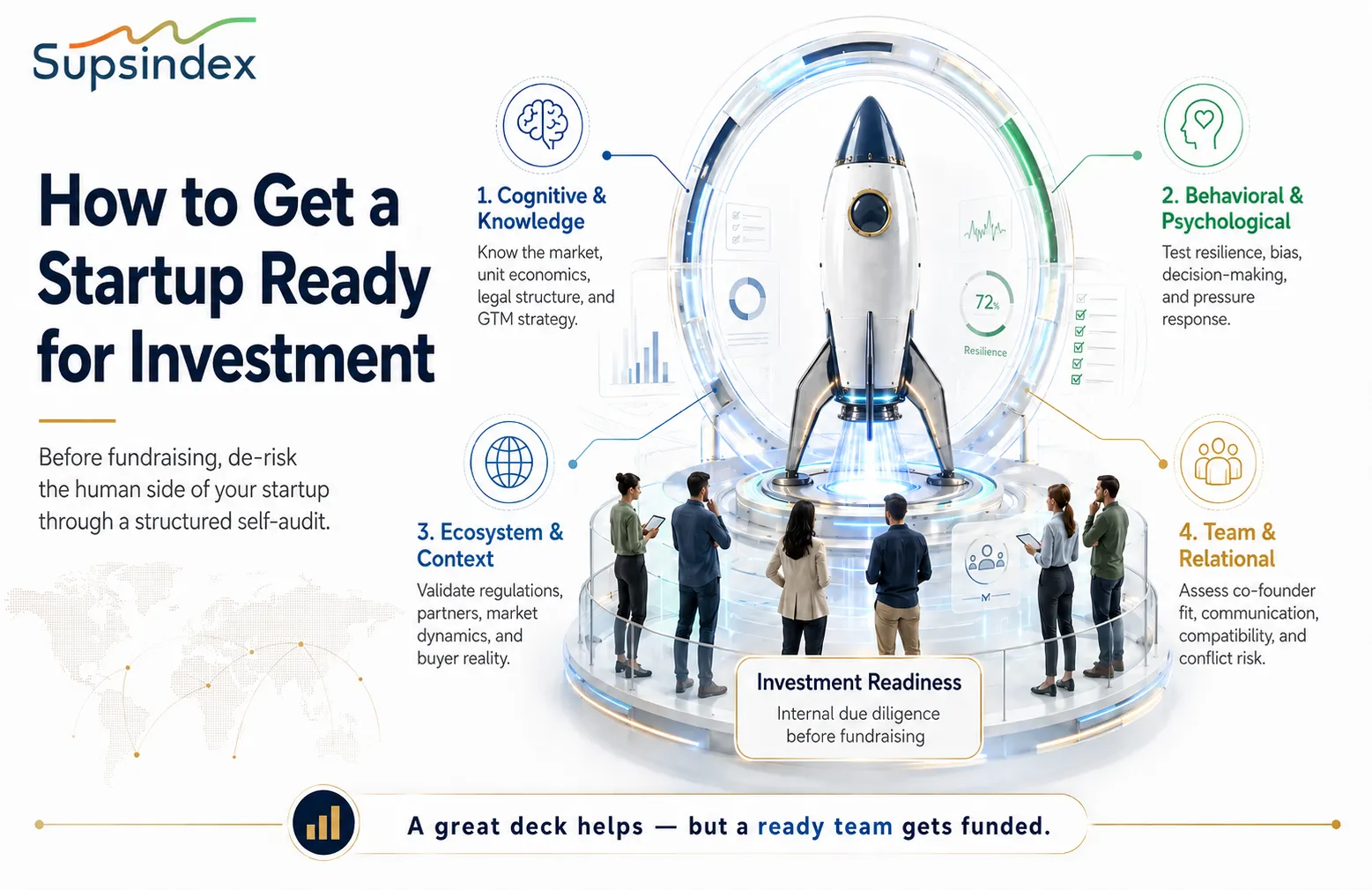
This self-audit must be structured and multi-dimensional, covering the foundational pillars of founder capability:
Cognitive and Knowledge Readiness: Do you truly understand the mechanics of your industry, the stage of your company, and the fundamentals of business? This goes beyond surface-level familiarity. It means mastering your unit economics, understanding the legal implications of your corporate structure, and being able to defend your go-to-market strategy from first principles. This is the domain of a Founder Public Awareness (FPA) assessment.
Behavioral and Psychological Readiness: How do you and your co-founders actually behave under pressure? Are you prone to the overconfidence that leads to reckless spending? Do you suffer from analysis paralysis when faced with ambiguity? Do you have the resilience to learn from failure, or does it crush your morale? A General Entrepreneurial Behavior (GEB) assessment is designed to uncover these hidden patterns, revealing the cognitive biases and behavioral tendencies that operate beneath the surface.
Ecosystem and Contextual Readiness: Have you mastered the specific environment in which you plan to win? If you are a FinTech startup in London expanding to the US, do you understand the nuances of the American regulatory landscape, the key distribution partners, and the cultural expectations of enterprise buyers? An Ecosystem Environmental Awareness (EEA) assessment validates this critical, context-specific knowledge.
Team and Relational Readiness: Is your co-founder relationship a force multiplier or a hidden liability? A Founders Engagement Efficiency (FEE) analysis moves beyond resumes to assess behavioral compatibility, communication styles, and potential conflict zones. It answers the question: “Are we wired to succeed together, or are we destined to fall apart?”
Building your startup for investment is not simply building a great presentation deck but preparing yourself and your team. It involves having the courage to look into the mirror and assess what you know, do, and collaborate on – then designing the systems that can counteract that.
How to win in pitch deck
Here’s how you can win at pitchdeck competition. Remember the tired VC investor in 2026 after 100 similar presentations? Here’s how you beat them: by changing the rules of the game. You not only make a better case but make a completely new case for why yours should be chosen.
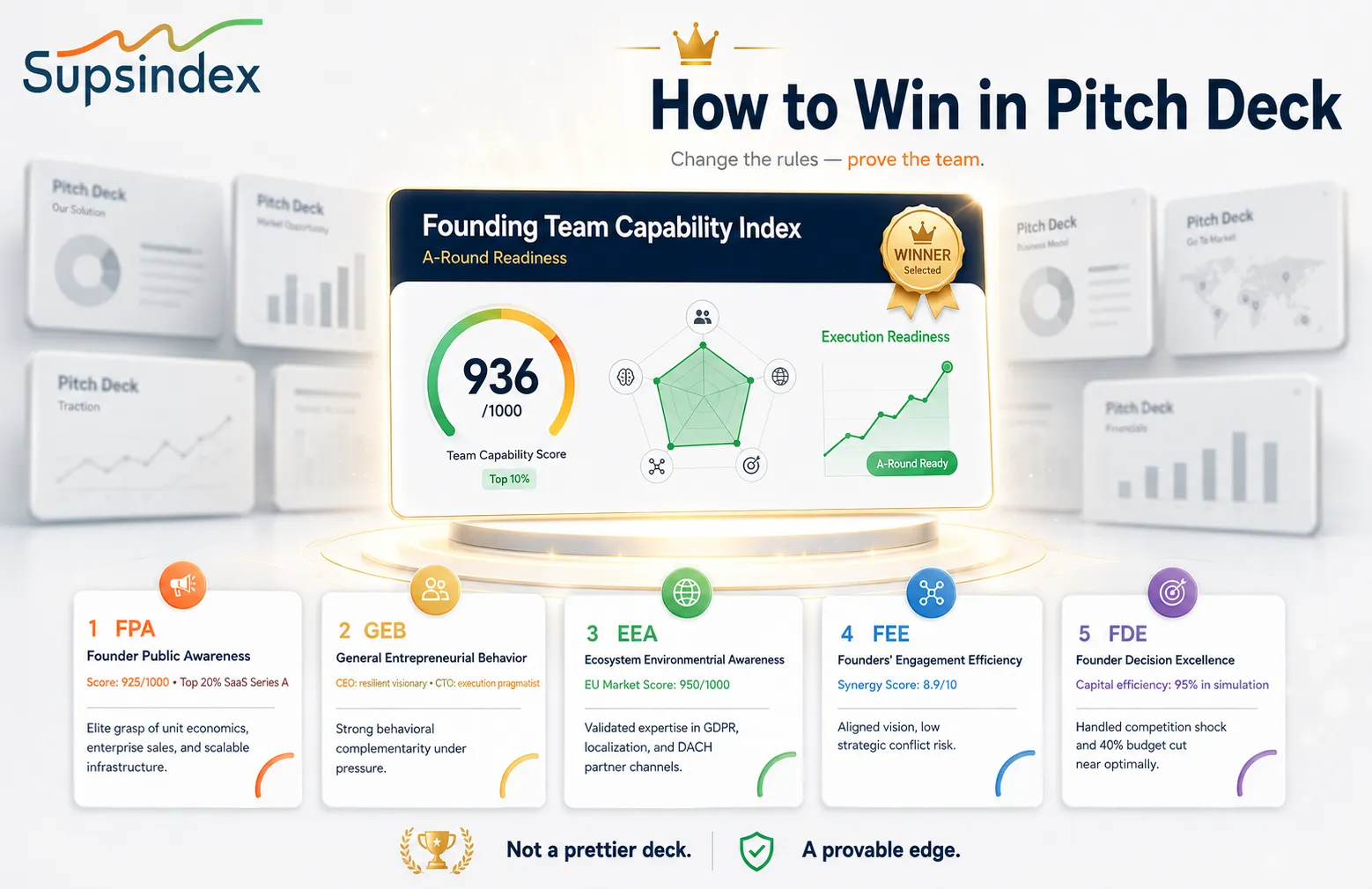
How about their face when you hit them with your “Founding Team Capability Index” slide? It replaces your typical team slide showing smiling pictures and logos with cold, factual data like this:
Founding Team Capability Index: A-Round Readiness
Founder Public Awareness (FPA):
Team Aggregate Score: 925/1000 (Top 20% for SaaS, Series A)
Insight: Demonstrates elite-level understanding of SaaS unit economics, enterprise sales cycles, and scalable infrastructure. [Link to Full FPA Report]
General Entrepreneurial Behavior (GEB):
CEO Profile: High Achievement Drive, High Resilience, Moderate Overconfidence Bias.
CTO Profile: High Self-Efficacy, High Organization, Low-Risk Comfort.
Team Dynamic: A synergistic combination of a risk-taker visionaire (CEO) and an executional pragmatist (CTO). [Full GEB Report Link]
Ecosystem Environmental Awareness (EEA):
EU target market : 950/1000
Insight: Confirmed expertise on GDPR compliance, data localization in Europe, and key partner channels in the DACH region. [See Full EEA Report here]
Founders’ Engagement Efficiency (FEE):
Synergy Score: 8.9/10
Insight: Strong behavioral complementarity. Low likelihood of disagreement regarding strategic priorities or resource use. Demonstrated congruence with respect to vision. [See Full FEE Report here]
Founder Decision Excellence (FDE) – Leadership Flight Simulator:
Outcome: Navigated two shocks (new competition from a major player and slashing the budget by 40%) within our simulated market environment with little variation from optimal decisions as dictated by our Digital Twin. We kept our capital efficiency at 95%.
One slide does what 20 pages cannot do for you. This is telling the investor:
- We are deeply self-aware. We have gone to extraordinary lengths to understand our own strengths and weaknesses.
- We are data-driven to our core. We apply the same analytical rigor to our human capital as we do to our product.
- We have already minimized the risk factor here. This is not an attempt to ask you to take a chance with our character; we have presented the outcome of our scientific review to you.
Here is how you should go about winning your pitchdeck negotiation game. The discussion moves beyond mere belief into facts. At this point, you are not just any ordinary founder, with just an idea, but you are a high-performing management team, who have been tested through various pressures.
In an economic environment defined by scarcity and risk aversion, the burden of proof has irrevocably shifted to the entrepreneur. The question is no longer just “Is this a good idea?” but “Is this the right team to execute this idea, in this market, at this time?” Answering this requires a new level of rigor and a new set of tools. The path to securing funding for your startup is paved with a ruthless commitment to self-assessment and the objective measurement of your team’s capabilities. The era of winning with charisma alone is over. The era of winning with evidence has begun.
The structures and metrics needed to create such evidence are not only theoretical anymore. With enough bravery, founders can start on the road to meaningful self-reflection and have the instruments at their disposal to do so.
