


VC due diligence is evolving past traditional market checks to finally measure the most critical variable in any investment: the founders themselves.
A Guide to Due Diligence for Venture Capital Firms
Between 2019 and 2024, the global venture capital market deployed over $1.7 trillion. According to our analysis, as much as $1.2 trillion of that was wasted—failing to return principal. Critically, 60-70% of those losses weren’t caused by bad markets or failed technology; they stemmed directly from preventable founder error. The message is becoming impossible to ignore: you can continue taking calculated risks on markets and business models, but you can no longer afford to fly blind on the human beings executing the vision.
A growing number of venture capitalists, angel investors, private equity funds, and corporate venture arms are recognizing this reality. They understand that different aspects of investment risk can—and must—be separated. Market risk can be accepted. Technology risk can be hedged. But founder risk? That can now be measured, quantified, and systematically reduced. As technology has evolved, so has the expectation that auxiliary tools must now step forward to support the most consequential decision in any investment: betting on the right people.
The question is no longer whether due diligence on founders matters. The question is whether your current process is precise enough to compete in the coming decade.
The Two Traditional Pillars of VC Due Diligence—and Their Silent Gap
Standard investment due diligence typically operates across two dimensions. First, there is the business and market analysis: TAM, SAM, SOM, competitive landscape, unit economics, financial projections. Second, there are the legal and structural checks: cap table cleanliness, IP assignment, regulatory compliance, contract review. Both are necessary. Neither is sufficient.
What these processes almost entirely miss is the third dimension: the soft power of the founding team. You might spend weeks evaluating the market opportunity, only to have the whole venture collapse because a co-founder relationship fractures under pressure, or because the CEO’s decision-making pattern collapses when runway tightens. Traditional reference calls and résumé reviews simply were not designed to detect these risks. They tell you what someone has done, not how they will behave when the storm hits.
This is the gap Supsindex addresses—not by asking founders to describe themselves, but by scientifically observing how they think, decide, and behave under conditions that mirror the entrepreneurial battlefield.
How Supsindex Transforms VC Due Diligence Across Your Investment Lifecycle
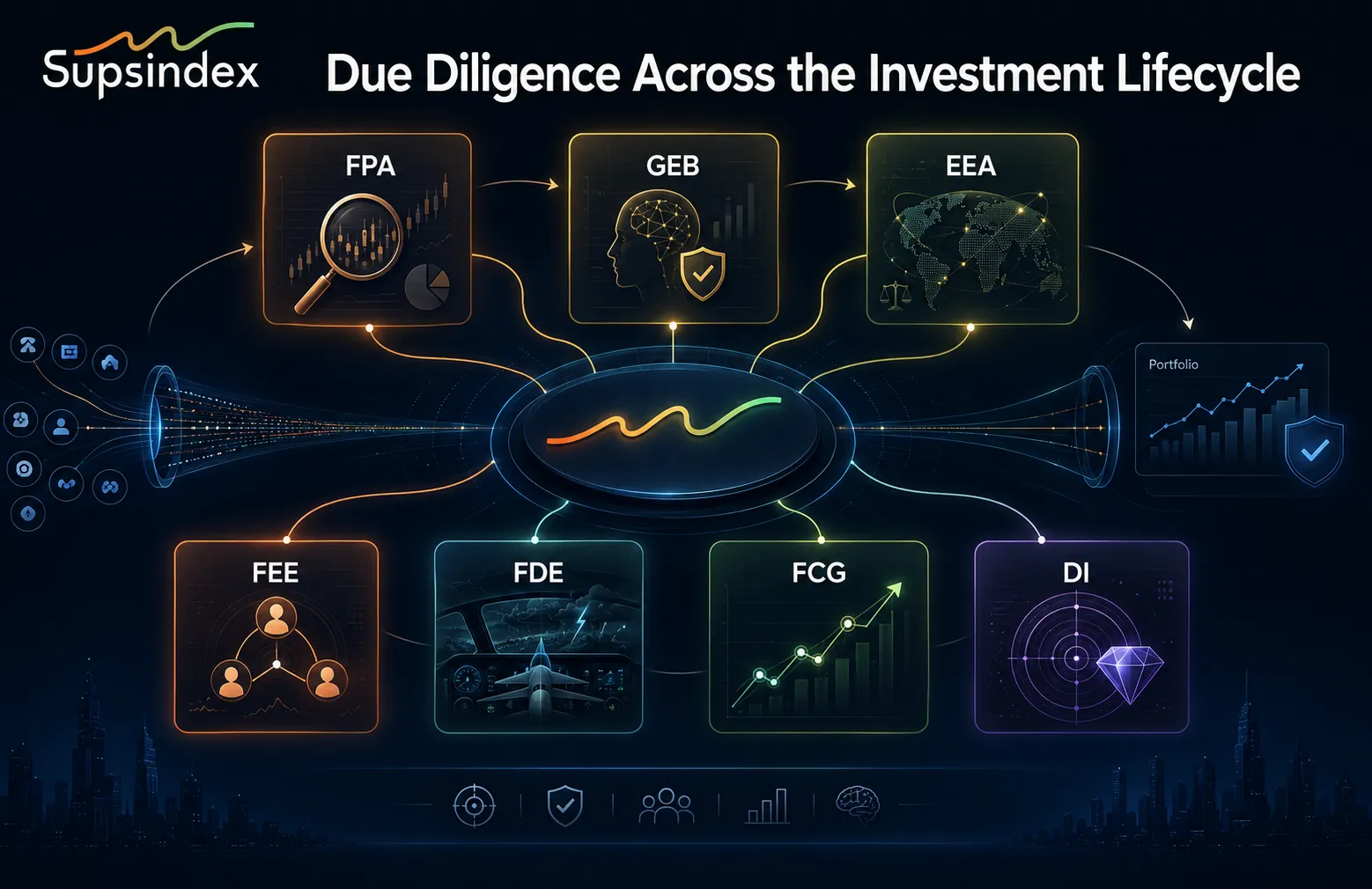
Our suite of seven indices doesn’t replace your existing diligence workflows—it augments them with objective, verifiable, and deeply predictive data about the human capital at the core of every deal.
- FPA (Founder Public Awareness) – For all investor types, this is your baseline reality check. Before you commit to a term sheet, the FPA confirms whether a founder’s understanding of their own market, financial mechanics, and go-to-market strategy is genuinely decision-ready, or merely a well-rehearsed narrative. For angel investors, this is often the difference between backing someone with true literacy and someone who has simply absorbed startup jargon from social media.
- GEB (General Entrepreneurial Behavior) – This is where traditional diligence falls completely silent. Across VC, PE, and CVC portfolios, founders are selected for charisma and conviction, yet frequently derailed by behavioral blind spots. The GEB uses forced-choice, high-pressure scenarios to map decision-making quality, resilience patterns, and susceptibility to cognitive biases. For a private equity firm evaluating an acquisition target’s leadership team, or a CVC assessing whether an innovation unit’s leader can navigate corporate complexity, this insight is invaluable.
- EEA (Ecosystem Environmental Awareness) – For cross-border investors and those backing founders entering unfamiliar markets, the EEA quantifies what no reference call can: genuine, decision-ready knowledge of a specific ecosystem’s regulatory landscape, funding infrastructure, and cultural norms. For government-linked venture programs or startup visa evaluations, this index is particularly powerful.
- FEE (Founders Engagement Efficiency) – Co-founder conflict ranks among the top causes of early-stage failure. Before your investment proceeds, the FEE models team synergy, communication patterns, and behavioral complementarity. It identifies the hidden friction points that traditional diligence can only guess at—giving both VCs and angel investors an early warning system for team risk.
- FDE (Founder Decision Excellence) – The Leadership Flight Simulator – This is our most advanced due diligence tool, designed for the moments that matter most: late-stage diligence, significant Series A or B rounds, and PE acquisitions where leadership quality under pressure directly impacts valuation. The FDE immerses founders in AI-driven crisis scenarios—funding gaps, competitor shocks, team conflicts—and measures actual decision-making behavior against an optimal, bias-free digital twin. For CVCs evaluating whether an internal venture team can truly operate with entrepreneurial autonomy, this simulation provides unprecedented visibility.
- FCG (Founder Continuous Growth) – Post-investment, your portfolio companies don’t stand still—and neither should your visibility into their leadership. The FCG provides longitudinal monitoring of founder development, tracking whether key capability gaps identified during diligence are closing or widening. For the VC who sits on multiple boards, this is an early indicator of which portfolio leaders may need intervention before a crisis becomes a write-off.
- DI (Dedicated Requested Indexes) – When your investment thesis is highly specialized—a specific sector focus, a unique stage strategy, or a proprietary evaluation framework—a DI allows you to build a bespoke assessment index co-designed with our scientific team. For institutional investors managing large, thesis-driven portfolios, this turns your internal selection criteria into a repeatable, defensible measurement system.
“You can’t manage what you can’t measure.” – Peter Drucker
For decades, venture capital has managed market risk, technology risk, and financial risk with increasing precision. Founder risk—the most decisive variable of all—has remained stubbornly unmeasured. That era is closing. With Supsindex integrated into your due diligence process, you finally have the data to make the most important decision in any investment with the same rigor you apply to everything else.
