


Founder risk is one of the most consequential variables in early-stage investing. This founder risk checklist helps investors evaluate founder judgment, execution, team dynamics, financial discipline, and readiness before funding a startup.
The Founder Risk Checklist: 12 Red Flags Investors Should Watch For Before Funding a Startup
Investors rarely write a check without picking apart the market, the financial model, the traction, the competition, the legal structure, the growth assumptions. But there’s one variable that shapes almost everything else on that list, and it usually gets the least rigorous look: the founder.
A great market won’t save a company from a founder with poor judgment forever. A brilliant product can’t fix a co-founder relationship that’s quietly falling apart. And a polished pitch deck has never once stretched a runway that reckless spending was already shortening.
That’s the case for treating founder risk as its own line item in due diligence — especially at pre-seed and seed, where there’s barely any track record to lean on, and where the quality of decisions the founder hasn’t made yet may matter more than the metrics already on the slide.
A founder risk checklist isn’t about disqualifying people. It’s a way to surface the behavioral, cognitive, operational, and team-dynamic signals that standard due diligence tends to walk right past. No single red flag should sink a deal on its own — the value is in knowing what to look for and how to weigh it.
What are the biggest founder red flags investors should look for?
Twelve show up again and again: falling in love with the solution instead of the problem, defensiveness and low coachability, charisma that isn’t backed by execution, an uneven co-founder workload, over-reliance on outside advisors, cracking under unexpected pressure, unresolved role conflict between founders, reckless risk-taking, avoiding hard financial truths, chasing every new idea, a founding team that doesn’t actually complement itself, and an inability to let go of control.
None of these mean much on their own. What matters is whether they stack into a pattern — one that erodes a founder’s ability to learn, decide, execute, and lead once things stop going according to plan.
Why founder risk belongs in startup due diligence
Startups rarely fail for one reason. Weak product-market fit, cash pressure, bad timing, an economic model that never quite worked, a team that fell apart — these usually show up together, feeding each other.
And a lot of that traces back to the founder. A cash crunch is often just the visible endpoint of hiring, pricing, or forecasting mistakes made months earlier. A product that never finds its market may be stuck there because the founder keeps waving away the customer evidence.
None of this means “startups fail because of founders” — that’s too simple. But many of the risks investors already track closely are, underneath, shaped by founder judgment and team dynamics. Early-stage investing is, in a real sense, a bet on decisions that haven’t been made yet.
Market and Decision-Making Risk
1. Falling in love with the solution instead of the customer problem
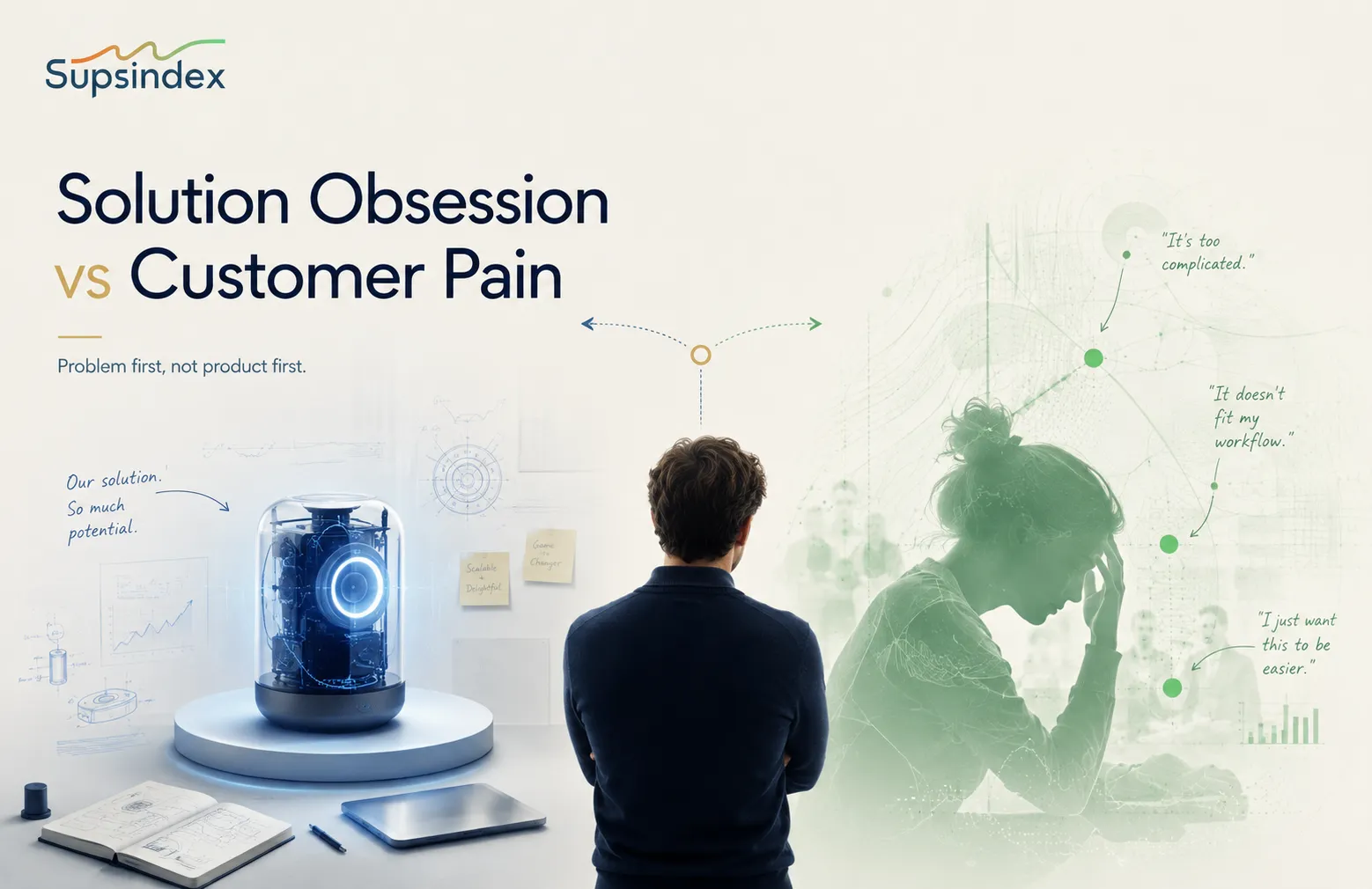
Some founders can talk about their technology for twenty minutes and still struggle to explain, in two sentences, what customer problem it actually solves.
They light up describing features, architecture, patents, technical elegance — and get noticeably vaguer when asked who urgently needs this, how people solve the problem today, or what evidence backs up the demand.
Passion isn’t the issue. The trouble starts when a founder’s attachment to their solution outweighs their interest in finding out whether it’s right. At that point, contradictory customer feedback stops reading as information and starts reading as resistance.
What investors should test
Ask: “Tell me about a product assumption customers proved wrong. What did you do once you realized it?”
A strong answer separates the original belief from the evidence that challenged it, and shows what actually changed as a result. The ability to update a belief is often worth more than having guessed right the first time.
2. Defensiveness and low coachability
Coachability doesn’t mean agreeing with every investor or advisor in the room — that kind of blind compliance is its own risk. A genuinely coachable founder can take in outside information, weigh it, and use what’s useful without treating disagreement as an attack.
The warning sign is what happens under a hard question: does it get met with defensiveness? Is customer criticism waved off? Is internal disagreement treated as disloyalty? Does feedback get nodded along to in the room and quietly ignored afterward?
Disagreement isn’t the problem. Not being able to seriously entertain the possibility of being wrong is.
What investors should test
Ask: “What’s the strongest criticism of your current strategy that you think might actually be valid?”
Then push back on the answer, respectfully. Don’t judge whether they agree with you — judge how they reason through the disagreement. What you’re looking for is intellectual flexibility paired with independent judgment, not one without the other.
3. Charisma without the numbers to back it up

Charisma matters — founders have to recruit, sell, raise money, and get people to believe in something that doesn’t exist yet. But being persuasive and being operationally capable are two different skills.
The red flag shows up when the pitch is polished but the founder gets fuzzy the moment the conversation moves to conversion, retention, CAC, sales cycle, burn, runway, or margins. If the story only holds up when the founder is the one telling it, that’s worth noting.
What investors should test
Step away from the deck and ask: “What are the three numbers you check most often to know whether the company’s improving?”
A pre-seed founder doesn’t need flawless metrics. But they should know exactly what evidence would prove — or disprove — their core assumptions. A good story can raise money. Evidence is what tells you whether it deserves to.
Operational Risk
4. The asymmetric team: co-founders on paper
A startup with three names on the cap table isn’t necessarily a startup with three people actually running it.
Often one founder is carrying product, fundraising, hiring, customer relationships, and day-to-day execution, while the others show up mostly in the deck. That’s hidden key-person risk sitting in plain sight.
Look for one founder answering nearly every question, one person owning all the important relationships, only one founder who actually understands the finances, or a team that describes roles vaguely as “we all just do everything.”
The issue isn’t that one founder is doing more — it’s that nobody’s noticed how concentrated things have become.
What investors should test
Interview the founders separately and ask each: “What are you personally accountable for over the next 90 days?”
The answers shouldn’t be identical, but they should fit together like puzzle pieces. A healthy team can describe both their individual ownership and how it connects to the whole.
5. Can’t make decisions without checking first
Mentors and advisors can sharpen a founder’s judgment. They shouldn’t replace it.
There’s a real difference between “I want more information before I decide” and “someone else needs to tell me what to do.” Watch for a founder who needs sign-off on routine calls, freezes when advisors disagree with each other, or blames the advisor when something goes wrong.
The healthier pattern looks like: seek input, weigh the evidence, decide, own what happens, learn from it.
What investors should test
Give them a strategic problem with incomplete information and ask: “What would you decide today — and what would have to change for you to decide differently?”
A capable founder can act without pretending they have certainty they don’t.
6. Cracking under pressure they didn’t see coming
A pitch meeting is a controlled environment. Running a startup is not.
Customers churn. Key people quit without warning. A competitor drops their prices. The product breaks at the worst time. Funding gets delayed. What happens to a founder’s decision-making when several of those things hit at once?
Watch for someone who loses their logical footing under challenge, makes impulsive commitments, swings emotionally, or simply can’t figure out what to prioritize.
What investors should test
Introduce some manufactured uncertainty, without being unnecessarily harsh: “Your biggest customer leaves next week and your next round slips six months. Walk me through your first 48 hours.”
Listen for the sequencing — what gets protected first, what gets cut, who gets told, what information they’d need before deciding anything. You’re not grading for a perfect answer. You’re watching whether pressure sharpens their thinking or scrambles it.
Founding-Team Risk
7. Founder infighting and unclear authority
Disagreement between co-founders is normal — often it’s healthy. The red flag is unresolved ambiguity about who actually decides what.
Watch for two founders who both believe they own the same call, titles that seem negotiated by ego rather than function, contradictions between founders in the same investor meeting, tension over equity or workload, or simply no process for breaking a tie.
What matters more than whether founders “get along” is whether they can disagree productively, keep authority clear, and resolve conflict without it spilling into execution.
What investors should test
Ask each founder separately: “Which decisions can your co-founder make without checking with you first?”
Then compare notes. The gap between the two answers can tell you more than either answer alone.
8. Reckless risk dressed up as founder courage
Startups need some appetite for risk — too much caution can be just as fatal as too little. But there’s a difference between a calculated bet and unmanaged exposure, and investors should be able to tell them apart.
Warning signs: big irreversible commitments made on thin evidence, waving away downside scenarios because “we’re confident,” putting most of the company’s cash into one untested bet, or treating any contingency planning as pessimism.
The problem isn’t confidence. It’s miscalibration.
What investors should test
Ask: “What’s the biggest risk you’re deliberately taking right now — and what would tell you it’s no longer worth taking?”
A well-calibrated risk has a rationale, a known downside, an expected payoff, and some kind of stopping point. Conviction with no exit condition is worth a second look.
9. The ostrich effect: avoiding bad financial news
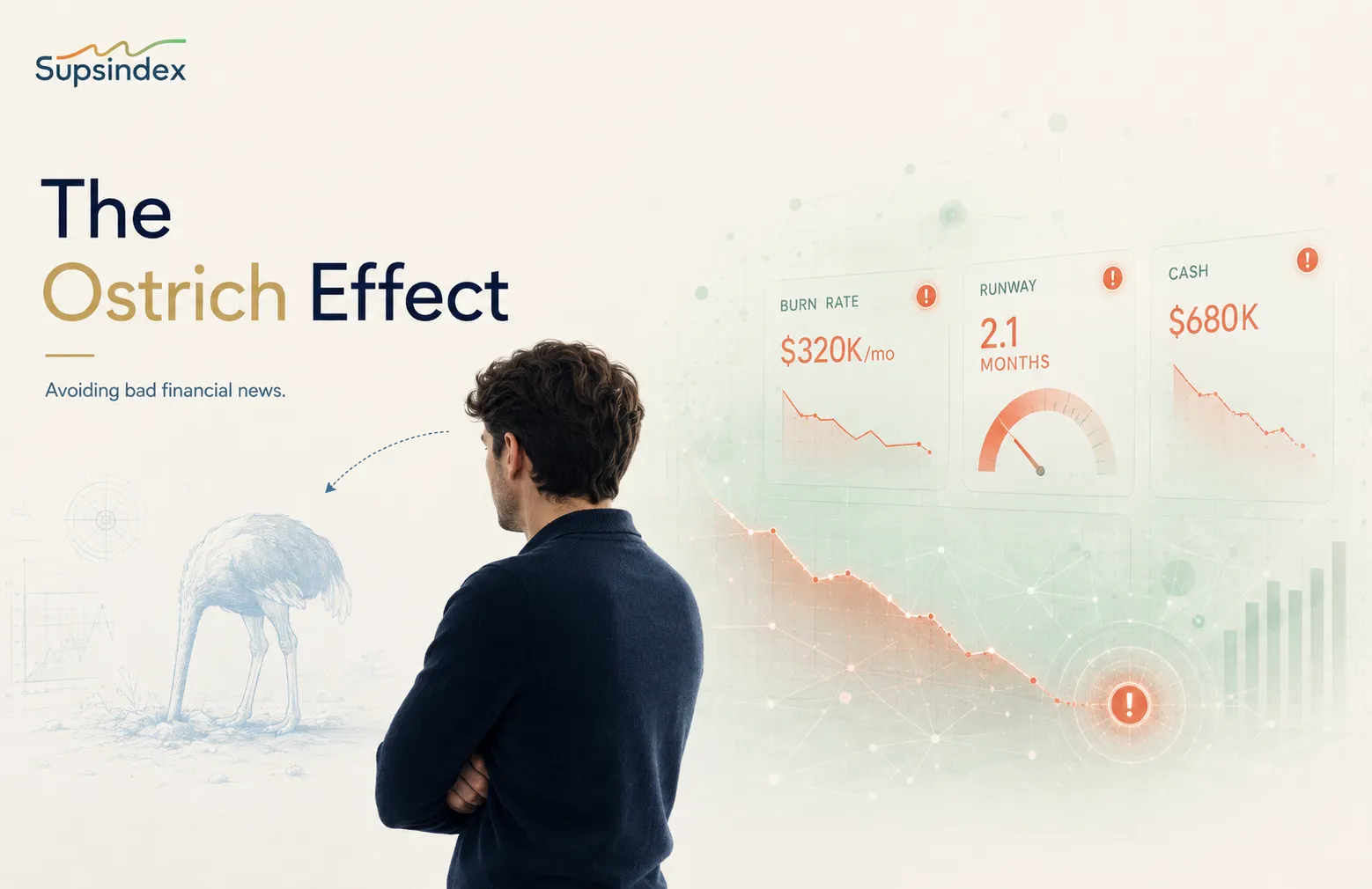
Some of the most important numbers in a startup are the simplest ones: cash in the bank, monthly burn, runway, receivables, committed spend, revenue concentration.
The problem usually isn’t that founders can’t calculate these. It’s that some avoid looking closely enough to confront what the numbers actually say. That’s information avoidance — dodging something useful because knowing it is uncomfortable.
Look for a CEO who can’t estimate runway on the spot, financial reporting that keeps slipping, forecasts that stay optimistic despite repeated misses, or a founder who can talk revenue fluently but goes quiet on costs.
What investors should test
Ask, without warning: “Roughly how many months of runway do you have, and what would move that number the most?”
Then: “If revenue comes in 30% below plan for six months, what’s the first thing that changes?”
Nobody expects the founder to be an accountant. But they need to actually know where the company stands financially, not just believe it’s fine.
Focus and Scaling Risk
10. Novelty bias: chasing the shiny object
Curiosity can be a real asset — plenty of startups exist because a founder noticed something everyone else ignored. But that same curiosity turns risky when every new idea gets more attention than the strategy already in motion.
Watch for a roadmap that shifts every time a competitor launches something, instant pivots toward whatever’s trending, projects that keep starting but rarely finish, priorities that change weekly, and a team that’s stopped trusting what leadership calls “urgent.”
Pivoting isn’t the issue. Changing direction because something is new, rather than because something was actually learned, is.
What investors should test
Ask: “What’s an attractive opportunity you’ve deliberately chosen not to pursue?”
This is a surprisingly effective question, because a real strategy is partly defined by what a company refuses to do. A founder who can’t name anything may not have a strategy yet — just a list of options.
11. A founding team that looks complementary but isn’t
Founding teams often come together through familiarity — old friends, former colleagues, classmates. That can absolutely work. But familiarity doesn’t guarantee complementary skills.
Warning signs: every founder is strong in the same area, no one owns a critical capability, several risk-takers and no one grounding the team, multiple strategists and no one who actually executes, or everyone quietly competing for the same kind of authority.
More founders doesn’t automatically mean less risk. Three founders who share the same blind spot just amplify it.
What investors should test
Ask each founder: “What does your co-founder do materially better than you?”
Then: “Where does your co-founder cover for one of your weak spots?”
Teams that work well together usually have a clear, specific answer for why they need each other.
12. Micromanagement and the inability to let go
Some founders end up trapped by the exact instincts that got the company off the ground.
Early on, hands-on ownership helps — reviewing every product call, talking to every customer, approving every hire. Then the company grows, and the founder keeps operating as if it’s still a five-person team.
The strength turns into a ceiling.
Watch for employees waiting on approval for minor decisions, work quietly getting taken back after it was delegated, senior hires with titles but no real authority, or execution slowing down as headcount goes up.
Scaling means shifting from personally producing every outcome to building a system that can produce outcomes without you.
What investors should test
Ask: “What decision could your leadership team make tomorrow without asking you first?”
Then: “What are you still doing personally that you should probably stop doing in the next year?”
A founder who can name the bottleneck is in a very different place than one who thinks the bottleneck is everyone else.
One more financial red flag: excessive founder pay
There’s a separate financial signal worth calling out on its own: a founder taking a disproportionately high salary right after closing an early-stage round.
Founder salary by itself isn’t a red flag. The real question is whether it’s reasonable given the stage, the round size, the runway, local norms, and what the rest of the team is being paid.
An unusually high salary drawn from a small seed round can say something about how a founder actually thinks about investor capital — as company resources to steward, or as personal upside already earned.
A red flag is a prompt, not a verdict
The worst way to use a founder risk checklist is mechanically. One defensive answer, one delegation problem, one disagreement between co-founders — none of that should sink a deal by itself.
Every founder has weak spots. What matters is understanding where the risk actually sits, how serious it is, whether the founder even sees it, whether the team compensates for it, and whether it’s something that can be coached or something that’s just baked in.
Context changes everything. Micromanagement in a three-person pre-product startup means something very different from micromanagement in a 70-person company. High risk tolerance can fuel experimentation and wreck treasury management in the same breath. Deep conviction can help a founder survive early rejection — and become dangerous the moment it stops them from seeing clear market evidence.
The more useful question isn’t “does this founder have this trait?” It’s: under what conditions does this behavior show up, and what does it cost the company when it does?
Look for patterns, not isolated traits
Founder risks get a lot more informative once you see how they interact.
High confidence alone can be an asset. Pair it with weak financial fluency, avoidance of bad news, low coachability, and reckless capital decisions, and the risk profile looks completely different.
A controlling founder can be perfectly normal in a five-person startup. Add low trust, poor delegation, an uneven workload, and volatility under pressure, and you may be looking at a future organizational bottleneck instead.
This is why founder assessment has to be multidimensional. Individual traits are just signals. It’s the combinations that turn into systems.
Why founder interviews alone don’t catch everything
Interviews are useful, but they have real limits. Founders know they’re being evaluated. The common VC questions get rehearsed. Strong communicators leave a better impression than weaker ones with the same substance — and investors are just as susceptible to that as anyone else.
The fix isn’t to drop interviews. It’s to triangulate them. Financial and market due diligence test claims against evidence; founder due diligence deserves the same standard.
From gut feel to structured founder assessment
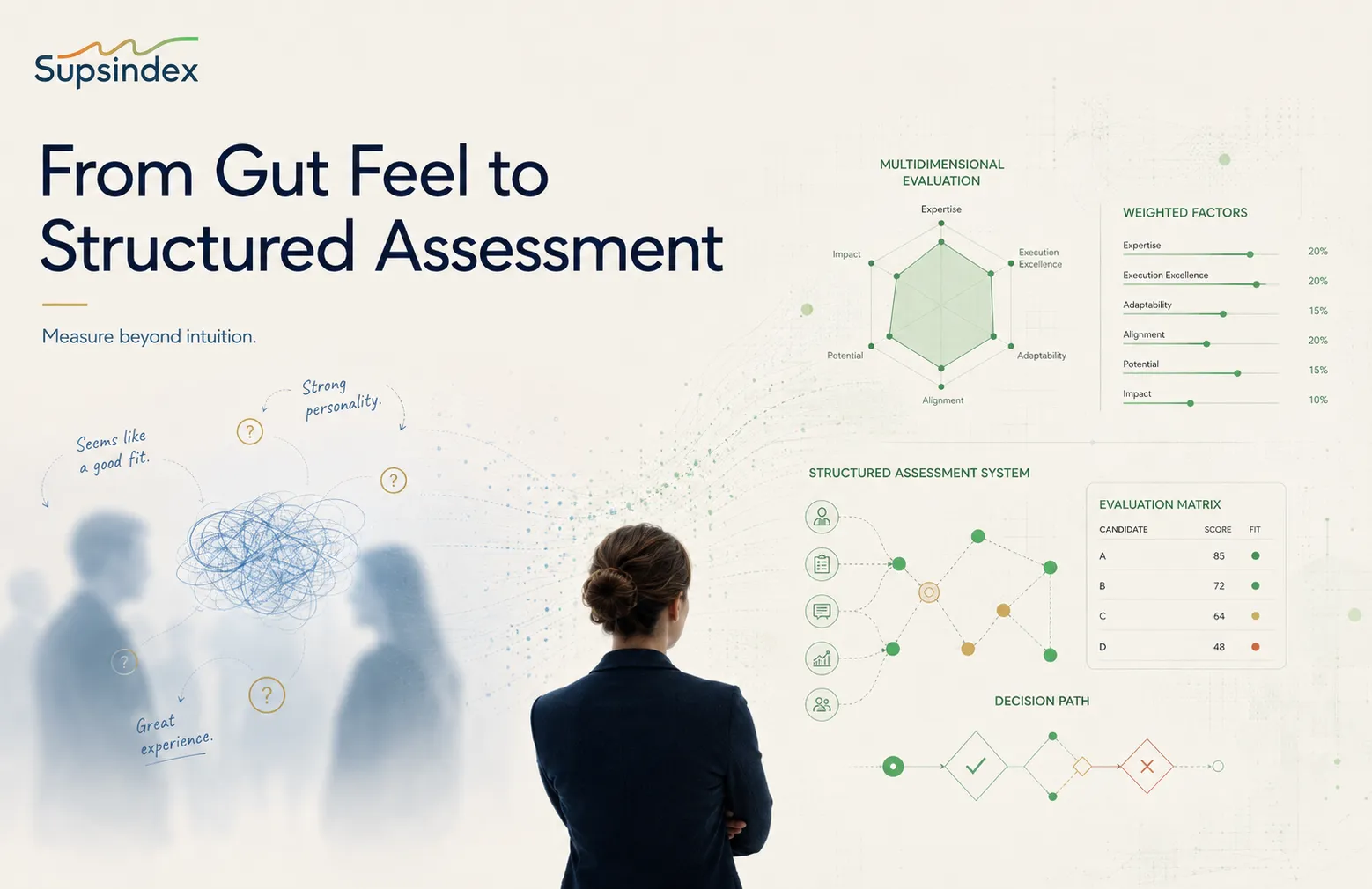
A stronger approach to founder assessment combines behavioral interviews, reference checks, operating evidence, team analysis, scenario questions, knowledge checks, decision simulations, and validated psychometric methods.
This works best when it moves past the obvious self-report questions — “how would you describe yourself?” or “are you good under pressure?” — because in a high-stakes conversation, the desirable answer is too easy to guess.
Forced-choice and situational formats help here, since they ask people to choose between competing actions instead of letting them rate themselves highly on every trait that sounds good. Techniques like Thurstonian Item Response Theory can model someone’s actual latent preferences from those forced-choice responses — though no assessment should be sold as fake-proof or as a guarantee of startup success.
The realistic goal is better measurement of uncertainty, not the elimination of it.
How Supsindex approaches founder risk assessment
Supsindex treats founder assessment as something broader than a standard personality test.
The framework looks across several dimensions of founder capability: entrepreneurial knowledge, behavioral judgment under uncertainty, exposure to cognitive bias, adaptability, resource management, strategic judgment, and awareness of the ecosystem the founder is actually operating in.
The goal isn’t to stamp a founder “good” or “bad.” It’s to surface strengths and blind spots, and to show how those weaknesses might interact with the specific realities of that startup.
For investors, the value is simple: founder risk becomes another due-diligence layer, instead of a gut feeling sitting outside the investment model.
Founder Risk Checklist FAQ
What is founder risk?
Founder risk is the possibility that a founder’s decisions, behaviors, knowledge gaps, leadership patterns, or team dynamics end up hurting the startup’s ability to execute, adapt, allocate resources, or simply survive. It’s not the same as personality — it’s specifically about behaviors and capabilities that have operational consequences.
What are the biggest red flags in a startup founder?
The major ones: resisting customer evidence, defensiveness, weak grasp of company metrics, co-founder conflict, an uneven workload, over-reliance on advisors, reckless risk-taking, avoiding hard financial truths, chasing new ideas at the expense of focus, and struggling to delegate. No single signal should decide an investment on its own — what matters is whether a pattern shows up.
How do investors assess founders during due diligence?
Through structured interviews, operating metrics, reference checks, scenario questions, separate co-founder interviews, knowledge checks, and behavioral assessment. The goal is to understand not just what a founder has achieved, but how they think, learn, decide, handle pressure, and work with others.
Is coachability important when investing in founders?
Yes — but it shouldn’t be confused with obedience. A coachable founder can seriously weigh feedback, tell good advice from bad, update their assumptions when the evidence changes, and still hold on to independent judgment.
Is founder conflict always a red flag?
No. Disagreement can be healthy. The risk shows up when conflict turns personal, authority stays unclear, decisions stall, or the team can’t work through disagreement without damaging execution.
Can founder behavior actually be measured?
Some of it, yes — though no assessment can perfectly predict startup success. Structured interviews, situational judgment tests, forced-choice assessments, simulations, and longitudinal data all provide more signal than intuition alone. The goal isn’t perfect prediction. It’s better measurement of uncertainty.
Founder risk deserves its own due-diligence layer
Investors have gotten remarkably sophisticated about measuring startups. Markets get modeled. Cap tables get inspected. Customer references get checked. Legal risk gets reviewed. Unit economics get stress-tested.
And yet the people responsible for navigating all of that are still often evaluated mostly through pitches, references, pattern-matching, and gut instinct.
That gap matters most at the earliest stages, where a company’s future value depends heavily on decisions that haven’t been made yet.
A founder risk checklist won’t tell an investor which startup succeeds — and it shouldn’t try to. What it can do is make one of the most consequential parts of due diligence a little less invisible.
Does the founder respond to evidence? Can they take criticism without losing their own judgment? Do the numbers actually support the story? Is the founding team functional, not just friendly? Does the founder understand risk, or just tolerate it? Will bad news get confronted or avoided? Can the company eventually run without every decision passing through one person?
And maybe the most important question of all: when reality contradicts the plan, is this a founder who changes course before the market forces them to?
Uncertainty isn’t going away in early-stage investing. The goal isn’t to eliminate it. It’s to stop leaving so much of it unmeasured.
