


Founder science is still being drowned out by startup noise. This article examines Founder Readiness, Founder Assessment, and the evidence gap behind hustle culture.
The Great Distraction: How Hustle Culture Is Silencing Founder Science
What happens when an ecosystem becomes obsessed with the appearance of success while paying remarkably little attention to the science of becoming capable of achieving it?
The global startup ecosystem has never been louder. Every day, millions of posts, articles, videos, interviews, and conversations celebrate fundraising announcements, unicorn valuations, founder journeys, productivity techniques, inspirational quotes, and the latest story of someone who apparently managed to overcome impossible odds through determination and relentless effort. Founders are constantly encouraged to move faster, work harder, raise more capital, think bigger, stay resilient, and never give up. Yet beneath this enormous volume of entrepreneurial conversation lies a remarkably different reality: while we have developed an almost limitless vocabulary for describing what startups want to achieve, we still have a surprisingly limited vocabulary for discussing whether the people building those companies are actually prepared for the journey.
This is the central finding of the first Supsindex Ecosystem Pulse Report, titled “The Great Distraction: How ‘Hustle Culture’ Is Silencing ‘Founder Science’.” Rather than examining another group of startups, investors, or funding rounds, the report looks at the ecosystem itself and asks a deceptively simple question: how much attention does the entrepreneurial world actually give to the concepts of Founder Readiness and Founder Assessment when compared with the enormous attention given to conventional startup narratives? The answer, based on the first-quarter baseline, is striking. The ecosystem is saturated with conversations about effort, funding, ambition, and outcomes, while the language of readiness, founder capability, execution efficiency, behavioral risk, and measurable human capital remains almost invisible. In other words, the startup world spends enormous energy discussing where founders want to go, while devoting remarkably little attention to whether they are prepared for the journey.
Why the Pulse Report Exists
Supsindex was created around a relatively simple proposition: some of the most consequential variables in entrepreneurship are also among the least objectively measured. Markets can be analyzed, financial models can be audited, customer acquisition costs can be calculated, and metrics such as revenue, churn, runway, valuation, and growth can be tracked with extraordinary precision. The founder, however, has traditionally remained largely outside this measurement system. Founder capability is frequently evaluated through interviews, reputation, previous experience, pitch performance, intuition, or the subjective impression created during a relatively short interaction, even though the individual making the decisions may ultimately have a greater influence on the company’s trajectory than many of the variables that receive far more analytical attention.
The Supsindex approach begins with a different assumption: if human capabilities have a meaningful influence on entrepreneurial outcomes, then they should not remain permanently confined to the realm of intuition simply because they are difficult to measure. Founder Readiness is therefore approached as a multidimensional construct that can be examined through structured assessment rather than inferred from confidence, charisma, or the quality of a pitch deck. The Ecosystem Pulse Report extends that philosophy beyond the individual founder and turns the measurement lens toward the entrepreneurial ecosystem itself. Its purpose is to observe whether the concepts surrounding Founder Readiness and Founder Assessment are beginning to appear in the language of founders, investors, researchers, media, and other ecosystem participants—and, over time, whether that language changes.
The first report therefore establishes a baseline. Before asking whether the world is becoming more interested in Founder Science, Supsindex first needed to determine how much attention the subject receives today.
33 Million Signals—and a Remarkable Silence
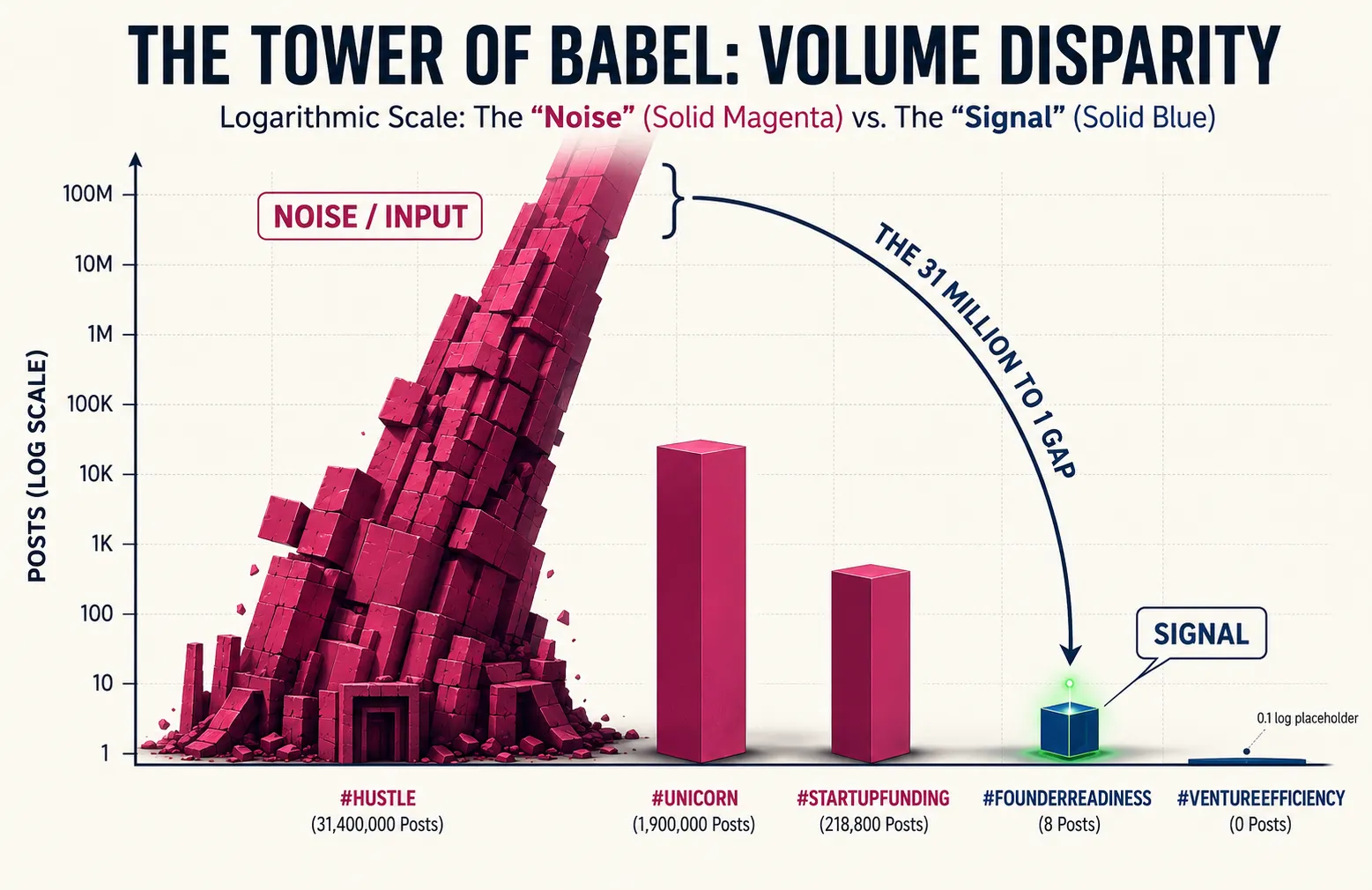
For the Q1 baseline, the Supsindex Communication Unit analyzed more than 33 million digital signals, using data from Google and X alongside keyword and hashtag frequency to compare the volume of different narratives within the startup ecosystem. The objective was not merely to identify popular startup topics, but to compare the enormous amount of attention devoted to aspirational narratives with the amount of attention devoted to the underlying mechanics of entrepreneurial performance.
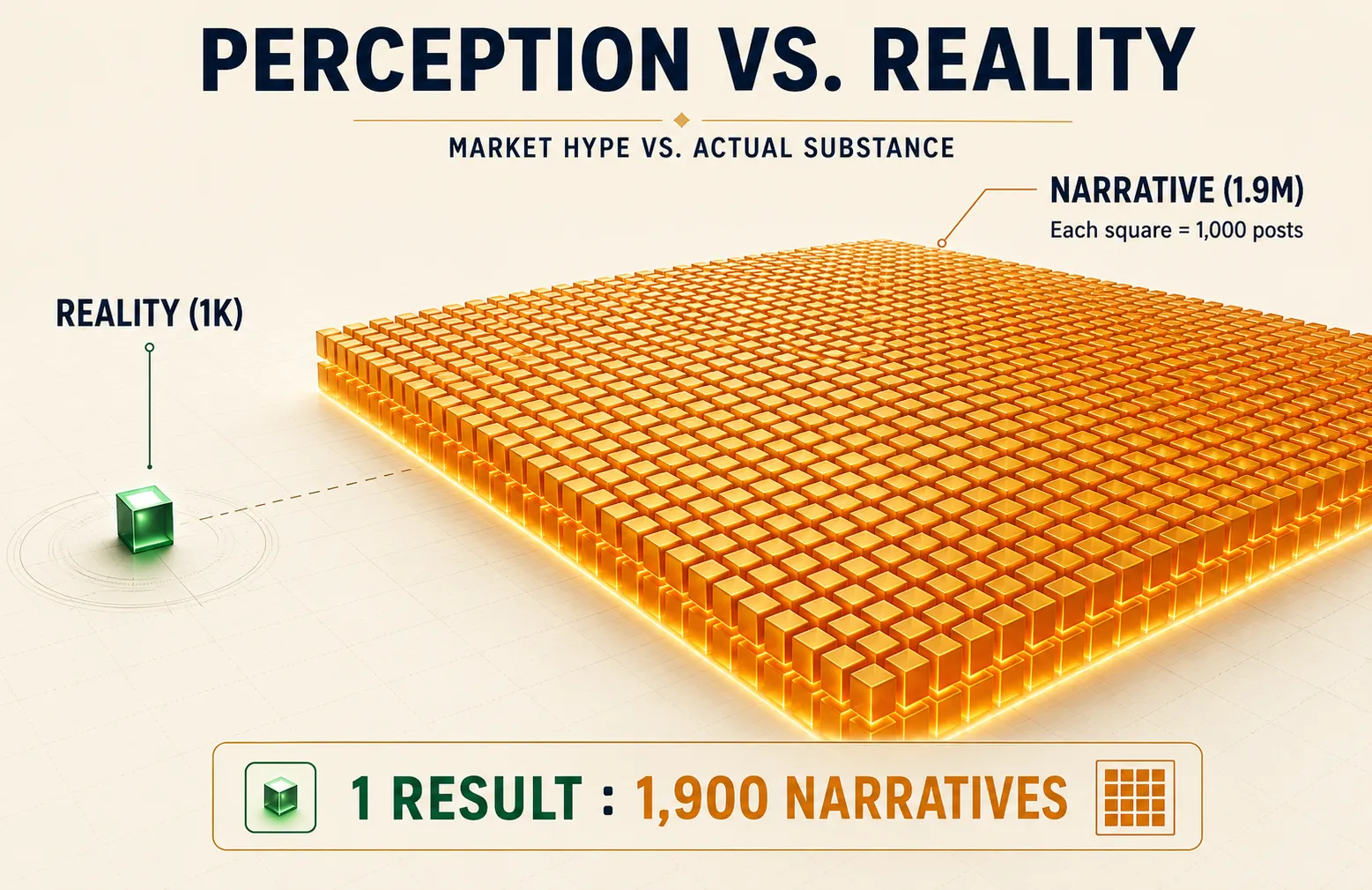
What emerged was not simply a difference in popularity between two groups of topics; it was a structural imbalance in the language of entrepreneurship. The analysis identified approximately 31.4 million posts associated with #Hustle and approximately 1.9 million signals associated with #Unicorn, while terms associated with Founder Readiness, Venture Efficiency, Founder Blindspots, Founder Soft Power, and related concepts appeared at extraordinarily low levels—or, in several cases, at zero. The resulting Supsindex Pulse Score is 0.000025, a proprietary diagnostic intended to represent the relationship between what the report calls “Structural Reality” and “Toxic Positivity”: the measurable mechanics of entrepreneurial execution on one side and the enormous volume of aspirational success narratives on the other.
The significance of that number becomes easier to understand when expressed in relative terms. According to the report’s analysis, for approximately every four million posts celebrating #Hustle, only one discusses #FounderReadiness. The point is not that hustle is inherently harmful, nor that ambition and persistence have somehow become irrelevant to entrepreneurship. Hard work remains an essential component of building a company, particularly when resources are limited and uncertainty is high. The deeper problem is that the ecosystem appears to have created a cultural equation in which effort is too often treated as a proxy for effectiveness, even though the two are fundamentally different. A founder can work extraordinarily hard while repeatedly making poor decisions; a team can spend eighteen hours a day executing the wrong strategy; and a company can raise substantial capital while lacking the internal capabilities required to deploy that capital intelligently.
The question, therefore, is not whether founders should hustle. It is whether hustle without diagnosis has become one of the dominant narratives through which entrepreneurial competence is understood.
The Startup Ecosystem’s “Cult of Optimism”
The Pulse Report describes this phenomenon as the “Cult of Optimism,” a term intended to capture the point at which optimism ceases to be a source of entrepreneurial resilience and begins to function as a substitute for diagnosis. Entrepreneurship would obviously be impossible without optimism: founders must believe that something can be built before there is evidence that it can be built, and they must often continue moving forward long before the outcome is certain. But optimism becomes dangerous when it discourages founders and investors from asking uncomfortable questions about capability, execution, decision quality, and risk.
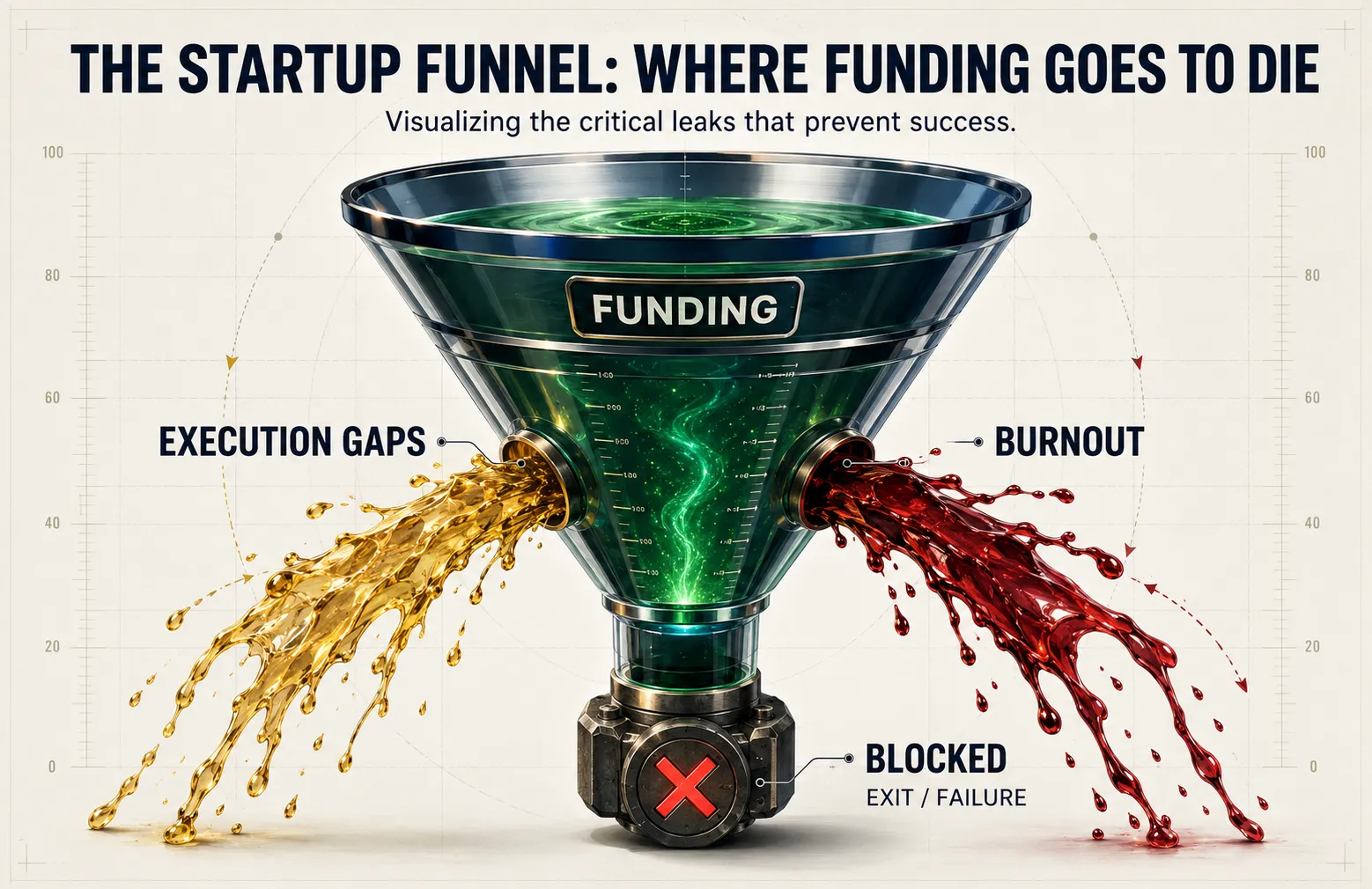
One of the clearest illustrations in the report is the comparison between approximately 218,000 mentions of #StartupFunding and essentially zero mentions of #VentureEfficiency. The contrast reveals something important about what the ecosystem chooses to discuss. We have developed sophisticated language for describing how founders acquire capital, how much they raise, from whom they raise it, and what valuation they achieve, but considerably less language for discussing whether that capital will be stewarded effectively once it enters the company. The funding event receives enormous attention because it is visible, measurable, and socially legible; the quality of the decisions made after the funding event is far more difficult to observe, and consequently receives far less public attention.
The report describes this as a “Leaky Bucket” problem: capital continues to be poured into the entrepreneurial system while comparatively little attention is given to identifying the holes through which that capital may subsequently disappear. This is why the report argues for a transition from what it calls a “Lottery Mindset,” in which capital is repeatedly placed behind perceived winners, toward a “Laboratory Mindset,” in which leadership capabilities can be examined, simulated, stress-tested, and verified. The distinction is central to the Supsindex philosophy because it reframes the role of founder evaluation: rather than attempting to predict the future by looking for the most convincing narrative, the ecosystem can begin looking for evidence about the capabilities that will actually be required to navigate that future.
The Void Between What Founders Feel and What They Say
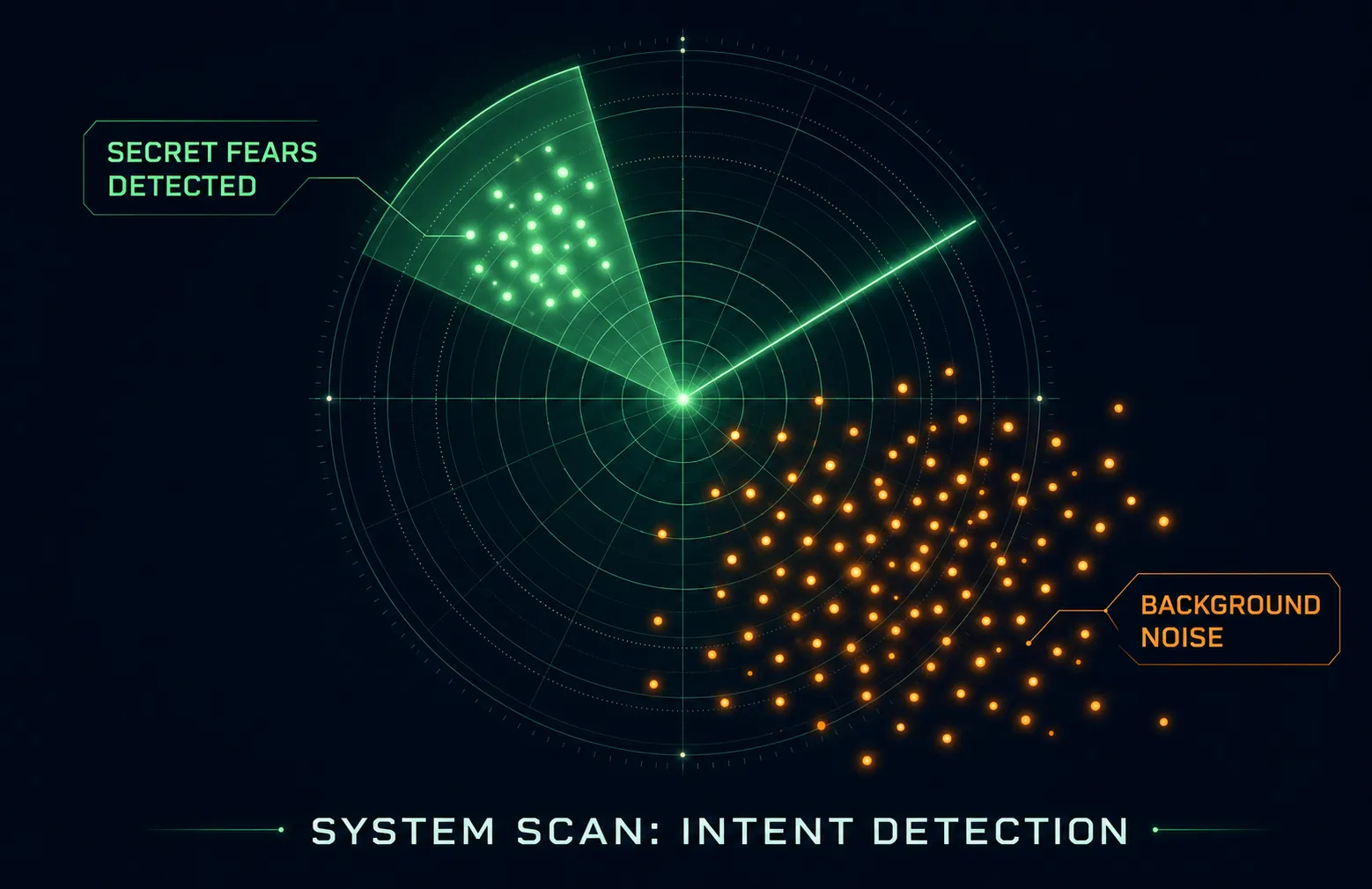
Perhaps the most revealing part of the Pulse Report is not the sheer volume of public conversation, but the contradiction between public behavior and private intent. Social platforms have become places where founders construct narratives about their companies and themselves, often emphasizing fundraising milestones, growth, resilience, productivity, and the visible markers of entrepreneurial progress. Search behavior, however, can reveal a different side of the same ecosystem—one that is less concerned with projecting confidence and more concerned with finding answers to problems that are difficult to discuss publicly.
The report identifies a striking divergence between these two layers. Founders may publicly communicate confidence and resilience while privately searching for information about issues such as founder depression, burnout, co-founder disputes, imposter syndrome, and startup anxiety. Supsindex refers to this gap as “The Void”: the measurable space between the problems people actually experience and the language the ecosystem has developed to discuss those problems. The symptoms are present, sometimes at significant scale, but the vocabulary required to diagnose them is comparatively weak.
That distinction matters because a problem does not become less important simply because an ecosystem lacks the language to describe it. In many cases, the opposite is true. When a founder experiences a structural problem but has no established framework through which to identify, measure, and address it, the problem can remain invisible until it becomes sufficiently severe to threaten the company itself. By then, the opportunity for early intervention may have disappeared.
When the Market Has Questions but the Ecosystem Has Few Answers

The Pulse Report goes further by examining the relationship between demand and supply. The data suggests that founders are actively searching for answers related to the human and operational difficulties of entrepreneurship, while the market provides a disproportionately small amount of specialized content and tooling around those needs.
One of the report’s examples concerns what it calls “Founder Science.” The analysis identifies approximately 500 monthly search signals related to founder simulators and readiness tests while identifying only two relevant content or tool signals, producing a reported 250:1 gap between apparent demand and available supply. Whether one interprets that gap as an emerging commercial category, an intellectual deficit, or both, the underlying observation is difficult to ignore: people are asking questions that the dominant startup ecosystem has not yet developed sufficiently sophisticated answers for.
This helps explain why the distinction between Founder Assessment and conventional personality testing is so important. When users search for ways to understand themselves as founders, the available market frequently directs them toward generalized personality tests, motivational content, or broad entrepreneurial advice. Those resources can have value, but they do not necessarily answer the more consequential question: what capabilities does this particular founder possess, where are the blind spots, and how might those capabilities affect decisions within an entrepreneurial environment?
That is the territory in which Supsindex places Founder Assessment.
From Personality Tests to Founder Assessment
Founder Assessment should not be confused with another personality quiz, because its objective is not to assign a founder a personality label or determine whether someone is “naturally entrepreneurial.” The more meaningful objective is to examine capabilities that can have practical consequences for entrepreneurial performance and to convert aspects of founder behavior that are normally treated as subjective impressions into structured information that can support better decisions.
The current Supsindex assessment framework approaches this through several dimensions, including knowledge and cognitive capability, behavioral and mindset characteristics, and ecosystem fit. These dimensions matter precisely because entrepreneurial readiness is not a single trait. A founder may possess considerable knowledge while struggling to make decisions under pressure; another may demonstrate strong resilience but misunderstand the regulatory, cultural, or market environment in which the company is expected to operate; a third may have excellent strategic awareness but significant behavioral blind spots that become visible only when the company enters a period of sustained uncertainty.
Readiness, therefore, cannot be reduced to charisma, confidence, intelligence, previous success, or even motivation. It is multidimensional, contextual, and dynamic, which is precisely why the ecosystem needs better ways of measuring it. The goal is not to produce a simplistic score that claims to predict the future with certainty, but to generate meaningful evidence about the human variables that traditional startup evaluation often leaves implicit.
The Soft Power Deficit
The Pulse Report introduces another important distinction when it compares hard work with founder soft power. The report records approximately 31.4 million mentions of #Hustle, compared with effectively zero mentions of #FounderSoftPower. Once again, the importance of this comparison is not the popularity of one hashtag over another; it is what that difference tells us about the conceptual boundaries of the ecosystem.
For decades, entrepreneurship has developed increasingly sophisticated ways of talking about financial capital, market size, product performance, technology, and growth. Yet the human capabilities that determine how founders behave when those variables become uncertain have remained comparatively difficult to name, let alone measure. Knowledge, decision-making behavior, resilience, ethical grounding, adaptability, and ecosystem awareness can all influence entrepreneurial outcomes, but because they are less tangible than revenue or valuation, they are frequently left to intuition.
The Supsindex argument is that difficulty of measurement should not be confused with lack of importance. In fact, the opposite may be true: the more consequential a variable is and the more difficult it is to observe directly, the greater the need for a disciplined framework capable of making that variable visible.
The First Baseline of a New Category
Perhaps the most important conclusion of the first Pulse Report is therefore not simply that Founder Readiness currently has limited visibility. The more consequential finding is that we now have a baseline against which future change can be measured.
Today, concepts such as #FounderSoftPower, #VentureEfficiency, #FounderBlindspots, and #SupsDiagnostics have extremely limited visibility in the broader startup conversation. From one perspective, that represents a significant problem: if almost nobody is talking about the mechanisms behind founder readiness, then the ecosystem is clearly underdeveloped in this area. From another perspective, however, it represents something quite different—a rare opportunity to observe the emergence of a category from its earliest stages.
When a subject already attracts millions of conversations, entering that space means competing for attention within an established narrative. When a subject has almost no established language, the strategic situation changes. The challenge is no longer simply to become louder than competitors; it is to help establish the vocabulary through which an emerging problem can eventually be understood.
This is why the Pulse Report is intended to be more than a one-time marketing measurement. It is a longitudinal experiment. By repeating the measurement quarterly, Supsindex can observe whether founders begin discussing readiness more frequently, whether investors begin talking about founder blind spots, whether new tools and assessment methodologies emerge, whether academic research begins to recognize the subject, and whether the broader language of entrepreneurship gradually moves from aspiration toward measurement.
The first report is therefore not the conclusion of the story. It is the point from which the story can be measured.
From Hustle to Readiness
The startup ecosystem does not need less ambition; it needs better diagnosis. It does not need to stop celebrating successful founders or successful companies; it needs to become more interested in the mechanisms that make success possible and, more importantly, in the capabilities that determine whether a founder can navigate the difficult periods that precede it. Nor does the ecosystem need to eliminate intuition from entrepreneurial decision-making, because intuition will always have a role in a field characterized by uncertainty. What it needs to do is stop treating intuition as sufficient evidence for decisions involving enormous amounts of capital, human potential, and time.
That is the paradigm shift behind Founder Readiness.
The central question is no longer simply, “How hard are you willing to work?” It is increasingly, “Are you equipped to make the decisions this journey will demand?” And once that question has been asked seriously, another follows almost inevitably: “Can we measure it?”
The first Supsindex Ecosystem Pulse Report suggests that the global startup ecosystem is not yet asking these questions at anything close to the scale required. The conversation remains dominated by hustle, funding, unicorns, ambition, and visible success, while beneath that noise there is an emerging demand for something considerably more substantive: scientific support, meaningful diagnostics, better simulations, and objective evidence about the human capabilities that sit behind entrepreneurial outcomes.
That is the space that Supsindex calls Founder Science.
What Comes Next: From the Web to Academia
The first Pulse Report establishes its baseline through digital and social signals, measuring the frequency with which concepts associated with Founder Readiness and Founder Assessment appear across the public web and social-media environment. In doing so, it captures one layer of the ecosystem’s relationship with the subject: what people search for, what they discuss, what they publish, and what they amplify.
But public discourse is only one layer of the story.
The next question is considerably deeper: what is the academic world doing about it?
In the second issue of the Pulse Report, Supsindex will turn its attention toward the academic ecosystem, examining the degree to which researchers, universities, scientific publications, and academic communities are paying attention to the concepts surrounding Founder Readiness, Founder Assessment, and the measurable human factors of entrepreneurship.
This transition—from public web and social-media behavior into academia—is important because it allows the Pulse Report to examine the development of Founder Science from another perspective. If the first report asks whether the entrepreneurial ecosystem is talking about Founder Science, the second asks whether the academic community is studying it. Taken together, these two measurements can begin to reveal whether Founder Readiness is simply an emerging commercial narrative or whether it is gradually developing into a recognized area of intellectual and scientific inquiry.
The Beginning of a Measurement Journey
The first Pulse Report should therefore be understood for what it is: a baseline measurement of an ecosystem at a particular moment in its evolution. It captures a startup world that is extraordinarily rich in narratives about success, ambition, funding, resilience, and hustle, yet comparatively poor in standardized language for discussing the capabilities and human factors that determine whether founders are actually prepared to navigate the complexity of entrepreneurship.
That imbalance is the problem, but it is also the opportunity.
Supsindex believes that entrepreneurship deserves the same intellectual discipline that has transformed other complex fields. If markets can be measured, capital can be measured, risk can be modeled, and performance can be tracked, then the human capabilities responsible for making entrepreneurial decisions should not remain permanently trapped inside the realm of intuition simply because they are harder to observe.
The first Pulse Report begins by measuring the silence. Future reports will show whether that silence remains—or whether, gradually, the language of entrepreneurship begins to change: from hustle toward competence, from optimism toward diagnosis, from intuition toward evidence, and from a Lottery Mindset toward a Laboratory Mindset in which founder capability can increasingly be examined rather than assumed.
Ultimately, the question is not whether founders should work harder or believe more strongly in their ideas. The more important question is whether the ecosystem can develop better ways of understanding the people who are expected to make the thousands of decisions upon which those ideas depend.
And that brings us back to the question at the center of the entire Pulse initiative:
Are founders ready?
The complete Supsindex Ecosystem Pulse Report — Q1 Baseline, “The Great Distraction: How ‘Hustle Culture’ Is Silencing ‘Founder Science’” is available for readers who want to examine the methodology, data points, comparative analysis, and detailed findings behind this article. The report provides the full baseline from which Supsindex intends to track the evolution of Founder Readiness and Founder Assessment across the global startup ecosystem.
And this is only the beginning. In the second issue of the Pulse Report, Supsindex will move beyond the public web and social-media landscape and into the academic space, measuring the level of attention researchers and universities are giving to Founder Readiness and Founder Assessment. If the first report measures what the ecosystem is saying, the next will begin measuring what the academic world is studying.
The question is no longer simply whether Founder Science exists.
The question is whether the world is beginning to recognize that it needs it.
