

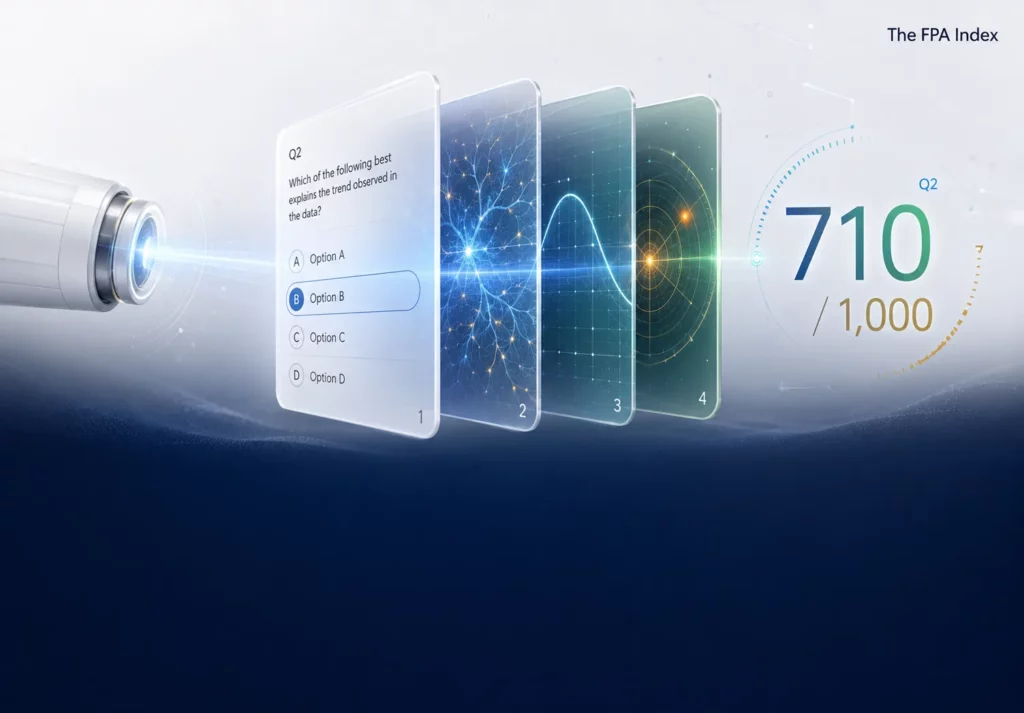
To move beyond static trivia and truly measure a founder’s capacity to navigate complex markets, venture ecosystems must adopt the FPA Index as the definitive standard for assessing entrepreneurial readiness.
The FPA Index: A MultiLayered Model for Assessing Entrepreneurial Readiness
From Entrepreneurial Knowledge to Cognitive Readiness
The startup mortality rate remains persistently high — approximately 90% of new ventures fail, with nearly 70% collapsing within the first three to five years (CB Insights, 2026). The most commonly cited proximate cause is, of course, running out of cash. However, a more instructive question is why these ventures run out of cash before discovering a viable market. The evidence points toward founder cognition: gaps between knowledge and applied judgment, blind spots in market understanding, and an inability to distinguish strategic signals from noise. The Founder Public Awareness (FPA) Index was designed precisely to close this gap — not as a static checklist, but as a multilayered, scientifically calibrated instrument for measuring the cognitive infrastructure of entrepreneurial readiness.
1. Why Knowledge Tests Are Typically Underwhelming — and What They Miss

Conventional tests of business knowledge suffer from three welldocumented limitations: (1) static item banks that treat all questions as equally informative, (2) uniform measurement error across all ability levels, and (3) an exclusive focus on declarative memory rather than applied judgment under uncertainty. These limitations are not merely statistical curiosities; they undermine predictive validity precisely where it matters most.
Entrepreneurship, by contrast, requires not only knowing what to do but also knowing when to do it, recognising which information is actionable, and suppressing the cognitive biases — overconfidence, confirmation bias, anchoring — that systematically distort judgment under pressure. Research in entrepreneurial cognition has long recognised that opportunity recognition itself is fundamentally a patternrecognition process: the ability to identify meaningful relationships in complex and ambiguous information (Baron, 2006). Yet most conventional tests do not measure this capacity at all. They treat the founder as a passive repository of facts rather than an active sensemaker navigating uncertainty.
The FPA was built to invert this logic. It is not a knowledge test disguised as competence. It is a Dynamic Knowledge Engine structured to evaluate how founders think, not merely what they can recall.
2. The FPA’s Architectures: A Four-Dimension Multi-Layered Model
Rather than collapsing all responses into a single score, the FPA evaluates answers through four independent analytical lenses, each of which captures a distinct cognitive capability.
2.1 Knowledge Weight — Declarative Correctness
At its most basic level, the FPA measures whether a founder’s understanding of core entrepreneurial concepts is accurate and stageappropriate. A preseed founder is not judged against the benchmarks of a Series A founder; the test adapts to the startup’s lifecycle stage.
Take, for example, an item from the FPA’s Market Research & Validation category:
Question: Which financial statement provides a snapshot of a company’s assets, liabilities, and equity at a single point in time?
Options: (A) Income Statement (B) Cash Flow Statement (C) Balance Sheet (D) Capitalization Table
The correct answer (C) demands a foundational literacy that, while simple, is missed by a surprising number of earlystage founders (FPAGENSEED00GlobalVer1, Category 5.1). Founders who cannot distinguish a balance sheet from a cash flow statement are operating without one of the most basic navigation instruments in business. The Knowledge Weight captures this baseline, reporting categorybycategory literacy scores so that founders see exactly where their understanding is solid and where it is not.
2.2 Behavioral Weight — Latent Trait Inference
Behind each FPA question is a mapping to one or more Behavioral Codes — stable entrepreneurial traits such as responsibility, curiosity, delegation ability, resilience, and risk comfort. A founder who answers a question correctly may still reveal a behavioural vulnerability in how they arrived at that answer. Conversely, an incorrect answer can be highly informative about trait deficits.
Consider the FPA’s assumptiontesting item:
Question: Prioritise the following methods to validate that target customers are willing to pay $50/month for a new tool.
Methods: (1) Build the full product and launch. (2) Ask customers in a survey. (3) Create a landing page with a preorder button. (4) Ask friends for their opinion.
A founder who ranks methods (2) and (3) appropriately (option 3C, option 2B on the prioritization scale) is revealing both scientific curiosity (experimenting before committing resources) and delegation ability (trusting external validation over internal assumptions). The founder who chooses option (1) as the highest priority (build first, ask later) is signalling a low tolerance for uncertainty and a fixed mindset. The FPA does not merely score correctness; it decodes these behavioural signatures and reports them as radar charts and coaching narratives.
2.3 Cognitive Weight — Question Difficulty and Discrimination
Not all questions carry the same empire-level weight. The FPA applies a 2Parameter Logistic (2PL) Item Response Theory (IRT) model to empirically estimate two parameters per item: difficulty ($ \beta $) — the ability level at which a founder has a 50% probability of answering correctly — and discrimination ($ \alpha $) — how sharply the item separates highability founders from lowability founders.
An item with high discrimination contributes more to the final score than an item that almost everyone answers correctly. This dynamic weighting ensures that founders are not rewarded equally for trivial knowledge (“What does MVP stand for?”) and genuine strategic judgment (“Under the Modern Slavery Act 2018, what is the reporting threshold revenue that makes supply-chain transparency a must-have rather than a nice to have?”). The model learns from the calibration dataset which items actually correlate with downstream entrepreneurial outcomes — shifting the FPA from a static test to an instrument that continuously improves its predictive precision.
2.4 Concentration Weight — Signal Detection Through Distractors
Perhaps the FPA’s most distinctive feature is its deliberate inclusion of irrelevant questions — content that, while not technically incorrect, carries zero predictive value for entrepreneurial success. Consider an item from the GEB version:
Question: Historical analysis suggests that the adoption of the meridian system for global navigation was primarily driven by which factor?
Options: (A) Advances in agricultural science (B) Economic impetus of maritime trade routes (C) Philosophical shift during Renaissance (D) Standardisation of timekeeping devices
The question is about maritime history, not entrepreneurship. It contributes nothing to the knowledge score. Its purpose is purely behavioural: to measure the founder’s ability to distinguish signal from noise.
This is not a trick; it is a direct operationalisation of Signal Detection Theory (SDT) in an entrepreneurial context. Founders are constantly bombarded with information — competitive rumours, investor feedback, media trends, internal metrics — and must decide, often under time pressure, which signals warrant attention and which can be safely ignored. The FPA calculates a DPrime ($ d’ $) sensitivity score based on the founder’s Hit Rate (correctly flagging a distractor as irrelevant) and False Alarm Rate (mistaking a real strategic issue for noise because it resembles a distractor). A high DPrime indicates a founder who is both vigilant and discerning — qualities that predict effective resource allocation and strategic focus.
In the GEB, the forcedchoice format uses socially desirable distractors — options that are intentionally engineered to appear virtuous but are actually detrimental in practice. For example, an option framed as “supportive checkingin” may actually encode a micromanagement bias. Novice founders select it because it sounds good; experienced founders reject it because it undermines autonomy. The FPA (and its sibling indices) track these patterns to produce a safety score: the higher the score, the lower the susceptibility to “impressionmanagement” traps.
3. Score Architecture: From Raw Responses to Meaningful Quartiles
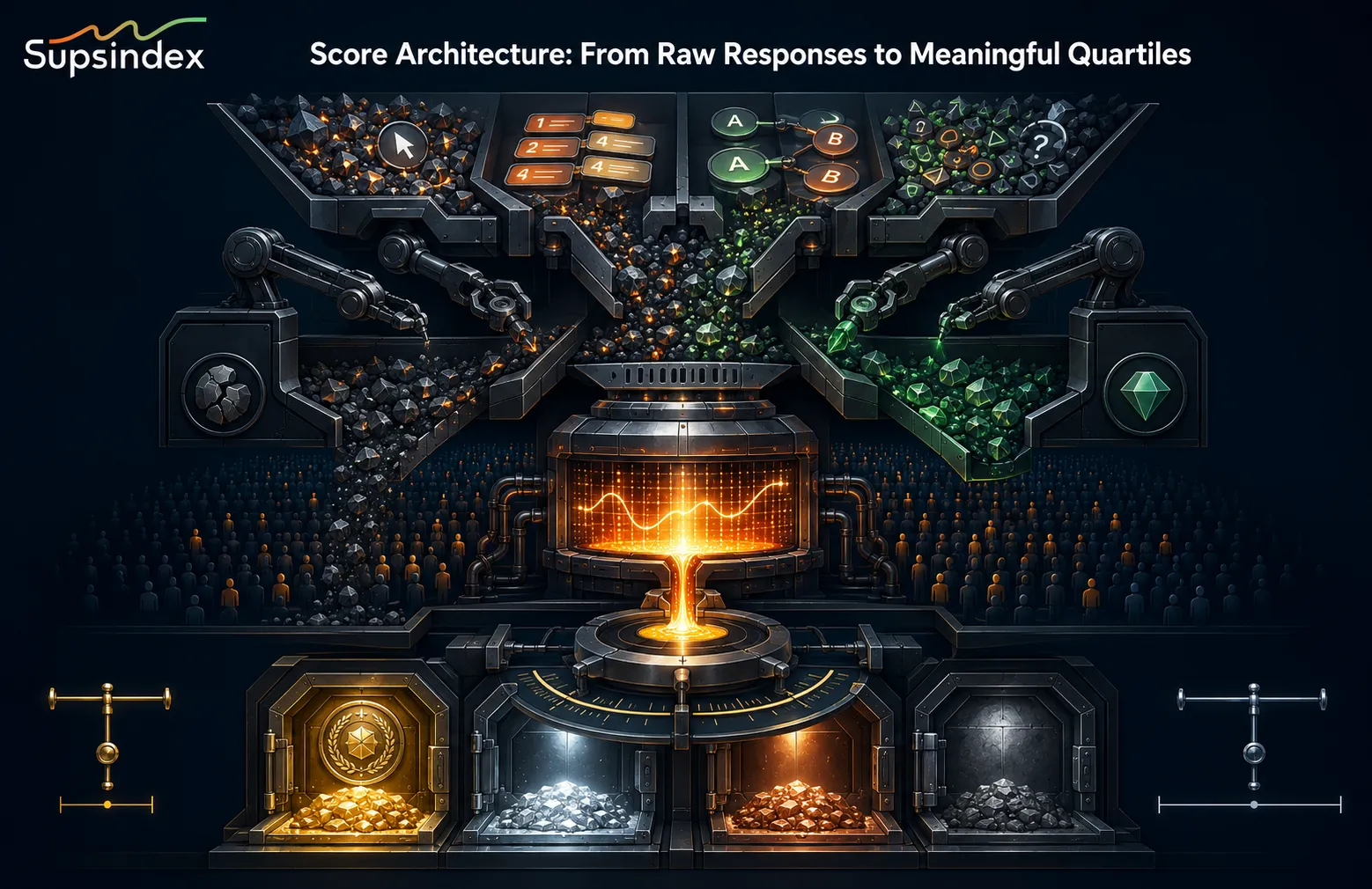
Each FPA assessment produces a composite score ranging from 0 to 1,000, derived from the weighted aggregation of the four analytical layers.
- Step 1 — Item scoring: Singleselect and true/false items are scored 1/0 with difficulty parameters. Multiselect items award partial credit only for “allandonly” correct selections, penalising both overselection (guessing) and underselection (risk aversion). Ranking tasks are scored via distancebased metrics (e.g., Kendall’s tau), and matching tasks via perpair scoring.
- Step 2 — IRT calibration: Item parameters are estimated using a baseline calibration sample of 300 founders (growing to 3,000 by 2026), with anchor items used for longitudinal stability. This ensures that the score reflects true underlying ability, not merely the accidental difficulty of a particular test form.
- Step 3 — Standardisation and benchmarking: Raw scores are transformed into a Tscale (mean = 50, SD = 10) and then mapped onto the 0–1,000 FPA Index scale.
- Step 4 — Quartile placement: The score is benchmarked against founders in the same exact contextual bucket: same industry (55+ sectors), same startup stage (preseed, seed, early, growth), and same target ecosystem (15 countries, expanding to 30). Founders are placed into one of four quartiles:
| Quartile | Performance Tier | Interpretation |
|---|---|---|
| Q1 | Legendary | Topquartile mastery; investablegrade readiness; outperforms 75% of peers. |
| Q2 | Visionary | Strong strategic literacy; near top of peer group. |
| Q3 | Architect | Solid, structured knowledge; good foundation for targeted growth. |
| Q4 | Aspirant | Foundational awareness; significant gaps; priority learning targets. |
Certificates are awarded exclusively to Q1 achievers. Importantly, the standard error of measurement is not uniform; the FPA reports confidence intervals based on the information function of the specific items delivered to each founder. A founder whose ability is near the mean receives a narrower confidence interval; a founder at the extremes (very high or very low ability) carries more measurement uncertainty, and this is disclosed transparently — not concealed behind a single, misleading margin of error.
4. What Would Be Lost Without This Layered Structure
Without the fourlayer architecture, the FPA would be indistinguishable from the standardised business quizzes that currently populate the market. Founders would receive a single number, a uniform error estimate (±5 points for everyone), and no insight into why they scored what they scored — or what to do about it. The behavioural codes would remain inaccessible. The cognitive weighting would collapse. And the concentration weight would vanish entirely, removing the signaldetection diagnostic that distinguishes focused founders from those who are inattentive, overly cynical, or simply guessing.
In short, the FPA would measure knowledge alone. And knowledge alone, as decades of entrepreneurship research has shown, is a modest predictor of venture survival. The founder’s capacity to distinguish signal from noise, to apply knowledge under uncertainty, and to detect their own susceptibility to cognitive biases — these are the capabilities that separate ventures that survive from those that do not. The FPA is built to measure all of them.
5. Real-World Evidence

The FPA’s predictive validity has been tested in a multiyear study (2019–2024) linking founder assessment scores to downstream financial outcomes. Founders in the top quartile of the FPA were 22% more likely to achieve an MOIC ≥ 1x (Multiple on Invested Capital at or above principal) compared to medianscoring founders. Among founders who scored in the bottom quartile, the hazard of failure (timetoshutdown) was significantly elevated, even after controlling for sector, geography, and total funding raised.
Case studies further illustrate the mechanism. One founder in HealthTech (KaraB, Liverpool, UK) completed the FPA and received a composite score of 710 out of 1,000 — a Q2 placement. The categorybycategory report revealed glaring deficits in delegation (0/100) and risk comfort (25/100) — precisely the traits that were creating a founder bottleneck as the company scaled. The report did not label the founder as a “failure risk.” It gave her a behavioural radar chart and a specific improvement roadmap: 90 days of practice in delegating reversible decisions, reading on growth mindset, and weekly exercises in tolerating small failures. Within three months, her delegation score had moved from 0 to 35, and her partnership manager closed a deal without her oversight — an outcome that would have been unimaginable before the FPA.
This is the difference between a diagnostic instrument and a mere score. The FPA does not tell founders who they are; it tells them where to grow.
6. Scientific Grounding and Future Development
The FPA’s methodology is grounded in validated psychometric standards:
- Content validity is established through explicit blueprints per industry and stage, reviewed by a global faculty network.
- Construct validity is demonstrated through correlations between FPA category scores and established entrepreneurial cognition constructs (pattern recognition, opportunity evaluation, decision quality).
- Reliability is measured at the category level using KR20/Cronbach’s alpha (target ≥ 0.70), with testretest stability tracked over acceptable windows.
- Measurement invariance is tested via multigroup CFA and Differential Item Functioning (DIF) analysis, ensuring items function equivalently across geographies, languages, and demographic groups.
The FPA is live today on the Supsindex platform. Its calibration sample is expanding from 300 to 3,000 founders by the end of 2026, with a roadmap that includes Computerized Adaptive Testing (CAT) — reducing test length while improving precision — and deeper integration with the platform’s continuous growth tools (FCG), flight simulator (FDE), and team dynamics indices (FEE).
Conclusion
The FPA Index is not a quiz. It is a multilayered, IRT-calibrated assessment engine that measures entrepreneurial knowledge, behavioural disposition, cognitive processing power, and signaldetection capacity simultaneously. It was built because knowing what a founder knows is necessary but insufficient. What matters is whether they can apply that knowledge when the signal-to-noise ratio drops, when the runway shortens, and when the easy answers sound virtuous but lead to failure.
By delivering not just a score but a diagnostic report — heatmaps, behavioural radar charts, category deficits, and confidence intervals — the FPA transforms assessment from a static credential into a dynamic improvement tool. It does not predict the future. It illuminates the present with enough clarity that founders, mentors, and investors can act before the market forces the lesson.
The era of assessing founders on gut feeling alone has produced a trillion dollars in avoidable waste. The FPA is part of a deliberate shift: from intuition to measurement, from static knowledge to dynamic cognition, and from hoping founders will succeed to understanding, systematically, why they might fail — and what to change before they do.
