


Founder Assessment vs. Personality Tests: What Each Can and Cannot Tell You
Founder assessment vs. personality tests is not a contest between science and intuition. The key is understanding what each method measures, where the evidence is strongest, and which decisions the results can responsibly inform.
A founder walks into an investor meeting with a strong professional background, an impressive pitch deck, and a personality profile suggesting high conscientiousness, confidence, and openness to new experiences. They appear disciplined, ambitious, and comfortable with uncertainty. Yet when the conversation turns to cash runway, customer retention, or the regulatory requirements of their target market, important gaps begin to emerge.
Another founder may present the opposite impression. They are reserved, less comfortable with public speaking, and cautious when discussing ambitious growth projections. Their personality profile may not immediately resemble the charismatic entrepreneur that investors expect, but their financial knowledge, customer understanding, and strategic judgment may be considerably stronger.
These situations illustrate why founder assessments and personality tests should not be treated as interchangeable tools. They can provide different kinds of information about the same person, but their purposes, methods, and limitations vary.
Personality assessments generally examine relatively broad psychological characteristics, preferences, or workplace behavioral tendencies. Founder-specific assessments focus on entrepreneurial capabilities that may include business knowledge, responses to strategic trade-offs, and awareness of the environment in which a startup operates. There is meaningful overlap between these categories, particularly when behavioral judgment and personality traits are evaluated, but neither approach provides a complete picture of entrepreneurial readiness.
The practical question in a founder assessment vs. personality test comparison is therefore not which instrument is universally superior. It is what each instrument measures, which decisions its evidence can support, and how the results should be combined with real-world observations.
What Do Personality Tests Actually Measure?
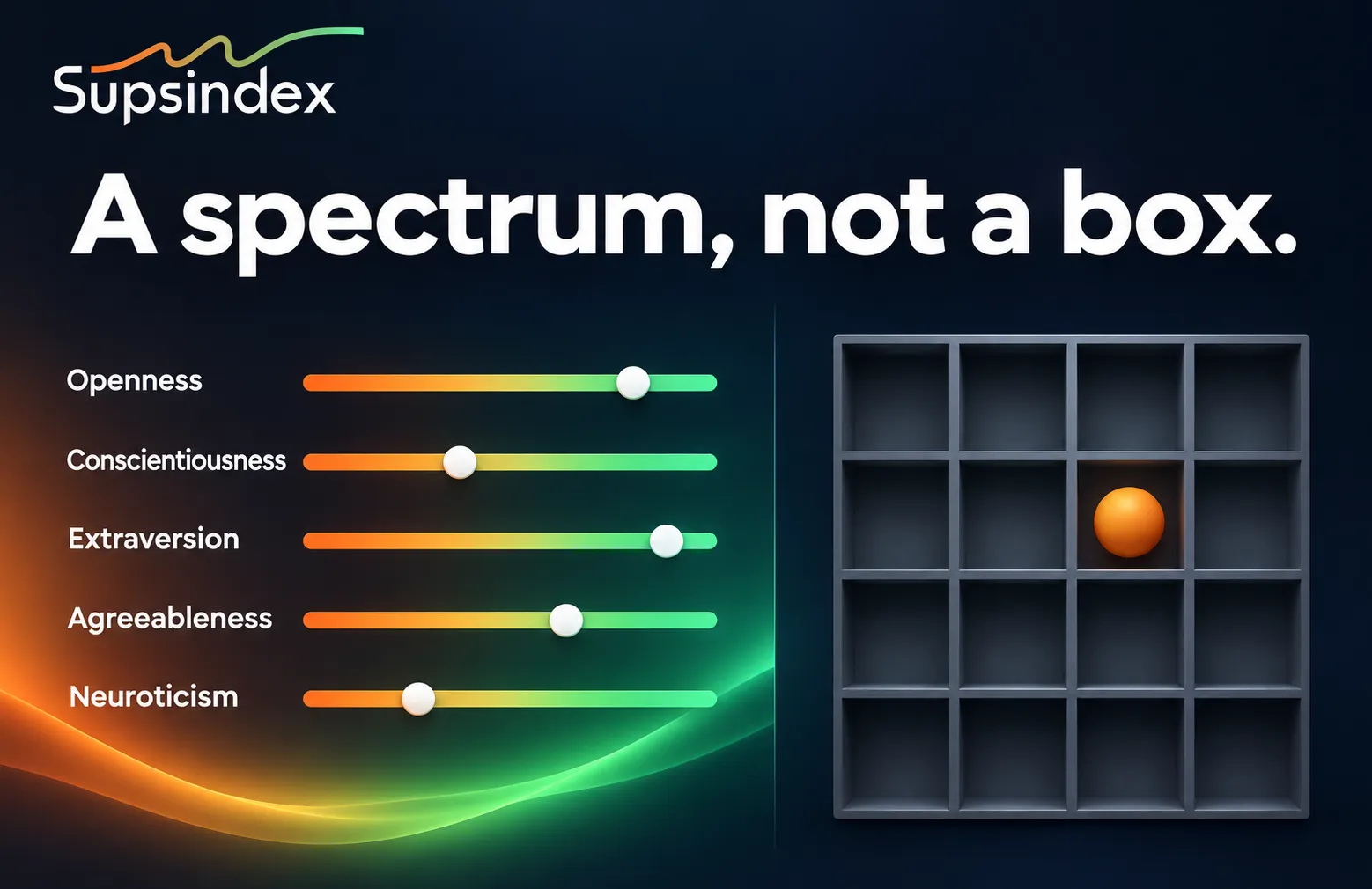
The term personality test covers several different approaches, and grouping them together can create misleading comparisons. Some are based on extensively researched psychological trait models, while others focus on communication preferences, workplace behavior, or categorical personality descriptions.
The Big Five, also known as OCEAN or the Five-Factor Model, describes personality across Openness, Conscientiousness, Extraversion, Agreeableness, and Neuroticism. These dimensions are generally represented as continuous traits rather than fixed personality types. Someone may be relatively high in conscientiousness, for example, without being classified as either entirely conscientious or entirely unconscientious.
The Big Five has substantial empirical support. A quantitative synthesis published in the Journal of Personality, combining 54 meta-analyses and more than 550,000 participants, found statistically meaningful associations between personality dimensions and performance. Conscientiousness showed the strongest overall association, although the relationships differed across performance categories.
Entrepreneurship-specific evidence also exists. A meta-analytic review published in the Journal of Management found that several Big Five dimensions were associated with entrepreneurial intentions and performance. This means it would be scientifically inaccurate to describe personality models as purely descriptive instruments with no predictive relevance.
However, the existence of population-level associations does not mean that an individual founder’s trait profile can determine whether their startup will succeed. Personality may contribute to behavior, but venture performance also depends on knowledge, skills, experience, market conditions, financing, team composition, and execution.
Big Five, HEXACO, MBTI, DISC, and Workplace Assessments
The HEXACO model provides another research-based approach to personality, examining six dimensions that include Honesty-Humility alongside Emotionality, Extraversion, Agreeableness, Conscientiousness, and Openness. It can be particularly useful when the research or developmental question concerns broad interpersonal tendencies and ethical dispositions, although no single trait score proves that someone will act ethically in every situation.
The Myers-Briggs Type Indicator (MBTI) takes a different approach by describing preferences through sixteen possible personality types. Its accessible terminology can provide a useful starting point for conversations about communication, working preferences, and interpersonal differences. However, researchers have questioned whether personality is adequately represented through distinct binary categories rather than continuous dimensions.
Importantly, the Myers-Briggs Company itself states that MBTI should not be used to screen job applicants or make hiring decisions. Its intended purpose is development and self-understanding, not measuring professional competence or predicting job performance.
DISC assessments are commonly used to discuss behavioral and communication styles in professional settings. They can help teams reflect on interpersonal differences, although the scientific evidence depends on the specific DISC instrument and its supporting technical documentation. DISC should not be treated as a single standardized psychometric product with identical properties across every provider.
More specialized workplace tools include the Predictive Index and Hogan Assessments. The Predictive Index Behavioral Assessment examines work-related behavioral drives and preferences, while Hogan provides instruments addressing everyday personality characteristics, values, and potential leadership derailers. These tools have established organizational applications and should not be dismissed as merely superficial personality quizzes.
Their primary assessment targets, however, differ from directly evaluating a founder’s understanding of startup financing, customer validation, or market-specific regulatory requirements.
The crucial distinction is that a scientifically useful personality instrument measures the constructs for which it was designed. Problems arise when its results are extended to decisions that the instrument was never intended or adequately validated to support.
What Makes a Founder Assessment Different?
A founder-specific assessment attempts to examine capabilities that are directly relevant to building and operating a venture. Rather than concentrating exclusively on broad psychological traits, it may evaluate entrepreneurial knowledge, strategic reasoning, practical judgment, and understanding of the surrounding business environment.
Supsindex organizes these dimensions through three complementary assessment indices: Founder Public Awareness (FPA), General Entrepreneurial Behavior (GEB), and Ecosystem Environmental Awareness (EEA).
The FPA assessment focuses on entrepreneurial knowledge and applied business reasoning. It examines whether founders understand relevant commercial and operational concepts, including areas such as financial management, unit economics, go-to-market strategy, and business decision-making. The framework also incorporates cognitive-processing and signal-detection concepts intended to examine how founders distinguish meaningful business information from less relevant material.
This produces a different type of evidence from a general conscientiousness score. A founder may be exceptionally organized and diligent yet misunderstand how to calculate runway or evaluate customer acquisition costs. Their personality may help explain certain working tendencies, but it does not demonstrate mastery of those financial concepts.
The EEA assessment addresses another dimension that general personality tests do not ordinarily measure: knowledge of a particular entrepreneurial ecosystem. Regulations, funding structures, local distribution channels, institutional processes, and industry conditions can change substantially between countries. EEA is designed to examine whether founders understand these contextual realities in relation to their intended market and industry.
A founder’s openness to experience may influence their interest in international expansion, but it cannot establish whether they understand the relevant licensing requirements or commercial gatekeepers in the target country. Those questions require separate evidence about actual knowledge.
The third component, GEB, evaluates entrepreneurial behavioral judgment, which creates the most important conceptual overlap with personality assessment.
GEB vs. Personality Tests: The Difference Between Traits and Situational Judgment
The General Entrepreneurial Behavior (GEB) assessment examines how founders evaluate competing actions in entrepreneurial situations. Its framework addresses decision-making tendencies, resilience, adaptability, ethical judgment, and potential behavioral derailers such as overconfidence, confirmation bias, and resistance to delegation.
Some of these concepts overlap with established personality dimensions. For example, conscientiousness may relate to execution discipline, openness may relate to intellectual curiosity, and emotional stability may contribute to responses under uncertainty. The constructs are not entirely independent, and a founder assessment should not claim to have eliminated personality influences simply by using different questions.
The more useful distinction concerns what respondents are asked to do.
Many personality inventories ask people to describe their typical behavior or preferences. A respondent might indicate how strongly they agree with a statement about being organized, adaptable, or comfortable with risk.
GEB instead presents 75 forced-choice Situational Judgment Test scenarios in which founders consider alternative responses to entrepreneurial challenges. Participants select the most and least effective actions among available choices, allowing the framework to examine how they prioritize decisions within a defined business context.
For example, a founder might face a situation where customer retention is deteriorating while an investor encourages aggressive expansion. Different responses could prioritize growth, further customer research, financial safeguards, or preserving the existing strategy. The pattern of choices provides information about judgment within the hypothetical scenario.
This differs from directly asking the founder whether they consider themselves financially disciplined or open to feedback.
However, choosing an appropriate response in a simulation is not identical to behaving that way during an actual business crisis. Situational judgment assessments capture responses to structured situations, and the extent to which those responses generalize to real-world execution must be established empirically.
Why Forced-Choice Scoring Matters
GEB uses Thurstonian Item Response Theory (T-IRT) to analyze comparative choices. This approach is intended to address limitations associated with conventional ipsative scoring, where prioritizing one statement can mechanically constrain the relative score assigned to another trait.
Thurstonian IRT models the underlying preference or utility relationships behind those choices. Under appropriate psychometric conditions, it can support more interpretable between-person estimates than conventional ipsative scoring.
Forced-choice formats may also help address some forms of socially desirable responding because the available options can be designed to appear similarly attractive. GEB includes socially desirable distractors and a Safety Score intended to examine how respondents handle seemingly positive but potentially ineffective choices.
These features represent meaningful methodological design decisions, but they should not be described as making an assessment impossible to manipulate. Research on Thurstonian IRT has also identified important limitations involving item design, the number of constructs being measured, and statistical assumptions.
The strongest scientific claim is therefore that Supsindex uses a specialized assessment architecture designed to examine entrepreneurial judgment and reduce certain measurement problems. Whether it produces more reliable or more predictive results than a validated personality instrument requires direct comparative evidence.
Founder Assessment vs. Personality Test: Comparison Table
The differences become clearer when the instruments are compared according to purpose, response format, output, and intended use rather than marketing labels.
| Dimension | Big Five / HEXACO | MBTI / DISC | Hogan / Predictive Index | Supsindex FPA, GEB, EEA |
|---|---|---|---|---|
| Primary purpose | Broad personality traits | Personality preferences or workplace styles | Work-related personality, behavioral drives, and leadership development | Specified dimensions of entrepreneurial readiness |
| Typical response format | Trait questionnaires; some observer-report options | Preference or style questionnaires, varying by instrument | Work-related personality inventories and behavioral questionnaires | Knowledge items, scenario-based questions, and forced-choice SJTs |
| Main outputs | Continuous trait profiles | Types or behavioral-style profiles | Workplace trait, motivation, and potential derailer profiles | Entrepreneurial knowledge, behavioral judgment, and ecosystem-awareness reports |
| Business knowledge | Not directly assessed | Not directly assessed | Not the primary measurement objective | Addressed through FPA |
| Behavioral tendencies | Core measurement focus | Core descriptive focus | Core measurement focus | Examined through entrepreneurial scenarios in GEB |
| Country and industry knowledge | Not directly assessed | Not directly assessed | Not the primary measurement objective | Addressed through EEA |
| Typical applications | Research, self-awareness, and appropriately validated organizational decisions | Self-reflection and communication development | Talent management, coaching, leadership and organizational applications | Founder development and supplementary due diligence |
| Main limitation | Broad traits do not establish specific knowledge or execution competence | Style or type classifications do not establish capability | Workplace results do not automatically establish startup-specific knowledge | Scores do not independently establish future startup success |
This comparison should not be interpreted as a ranking of overall scientific quality. Each approach is built around different constructs, and its usefulness depends on the intended application and supporting validation evidence.
An established personality instrument may have stronger published evidence for certain workplace predictions than a newer founder-specific assessment. Conversely, a founder assessment may address knowledge areas that the personality instrument was never designed to measure.
A sound evaluation begins with identifying the question that actually needs an answer.
Which Assessment Should Founders, Investors, and Accelerators Choose?
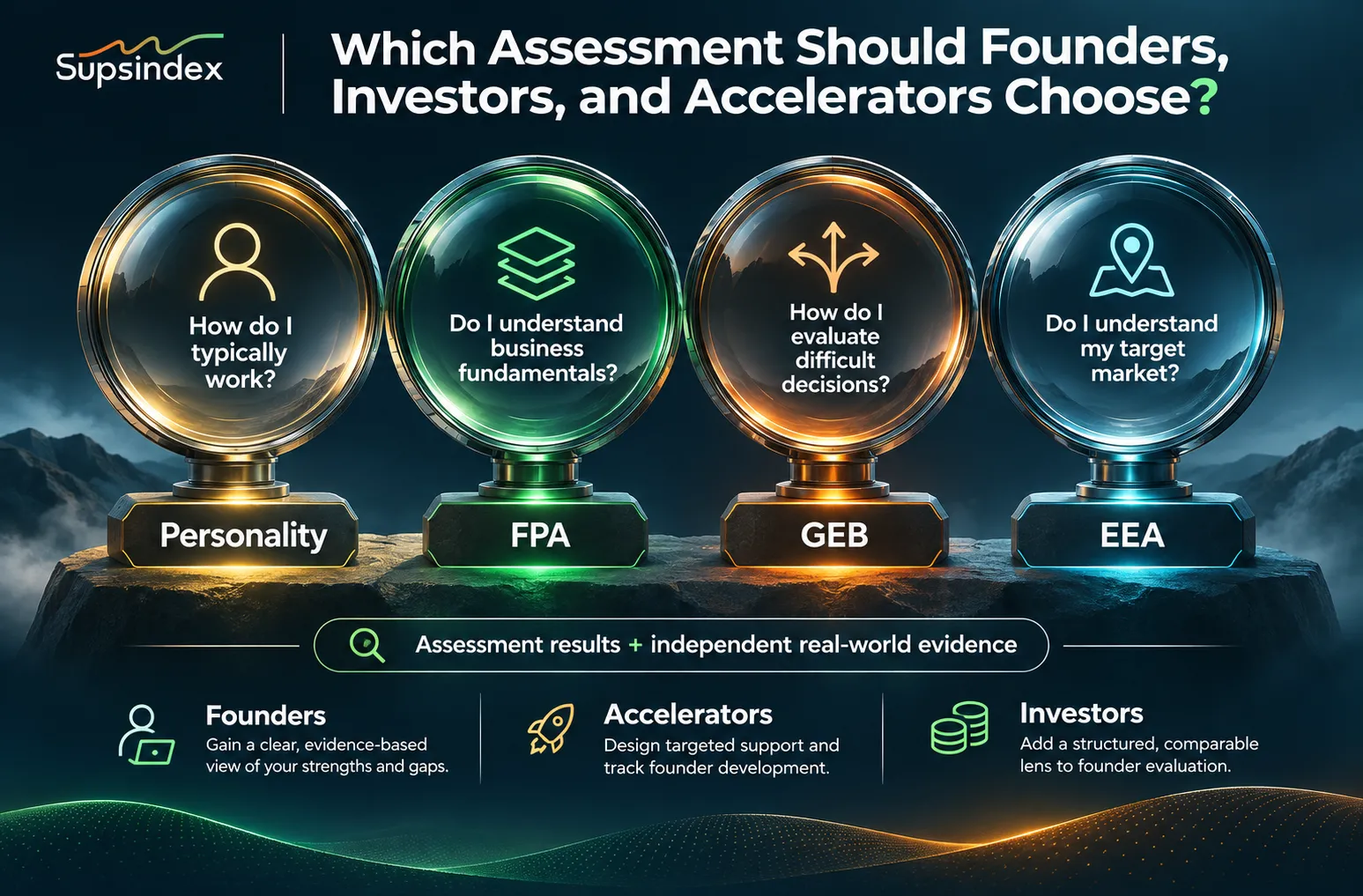
The most useful selection principle is to choose the instrument according to the decision it needs to inform. A founder looking to understand working preferences has a different objective from an accelerator trying to identify gaps in financial literacy or an investor evaluating whether a team understands its operating environment.
The following decision guide provides a practical starting point.
| Your primary question | Appropriate assessment approach | What to do with the result |
|---|---|---|
| How do I typically approach work and relationships? | Big Five, HEXACO, or an appropriate personality instrument | Reflect on traits and compare with behavioral observations |
| How can our team communicate more effectively? | Development-focused workplace or preference assessment | Facilitate discussion and agree on practical communication changes |
| Does this founder understand key business mechanics? | FPA, alongside practical knowledge checks | Identify knowledge gaps and build a development plan |
| How does this founder judge difficult entrepreneurial trade-offs? | GEB, alongside interviews and observed decisions | Investigate behavioral patterns and potential risks |
| Does this founder understand a target market? | EEA plus legal, commercial, and regulatory due diligence | Identify ecosystem knowledge gaps before expansion |
| Is someone suitable for a particular professional role? | Job-relevant, appropriately validated assessments and work samples | Combine evidence within a structured human-led process |
| Is this startup ready for investment? | Multiple founder, team, market, and financial evidence sources | Conduct comprehensive due diligence; do not rely on a single score |
For individual founders, a combination of personality information and capability assessment may be especially useful. Personality measures can contribute to self-awareness, while FPA, GEB, and EEA can identify more specific areas for entrepreneurial development.
For accelerators, domain-specific assessment results may help inform mentorship and curriculum planning. For example, a cohort demonstrating knowledge gaps in financial management may benefit from targeted financial-literacy workshops, while a group struggling with customer validation may need more structured discovery training.
Investors can use founder-specific assessments as supplementary evidence during due diligence, but not as automatic rejection mechanisms. The results should be interpreted alongside customer traction, actual decision histories, leadership references, market conditions, and team execution.
The objective is to reduce reliance on superficial impressions without replacing them with an equally simplistic reliance on assessment scores.
Three Examples of How Different Assessments Reveal Different Information
The following scenarios are hypothetical illustrations, not documented results from founders who completed both personality testing and Supsindex assessments.
The Disciplined Technical Founder With a Financial Knowledge Gap
A technical founder scores highly on conscientiousness and emotional stability in a Big Five assessment. They are organized, dependable, and generally comfortable managing demanding work. These results suggest useful tendencies, but they do not establish whether the founder has the financial knowledge required to lead a growing company.
A separate FPA assessment might identify weaknesses in runway calculations, cap table dilution, or customer acquisition economics. GEB could also indicate that the founder tends to retain excessive control over operational decisions, while EEA might reveal gaps in understanding a regulated target market.
These findings would not invalidate the personality assessment. They would answer different questions. The founder may genuinely be conscientious while lacking particular business competencies or relying on ineffective approaches to delegation. A sensible development plan could combine financial training, clearer decision rights, and relevant market expertise rather than treating the founder’s personality as the underlying problem.
The Charismatic Founder Who Confuses Attention With Demand
Another founder is highly extraverted and open to new experiences. They communicate confidently, enjoy meeting investors, and readily explore new commercial opportunities. These characteristics may contribute positively to networking, persuasion, and learning, depending on the situation.
However, the founder repeatedly interprets positive press coverage and customer compliments as evidence of product-market fit. They increase acquisition spending despite weak retention and dismiss concerns about unit economics.
A founder-specific assessment may help investigate whether the problem involves gaps in financial reasoning, poor evidence evaluation, or a recurring tendency toward overconfidence. The appropriate response would be to examine actual customer cohorts, introduce spending safeguards, and test the assumptions behind expansion.
The issue is not that extraversion or openness is inherently dangerous. It is that favorable interpersonal traits do not replace evidence about commercial execution.
The Quiet Founder With Strong Entrepreneurial Judgment
Consider a biotechnology founder who is reserved during presentations and prefers detailed preparation over spontaneous networking. A personality assessment may indicate lower extraversion and a cautious interpersonal style.
An interviewer who equates entrepreneurial potential with charisma could underestimate this person. Yet a knowledge assessment might reveal a strong understanding of financial planning, development timelines, and industry-specific requirements, while situational judgment testing could suggest careful evaluation of strategic alternatives.
The correct conclusion would not be that the founder is guaranteed to succeed or possesses perfect judgment. It would be that their quieter presentation style should not substitute for evidence about relevant capabilities.
The founder may still benefit from commercial support or presentation coaching, but those needs should be evaluated separately from technical and strategic competence.
Together, these examples demonstrate why a multidimensional assessment process is more informative than assuming any single trait, type, or score represents the complete founder.
Can Personality Assessments and Supsindex Be Used Together?
Yes, provided the instruments are appropriate for their intended purposes and the results are interpreted within the limits of the available evidence.
A validated Big Five or HEXACO instrument can offer information about relatively broad psychological tendencies. A founder-specific assessment may add information about entrepreneurial knowledge, responses to structured decisions, or familiarity with a particular ecosystem. Interviews, work samples, financial records, and observed behavior provide further context.
However, these layers should not be described as completely non-overlapping. GEB’s assessment of resilience, adaptability, decision tendencies, and behavioral risks may share meaningful variance with personality constructs. Establishing how much unique information GEB contributes beyond existing personality measures is an empirical research question.
This distinction is called incremental validity: whether an assessment provides useful predictive or explanatory information beyond what is already known from other relevant measures.
For example, if an investor already has a founder’s experience, past execution record, and validated personality assessment, does adding GEB meaningfully improve the ability to anticipate specific subsequent behaviors? If the goal is to understand financial literacy, does FPA identify important knowledge gaps that general personality information does not cover?
These are different validation questions. The latter concerns a distinct knowledge domain, while the former requires direct comparative and predictive evidence.
Using multiple tools can improve the breadth of information collected, but it does not automatically improve decision accuracy. Poorly interpreted or highly redundant assessments can introduce additional complexity without adding useful evidence.
What Does the Scientific Evidence Actually Support?
The evidence supporting established personality research should be distinguished from Supsindex’s own preliminary findings and ongoing validation objectives.
The Big Five has a substantial research history documenting relationships with workplace performance and entrepreneurial outcomes. Instruments such as Hogan and the Predictive Index also have organizational assessment applications supported by their respective technical documentation, although evidence must always be evaluated for the specific instrument and use.
Supsindex’s scientific literature documents its assessment architecture, item-development framework, and a preliminary partner evaluation involving 75 founders across organizations in the United Kingdom, Türkiye, and the United Arab Emirates.
That preliminary evaluation compared Supsindex assessment rankings with partner judgments of participating founders. Reported pairwise agreement varied across the three core indices, reaching up to 94.8% for FPA in one partner sample. These findings provide preliminary evidence of alignment with existing professional evaluations, but they do not establish predictive accuracy for subsequent founder execution or startup survival.
Supsindex’s FD-01 Founder Discovery Study is designed to investigate prospective relationships between baseline assessment results and later entrepreneurial execution. Its research framework includes examining whether assessment scores contribute additional information beyond conventional founder and venture characteristics.
At present, no published head-to-head founder study has established that Supsindex outperforms Big Five, HEXACO, MBTI, DISC, Hogan, or the Predictive Index for predicting startup success.
The same limitation applies to claims about resistance to response distortion. Forced-choice situational judgment methods offer plausible methodological advantages under appropriate conditions, but the extent to which GEB reduces deliberate faking compared with particular alternative instruments needs direct validation.
This does not negate the relevance of founder-specific assessment. It means the argument for using such assessments should rest on their clearly defined measurement objectives and available evidence rather than unsupported claims of universal superiority.
The Supsindex Scientific Catalog and Assessment Criteria provide additional information about the framework, preliminary findings, and research program.
Important Limitations: What Neither Approach Can Tell You

A personality assessment cannot establish that someone will be a successful entrepreneur simply because they possess traits associated with performance. Likewise, a founder-specific assessment cannot determine whether a startup will succeed simply because the founder demonstrates strong knowledge or favorable responses to hypothetical scenarios.
Both approaches have measurement limitations. Self-report instruments may be affected by response distortion, limited self-awareness, and the context in which they are administered. Situational judgment assessments may be affected by scenario design, interpretation, learned test-taking strategies, and the difference between hypothetical choices and actual behavior.
Assessment fairness also matters. Language, culture, accessibility, professional experience, and industry familiarity can influence performance in ways that require investigation. Contextualization and sophisticated scoring models are useful design mechanisms, but they do not automatically eliminate these concerns.
Supsindex’s official framework positions its assessments as developmental and decision-support instruments, not medical or clinical diagnostic tools. Results should not be used as the sole basis for funding approvals, hiring decisions, accelerator rejection, or immigration-related decisions without adequate validation and appropriate human review.
The most responsible application is to identify questions worth investigating, make developmental needs more visible, and support decisions alongside independent evidence.
This principle also underpins the Founder Risk Checklist, which encourages investors to examine behavioral, financial, operational, and team-related warning signs without treating a single observation as a definitive verdict.
Frequently Asked Questions About Founder Assessments and Personality Tests
Is a founder assessment the same as a personality test?
No. Personality assessments generally measure broad traits, preferences, or workplace behavioral tendencies. Founder assessments such as Supsindex FPA, GEB, and EEA examine additional dimensions of entrepreneurial knowledge, situational judgment, and ecosystem awareness. Some behavioral constructs overlap, but the assessments are designed to address different questions.
Can Big Five personality traits predict entrepreneurial success?
Research has found statistical relationships between several Big Five traits and entrepreneurial outcomes. However, these relationships are probabilistic and do not provide reliable guarantees about individual founder performance or startup survival.
Is MBTI useful for startup founders?
MBTI may be useful for personal reflection and discussing communication preferences within a founding team. It is not designed to measure entrepreneurial competence or determine who should receive funding, and its own provider advises against using it for hiring or selection.
What does Supsindex GEB measure that personality tests may not?
GEB uses entrepreneurial Situational Judgment Test scenarios to examine how founders select responses to business-related challenges. It is designed to investigate behavioral judgment and potential decision-making risks in a startup context, although some constructs overlap with general personality traits.
Is Thurstonian IRT automatically more accurate than traditional personality scoring?
No. Thurstonian IRT can address certain issues associated with conventional forced-choice scoring, but its performance depends on instrument design, statistical assumptions, calibration, and empirical validation. It does not automatically establish greater reliability or predictive accuracy.
Which assessment should an accelerator use to evaluate founders?
The choice depends on the objective. FPA may help identify entrepreneurial knowledge gaps, GEB can provide information about situational judgment, and EEA addresses ecosystem-specific awareness. Personality assessments may complement this information, but selection decisions require relevant validation, human oversight, and additional evidence about actual founder and venture performance.
Can an introverted founder be a successful CEO?
Yes. Lower extraversion does not imply an inability to lead, communicate, or build a successful company. Leadership effectiveness depends on multiple capabilities and situational factors, and a personality score should not be used as a deterministic judgment of entrepreneurial potential.
Does Supsindex guarantee better investment decisions?
No. Supsindex assessments are designed to contribute structured information about founder readiness and development needs. They do not guarantee startup success, investment returns, or superior selection outcomes, and their prospective predictive validation remains an ongoing research objective.
Conclusion: Choose the Assessment That Answers the Right Question
Personality assessments and founder-specific assessments offer different perspectives on entrepreneurial capability. Established trait models such as the Big Five can provide meaningful information about psychological tendencies, while workplace-oriented instruments can support appropriately validated organizational and leadership applications.
Founder-specific assessments extend the evaluation toward knowledge and decisions that are directly relevant to operating a startup. Supsindex’s FPA examines entrepreneurial knowledge and cognitive reasoning, GEB explores judgment in structured business scenarios, and EEA evaluates understanding of the founder’s target ecosystem.
These approaches can complement each other, but their value depends on the questions being asked, the strength of the supporting evidence, and the way results are interpreted.
A founder’s confidence does not establish financial literacy. Their charisma does not prove commercial judgment. Their conscientiousness does not guarantee regulatory knowledge, and their introversion does not establish poor leadership potential.
Equally, strong founder-assessment results cannot guarantee future execution or eliminate the uncertainty inherent in entrepreneurship.
The goal is not to replace personality tests with founder assessments. It is to use each instrument for what it can meaningfully measure, recognize what remains unknown, and make better-informed development and investment decisions.
To explore the different dimensions of founder readiness, visit Supsindex Assessment Criteria or learn more about FPA, GEB, and EEA.
Scientific References and Further Reading
- Zell, E., & Lesick, T. L. — Big Five Personality Traits and Performance: A Quantitative Synthesis of 50+ Meta-Analyses. Journal of Personality.
- Zhao, H., Seibert, S. E., & Lumpkin, G. T. — The Relationship of Personality to Entrepreneurial Intentions and Performance: A Meta-Analytic Review. Journal of Management.
- McCrae, R. R., & Costa, P. T. — Reinterpreting the Myers-Briggs Type Indicator From the Perspective of the Five-Factor Model of Personality. Journal of Personality.
- The Myers-Briggs Company — MBTI Facts and Appropriate Uses.
- HEXACO Personality Inventory — Official Scale Descriptions.
- Hogan Assessments — Hogan Development Survey.
- The Predictive Index — Behavioral Assessment.
- Supsindex Scientific Catalog — Founder-assessment architecture, preliminary partner evaluation, and FD-01 prospective research framework.
