


Like neglected equipment on an assembly line, unmeasured founder blind spots erode productivity and gradually destroy value before a single sale is made. In the startup ecosystem, the failure to systematically assess founder capabilities does not merely result in occasional disappointment—it produces a predictable, recurring destruction of economic wealth on a global scale. Quantifying the costs of these founder blind spots reveals an unspoken truth: subjective assessment is far more expensive than any psychometric test ever published.
Part I: A Taxonomy of Preventable Loss
The cost of startup failure, often driven by founder blind spots, extends beyond the balance sheet of a defunct venture. Like shockwaves radiating from a structural collapse, the financial and psychological losses cascade outward, affecting individuals, investors, communities, and entire industries. Data from 2024–2025 reveals that 90% of early-stage ventures fail globally, with first-time founders achieving success at a mere 18% rate.
1. Direct Financial Costs: The Capital That Vanishes
These are the quantifiable monetary losses borne by those who funded the failed venture.
-
- Founder personal capital depletion. Founders often invest significant personal savings into their ventures. The average startup costs approximately $40,000 to launch, yet 58% of founders launch with less than $25,000, leaving little margin for error and devastating personal financial consequences when failure arrives. When founder finances are intertwined with venture capital, a single failure can wipe out years of personal wealth accumulation.
- Investor principal loss. The magnitude of capital destruction in venture markets is staggering. University of Pennsylvania professor Elizabeth Pollman cites estimates that approximately 75% of venture-backed startups fail to provide returns to all equity holders. Notable examples include the $14 billion collapse of battery manufacturer Northvolt, which had raised over $14 billion before filing for bankruptcy in 2024, with $5.8 billion in debt and only $30 million in cash remaining. For every unicorn that emerges, dozens of portfolio companies quietly disappear, along with their invested capital.
- Operational capital misallocation. When a startup fails, the capital deployed to build its product, develop its technology, and launch its marketing campaign is permanently lost. These sunk costs cannot be recovered or redeployed. Studies indicate that 29% of failures stem explicitly from running out of capital, often because resources were misdirected toward unvalidated activities rather than strategic priorities.
2. Indirect Financial Costs: The Opportunities That Never Materialize
Subtler but equally significant, these costs represent the ventures that could have succeeded with the same resources but were denied the chance.
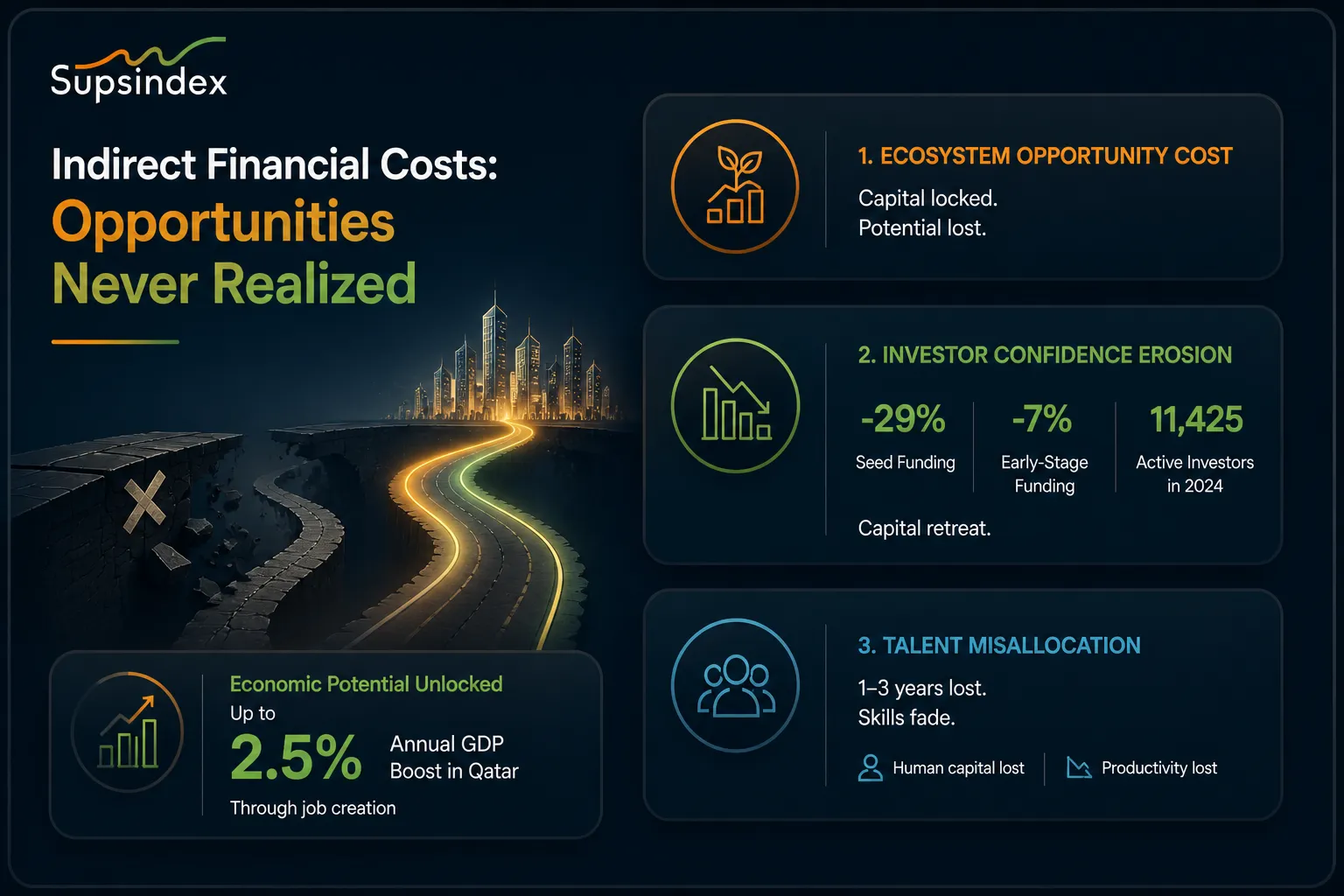
- Ecosystem opportunity cost. Capital allocated to doomed ventures cannot simultaneously fund ventures with genuine potential. In Qatar, research indicates a thriving startup ecosystem could boost annual GDP by up to 2.5% through job creation alone—economic expansion that remains unrealized when capital is repeatedly destroyed in preventable failures caused by founder blind spots. Each failed venture consumes not only its direct investment but also the multiplier effect that capital could have generated elsewhere.
- Investor confidence erosion leading to capital retreat. The cumulative effect of persistent failures drives capital away from early-stage innovation. By the end of 2024, seed funding had fallen 29% compared to the same period in 2023, while early-stage funding declined 7%. More venture firms than ever have become “zombies”—unable to raise new funds yet not fully dissolved—with active investor participation in US VC deals dropping from 15,303 in 2023 to just 11,425 in 2024. This contraction reduces the total pool of capital available for all founders.
- Talent misallocation and skill atrophy. Talented engineers, designers, and business professionals who spend one to three years on a failing venture emerge with depleted networks, outdated skills, and diminished professional confidence. The human capital embedded in failed startups does not simply disappear—it returns to the labor market devalued, having spent its most productive years on initiatives that produced no sustainable economic output.
3. Direct Non-Financial Costs: The Psychological Burden
These are the immeasurable yet deeply consequential harms to the individuals who bear the weight of failure.
- Loss of founder self-confidence and identity erosion. When self-worth becomes intertwined with business outcomes—as it inevitably does for founders who have staked their identity on their venture—failure is not experienced as a setback but as a personal indictment. Research shows that for entrepreneurs, emotions fluctuate wildly with every gain or setback; success feels euphoric, but failure or criticism often feels like a personal attack. When growth stalls, founders carry it like a moral failing, creating chronic stress, resentment, and persistent feelings of being overwhelmed.
- Mental health deterioration. The psychological toll on failed founders is severe and well-documented. Studies indicate that 25% of founders experience clinical anxiety, while 41% report debilitating fear of failure. The pressure to remain strong and confident during chaos—often maintained at the expense of mental health—leaves many founders suffering from depression, chronic insomnia, and post-failure trauma once the venture collapses. Untreated mental health challenges impair decision-making, reduce creativity, and increase the likelihood of future failure, creating a downward spiral that extends far beyond the original venture.
- Relational and marital strain. The intense pressure and extended working hours required to sustain a failing startup place extraordinary strain on personal relationships. Co-founder conflicts, which Harvard Business School Professor Noam Wasserman identifies as the cause of 65% of startup failures, often intensify during periods of distress, leading to relational debt—the accumulated toxicity that builds when founders avoid mentioning tensions or suppress difficult feelings for too long. Spouses, children, and extended family members bear the emotional consequences of a founder’s psychological exhaustion and financial precarity.
4. Indirect Non-Financial Costs: The Ecosystem-Wide Consequences
These are the structural harms that persist long after individual failures fade from memory.
- Stigmatization of innovative concepts. When a high-profile startup fails in a particular sector—be it fintech, proptech, or AI—investors become risk-averse toward that entire domain for years. Analysis of 2025 shutdown data reveals that Series A failures average around seven years old, largely concentrated in fintech, proptech, logistics, HR tech, and B2B SaaS—sectors that once attracted abundant capital but now struggle to secure follow-on funding. Promising ventures in those sectors face an elevated hurdle, forced to overcome the reputational damage caused by their failed predecessors.
- Decline in entrepreneurial participation rates. The fear of failure has a measurable chilling effect on entrepreneurial activity. Recent GEDI research reveals that 49% of respondents in 2024 stated they would not start a business due to fear of failure, up significantly from 44% in 2019. As visible failures accumulate, potential founders—particularly those from underrepresented backgrounds who lack robust safety nets—opt for salaried employment rather than venturing into an ecosystem they perceive as hostile to success. This talent diversion represents a permanent loss of innovative capacity.
- Loss of institutional learning and ecosystem wisdom. When a startup fails, its accumulated knowledge—about customer needs, distribution channels, regulatory hurdles, and technical architectures—is often lost rather than captured and disseminated. Unlike the scientific community, which archives failed experiments to prevent repetition, the startup ecosystem treats failure as a shameful secret rather than a source of data. Consequently, subsequent founders repeat the same mistakes, perpetually rediscovering what their predecessors learned at great cost.
The Fallacy of the “All Risk-Taking Is Necessary” Narrative
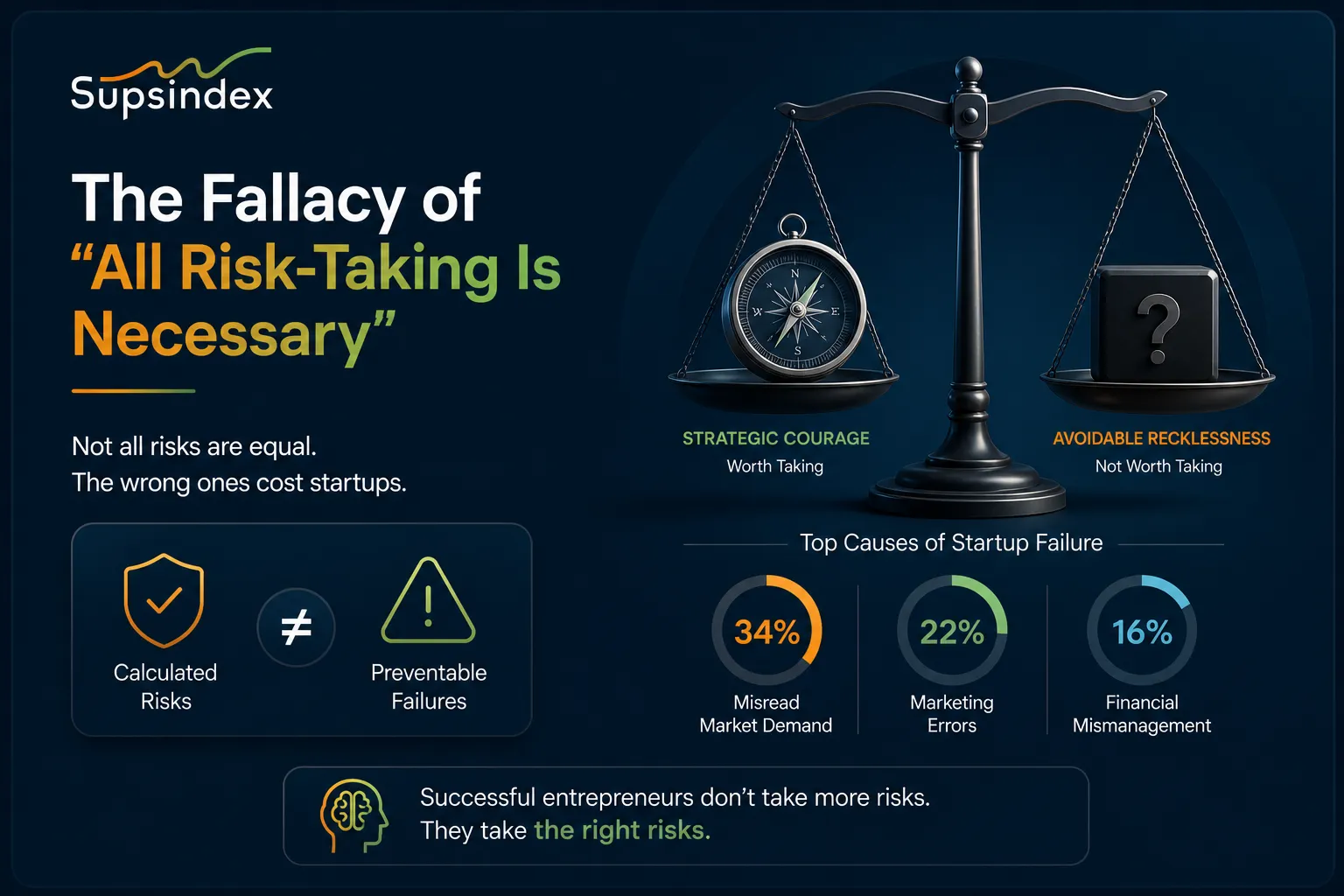
The traditional ecosystem narrative holds that high failure rates are an acceptable price for the occasional transformative success. This framing, however, conflates calculated risk-taking with preventable failure. Strategic risk evaluation is not about eliminating risk but about distinguishing which risks are worth taking. Studies consistently find that 34% of failures stem from misreading market demand—creating products no one wants—while 22% result from marketing errors and 16% from financial mismanagement. These are not unavoidable bets; they are predictable outcomes of unmeasured founder blind spots.
Rosenkopf’s research reveals that risk is not one of the six drivers of entrepreneurial success—successful entrepreneurs avoid unreasonable risks entirely, instead taking calculated risks grounded in clear vision, experience, and confidence. The instinct to celebrate all risk-taking as virtuous ignores the distinction between strategic courage and avoidable recklessness. The problem is not that founders take risks; it is that they take the wrong ones, systematically, because they lack the self-awareness and decision-making frameworks to distinguish signal from noise.
Part II: The Growth Dividend of Better Founder Assessment
If the costs of unmeasured founder blind spots represent a drain of epic proportions, the benefits of reducing those blind spots represent an equally significant opportunity. Redirecting even a portion of currently wasted capital toward ventures with higher success probabilities would unlock compounding economic and social returns.
The Capital Reallocation Multiplier
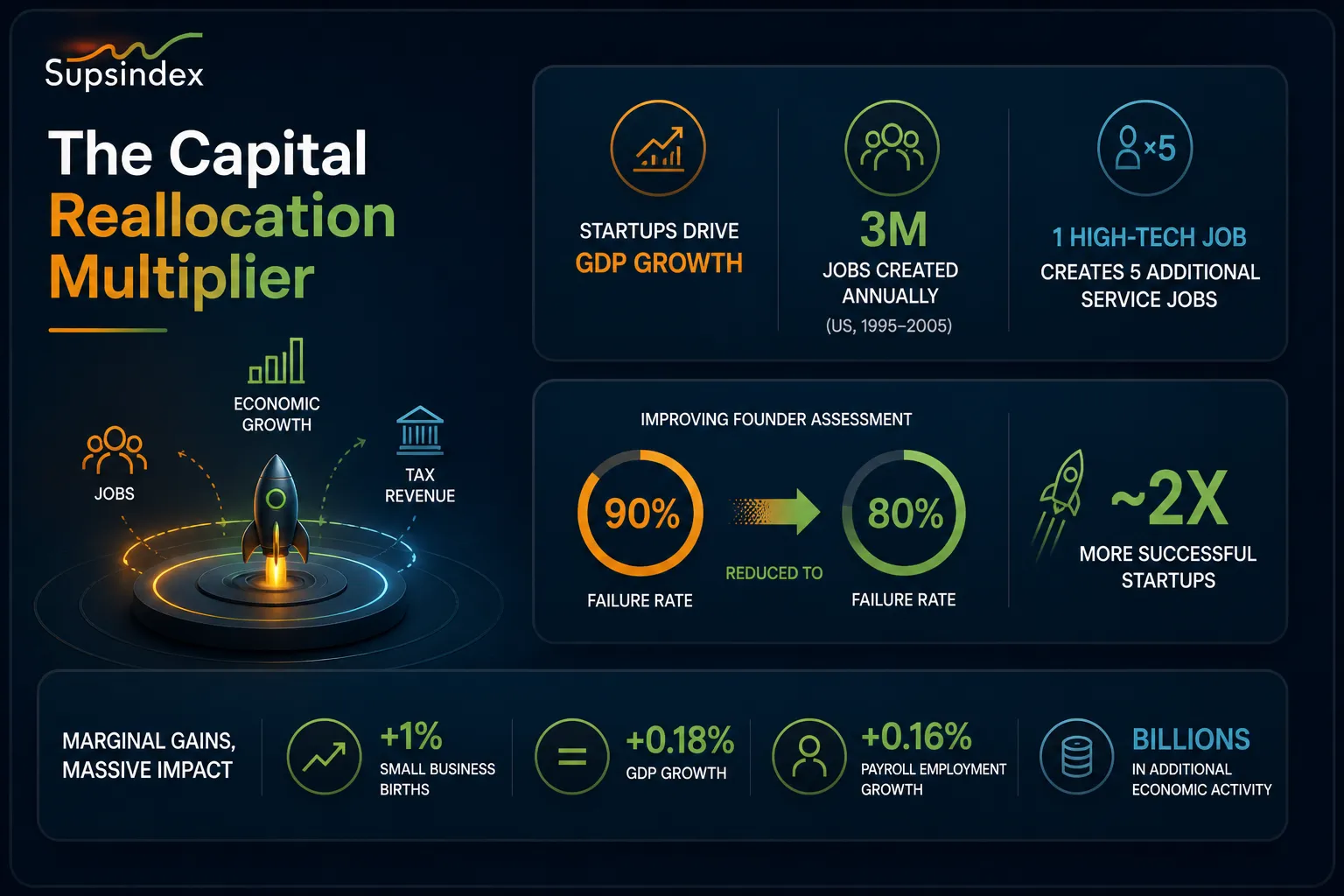
Each successful startup does not merely return its initial investment—it generates a multiplier effect that ripples through the entire economy. Research demonstrates a positive correlation between the number of startups in an economy and GDP growth. In the United States alone, startups contributed an estimated 3 million jobs annually between 1995 and 2005. Economist Enrico Moretti has shown that each new high-tech job in the US creates five additional jobs in the service economy—a multiplier that transforms local communities. Each startup that succeeds can spawn dozens of indirect jobs, exactly the multiplier effect described above.
If the current 90% failure rate were reduced to 80% through better assessment of founder blind spots, the number of successful startups would effectively double. The implications for job creation, economic output, and tax revenue would be profound. A one percent increase in small business births is associated with roughly 0.18 percent higher GDP growth and 0.16 percent higher payroll employment growth. At ecosystem scale, these marginal improvements aggregate into billions of dollars of additional economic activity.
Accelerated Technological Development
Failed startups do not merely waste capital—they delay innovation. The technologies that could have addressed climate change, extended human healthspan, or transformed education remain unrealized when the ventures developing them collapse prematurely. Concentrating capital on founders with demonstrated resilience, decision-making capability, and ecosystem mastery would accelerate the development and deployment of transformative technologies.
Consider the AI sector. AI investments are projected to hit $55–$60 billion annually, yet the high 70–90% failure rate for AI startups suggests that a substantial portion of this capital—potentially as high as $38–$54 billion—could be lost. Directing that capital toward ventures with validated founder capabilities would not only preserve billions in investment but would also accelerate the responsible development of artificial intelligence by ensuring that sophisticated technology is built by teams capable of handling its implications.
Improved Global Living Standards
The ultimate beneficiary of a more efficient founder assessment ecosystem is society itself. Startups are the primary engine of productivity growth, job creation, and rising living standards. In emerging economies, SMEs contribute as much as 40–60% of GDP, yet they remain the most constrained, under-digitized, and under-leveraged part of the economy. By increasing the success rate of these ventures, entire regions could accelerate their economic development trajectories.
A thriving ecosystem in a developing nation could boost annual GDP by up to 2.5% through job creation alone—a figure that translates into millions lifted from poverty, improved infrastructure, expanded educational access, and enhanced healthcare systems. The social returns on improved founder assessment vastly exceed the private returns to investors or founders.
Conclusion: From Intuition to Measurement
The costs described above are not immutable features of the entrepreneurial landscape—they are outcomes of a specific failure: the failure to measure founder capability and founder blind spots systematically. Supsindex exists to close this gap, providing the psychometric rigor, behavioral assessment, and ecosystem-specific calibration that the startup world has lacked.
When intuition guides capital allocation, preventable failure is the predictable result. When measurement guides capital allocation, success becomes not a matter of luck but of design. The choice between these two futures is not merely a matter of business efficiency—it is a choice about the speed of innovation, the depth of economic opportunity, and the number of human beings whose potential will be realized rather than extinguished.
—— The era of assessing founders on gut feeling is ending. The era of measuring has begun.
