


The Founder Assessment Tools Comparison published by TechBullion examines how Supsindex and six other platforms approach entrepreneurial potential, behavioural capability, leadership readiness, and founder development.
Supsindex Featured in TechBullion’s Founder Assessment Tools Comparison
Supsindex was recently included in an extensive TechBullion analysis titled Inside Out: Founder Assessment Tools Comparison. Published on July 12, 2026, the article explored how the startup ecosystem is gradually moving beyond traditional business-plan evaluation and paying greater attention to the capabilities of the founders responsible for execution.
Rather than presenting founder assessment as a single category with one universal methodology, the analysis compared seven platforms with different scientific foundations, target users, operational purposes, and definitions of entrepreneurial readiness.
The platforms examined were Founder Institute’s Entrepreneur DNA Assessment, Entrepreneurial Mindset Profile, Founder Diagnostics, The Founder Six, Readiness Institute, Readiness Engine, and Supsindex. Each platform was evaluated according to six dimensions: assessment philosophy, scientific foundation, primary audience, breadth of assessment, operational value, and key limitations.
This comparative structure is particularly important because founder assessment tools are not necessarily designed to solve the same problem. Some are built primarily for accelerator admissions, some support coaching and leadership development, while others are intended to improve investment screening, organisational readiness, or founder self-awareness.
TechBullion’s analysis therefore did not attempt to rank the platforms according to popularity. Instead, it examined what each framework contributes to the emerging field of structured founder assessment and where each approach may leave important gaps.
Why Founder Assessment Is Becoming More Important

The article began with a central observation: startup ecosystems have become increasingly sophisticated in evaluating markets, products, business models, traction, and investment potential, yet founder capability often remains assessed through interviews, personal referrals, instinct, and relatively narrow personality tests.
This creates a significant imbalance. Markets can change, technologies can become outdated, and business models can be revised. In each of these situations, the founder and founding team remain responsible for interpreting uncertainty, making decisions, adapting strategy, and maintaining execution.
For this reason, founder capability is increasingly being treated as a multidimensional and developable area rather than a fixed personality profile. Behaviour, knowledge, adaptability, decision-making, ecosystem understanding, cognitive readiness, and learning capacity can each influence how a founder responds to real entrepreneurial challenges.
How Supsindex Was Positioned in the Comparison
Within the seven-platform comparison, TechBullion described Supsindex as adopting one of the broadest architectural approaches to founder assessment.
Rather than concentrating exclusively on personality, leadership traits, behavioural tendencies, or business readiness, Supsindex was presented as a multidimensional system that separates different areas of entrepreneurial capability into interconnected indices.
The article highlighted several areas within this architecture, including entrepreneurial literacy, behavioural judgement, ecosystem awareness, decision quality, continuous learning, engagement efficiency, and institution-specific assessment.
This modular approach reflects the idea that entrepreneurial performance cannot be understood through one measurement alone. A founder may possess strong business knowledge but struggle to make effective decisions under pressure. Another founder may demonstrate resilience and leadership capability while lacking sufficient awareness of the industry or ecosystem in which the venture operates.
Supsindex is designed to examine these dimensions separately while connecting them within a broader assessment environment.
Contextual Assessment Rather Than Universal Scoring
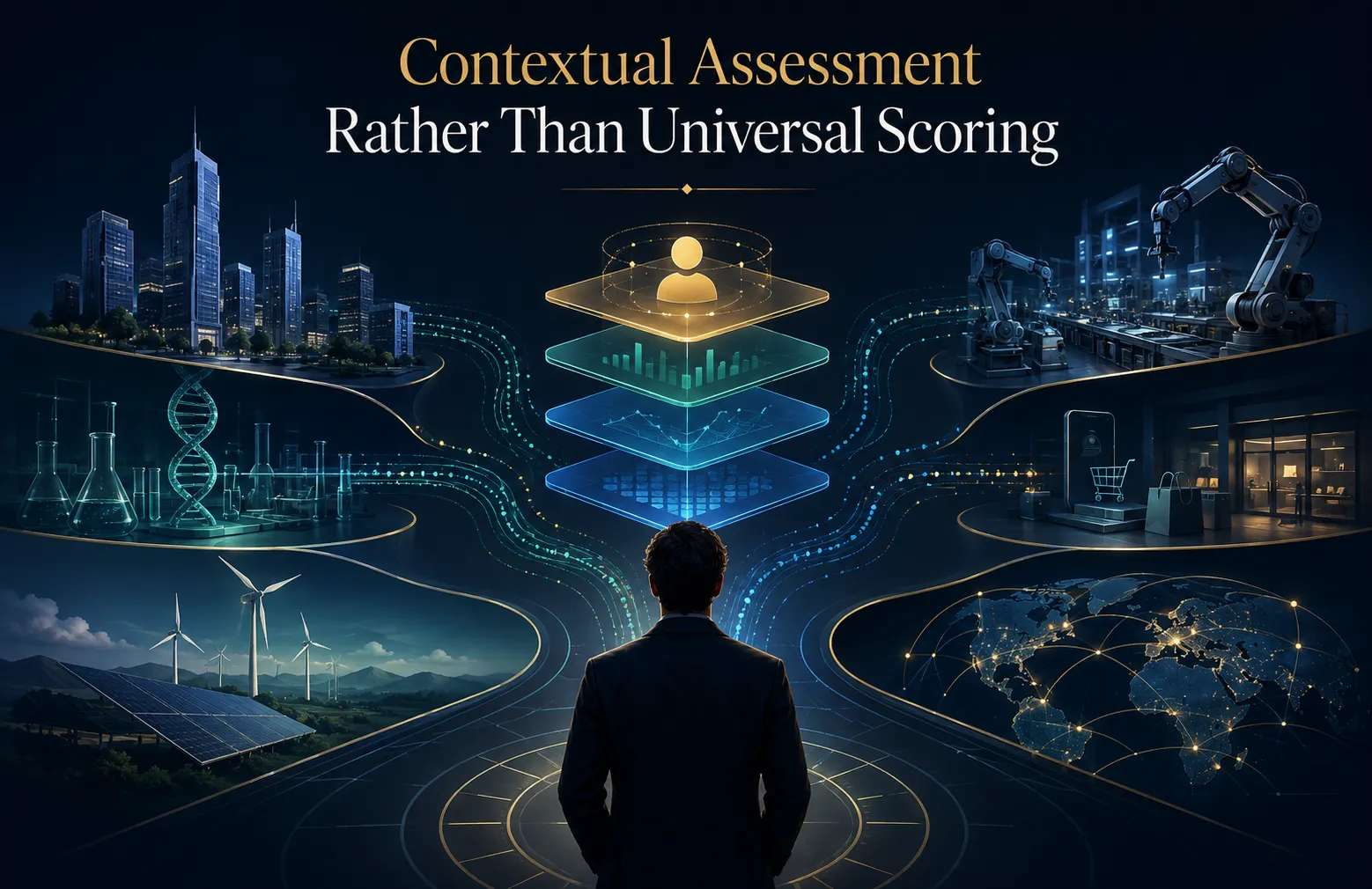
One of the main characteristics identified by TechBullion was Supsindex’s contextual benchmarking philosophy.
Many traditional assessment systems compare every participant against a broad or universal population. Supsindex instead adjusts assessment criteria according to factors such as industry, startup stage, and entrepreneurial ecosystem.
The analysis noted that Supsindex incorporates more than 55 industry calibration models, reflecting the view that founder capability cannot be separated from the environment in which it must be applied. A founder operating in financial technology, healthcare, artificial intelligence, manufacturing, or another specialised field may face different regulatory, operational, market, and execution demands.
This contextual structure also aligns with the broader Supsindex approach to assessing entrepreneurial knowledge, behaviour under pressure, and ecosystem readiness as distinct but complementary areas.
A Combination of Assessment Methodologies
TechBullion also highlighted the scientific breadth behind the Supsindex architecture.
According to the comparison, the system brings together psychometric assessment, situational judgement testing, cognitive modelling, behavioural analysis, AI-supported simulations, peer validation, and continuous calibration.
Rather than relying on a single psychological theory or self-reported personality framework, this combination is intended to provide a more complete understanding of how founders think, respond, decide, and develop across different situations.
The article also recognised Supsindex’s focus on development after assessment. Dynamic certification, continued benchmarking, institutional customisation, and learning pathways position assessment as an ongoing process rather than a one-time test.
This is an important distinction. Founder readiness is not necessarily permanent. Capabilities can improve, knowledge can become outdated, industries can change, and founders may perform differently as their ventures move from one stage to another.
A Balanced View of Supsindex’s Challenges
The TechBullion comparison did not present breadth without acknowledging its operational demands.
It identified implementation complexity as the primary challenge associated with the Supsindex model. A multidimensional platform requires more extensive validation, stronger scientific governance, continuous calibration, and greater operational effort than a shorter or more specialised assessment tool.
Maintaining consistency across industries, countries, startup stages, and entrepreneurial ecosystems will therefore remain an important responsibility as the platform expands.
Including this limitation strengthens the value of the comparison. Comprehensive assessment does not automatically guarantee accuracy. Its effectiveness depends on the quality of its models, evidence, validation processes, implementation, and long-term performance data.
Where the Founder Assessment Industry Is Heading
Across all seven platforms, TechBullion identified several broader shifts in founder assessment.
The field is moving away from static personality profiling toward the evaluation of dynamic capabilities such as judgement, adaptability, resilience, learning, and decision-making.
Founder assessment is also expanding beyond investors. Accelerators, universities, public innovation organisations, corporations, ecosystem builders, and founders themselves increasingly require structured information to support selection, development, team formation, investment, and resource allocation.
At the same time, universal scoring models are gradually giving way to contextual approaches that recognise differences between industries, venture stages, regulations, markets, and entrepreneurial ecosystems.
TechBullion concluded that the industry appears to be progressing from isolated assessments toward more integrated systems. Within this transition, the analysis described Supsindex as one of the most comprehensive current attempts to combine multiple dimensions of founder capability in a unified assessment ecosystem.
The article did not suggest that the future standard has already been established. It noted that broader adoption and long-term validation will ultimately determine whether integrated assessment systems become the dominant model.
However, the direction is becoming clearer: founder evaluation is shifting from intuition toward evidence, from static tests toward continuous measurement, and from generalised profiles toward contextual intelligence.
For Supsindex, inclusion in this comparison represents more than another international media mention. It places the platform within a wider discussion about how the next generation of founders may be assessed, supported, and developed.
Startup ecosystems have spent decades improving how they evaluate ventures. The emerging challenge is to build equally thoughtful systems for understanding the people expected to lead them.
Read the complete founder assessment tools comparison on TechBullion.
