

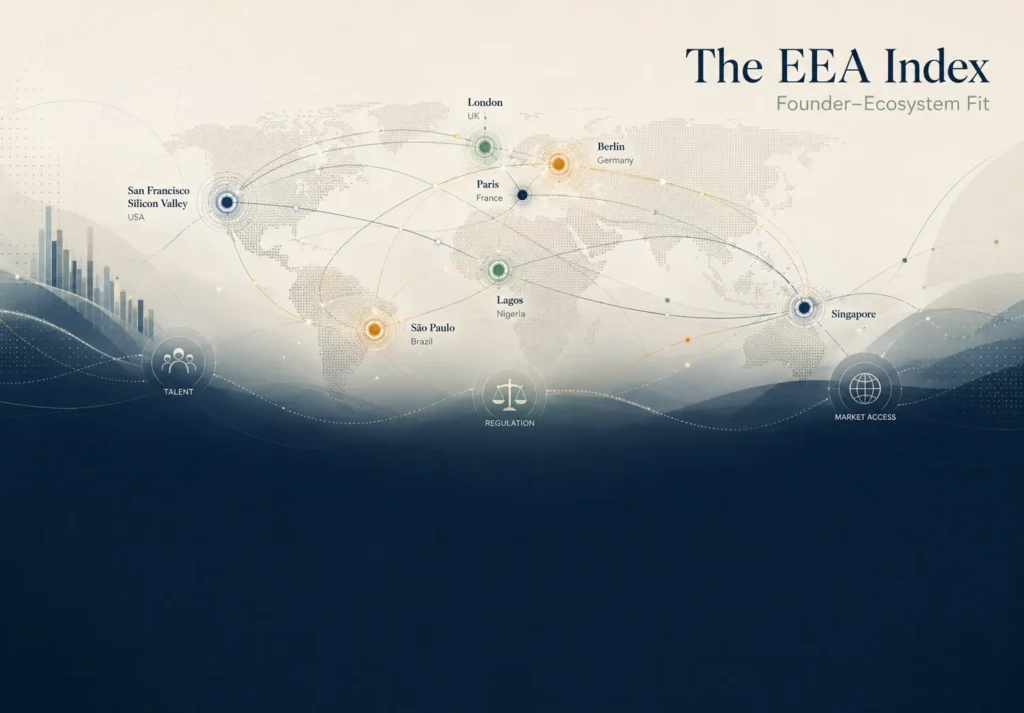
The EEA Index is a scientific framework revolutionizing how we quantify and measure founder-ecosystem fit for global startup success.
The Rise of the Ecosystem: Why Context Became King for the EEA Index
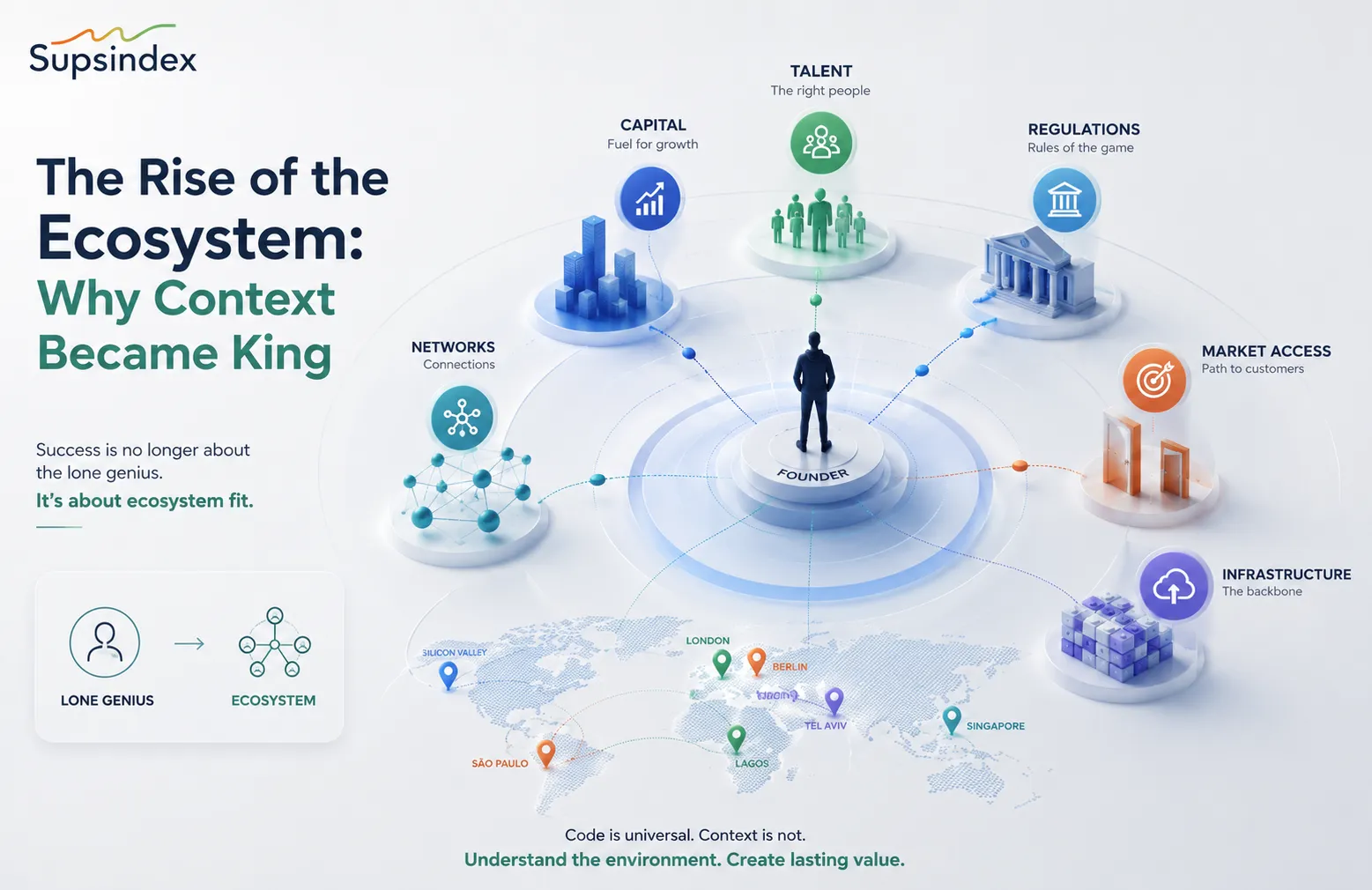
For decades, the narrative of entrepreneurship was dominated by the myth of the “lone genius”—the singular visionary who, through sheer force of will, bent the market to their desires. However, the last ten years have witnessed a profound paradigm shift in how economists, investors, and founders understand business success. We have moved from analyzing the individual in isolation to analyzing the organism within its environment. This is the era of the Startup Ecosystem.
The study of startup ecosystems has become paramount because the democratization of technology has leveled the playing field for product creation, but not for company building. While code is universal, the environment in which that code is commercialized is not. In the early 2000s, Silicon Valley was the singular gravitational center of the tech world. Today, we see the rise of distinct, powerful hubs in London, Berlin, Singapore, Madrid, São Paulo, and Lagos. As capital became global, the realization dawned that execution remains stubbornly local.
Researchers and venture capitalists began to notice a pattern: brilliant founders with validated products were failing at alarming rates when they attempted to scale in markets they did not fundamentally understand. Conversely, average products were succeeding because their founders had mastered the “soft power” dynamics of their local environment—leveraging specific government grants, navigating opaque regulatory frameworks, and tapping into informal talent networks. The study of ecosystems emerged as a necessary discipline to map these invisible forces. It is no longer enough to have a business plan; one must have an “ecosystem fit.” This realization has driven the creation of tools like Supsindex, which posits that humanity begets technology, and therefore, understanding the human and environmental constraints of a specific geography is the first step toward value creation.
The Divergence of Worlds: Why Ecosystems Are Contradictory
A common and fatal error made by founders is the assumption that startup ecosystems are variations of the same theme. They assume that what works in San Francisco will work in Paris, or that the rules of engagement in FinTech apply equally to HealthTech. This could not be further from the truth. Ecosystems are not just different; they are often fundamentally contradictory, shaped by deep-seated upstream regulations, market typologies, and cultural attitudes toward risk and labor.
Consider the Funding & Capital Landscape. In the United States, the ecosystem is predicated on high-risk, high-reward Venture Capital (VC) seeking “unicorn” returns. A founder is expected to burn cash to capture market share. Contrast this with many European or Asian ecosystems, where the landscape is heavily influenced by Government Grants & Public Funding Mechanisms. In these environments, the “move fast and break things” approach can disqualify a startup from essential non-dilutive funding. A founder applying a US-centric fundraising strategy in a grant-heavy ecosystem will not only fail to raise capital but will waste months chasing investors who do not exist or whose investment theses do not align with the local reality.
Furthermore, Talent & Human Capital dynamics vary wildly. In mature tech hubs, equity compensation (ESOPs) is a standard expectation; talent will accept lower salaries for higher upside. In emerging markets or more conservative economies, cash is king, and equity is often viewed with suspicion or lacks the legal framework to be liquid. A founder attempting to recruit top-tier engineers in a risk-averse culture using a low-salary/high-equity offer will find themselves with an empty office. The definition of “educated force” also shifts; one ecosystem may produce world-class theoretical data scientists (University Linkages) but lack the Business & Commercial Talent to sell the product, requiring a completely different hiring strategy.
The contradictions deepen when we layer on Industry-Specific Categories. The Regulatory & Legal Framework for a FinTech startup involves navigating central bank compliance and KYC/AML laws that are rigid and binary. Conversely, a startup in the Creator Economy might operate in a regulatory gray zone where speed is the only metric that matters. A HealthTech founder must master Sector-Specific Regulations like HIPAA or GDPR, where a single compliance slip is an existential threat, whereas a SaaS founder focuses on Value Chain Dynamics and API integrations. The “best practice” for one is the “death sentence” for the other. These are not nuances; they are structural barriers that dictate the viability of a business model.
The High Cost of Ignorance: The Danger of the Unknown in Founder-Ecosystem Fit
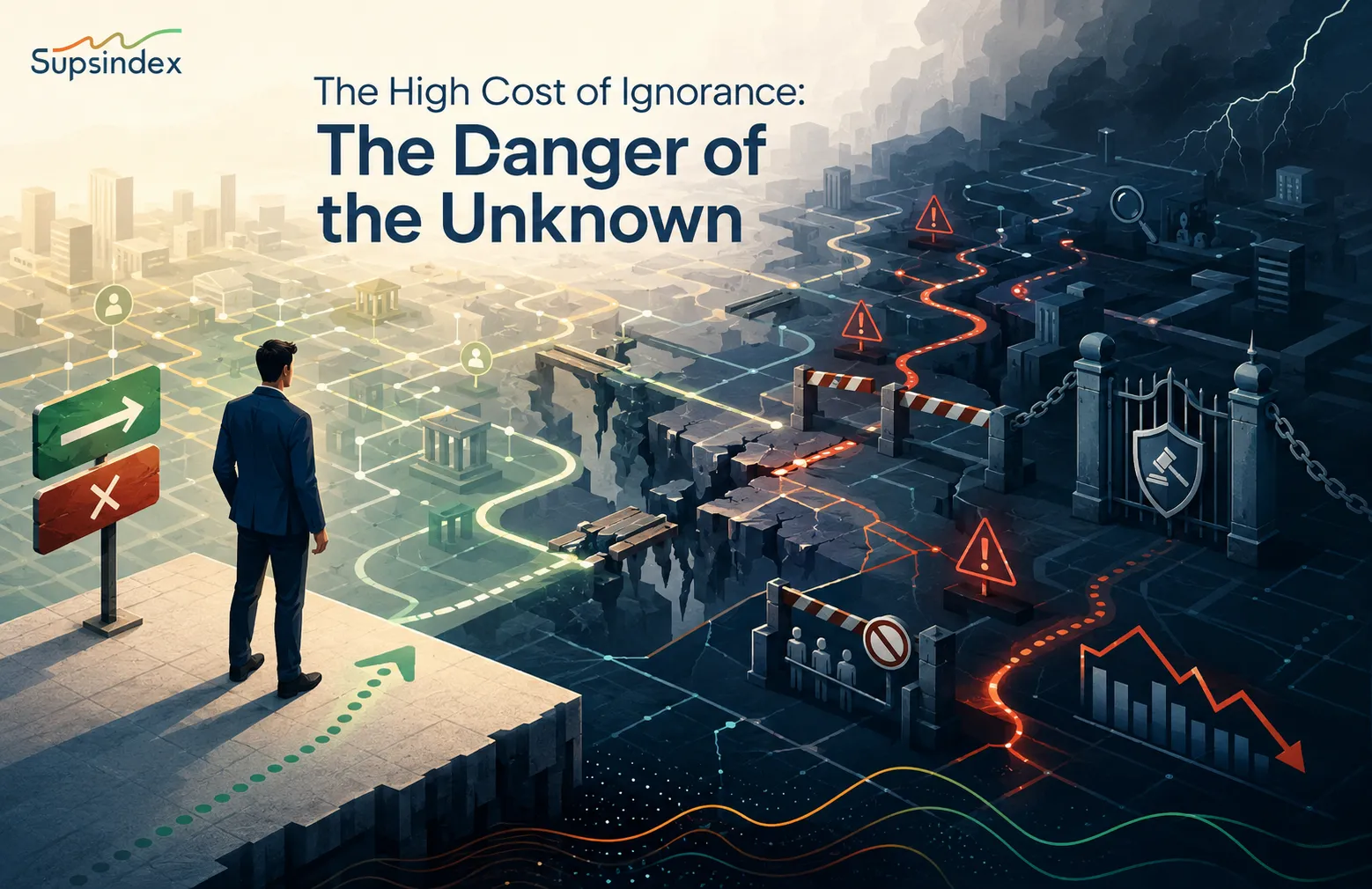
For a startup launcher, failing to master these ecosystem details is not merely an inconvenience; it is a source of existential risk. Ignorance of the ecosystem forces founders to make decisions based on assumptions rather than reality, leading to a misalignment between the startup’s strategy and the environment’s constraints. The most dangerous aspect of this ignorance is that it often masquerades as bad luck. A founder might believe their product failed because of “poor market fit,” when in reality, it failed because they misunderstood the Market Access & Commercialization Culture. For instance, attempting a bottom-up, product-led growth strategy (common in B2C) in a market dominated by Public Sector & Enterprise Procurement Processes will lead to a depleted runway before a single sale is made. If the local ecosystem relies on “gatekeepers” and formal distribution channels, bypassing them is not disruption—it is suicide.
Legal and regulatory blindness is equally catastrophic. A founder who does not understand the Intellectual Property (IP) Law of their target country may build a brand that they cannot trademark, or worse, inadvertently infringe on an incumbent’s IP. In the General Regulatory & Legal Framework, failing to understand Taxation & Fiscal Incentives means leaving free money on the table—R&D tax credits or startup incentives that could have extended the company’s survival by months. Furthermore, the Infrastructure & Support Networks are often the difference between life and death for an early-stage company. A founder who operates in a vacuum, ignoring local Accelerators, Incubators, and Mentorship Networks, denies themselves the “smart money” and network effects that competitors leverage. They pay full price for mistakes that a mentor could have helped them avoid for free. In the high-stakes arena of entrepreneurship, where the margin for error is razor-thin, the inability to read the room—to understand the specific Competitive Landscape & Incumbent Dynamics—forces the founder to play a game where the rules are rigged against them, simply because they never bothered to read the rulebook.
The EEA Solution: A Scientific Approach to the EEA Index
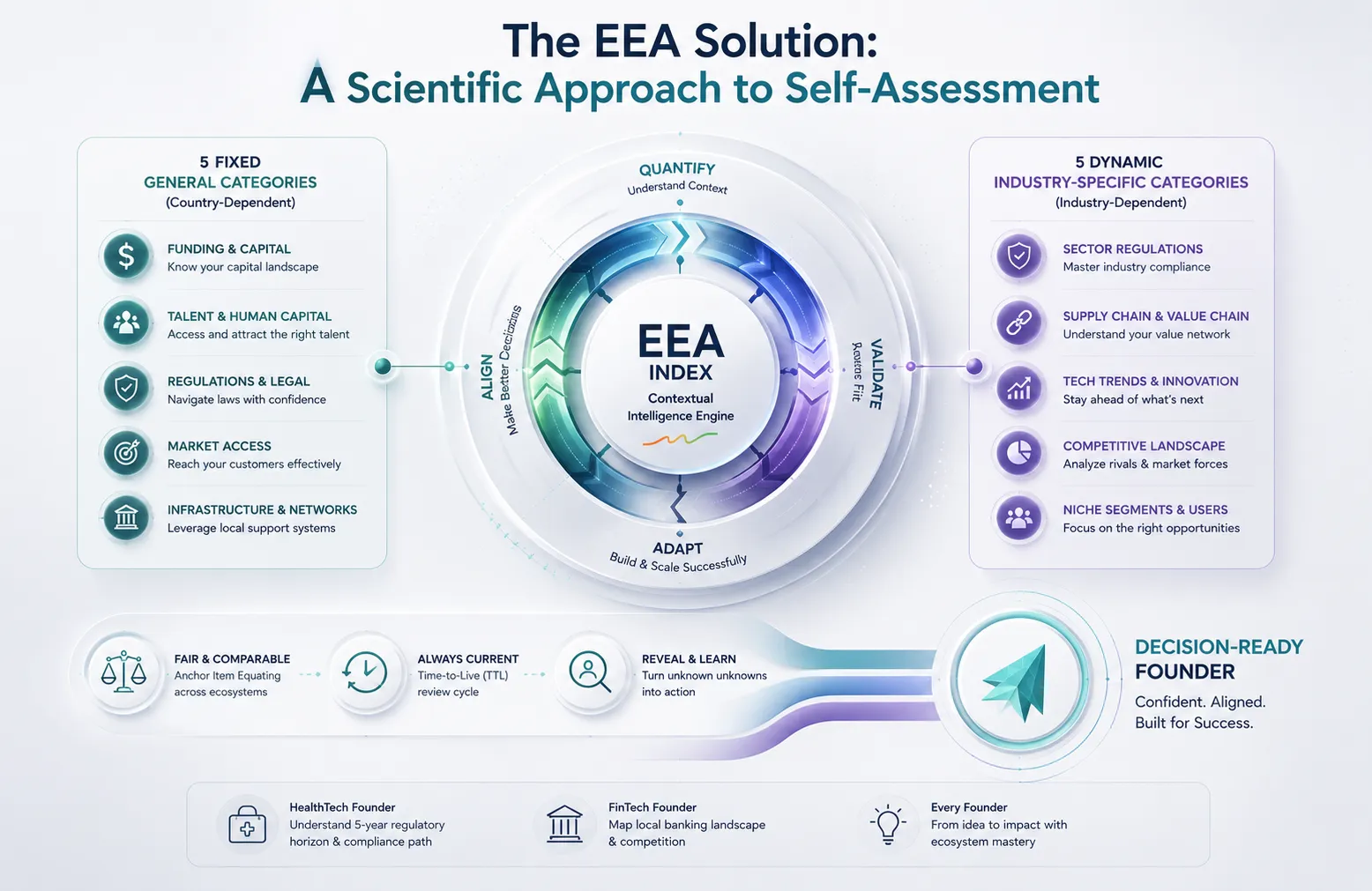
This is where the Ecosystem Environmental Awareness (EEA) Index becomes an indispensable tool for the modern entrepreneur. Developed by Supsindex, the EEA is not a trivia quiz; it is a “Contextual Intelligence Engine” designed to quantify a founder’s strategic fit with their target geography and industry. Startup launchers must courageously seek self-assessment because the “fake it until you make it” ethos does not apply to structural knowledge. You cannot fake compliance with the FDA, and you cannot fake an understanding of local labor laws during a due diligence audit. The EEA forces a mindset shift from “I have a great idea” to “I have a decision-ready understanding of the environment.”
The EEA is structured to address the complexity discussed above. It is divided into two distinct parts: 5 Fixed General Categories (Country-Dependent) and 5 Dynamic Industry-Specific Categories (Industry-Dependent). The General Categories (Funding, Talent, Regulations, Market Access, Infrastructure) ensure the founder is grounded in the national reality. It tests whether they know who the local VCs are, how to incorporate efficiently, and where to find talent. The Industry Categories (Sector Regulations, Supply Chain, Tech Trends, Competition, Niche Segments) ensure the founder is not applying generic startup advice to a specialized sector. It validates whether they understand the specific Value Chain of their vertical or the Pace of Obsolescence in their tech stack.
By utilizing Anchor Item Equating and a rigorous Time-to-Live (TTL) review cycle for questions, the EEA ensures that the assessment is fair and current. It provides a mirror to the founder, revealing blind spots that would otherwise only be discovered through expensive failures. It transforms “unknown unknowns” into a clear roadmap for learning. For a founder in HealthTech, the EEA confirms they understand not just “fundraising,” but fundraising for a medical device with a 5-year regulatory horizon. For a FinTech founder, it verifies they understand the Competitive Landscape of local banking incumbents. This is the difference between a generic entrepreneur and a master of the ecosystem.
The Local Fallacy: Why Natives Are Not Exempt
There is a pervasive misconception that the EEA is a tool exclusively for immigrant entrepreneurs or those expanding into foreign markets. While it is undeniably critical for cross-border expansion—providing a verifiable credential for startup visas and investor due diligence—it is equally vital for local founders. Entrepreneurs operating in their home countries often suffer from the “familiarity heuristic.” Because they speak the language, know the geography, and understand the social culture, they assume they understand the business ecosystem. However, knowing the best café in the city is not the same as knowing the Corporate Venture Capital (CVC) landscape. Being culturally assimilated does not mean one is commercially astute. Local founders often rely on outdated assumptions, “folklore” passed down from previous generations of business owners, or generic advice from global media that does not apply to their specific city or sector.
A local engineer might be brilliant at coding but completely ignorant of the Labor Laws & Equity Culture required to hire a sales team. A local marketing expert might know consumer behavior but fail to understand the Government Grants available for tech innovation. The EEA strips away this false confidence. It benchmarks the local founder not against their neighbors, but against the objective realities of the ecosystem and the best practices of their industry. It ensures that their confidence is born of competence, not complacency. In a globalized economy, investors do not grade on a curve based on origin; they demand execution. Whether you have lived in the ecosystem for five days or fifty years, the market only cares about one thing: do you know the rules well enough to win?
Conclusion
The romantic era of the startup is over; the scientific era has begun. Success is no longer a matter of luck or raw intuition; it is a function of how well a founder understands the complex, contradictory, and dynamic machine that is the startup ecosystem. To ignore the environment is to build on quicksand. To master it is to build a fortress.
The Ecosystem Environmental Awareness (EEA) assessment is the standard for this mastery. It is the bridge between the potential of an idea and the reality of execution. It provides the data, the insight, and the validation required to navigate the funding, talent, and regulatory landscapes with precision. Do not leave your startup’s fate to chance or assumption. Prove your readiness. Identify your blind spots before the market finds them for you.
