


Argentina Joins Supsindex EEA: Measuring Founder Readiness in a Dynamic Ecosystem
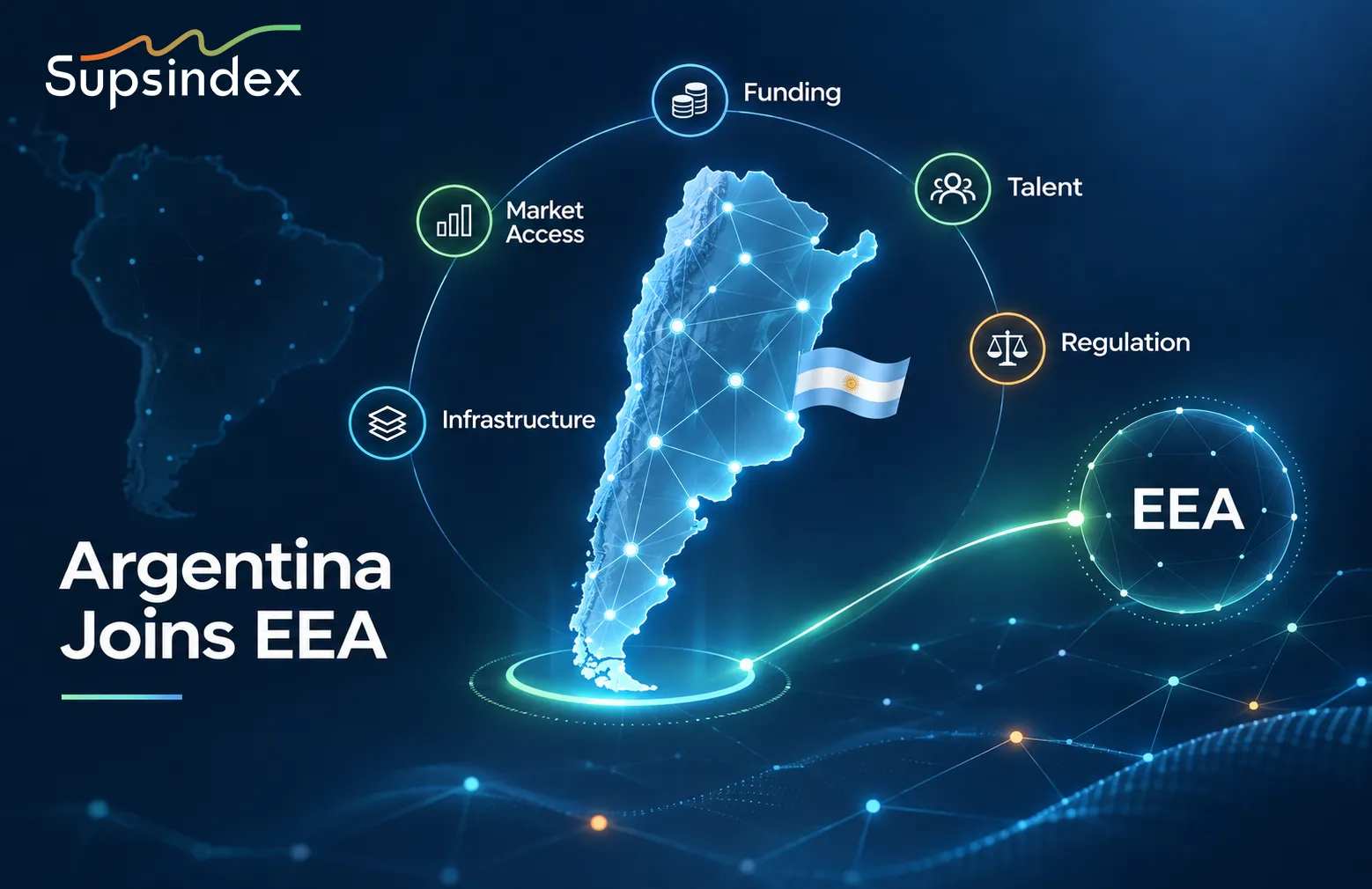
The EEA assessment in Argentina expands Supsindex founder readiness evaluation with country-specific and industry-specific ecosystem knowledge, contextual benchmarks, and local relevance.
The Ecosystem Environmental Awareness (EEA) assessment is now available for Argentina, following requests from the Supsindex community and as part of the company’s broader international expansion strategy. This addition reflects a shared objective: making founder assessment accessible across more entrepreneurial ecosystems while preserving the local relevance needed for meaningful evaluation.
Argentina presents a distinctive environment for contextual founder assessment, combining technological innovation and entrepreneurial activity with complex funding structures, regional differences, and evolving market conditions. Understanding these dynamics requires more than general startup knowledge; it requires awareness of the specific environment in which a venture operates.
By expanding EEA to Argentina, Supsindex continues building an assessment framework that recognizes how entrepreneurial readiness depends not only on founders’ capabilities but also on their understanding of local operating conditions.
Why Argentina Matters for Contextual Founder Assessment
Argentina has a diverse innovation ecosystem supported by research institutions, universities, technology companies, and emerging ventures. According to the World Intellectual Property Organization (WIPO), Argentina ranked 75th among 139 economies in the Global Innovation Index 2026, with innovation outputs ranking higher than innovation inputs.
The country’s entrepreneurial investment landscape reveals an important distinction between startup activity and capital availability. According to the ARCAP and EY Argentina 2026 report, Argentina recorded USD 270 million in seed and venture capital investment across 73 transactions in 2025. While total investment declined compared with the previous year, the number of financing rounds increased, with 52.1% occurring at the pre-seed stage.
However, capital distribution remained concentrated. Approximately 75.7% of total investment was allocated across just nine financing rounds, illustrating how the availability of funding can differ considerably between ventures and development stages.
Regional differences introduce another dimension. Although Buenos Aires remains a central entrepreneurial hub, 47.2% of financing rounds occurred outside the City and Province of Buenos Aires, with activity across provinces including Santa Fe, Córdoba, and Tucumán. Biotechnology, Fintech, Healthtech, and AgTech were among the sectors recording the most investment transactions.
These characteristics demonstrate why founders must understand more than national innovation indicators. Financing pathways, institutional resources, regulatory requirements, and commercialization opportunities may differ significantly depending on a venture’s industry, location, and development stage.
How Supsindex EEA Supports Argentine Founders
Supsindex developed the Ecosystem Environmental Awareness assessment to evaluate founders’ understanding of the environments in which their ventures operate. Rather than treating entrepreneurial knowledge as universally transferable, EEA integrates national and industry-specific considerations into its assessment framework.
The assessment examines five fixed country-level dimensions: funding and capital, talent and human capital, general regulatory frameworks, market access, and infrastructure. Five additional dynamic dimensions address industry-specific regulations, supply chains, technological developments, competitive conditions, and specialized market characteristics.
For founders operating in Argentina, this structure creates opportunities to identify knowledge gaps related to local financing, talent availability, regulatory obligations, and commercialization pathways. Such awareness is particularly relevant in an ecosystem where access to resources and investment patterns can differ across sectors and regions.
To support measurement consistency, EEA incorporates Anchor Item Equating across assessment forms, while time-to-live (TTL) review cycles help maintain content relevance as regulations and market conditions evolve. Contextual benchmarking also considers the founder’s country, industry, and startup stage, rather than relying on direct comparisons between fundamentally different entrepreneurial environments.
EEA Assessment in Argentina: Which Local Factors Matter?
Consider a founder preparing to commercialize a biotechnology innovation in Argentina. Scientific expertise and technical feasibility provide an important foundation, but successful commercialization also requires understanding the surrounding ecosystem.
The founder needs to investigate suitable funding sources, intellectual property considerations, sector-specific regulatory requirements, access to specialized infrastructure, and potential partnerships with research institutions or commercial customers.
These considerations become even more important when comparing opportunities across different regional ecosystems. A venture based in Buenos Aires may encounter different institutional networks and financing pathways than one developing in Córdoba or Santa Fe.
Similar contextual challenges arise in Fintech, AgTech, Healthtech, and other technology-driven industries. The EEA assessment in Argentina is designed to examine founders’ awareness of these operating conditions and help identify areas requiring further investigation before consequential business decisions are made.
Assessment insights should complement direct market research, engagement with local institutions, and appropriate professional advice rather than replace them. Understanding an ecosystem does not guarantee entrepreneurial success, but it can help founders recognize important uncertainties before they become costly strategic mistakes.
Expanding Contextual Founder Assessment Through Community Demand
Argentina’s inclusion reflects two interconnected priorities within Supsindex’s development: responding to community requests for more locally relevant assessment and progressively expanding EEA’s international coverage.
Community feedback helps identify entrepreneurial ecosystems where greater assessment accessibility is needed, while the international expansion roadmap supports the systematic development of country-specific assessment content.
Together, these approaches reinforce Supsindex’s commitment to building a globally accessible yet context-sensitive assessment framework. As EEA continues expanding, its underlying objective remains consistent: evaluating entrepreneurial awareness in relation to the actual environments where founders intend to build and operate their ventures.
With Argentina now included, Supsindex takes another step toward making contextual founder assessment available across a broader range of markets.
Which country should join EEA next? Supsindex welcomes suggestions from founders, investors, researchers, and entrepreneurial communities worldwide.
Explore the Supsindex EEA Assessment to learn more about contextual entrepreneurial readiness.
