


How Accelerators Can Measure Founder Development Across a Cohort
An accelerator admits twelve startups into a three-month program. During the following weeks, founders attend workshops, receive mentorship, refine their business models, and prepare for Demo Day. By graduation, several companies have secured new customers, two have attracted investment, and almost everyone reports feeling more confident about running a business.
The program appears successful. But how much did the founders actually develop?
Fundraising, customer acquisition, and product launches provide evidence about venture progress. Workshop attendance and mentor hours describe program participation. Neither necessarily establishes whether founders improved their financial understanding, changed ineffective decision-making habits, or became better at responding to contradictory market evidence.
To measure founder development in an accelerator, program managers need a structured process connecting five stages: an initial capability baseline, targeted development goals, observed behavioral changes, relevant operating indicators, and follow-up measurement. The results should distinguish what founders learned, what they demonstrated through real-world execution, and what subsequently happened to their businesses.
Supsindex approaches this challenge through its Founder Public Awareness (FPA), General Entrepreneurial Behavior (GEB), and Ecosystem Environmental Awareness (EEA) assessments, together with the Penalty for Bottleneck (PFB) principle and its Founder Execution Measurement System (FEMS) research methodology. These frameworks provide different perspectives on founder readiness and development, but their scientific and operational roles must be interpreted carefully.
This guide explains how an accelerator can organize those perspectives into a practical 90-day measurement framework, illustrated through a fictional cohort dashboard. It also distinguishes currently available Supsindex Partner Reports from longitudinal research procedures that remain under validation.
1. Separate Admission Selection From Founder Development
Accelerators commonly evaluate applicants through pitch decks, founder interviews, professional backgrounds, and commercial traction. These sources provide useful information, but they can also favor founders who communicate confidently or already understand how investment applications work.
A structured founder assessment offers additional evidence about knowledge and judgment that may be difficult to identify through a presentation alone. However, its role depends on whether the program is selecting applicants or supporting founders who have already been accepted.
Admission selection asks whether an applicant fits the accelerator’s mandate. Development measurement asks what changes after the founder enters the program.
The distinction matters because a low baseline score may identify a development opportunity rather than an unsuitable founder. A technical entrepreneur who misunderstands cash-flow forecasting may benefit substantially from a finance-focused accelerator. Rejecting that applicant solely because of a knowledge gap could undermine the purpose of the program.
Supsindex’s partner model allows institutions to organize affiliated founders using program-specific affiliation codes. The Partner Dashboard supports affiliation management and access to reports under applicable permission rules. Programs may use assessment information during applicant review, but the evidence supporting each index must determine how heavily it should influence selection.
The preliminary Supsindex partner evaluation found stronger agreement between FPA results and partner judgments than between GEB results and those judgments. Its findings support treating behavioral assessment results particularly cautiously in high-stakes selection. GEB is better positioned as a supplementary developmental tool for mentor allocation and coaching rather than an automatic rejection filter.
After admission, accelerators can establish a separate Week 1 baseline across the relevant indices, together with an initial record of operating practices and business conditions.
| Evaluation stage | Main question | Appropriate use of evidence |
|---|---|---|
| Pre-admission | Is the startup appropriate for this program? | Application evidence, interviews, venture context, and suitably validated assessment information |
| Week 1 baseline | What does the founder currently know, understand, and demonstrate? | FPA, GEB, EEA, structured interviews, and initial operating records |
| Development period | What has the founder learned and applied? | Practical exercises, mentor observations, documented decisions, and operating evidence |
| Graduation | What changed during the accelerator? | Comparable assessments, verified behavioral evidence, and venture milestones |
| Post-program | Which improvements persisted, and what happened next? | Continued operating practices, commercial progress, and longitudinal outcomes |
Keeping these stages separate prevents an accelerator from attributing strong graduation results entirely to its program when the participants may have entered with significant advantages.
2. Establish a Baseline That Reflects Each Founder’s Context

A meaningful baseline should identify specific capabilities rather than assigning a general label such as high-potential founder.
Supsindex organizes its core individual assessment suite into three complementary dimensions.
The FPA assessment examines entrepreneurial knowledge and applied business reasoning, including subjects such as financial management, customer acquisition, and operational decision-making. Its scoring architecture incorporates Item Response Theory and other measurement components intended to provide more structured information than an unweighted knowledge quiz.
The GEB assessment uses 75 forced-choice Situational Judgment Test scenarios to examine how founders evaluate competing responses to entrepreneurial situations. The assessment incorporates Thurstonian Item Response Theory and examines constructive behavioral tendencies alongside potential decision-making risks. These are responses to simulated situations; they should not automatically be interpreted as observed real-world conduct.
The EEA assessment evaluates knowledge of a specific entrepreneurial environment, covering country-level conditions such as funding, talent, regulation, infrastructure, and market access alongside industry-specific considerations. This dimension is particularly relevant when a cohort includes international founders or companies preparing for expansion.
Together, the indices offer a multidimensional starting point. A founder may demonstrate strong financial knowledge but weak ecosystem awareness, or understand the relevant business concepts while showing potentially ineffective judgment in recurring situations.
Yet comparisons across a heterogeneous cohort require care. A pre-seed biotechnology founder and a growth-stage SaaS founder face different commercial and regulatory problems. Supsindex’s contextual assessment architecture is designed to account for industry, lifecycle stage, and ecosystem differences, including through tailored forms and equating procedures.
Those design features support more relevant interpretation, but they do not independently guarantee fairness across every population. Comparability depends on adequate calibration, appropriate normative references, measurement precision, and evidence that the forms measure the intended constructs consistently.
For accelerator reporting, the most defensible baseline combines assessment results with concrete observations about current operating practices. Program managers might record whether founders maintain cash-flow forecasts, systematically document customer interviews, delegate defined responsibilities, or use evidence when revising strategic assumptions.
This creates a reference point against which actual development can be assessed.
3. Turn Assessment Gaps Into a 90-Day Development Plan
A baseline provides value only when it influences the support that founders receive.
Supsindex’s Penalty for Bottleneck (PFB) approach emphasizes the importance of identifying weaknesses that may constrain the founder’s broader operating capability. Rather than treating all development categories as equally urgent, the accelerator investigates which gap creates the greatest practical risk.
For example, a founder might demonstrate strong product knowledge and commercial creativity while struggling to monitor cash runway. Improving presentation skills may be worthwhile, but financial discipline could represent the more consequential immediate priority.
The appropriate intervention would not simply be another financial-literacy lecture. It would involve establishing a repeatable process for reviewing burn, runway, cash commitments, and relevant unit economics.
Similarly, a founder who struggles with delegation may need to introduce explicit decision rights and gradually transfer responsibility for reversible operational tasks. A founder susceptible to reactive strategic changes might benefit from a documented decision process and precommitted review criteria.
This converts assessment findings into operational changes rather than permanent personality labels.
A Standardized Founder Development Action Record
Drawing on Supsindex’s Founder Progress Forum and 90-day development methodology, accelerators can use a consistent action record for each participating founder.
| Action Record field | What to document |
|---|---|
| Founder and startup ID | Pseudonymous identifiers linking the founder to the venture |
| Priority bottleneck | Specific assessment domain or operational weakness |
| Baseline evidence | Initial score, relevant uncertainty, and documented behavior |
| Target behavior | Observable practice the founder should establish or improve |
| Operational intervention | Repeatable action, decision rule, or environmental safeguard |
| Accountable owner and mentor | Person responsible for implementation and independent review |
| Evidence requirement | Documents, artifacts, or observable events needed to verify change |
| Review schedule | Weekly checks, Days 30 and 60 milestones, and Day 90 evaluation |
| Success criteria | Predefined conditions for meaningful improvement |
| Review decision | Continue, adapt, or stop the intervention |
Consider a founder whose principal weakness is financial discipline. Their development plan might require a weekly cash review, documented reconciliation of actual and forecast spending, and a pre-approval process for unbudgeted commitments.
The evidence would not be a statement that the founder now feels more financially confident. It would consist of completed financial records and consistent use of the new process over time.
The same principle applies to delegation. If the goal is reducing unnecessary CEO involvement, the accelerator might record whether a functional lead completed a defined operational workflow independently, with appropriate accountability and without the founder intervening at every step.
These examples illustrate the difference between improving knowledge and changing the way a business operates.
4. Measure Actual Execution With an Evidence Hierarchy
One of the most important scientific distinctions in accelerator evaluation is the difference between baseline assessment and subsequent execution.
An entrepreneur may understand how to conduct customer discovery but fail to act on critical feedback. Another may correctly answer questions about unit economics while continuing to make spending decisions without reviewing financial data.
Supsindex’s Founder Execution Measurement System (FEMS) is designed to investigate this knowledge–action gap through real-world evidence. Within the Founder Discovery FD-01 research protocol, FPA, GEB, and EEA provide baseline predictor information, while FEMS is specified as a separate outcome-measurement framework.
The separation is deliberate: a founder’s subsequent execution should not be scored simply by asking whether they understand the same concepts already measured at baseline.
The FEMS Execution-Evidence Hierarchy
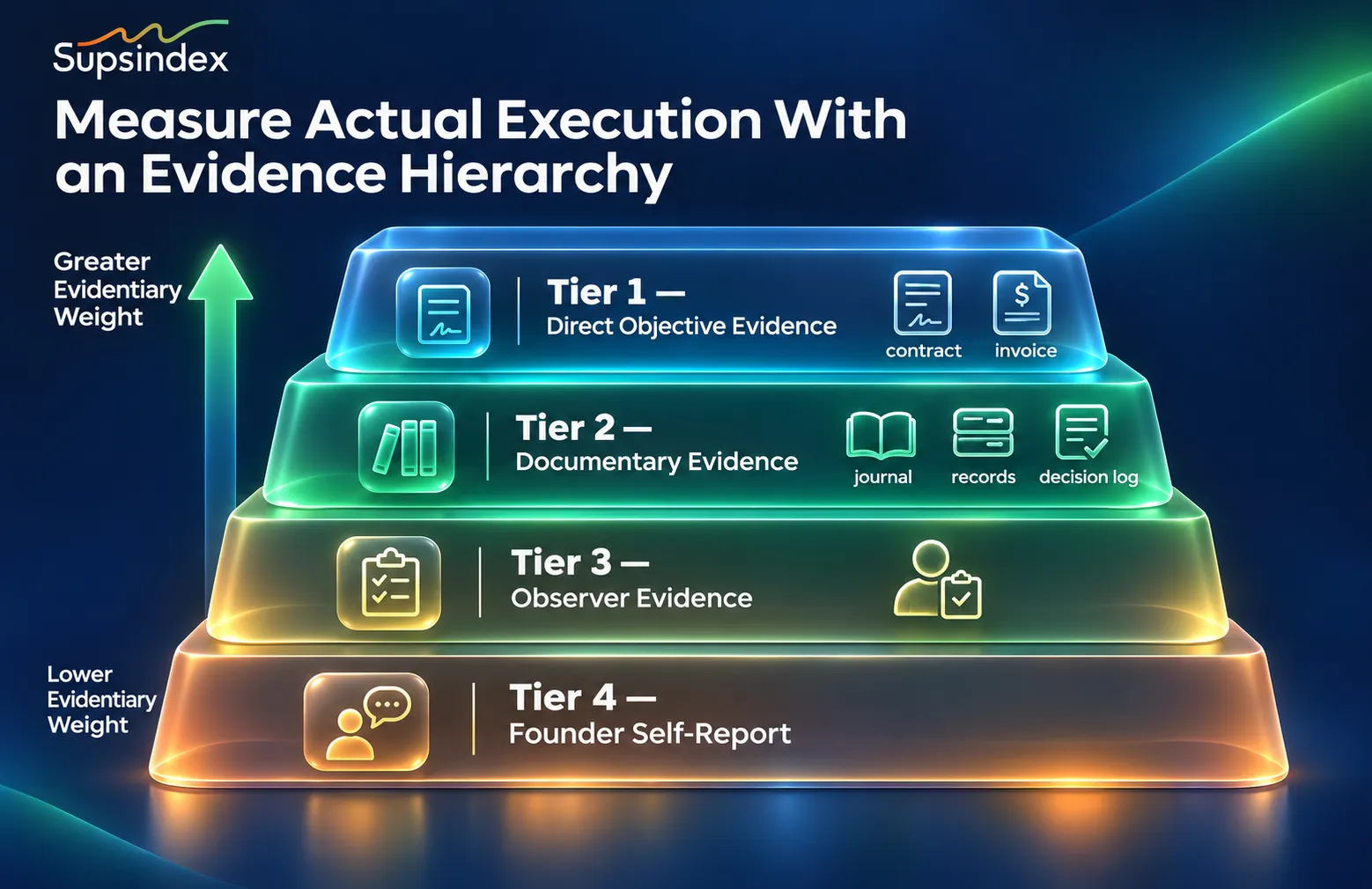
The FD-01 research specification organizes execution evidence into four tiers, with greater weight assigned to independently verifiable records.
| FEMS evidence tier | Evidence type | Examples | Interpretation |
|---|---|---|---|
| Tier 1 — Direct objective evidence | Verifiable real-world events | Paid invoices, signed contracts, regulatory filings, production releases | Strong evidence that a specified event occurred |
| Tier 2 — Structured documentary evidence | Auditable records of work and decisions | CRM logs, version-controlled plans, decision journals, experimental results | Evidence of documented processes and follow-through |
| Tier 3 — Independent observer evidence | Structured observations from relevant third parties | Mentor or program-director records using defined behavioral rubrics | Useful contextual evidence, subject to observer reliability |
| Tier 4 — Founder self-report | Unverified statements about activity or progress | Verbal updates, confidence ratings, retrospective descriptions | Exploratory information requiring corroboration |
These are the execution-evidence tiers specified in the FD-01 research framework. They should not be confused with other market-validation hierarchies that use different tier labels.
The hierarchy also requires careful interpretation. A signed customer contract is strong evidence that a commercial event occurred; it does not, on its own, prove that the founder improved a particular leadership skill. The accelerator must connect the evidence to the specific development objective.
For instance, if a founder’s goal was to improve delegation, a contract completed independently by a sales lead may contribute to the evaluation. But the program would still need evidence establishing the sales lead’s decision authority, the founder’s actual level of involvement, and whether the change represented a sustained new practice.
What Verified Behavioral Improvement Looks Like
The distinction becomes clearer when ordinary activity counts are compared with documented changes.
| Development area | Activity that is insufficient alone | Stronger evidence of improvement |
|---|---|---|
| Customer discovery | Attending workshops or conducting interviews | Documented customer findings influence a specific product or market decision |
| Financial discipline | Saying that cash management has improved | Consistent reconciled cash reviews and spending decisions aligned with defined limits |
| Delegation | Promising to give colleagues more responsibility | Operational tasks completed independently within documented decision rights |
| Strategic judgment | Reporting that a pivot was successful | A decision log records assumptions, alternatives, evidence, and precommitted review conditions |
| Mentor feedback | Agreeing enthusiastically with advice | Relevant feedback is evaluated, tested, adopted, or rejected with documented reasoning |
These indicators should be observed over time. One completed action may establish a milestone, while repeated practice provides stronger evidence that a new behavior has become part of normal operations.
The FD-01 methodology specifies monthly measurement and event-driven recording of material milestones over a six-month observation period. Accelerators running shorter programs can adapt this logic into their 90-day schedules without claiming they have implemented or validated the full FEMS research system.
5. Understand the Difference Between Mentoring and Blinded Scientific Observation
A distinction from Supsindex’s research protocol deserves particular attention.
In an ordinary developmental program, mentors benefit from seeing a founder’s assessment results. The information helps them identify learning needs, select interventions, and review subsequent changes.
However, in a study investigating whether baseline assessments independently predict future behavior, sharing those results with mentors can influence the outcome being measured.
A mentor who knows that a founder has been identified as potentially overconfident might interpret later decisions differently or deliberately provide coaching intended to address that risk. This could introduce expectation effects and make it harder to isolate the predictive relationship between baseline scores and subsequent execution.
The FD-01 research protocol therefore specifies blinded observers and delayed detailed founder feedback during its primary observation period. Researchers assessing subsequent execution are also intended to remain unaware of baseline predictor scores.
This design differs fundamentally from using assessment reports to guide personalized mentorship.
An accelerator should not claim that one process simultaneously provides unrestricted diagnostic coaching and fully blinded observational validation unless the study design explicitly separates those activities or accounts for the intervention.
For routine development, sharing assessment findings with authorized mentors is appropriate when consent and institutional access rules are satisfied. For predictive research, the relevant protocol should govern blinding, data access, feedback timing, and ethical approvals.
The scientific distinction is important because the objectives are different: coaching aims to change behavior, while predictive validation aims to measure the relationship between an earlier assessment and later outcomes without inadvertently creating that relationship through the assessment process itself.
6. Interpret Assessment Score Changes Carefully
At the end of a development cycle, accelerators naturally want to compare baseline and follow-up results.
Suppose a founder’s FPA score rises from 550 to 700 on a 0–1,000 scale. The observed change is 150 points, but that difference alone is insufficient to establish the precise amount of genuine capability development.
A defensible interpretation requires several conditions.
First, the two results must measure sufficiently comparable constructs. If the founder received a different assessment form, its difficulty and scoring should be appropriately linked to the baseline form.
Second, measurement uncertainty must be considered. Scores are estimates, and a difference should not automatically be treated as meaningful simply because the numbers are unequal.
Third, evaluators should consider practice effects, changes in administration conditions, and regression to the mean. A founder who received an unusually low first score may improve partly because their second performance is closer to their typical level.
Fourth, development should be evaluated against independent operational evidence. If the original weakness concerned financial management, did the founder begin using more reliable financial-control practices? Were those practices sustained?
Supsindex’s Founder Continuous Growth (FCG) and Founder Progress Forum frameworks describe recurring development cycles and longitudinal reassessment. However, the available scientific documentation does not establish completed, independently replicated longitudinal score-change findings for every assessment dimension or confirm that every proposed FCG capability is available as a live automated product.
For program reporting, accelerators should therefore distinguish an observed assessment-score difference from validated evidence of underlying change.
A statement such as “The founder’s reassessment score increased by 150 points, alongside twelve weeks of documented financial reviews” is more defensible than claiming that the assessment conclusively proves a 150-point improvement in entrepreneurial ability or that the program caused the change.
The scientific value comes from examining converging evidence while acknowledging uncertainty.
Fictional Example: A 12-Startup Accelerator Cohort Dashboard
Consider a fictional accelerator supporting twelve early-stage startups over ninety days. Each company nominates one lead founder for individual development reporting, while venture-level outcomes are recorded separately.
At the beginning of the program, the accelerator collects relevant founder assessments and operating records. Each founder receives a development plan targeting a priority bottleneck, with assigned mentors and monthly milestones. At graduation, the accelerator reviews comparable learning measures, documented execution, and commercial results.
All numbers in this dashboard are fictional and illustrative. They are not Supsindex customer results, research findings, or published accelerator benchmarks.
| Cohort indicator | Baseline | Day 90 | Evidence layer |
|---|---|---|---|
| Lead founders enrolled | 12 | 12 | Cohort population |
| Founders with paired financial-knowledge exercises | — | 10 of 12 | Measurement coverage |
| Median financial-knowledge exercise score among paired founders | 48/100 | 70/100 | Learning |
| Founders with a documented priority development plan | 0 of 12 | 12 of 12 | Intervention coverage |
| Founders maintaining weekly cash reviews | 4 of 12 | 10 of 12 | Observed execution |
| Founders documenting customer evidence in structured logs | 2 of 12 | 9 of 12 | Observed execution |
| Startups with at least one paid customer pilot | 2 of 12 | 5 of 12 | Venture milestone |
| Startups securing new external funding | 0 of 12 | 2 of 12 | Venture outcome |
The dashboard reveals three different stories.
First, the median score on the financial-knowledge exercise increased from 48 to 70 among the ten founders with comparable results at both measurement points. That is a 22-point change in the reported medians, but it is not necessarily the median of individual score improvements, nor does it establish statistical significance.
Second, the cohort demonstrated increased adoption of certain operating practices. More founders maintained weekly cash reviews and documented customer evidence. These are relevant process indicators, especially when the supporting records can be verified, although the quality and consistency of those practices still need evaluation.
Third, additional ventures reached commercial milestones. Five companies had secured paid pilots by graduation, and two raised new external financing. These outcomes are important but should remain analytically separate from founder capability development.
What Can the Program Honestly Report?
A defensible summary would state that the fictional cohort showed higher performance on a specific learning exercise among paired participants, greater documented use of targeted operating practices, and several positive commercial developments during the program.
It should not state that the accelerator caused the funding events, that every founder improved equally, or that assessment score changes guarantee stronger long-term business outcomes.
The denominator also matters. Results involving ten matched founders should not silently be presented as representing all twelve. Missing assessments, incomplete evidence, and different startup stages should be disclosed.
For larger cohorts, programs may additionally examine distributions by founder stage, industry, intervention type, and initial capability level. Such comparisons become less defensible when subgroup sizes are too small or assessment forms are not sufficiently comparable.
The purpose of a cohort dashboard is to preserve these distinctions, not conceal them behind a single performance percentage.
7. Build a Practical 90-Day Measurement Cycle
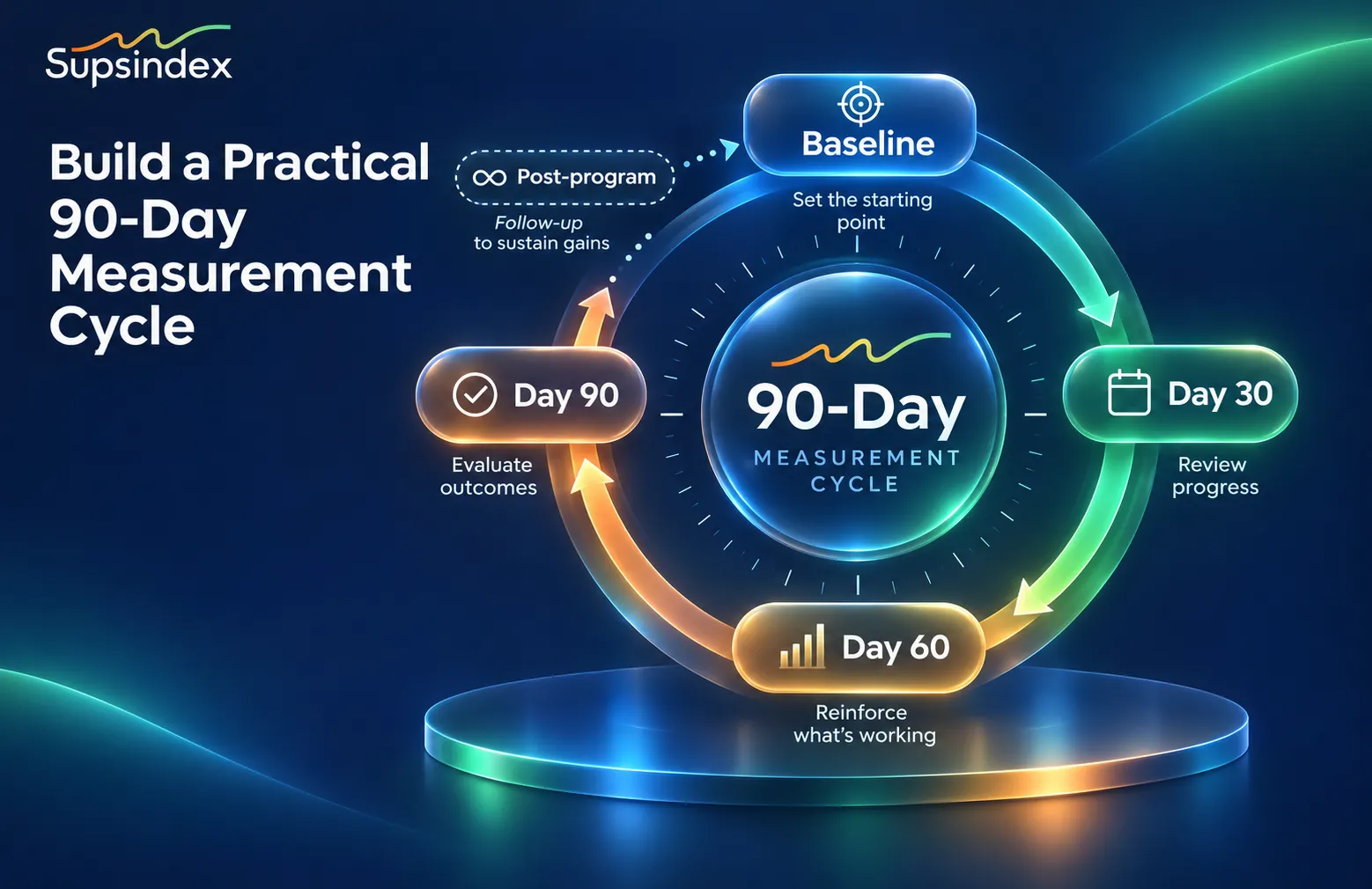
Accelerators can organize founder development measurement into a recurring cycle that aligns with existing program operations.
| Period | Measurement and development activity | Expected output |
|---|---|---|
| Weeks 1–2 | Establish assessment baseline, operating baseline, and primary bottleneck | Founder Development Action Record |
| Weeks 3–4 | Begin targeted intervention and collect initial documentary evidence | Early execution record |
| Day 30 | Review completed commitments and implementation barriers | Keep, adapt, or revise intervention |
| Days 31–59 | Reinforce the target behavior and record relevant operating decisions | Verified evidence of repeated practice |
| Day 60 | Evaluate progress against the development goal | Mid-cycle evaluation |
| Days 61–89 | Consolidate improvements and collect follow-up evidence | Final development evidence |
| Day 90 | Reassess where appropriate and document remaining bottlenecks | Founder and cohort development summary |
| Post-program | Track persistence, venture progress, and company continuation | Longitudinal follow-up report |
The midpoint reviews are particularly important. A founder who understands customer discovery but cannot access suitable participants may need introductions rather than additional training. Another who understands financial management but fails to maintain regular reviews may benefit more from operational accountability than from repeating a finance workshop.
The program should adjust interventions in response to these findings while preserving enough documentation to explain what changed and why.
Post-program follow-up is also necessary because some improvements may weaken after structured mentorship ends. In addition, financing, revenue growth, and company survival often develop over longer periods than a standard accelerator program.
The evaluation should reflect those different time horizons.
8. What Supsindex Partner Reports Can Currently Support
Supsindex’s institutional infrastructure provides several functions relevant to cohort assessment and reporting.
Through the Partner Dashboard and Partner Reports, authorized organizations can manage affiliations, review eligible individual reports, and obtain aggregated information about participating founders. The platform’s publicly described Partner Reports include individual explanatory reports and macro-level analytical products that identify common assessment strengths, weaknesses, and capability patterns.
For accelerator directors, this information can support baseline analysis, curriculum planning, and mentor allocation. If a cohort demonstrates recurring weaknesses in financial literacy, the program may allocate more practical instruction to cash-flow management. If ecosystem-awareness results reveal gaps in a target country’s regulatory environment, specialized workshops or local experts may be appropriate.
These features should not be confused with a fully automated, independently validated longitudinal execution dashboard.
Live Capabilities vs. Research and Roadmap Functions
| Capability | Status to communicate |
|---|---|
| Partner Dashboard and affiliation-code management | Available institutional functionality |
| Founder-authorized access to individual explanatory reports | Available, subject to sharing permissions and applicable partner entitlements |
| Aggregated cohort assessment reporting | Available through Partner Reports, including on-demand reporting |
| Structured 90-day founder development planning | Documented methodology that programs can implement |
| FEMS research-grade execution scoring | Specified within the FD-01 research framework; not established here as a general live Partner Dashboard feature |
| Automated longitudinal FCG measurement | Development framework; full production availability and empirical validation should not be assumed |
| Prospectively validated links between baseline scores and later execution | Under investigation through FD-01 |
Individual assessment results require particular attention to privacy. Supsindex’s public Partner Reports documentation emphasizes founder-controlled sharing, while the supplied operational specifications also describe partner-funded assessments as having specific access entitlements. An affiliation code should not be interpreted as universal permission to disclose all personal assessment data.
Institutions should verify the applicable permission rules and obtain appropriate consent before combining founder-level information with their own mentoring records.
For small cohorts, aggregated reporting should also account for the possibility of indirectly identifying participants, especially when results are divided into narrow industry or stage categories.
9. What Has Supsindex Scientifically Demonstrated?
The existing evidence should be separated into completed preliminary evaluations, internal developmental observations, and ongoing prospective validation.
Supsindex’s Scientific Catalog documents a preliminary partner evaluation involving 75 founders across three international ecosystem partners. The trial compared FPA, GEB, and EEA results with the partners’ prior judgments of participating founders.
Reported pairwise agreement ranged from 84.8% to 94.8% for FPA, 63.0% to 88.5% for EEA, and 58.7% to 70.6% for GEB.
These results provide preliminary information about how assessment rankings aligned with existing partner perceptions. They do not measure changes during an accelerator program, inter-rater reliability between independent FEMS observers, or predictive accuracy for subsequent venture outcomes.
Supsindex’s internal materials also describe qualitative founder-development examples involving delegation, financial discipline, and operational consistency. Such cases can help illustrate possible interventions, but they should not be treated as controlled evidence of program effectiveness.
The Founder Discovery FD-01 protocol addresses a different research question. It specifies a prospective study targeting 300 founders across five accelerator or incubator programs, followed for approximately six months. Baseline Supsindex assessment results are intended to be examined against later execution evidence collected using the FEMS methodology.
As documented, FD-01 has not yet produced completed, published six-month out-of-sample findings. Nor is there a published, completed FEMS inter-observer reliability study establishing agreement across independent raters.
These limitations matter because a rigorous research protocol is not the same as a completed validation result.
FD-01’s planned methods may support stronger future conclusions, including whether baseline readiness measurements provide incremental information about later execution. Until those results are available, institutional reporting should describe observed progress without presenting untested predictive relationships as established scientific findings.
10. How Can Accelerators Evaluate Their Own Impact?
Measuring progress is valuable, but demonstrating that an accelerator caused the observed changes requires additional evidence.
Founders develop through many influences: prior experience, changing market conditions, independent learning, customer feedback, and access to external networks. A before-and-after score comparison captures change over time, but it does not identify which of those influences produced it.
The Kauffman Foundation’s accelerator measurement framework emphasizes coordinated metrics, appropriate comparisons, and continued measurement. Similarly, the OECD’s 2023 evaluation framework distinguishes monitoring activities from impact evaluation and highlights the importance of appropriate comparison groups when making causal claims.
Accelerators seeking stronger evidence of their own impact may compare participant outcomes with appropriately selected nonparticipants, use matched cohorts, or employ other evaluation designs suited to their institutional constraints.
However, most programs can improve their reporting substantially without immediately undertaking a formal causal study. The priority is to establish clear definitions, measure change consistently, preserve evidence, document missing information, and avoid attributing every favorable outcome to the program.
A scientifically responsible report can therefore make three separate statements: what changed during the accelerator, what evidence supports those changes, and what remains unknown about their causes.
Frequently Asked Questions About Accelerator Founder Development
How do you measure founder development in an accelerator?
Begin with a structured baseline, identify specific development goals, track documented behavioral changes, and conduct appropriate follow-up assessments. Report learning, score changes, operating behavior, and venture outcomes separately.
Which founder development KPIs should accelerators track?
Useful KPIs include baseline capability distributions, completion of targeted development plans, relevant assessment changes, documented changes in operating practices, verified commercial milestones, and post-program continuation.
What is the difference between FPA, GEB, and FEMS?
FPA examines entrepreneurial knowledge, while GEB evaluates judgment within structured entrepreneurial scenarios. FEMS is a research framework designed to document subsequent real-world execution through independently verifiable evidence. They address different aspects of founder readiness and activity.
Does an improved assessment score prove that a founder has developed?
Not by itself. Meaningful interpretation requires appropriate score comparability, attention to measurement error, and evidence of changes in relevant behavior or operating practices.
Can Supsindex measure accelerator impact automatically?
Supsindex offers institutional assessment reporting and aggregated cohort insights. However, comprehensive longitudinal execution measurement and prospective validation belong to its broader research and development framework. A complete accelerator impact evaluation requires additional operating and outcome evidence.
Can accelerators use assessment results to reject applicants?
Assessment information may contribute to a sufficiently validated, human-led application review, but it should not serve as an automatic rejection mechanism. The evidence requirements for admission decisions differ from those for developmental coaching, and low scores may reveal precisely the gaps a program is designed to address.
Conclusion: Founder Development Must Be Demonstrated Through Evidence
Accelerators are expected to develop founders, yet many institutional reports remain dominated by participation counts, Demo Day activity, and financial outcomes. Those indicators matter, but they cannot independently establish how the founders’ knowledge, judgment, and operating practices changed.
A more defensible approach begins with an appropriate baseline and translates identified capability gaps into specific development goals. It then tracks whether founders apply what they learn, supported by documented operating records, structured observations, and suitable reassessment.
Supsindex’s FPA, GEB, and EEA assessments can provide structured baseline information. Its PFB principle helps organize priorities around consequential weaknesses, while the FEMS research framework offers an evidence-based model for distinguishing self-reported activity from documented execution.
These components serve different scientific purposes. Assessment results indicate aspects of readiness, execution records describe what happened, and venture outcomes show how the company progressed. Their relationships are important research questions, but the measures should not be treated as interchangeable.
For accelerators, the most valuable reporting system is not the one that produces the highest cohort score. It is the one that can explain what each founder needed to improve, which interventions were introduced, what changed in observable behavior, and which improvements persisted.
Measure what founders know. Verify what they do. Track what happens next. Keep the evidence separate.
To explore Supsindex’s institutional reporting framework, visit Partner Reports and the Entity Partners program. For a related discussion of the broader measurement challenge, read Accelerator Impact Reporting: The Missing Link.
Sources and Further Reading
- Supsindex — Scientific Catalog. Assessment architecture, preliminary partner evaluation, and FD-01 prospective research protocol.
- Supsindex — Partner Reports. Institutional access, individual explanatory reports, and aggregated cohort information.
- Supsindex — Founder Development: Turn Assessment Results Into a 90-Day Action Plan. Bottleneck prioritization, operational interventions, and reassessment principles.
- Supsindex — Inside the Science of Supsindex. Measurement methodology and distinction between preliminary evidence and prospective validation.
- Desai, S., Looze, J., & Chapman, M. — Measuring Accelerator Performance: Potential Metrics and the 4Cs. Ewing Marion Kauffman Foundation, 2020.
- Moroz, P. W., Sierra, O., & Anderson, R. — A Structured Review of Start-Up Accelerator Performance Measurement. Entrepreneurship & Regional Development, 2024.
- OECD — Framework for the Evaluation of SME and Entrepreneurship Policies and Programmes. 2023.
