


How to Validate a Founder Assessment: Reliability, Validity, Fairness, and Predictive Evidence
Founder assessments are increasingly discussed as a way to make entrepreneurial evaluation more structured. Investors want to understand the capabilities behind a startup’s business plan, accelerators need consistent methods for identifying development needs, and founders want clearer insight into their own strengths and weaknesses. A scientifically designed assessment may contribute useful information to these decisions, but an important question comes first: what evidence demonstrates that the assessment measures what it claims to measure?
The answer is more complicated than selecting an advanced statistical model or demonstrating that assessment scores correlate with the opinions of experienced investors. A test may produce consistent scores without measuring the intended capability. It may perform well within one founder population but behave differently across countries or industries. It may also align closely with expert judgments while offering little evidence about subsequent entrepreneurial performance.
These distinctions are central to founder assessment validity. Scientific evaluation requires examining reliability, the interpretation of scores, fairness across relevant populations, and evidence connecting assessment results with the outcomes they are intended to inform.
The Standards for Educational and Psychological Testing, developed jointly by the American Educational Research Association (AERA), American Psychological Association (APA), and National Council on Measurement in Education (NCME), provide an established framework for this evaluation. Their approach emphasizes that validity concerns the evidence and theory supporting particular interpretations and uses of test scores, rather than being a permanent quality label attached to an instrument.
This article explains how that framework applies to founder assessments, examines Supsindex’s measurement architecture and preliminary findings, and identifies which questions remain under investigation. The objective is to distinguish what a scientifically designed assessment can reasonably contribute from claims that require stronger evidence.
What Does It Mean for a Founder Assessment to Be Valid?
An assessment is not valid simply because it uses complex mathematics, generates detailed reports, or produces results that appear plausible. Validity concerns whether the available evidence justifies the conclusions people draw from its scores.
For example, a knowledge assessment may provide useful information about a founder’s understanding of financial management, customer acquisition, and business strategy. That does not automatically establish that the same score can predict whether the founder will successfully raise capital or build a profitable company.
Similarly, a behavioral assessment may reveal how someone prioritizes competing actions in hypothetical entrepreneurial situations. It does not necessarily establish how that person will behave during every real-world crisis.
The distinction is important because the same assessment can support one intended use more convincingly than another. Evidence sufficient for developmental coaching may be inadequate for making consequential decisions about investment eligibility or founder selection.
Supsindex organizes its individual assessment framework around three complementary dimensions of entrepreneurial readiness:
| Assessment | Intended score interpretation | Appropriate decision-support applications |
|---|---|---|
| FPA — Founder Public Awareness | Entrepreneurial knowledge, applied business reasoning, and relevant cognitive processing | Identifying knowledge gaps, establishing developmental baselines, and contributing to application reviews |
| GEB — General Entrepreneurial Behavior | Behavioral judgment, responses to entrepreneurial trade-offs, and potential decision-making risks | Mentorship planning, behavioral development, and identifying areas requiring further investigation |
| EEA — Ecosystem Environmental Awareness | Awareness of the funding, regulatory, commercial, and institutional environment relevant to a particular country and industry | Market-entry preparation, ecosystem-readiness evaluation, and development planning |
These interpretations are deliberately narrower than predicting whether a startup will succeed.
The assessments are intended to complement interviews, operational evidence, market research, and professional judgment. They are not clinical diagnostic instruments, nor should their scores independently determine investment approvals, accelerator admissions, or startup visa decisions without an adequately validated basis for those particular uses.
This distinction does not diminish the potential value of founder assessment. It clarifies the boundaries within which that value can be examined responsibly.
Reliability: Are the Scores Consistent and Precise?

Reliability concerns the consistency and precision of measurement. When an assessment attempts to measure a capability, the resulting scores contain both information about that capability and some degree of measurement error.
A reliable assessment should produce sufficiently consistent results under conditions where the underlying capability has not meaningfully changed. It should also provide an appropriate understanding of the uncertainty surrounding individual scores.
Several methods can be used to investigate reliability. Internal-consistency statistics examine relationships among items, test–retest studies evaluate score stability over time, and Item Response Theory can estimate measurement precision across different ability levels.
However, no single reliability coefficient is universally appropriate. The method must match the assessment’s structure and intended interpretation.
How Supsindex Approaches Reliability
Supsindex uses different measurement models for its three core indices.
The FPA index applies two-parameter logistic Item Response Theory (2PL IRT) to model item difficulty and discrimination. This allows the assessment framework to consider that questions differ in how much information they provide about an individual’s underlying ability. Test information functions and standard errors can then help characterize the precision of estimated scores.
The GEB index uses forced-choice Situational Judgment Tests, analyzed through Thurstonian Item Response Theory. This approach is intended to recover interpretable behavioral estimates from comparative choices rather than relying exclusively on conventional self-report ratings. Because forced-choice responses have particular statistical dependencies, reliability estimation requires methods suited to the fitted measurement model rather than applying ordinary internal-consistency calculations indiscriminately.
The EEA index incorporates country- and industry-specific assessment content with anchor-item equating procedures intended to support comparisons between different test forms. Its measurement precision must be evaluated within the relevant form, population, and contextual comparison framework.
These are methodological specifications. Their use does not, by itself, establish that every reported score has achieved an adequate level of reliability.
Supsindex’s internal research documentation describes an initial calibration sample of approximately 300 founders and further item-calibration work. It also identifies target reliability criteria and procedures for estimating measurement error. Such targets should not be confused with achieved empirical coefficients across every index, domain, or subgroup.
One particularly informative finding comes from the preliminary partner evaluation. In the UK GEB audit, internal documentation reports a very high unadjusted consistency coefficient of 0.988 alongside concerns about restricted score variation and possible ceiling effects. A coefficient this high is not automatically evidence of superior measurement. It may warrant investigation into item redundancy, dimensionality, and whether the assessment adequately differentiates among higher-performing respondents.
The general lesson is that reliability must be demonstrated through appropriate empirical evidence, not inferred from the sophistication of the scoring method.
For investors or researchers evaluating an assessment provider, the relevant questions concern the reliability estimates obtained in actual populations, the uncertainty around individual scores, and whether those findings remain stable across relevant testing conditions.
Validity: Does the Assessment Measure the Intended Capability?
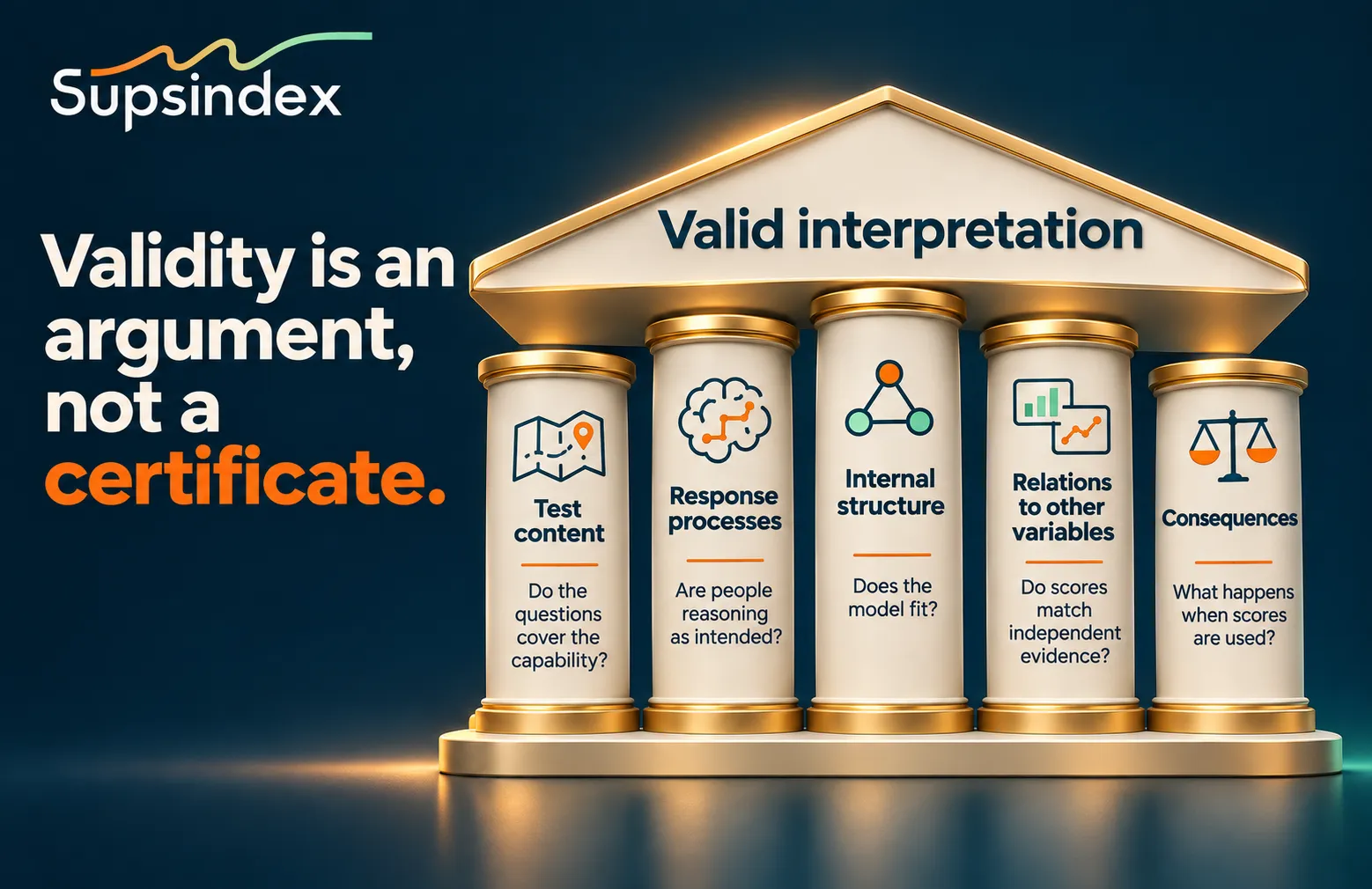
Reliability is necessary for many useful score interpretations, but consistency alone does not establish that an assessment measures the intended construct.
Imagine a test that repeatedly rewards founders for recognizing specialized business terminology. It might produce highly consistent results while primarily measuring familiarity with jargon rather than applied entrepreneurial judgment.
A strong validity argument requires several complementary sources of evidence.
The AERA/APA/NCME standards identify five major categories: evidence based on test content, response processes, internal structure, relationships with other variables, and the consequences of testing.
These categories are not five independent certificates that a test can simply collect. They contribute to a combined argument about whether a particular interpretation and use of assessment results is justified.
The Five Sources of Validity Evidence
| Evidence source | Scientific question | Application to founder assessment |
|---|---|---|
| Test content | Do the questions adequately represent the intended capability? | Expert review, construct definitions, item blueprints, and domain coverage |
| Response processes | Are respondents using the knowledge or reasoning processes the assessment intends to measure? | Cognitive interviews, response analysis, SJT design, and examination of unintended answer cues |
| Internal structure | Do item relationships and statistical models support the proposed constructs? | IRT analysis, model-fit testing, dimensionality, and measurement precision |
| Relations to other variables | Do scores show theoretically expected relationships with relevant independent measures? | Expert ratings, observed execution, and prospective outcome studies |
| Consequences of testing | What intended and unintended effects result from interpreting and using the scores? | Fairness, privacy, developmental utility, misuse, and inappropriate exclusion |
Supsindex’s scientific architecture addresses these areas through different design, governance, and research activities, although the amount of completed empirical evidence is not identical across them.
For test content, the framework specifies category blueprints that distinguish entrepreneurial knowledge, behavioral judgment, and ecosystem-specific awareness. Its Faculty review process is designed to examine item relevance, clarity, answer accuracy, and consistency with the intended construct. Internal documentation describes independent three-reviewer item evaluation and a global Faculty network contributing to content development.
For response processes, Supsindex employs scenario-based questions, forced-choice behavioral decisions, and distractor analysis. These methods are intended to reduce some limitations of conventional self-report assessments and examine how founders respond to relevant trade-offs. However, observed choices in simulated scenarios should not be described as direct observations of real-world behavior under actual financial or organizational pressure.
Internal-structure evidence concerns whether the statistical properties of the items support the intended score interpretations. Supsindex specifies 2PL IRT, Thurstonian IRT, anchor-item equating, and additional modeling procedures to address dependencies within scenario-based item groups. These approaches provide a technical basis for evaluating score structure, but their effectiveness depends on empirical model fit, adequate calibration, and ongoing evaluation.
Relationships with other variables introduce another level of validation. An assessment claiming to measure useful entrepreneurial capabilities should demonstrate theoretically consistent relationships with relevant independent observations. Agreement with experienced evaluators can provide preliminary evidence, while predicting subsequent execution requires a different and more demanding research design.
Finally, consequences matter because assessment results affect real people. An inaccurate or poorly interpreted score may influence how a founder views their abilities or how an institution allocates support. Responsible validation therefore examines not only the statistical properties of the test but also what happens when the scores are used.
Why Item Quality Control Matters
Supsindex’s partner audits illustrate why scientific validation must remain an ongoing process.
The preliminary evaluation identified weaknesses including answer-length cues, ambiguous distractors, and areas of question-bank inconsistency. Internal audit material subsequently identified 2,964 items requiring attention because answer length or wording patterns could provide unintended clues.
These defects matter because respondents may sometimes identify the correct answer through formatting conventions rather than the knowledge being assessed. If such patterns influence performance, the resulting score may partly reflect test-taking strategy instead of the intended capability.
Supsindex’s documentation describes automated quality-control procedures introduced to flag problematic option-length differences and support item remediation. These controls are valuable design safeguards, but their effectiveness still needs to be demonstrated through subsequent item analysis.
A transparent assessment provider should be willing to identify measurement problems, explain corrective actions, and distinguish an implemented fix from evidence that the fix has resolved the problem.
Fairness: Can Scores Be Interpreted Responsibly Across Different Founder Populations?
Fairness becomes particularly challenging when an assessment is administered across different countries, languages, industries, and entrepreneurial stages.
A founder operating in Ireland may encounter different regulations and institutional arrangements from someone building a startup in Singapore. A pre-seed SaaS entrepreneur will also require different knowledge from a growth-stage biotechnology founder.
These differences do not necessarily indicate bias. In a contextual assessment, some differences are precisely what the test intends to evaluate.
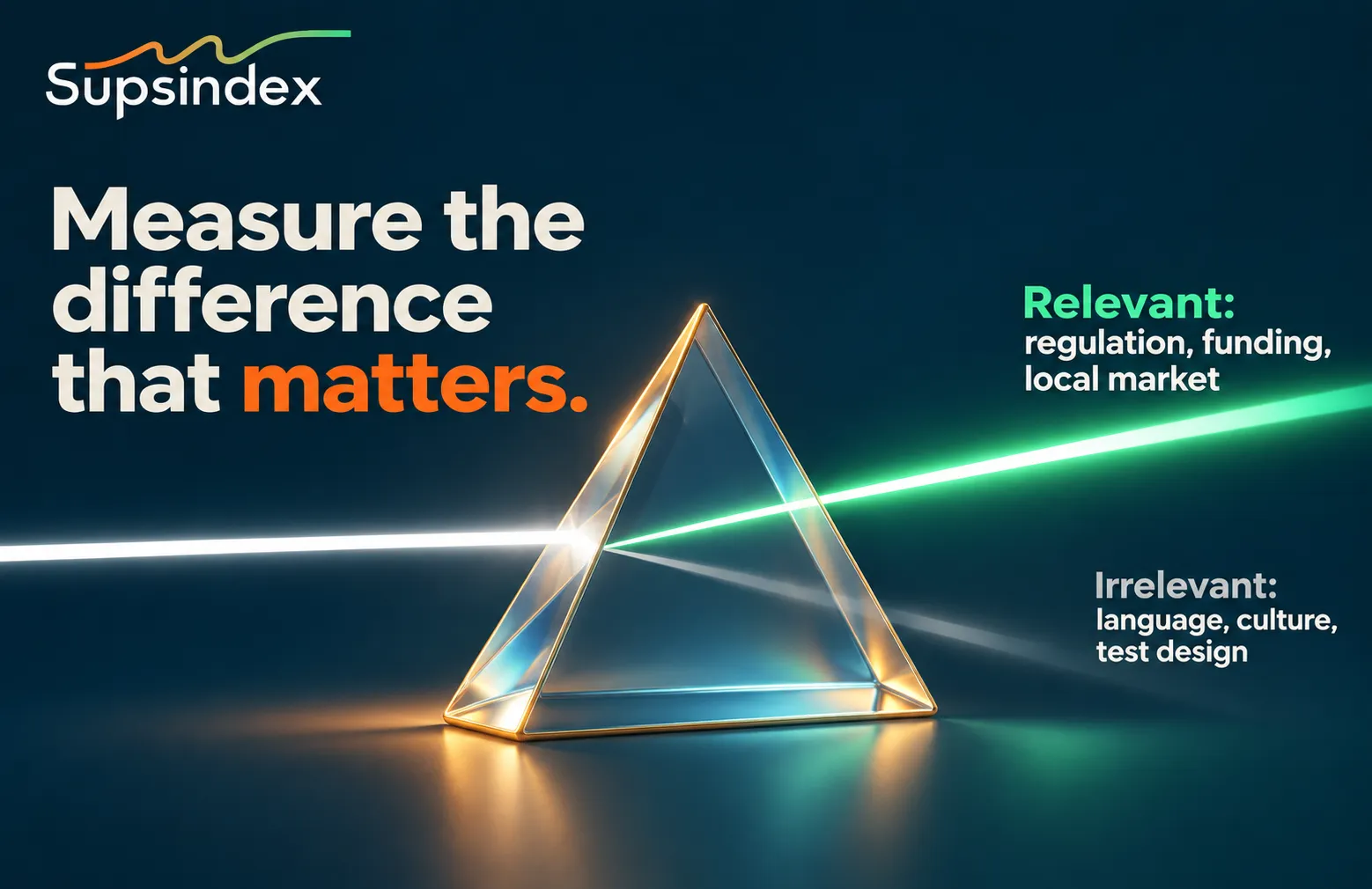
The challenge is separating relevant differences in the capability being measured from irrelevant differences introduced by language, culture, test design, or administration conditions.
Supsindex approaches this through contextual item selection, relevant benchmarking, and psychometric methods intended to examine score comparability.
For EEA, anchor-item equating is designed to provide a common measurement reference across forms with different ecosystem-specific content. For GEB, forced-choice scenarios and Thurstonian IRT are intended to address some limitations associated with self-report response styles. Across its research framework, Supsindex also specifies Differential Item Functioning (DIF) analysis, including Mantel–Haenszel procedures, to investigate whether comparable respondents from different groups have different probabilities of answering particular items in an expected way.
These methods address important fairness questions, but none independently guarantees an unbiased assessment.
A forced-choice format can reduce certain response-style problems while leaving other cultural influences unresolved. Anchor-item equating depends on the appropriateness and stability of the anchor items. DIF analysis can identify potentially problematic items, but a statistical difference does not automatically establish unfairness; the content and intended construct must also be examined.
What Do the Cross-Group Findings Establish?
Supsindex internal research materials report a multi-group Confirmatory Factor Analysis involving 7,690 founders—4,102 from the United States and 3,588 from European populations—with results described as supporting scalar measurement invariance for the scale analyzed.
The reported analysis includes a scalar-model Comparative Fit Index of 0.976 and a change in CFI of approximately −0.003 relative to the preceding model. These figures are consistent with a conventional approach to evaluating whether certain measurement parameters behave similarly across groups.
However, this reported analysis relates to an FEE-associated scale in the supplied technical materials. It should not be generalized automatically to FPA, GEB, or EEA without index-specific results. Nor would scalar invariance, even when properly established, prove that every question is fair or that the assessment measures all intended capabilities without cultural influence.
The underlying technical report, group definitions, item specifications, and independent replication would be required for a fuller evaluation of the claim.
Other fairness work remains at different stages. Internal documentation describes anchor-item equating as part of the implemented EEA architecture, while comprehensive DIF analysis across additional demographic subgroups remains associated with expanded calibration efforts.
Test accessibility and administration also require attention. Remote proctoring can protect assessment integrity, but restrictive monitoring requirements, language barriers, technology access, disability accommodations, and test anxiety may influence participation and performance. Supsindex’s internal partner findings have identified concerns about how some participants perceive automated monitoring, making transparent communication and appropriate accessibility practices important parts of the fairness framework.
Fairness is therefore not a property established once and then permanently settled. It requires continued testing, careful interpretation, and attention to the populations and purposes for which scores are used.
Predictive Evidence: Can Founder Assessments Forecast Future Performance?
Predictive evidence is one of the most consequential—and frequently misunderstood—areas of assessment validation.
An assessment may reliably measure entrepreneurial knowledge or behavioral judgment without demonstrating that its scores predict later startup performance. Even if a statistically meaningful association is identified, it does not establish that the assessment can determine the future of an individual founder.
Startup outcomes depend on many interacting factors, including market conditions, product quality, team composition, financing, competition, timing, and external shocks. Founder characteristics may contribute to performance, but they cannot reasonably be treated as its sole explanation.
To investigate predictive value, researchers need clearly defined outcomes, appropriate comparison groups, sufficient follow-up, and methods that distinguish relationships observed in existing data from performance on genuinely new observations.
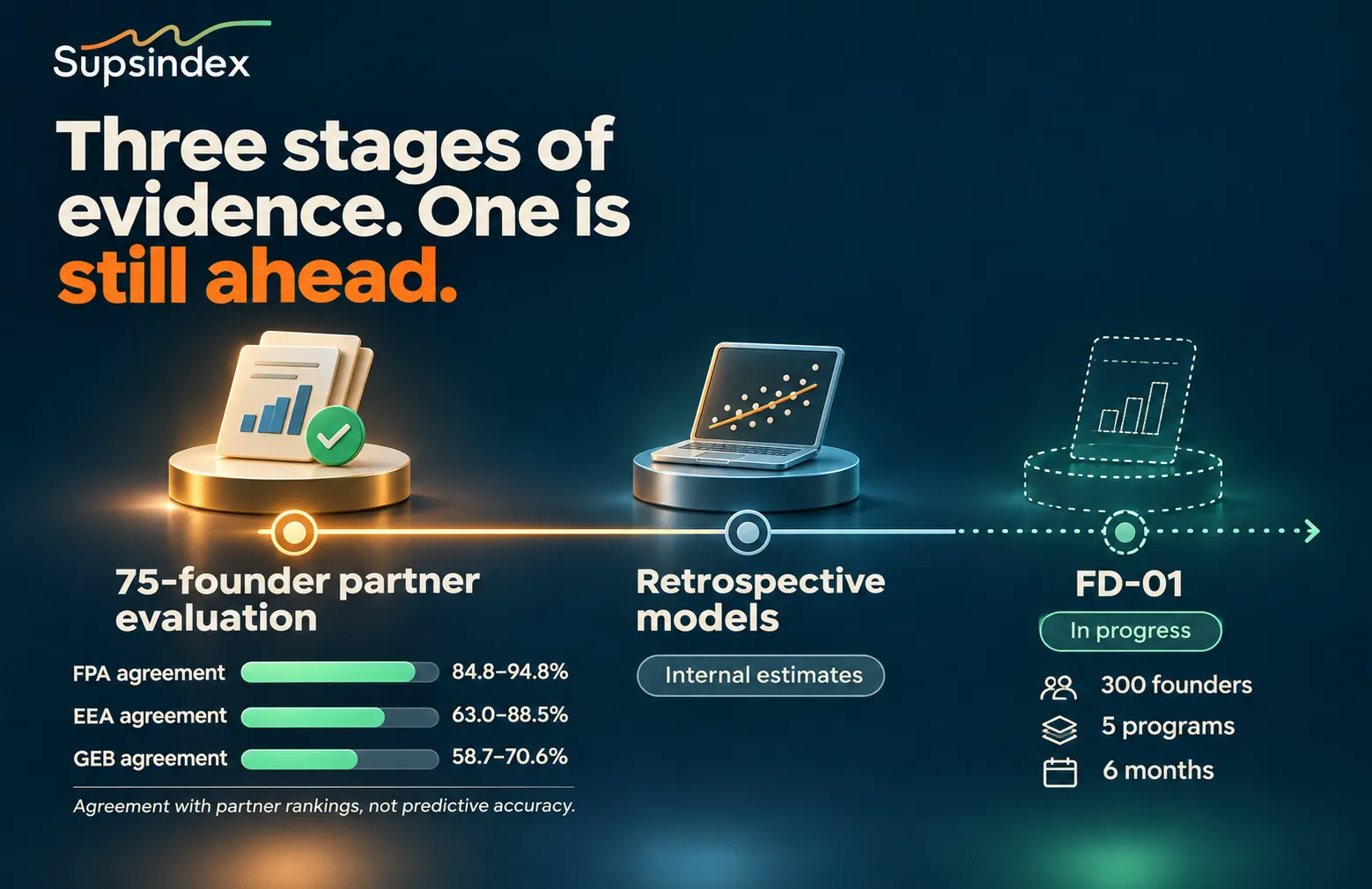
Supsindex’s research can be understood through three distinct evidence stages.
The Preliminary 75-Founder Partner Evaluation
Supsindex’s Scientific Catalog documents a preliminary evaluation involving 75 founders across three startup-ecosystem partners: HubSmartUp in the United Kingdom, Startup Xpand in Türkiye, and 5PM Ventures in the United Arab Emirates.
Each partner evaluated 25 founders. The partners had established internal assessments based on their existing knowledge of participating founders before reviewing Supsindex scores.
The evaluation then compared how Supsindex ranked founders with the order implied by partner judgments. Pairwise agreement measured the proportion of founder pairs ranked in the same relative order by both methods, excluding tied comparisons where applicable.
Results varied across the three indices.
| Assessment | Reported pairwise agreement across partner sites |
|---|---|
| FPA | 84.8%–94.8% |
| EEA | 63.0%–88.5% |
| GEB | 58.7%–70.6% |
The strongest alignment appeared in FPA, suggesting that entrepreneurial knowledge scores corresponded relatively closely with partner perceptions in these small preliminary samples. EEA showed more variation across ecosystems, while GEB demonstrated weaker agreement with existing behavioral judgments.
These results are informative but have specific limitations. Partner evaluations represented accumulated professional judgments rather than an independently validated ground-truth measure of founder capability. Reviewers were familiar with the founders through existing working relationships, and the sample included only 75 participants.
Most importantly, pairwise agreement with partner rankings is not predictive accuracy for startup survival, future revenue, or subsequent execution.
The evaluation provides preliminary evidence concerning alignment with an external judgment criterion. It does not establish that founders who receive higher scores will subsequently build more successful companies.
The fact that agreement differed substantially across FPA, GEB, and EEA is also useful. It demonstrates why evidence should be reported separately for each index rather than making a single claim that the assessment suite has been scientifically validated to the same degree.
Retrospective Econometric Findings
Separate Supsindex internal research manuscripts describe retrospective analyses of venture datasets, founder-related variables, and startup outcomes.
These materials report estimates including a 15.2% lower failure hazard associated with a one-standard-deviation increase in a composite readiness score and a 22% higher likelihood of returning invested principal among top-quartile FPA founders in the modeled data.
Such figures should be understood as internal retrospective model estimates, not completed prospective validation of the currently available assessment suite.
Their interpretation depends on the precise dataset, the way historical assessment-related variables were constructed or matched, the models and controls used, and whether the findings generalize to founders assessed prospectively using the operational instruments.
An association observed in retrospective data does not prove causation. It also does not establish that a score provides incremental predictive value beyond existing information such as startup stage, founder experience, previous investment, or commercial traction.
These estimates may motivate further research, but they should not be presented as independently replicated evidence that using Supsindex reduces failure risk or guarantees superior investment returns.
Founder Discovery FD-01: Prospective Validation in Progress
The next research stage is the Founder Discovery FD-01 study, described in the Supsindex Scientific Catalog.
FD-01 is designed as a prospective, multi-site observational study targeting 300 founders across five accelerator or incubator programs, with approximately six months of follow-up.
The study separates baseline founder-readiness assessment from subsequent execution. FPA, GEB, and EEA provide the initial assessment data, while the Founder Execution Measurement System (FEMS) is intended to document observable entrepreneurial behaviors during the follow-up period.
The central research question is whether baseline assessment scores can provide useful information about later founder execution, including information not already explained by conventional founder and venture characteristics.
This is known as incremental predictive validity.
For example, if an accelerator already knows a founder’s industry experience, previous startup history, company stage, team size, and commercial traction, does adding FPA, GEB, or EEA scores meaningfully improve its ability to anticipate relevant execution milestones?
Answering that question requires prospective observations, appropriate statistical analysis, and evaluation on data not used to develop or optimize the prediction model.
FD-01 remains an active research protocol rather than a completed out-of-sample predictive-validation result. Its sample size and observation period describe the study design, not findings that have already been demonstrated.
Even if the study eventually identifies statistically meaningful relationships, its observational nature will not establish that taking an assessment causes a startup to succeed.
Supsindex Evidence Status: What Is Demonstrated and What Remains Under Investigation?
Scientific transparency requires distinguishing implemented methods, completed evaluations, internal research estimates, and future validation objectives.
The following table summarizes the evidence landscape described in Supsindex’s public scientific materials and the additional internal research documentation.
| Evidence area | Current status | Appropriate interpretation |
|---|---|---|
| Assessment constructs and blueprints | Documented framework | Defines intended capabilities and uses; does not establish all empirical properties |
| Faculty review and item governance | Documented operational processes | Supports content-quality evaluation; requires continuing audit |
| 2PL IRT, Thurstonian IRT, and EEA equating | Specified measurement architecture, with calibration activities | Describes scoring methods; does not independently prove validity or predictive performance |
| Reliability across indices and populations | Initial calibration and selected internal results; comprehensive reporting remains incomplete | Requires index-specific coefficients, uncertainty estimates, and replication |
| 75-founder partner evaluation | Completed preliminary evaluation | Demonstrates varying agreement with existing partner judgments, not subsequent startup outcomes |
| Cross-group measurement invariance | Reported internal analysis for a specified scale | Requires technical documentation and index-specific verification before broader generalization |
| DIF and comprehensive fairness testing | Specified procedures and calibration work | Not evidence that all demographic or cultural biases have been eliminated |
| Retrospective outcome models | Internal research estimates | Exploratory associations requiring further documentation and external validation |
| FD-01 prospective predictive study | Protocol and research implementation stage | Intended to investigate incremental predictive evidence; final results are not yet established |
This distinction should guide the interpretation of any founder-assessment claim.
A completed pilot study can be useful without demonstrating predictive validity. A sophisticated scoring method can improve measurement design without guaranteeing fairness. And a research protocol can be scientifically rigorous while still awaiting the evidence necessary to answer its central hypothesis.
The credibility of an assessment depends partly on how clearly these differences are communicated.
A Practical Checklist for Investors and Accelerators
Organizations considering a founder-assessment tool should evaluate its evidence before incorporating scores into consequential decisions.
The following checklist applies to Supsindex and other assessment providers.
| Evaluation question | What a credible provider should explain |
|---|---|
| What does the assessment claim to measure? | Clearly defined constructs and intended score interpretations |
| What decisions may the scores inform? | Appropriate uses, limitations, and safeguards against misuse |
| How consistent are the results? | Reliability estimates, measurement error, and relevant population data |
| How were questions developed? | Content blueprints, expert review, and item-quality procedures |
| Is the statistical model appropriate? | Model specification, fit, assumptions, and calibration evidence |
| Has fairness been investigated? | Relevant subgroup analyses, accessibility review, DIF, and contextual comparability |
| What external evidence supports the scores? | Clearly identified independent criteria, methods, and sample sizes |
| Is there genuine predictive validation? | Prospective outcomes, out-of-sample results, and incremental predictive analyses |
| Are results reproducible? | Technical reports, transparent methods, and opportunities for independent review |
| How should the results be used? | Human oversight, consent, privacy safeguards, and appropriate decision boundaries |
For high-stakes uses, institutions should also consider whether the assessment has been validated in a population and context sufficiently similar to the people being evaluated.
An assessment developed primarily for early-stage technology founders may require additional evidence before being applied to later-stage companies or specialized industries. Similarly, a measure intended for developmental coaching should not automatically become a rigid eligibility threshold for institutional financing.
The appropriate principle is to use assessments as one source of structured information rather than allowing any single score to substitute for a comprehensive evaluation.
Frequently Asked Questions About Founder Assessment Validity
What is founder assessment validity?
Founder assessment validity concerns the extent to which scientific evidence supports specific interpretations and uses of assessment scores. It requires examining whether the assessment represents the intended capabilities and whether those scores provide useful information for the decisions they are intended to inform.
What is the difference between reliability and validity?
Reliability concerns score consistency and measurement precision, while validity concerns whether the evidence supports the intended interpretation and use. A test can produce highly consistent results while measuring the wrong capability or supporting an unjustified conclusion.
Does validity mean an assessment predicts startup success?
No. An assessment can have evidence supporting a particular developmental or diagnostic interpretation without demonstrating predictive accuracy for startup outcomes. Predictive validity requires separate evidence connecting baseline scores with relevant future observations, ideally including out-of-sample evaluation.
What is the difference between an IRT model and validated predictive performance?
Item Response Theory describes statistical relationships between assessment items and underlying ability estimates. It can support measurement and precision analysis, but it does not independently establish that the resulting scores predict fundraising, venture survival, or commercial performance.
How can a founder assessment be fair across countries?
Cross-country fairness requires examining language, cultural interpretation, administration conditions, relevant contextual knowledge, and the behavior of assessment items across populations. Methods such as Differential Item Functioning analysis and anchor-item equating can help investigate comparability, but their use does not automatically establish the absence of bias.
What does Supsindex’s 94.8% agreement finding mean?
The reported figure represents the highest pairwise agreement observed between FPA rankings and a partner’s existing founder rankings in the preliminary 75-founder evaluation. It does not mean that FPA predicts startup success with 94.8% accuracy.
Has Supsindex completed prospective predictive validation?
Supsindex has documented a preliminary partner evaluation and the FD-01 prospective validation protocol. The final six-month out-of-sample predictive findings from FD-01 have not yet been established in the published evidence described here.
Should investors use founder assessments to approve or reject investments?
Assessment results may contribute useful evidence to due diligence, but they should not independently determine investment decisions without sufficiently strong validation for that specific purpose. They are most responsibly interpreted alongside founder interviews, team evidence, market validation, financial analysis, and observed execution.
Conclusion: Scientific Credibility Depends on Evidence, Not Certainty
Evaluating founder capability is difficult because entrepreneurship combines knowledge, judgment, behavior, and contextual understanding in an environment shaped by considerable uncertainty. Structured assessments can help make parts of that complexity more observable, but their scientific value depends on the evidence supporting their scores and intended uses.
Reliability establishes whether results are sufficiently consistent and precise. Validity examines whether those results support meaningful interpretations. Fairness investigates whether irrelevant differences between populations or testing conditions distort measurement. Predictive evidence asks whether the scores provide useful information about subsequent outcomes.
These questions are related, but answering one does not automatically answer the others.
Supsindex’s scientific architecture provides a structured framework for evaluating entrepreneurial knowledge through FPA, behavioral judgment through GEB, and ecosystem awareness through EEA. Its preliminary partner evaluation provides evidence of varying agreement with existing human assessments, while its ongoing calibration, fairness work, and Founder Discovery FD-01 study address additional scientific questions.
The distinction between what has been demonstrated and what remains under investigation is essential. Preliminary findings can inform development without being presented as final proof, and retrospective associations can motivate prospective research without establishing deterministic predictions.
For founders, investors, and ecosystem institutions, the most responsible approach is to ask not whether an assessment is simply “scientific,” but which interpretations are supported, how strong the evidence is, and what decisions those results can reasonably inform.
That is the foundation of meaningful founder assessment validity—and of measurement that improves judgment rather than replacing it.
Sources and Further Reading
AERA, APA & NCME — Standards for Educational and Psychological Testing — Foundational guidance on reliability, validity, fairness, and appropriate assessment use.
Supsindex Scientific Catalog — Assessment architecture, preliminary 75-founder partner evaluation, and Founder Discovery FD-01 research framework.
Supsindex Assessment Criteria — Intended uses and measurement approaches for FPA, GEB, and EEA.
Inside the Science of Supsindex — Scientific methodology, preliminary evidence, and current research limitations.
APA Guidelines for Psychological Assessment and Evaluation — Assessment interpretation, responsible testing practice, and evidence standards.
Invariance: What Does Measurement Invariance Allow Us to Claim? — Research on the limits of interpreting measurement-invariance results.
