


A founder community becomes more useful when access to knowledge is open, participation is structured, and contributors have visible qualifications. SupsHub is designed to connect founder assessment with practical peer learning and verified capability.
Introducing SupsHub: A Founder Community Built on Verified Knowledge
Founders are surrounded by advice. Investors explain how to raise capital, mentors recommend growth strategies, experienced entrepreneurs share lessons from their journeys, and social media offers an endless stream of opinions about what makes a startup successful.
Access to information is rarely the problem.
Determining which information deserves attention is much harder.
A founder struggling with cash runway may receive conflicting financial recommendations. Another founder may need help interpreting an assessment report, resolving a co-founder disagreement, or understanding the regulatory environment of an unfamiliar market. Traditional online communities offer places to ask these questions, but the credibility and relevance of the answers can be difficult to evaluate.
A convincing response does not necessarily come from someone with relevant experience. A large following does not establish technical competence. And advice that worked for one startup may be inappropriate for another company operating in a different industry, ecosystem, or development stage.
SupsHub is Supsindex’s approach to creating a more structured environment for founder knowledge sharing.
Positioned as The Sanctuary of Competence, SupsHub is a founder community designed to connect entrepreneurial assessment with practical peer learning, structured discussions, and capability-based recognition.
Unlike conventional communities where participation privileges are largely identical for everyone, SupsHub introduces a model that distinguishes between accessing knowledge, participating in discussions, and providing qualified guidance.
SupsHub will be open for everyone to view. However, founders who want to participate in discussions, ask questions, or interact with community content must first complete at least one Supsindex assessment.
The platform is currently undergoing its finalization process and will become available soon. Its community model is designed to help founders move beyond abstract advice and connect their assessment findings with practical insights from qualified contributors.
The objective is not simply to build another startup networking platform. It is to create a more transparent relationship between demonstrated entrepreneurial capability, shared knowledge, and continuous founder development.
Why SupsHub Exists: The Problem With Unfiltered Startup Advice
Entrepreneurship is highly context-dependent.
A recommendation that helps one startup grow may create serious problems for another.
Consider a founder preparing to scale a B2B SaaS business. One mentor recommends expanding the sales team. Another suggests pursuing product-led growth. An investor believes the company should accelerate fundraising, while a financial advisor argues that improving retention and unit economics should take priority.
Each recommendation may reflect valuable experience, but the founder cannot implement every suggestion simultaneously.
They need to understand which advice addresses their current problem, which assumptions support it, and whether the person offering it has relevant expertise.
Traditional founder communities often rely on professional biographies, public visibility, or informal reputation as indicators of credibility. These signals can be useful, but they do not necessarily demonstrate current entrepreneurial capability.
Supsindex was developed around the principle that founder readiness can be evaluated more systematically.
Its assessment suite examines different dimensions of entrepreneurial capability through Founder Public Awareness (FPA), General Entrepreneurial Behavior (GEB), and Ecosystem Environmental Awareness (EEA).
These assessments provide structured information about entrepreneurial knowledge, behavioral patterns, and ecosystem understanding.
SupsHub extends that approach into the community environment.
Rather than treating every response as equally authoritative, the platform connects participation privileges with verified assessment achievements and approved scientific or ecosystem roles.
This introduces a more explicit basis for evaluating who is providing guidance.
A high assessment result does not make someone an expert in every discipline, and community responses still require independent judgment. However, visible qualifications can help founders evaluate recommendations with more context than an anonymous username or popularity metric alone.
SupsHub is designed to make relevant knowledge easier to discover without asking founders to abandon critical thinking.
What Is SupsHub?
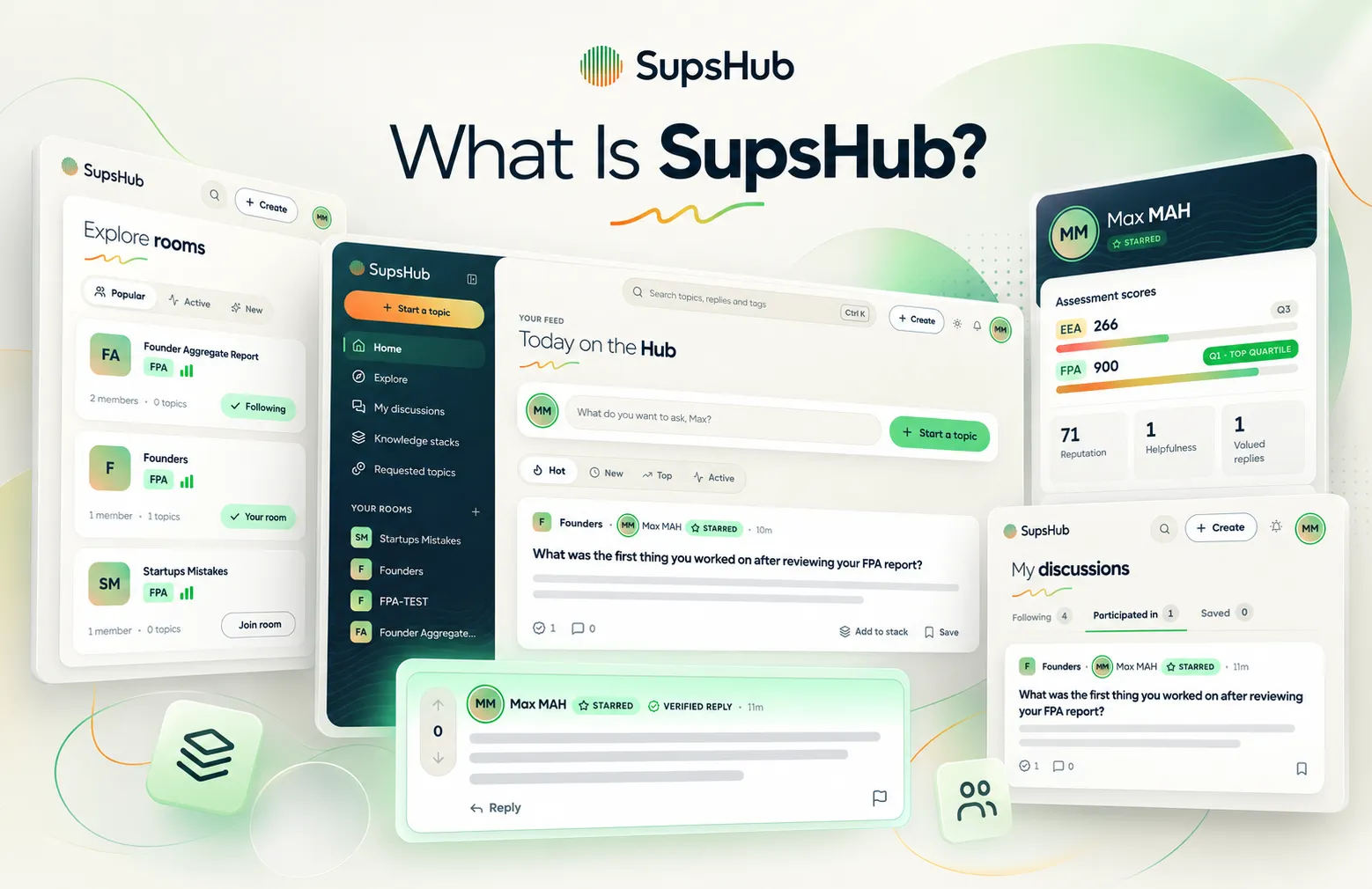
SupsHub is the community platform within the Supsindex ecosystem, designed to bring together assessed founders, qualified community contributors, Faculty Members, and Ecosystem Ambassadors.
Its purpose is to support structured discussions about startup challenges, entrepreneurial readiness, founder development, and the practical application of assessment findings.
Instead of functioning as an isolated discussion forum, SupsHub is intended to become part of the wider founder development journey.
A founder may begin by completing an assessment and receiving a detailed Test Explanatory Report. The report may identify a weakness in financial knowledge, an operational bottleneck, or a behavioral tendency that affects decision-making.
Understanding the assessment result is the first step.
The next challenge is determining how to act on it.
SupsHub creates a place where founders can ask focused questions, learn how others have approached similar challenges, and discuss practical development strategies with qualified community members.
The platform combines Conversation Hashtags, assessment-based participation privileges, community voting, reputation indicators, profile recognition, and selected assessment-report sharing within one environment.
Its guiding idea is straightforward:
An assessment should not end with a score. It should help start a process of learning, action, and measurable improvement.
SupsHub Is Open to View, but Participation Requires Assessment
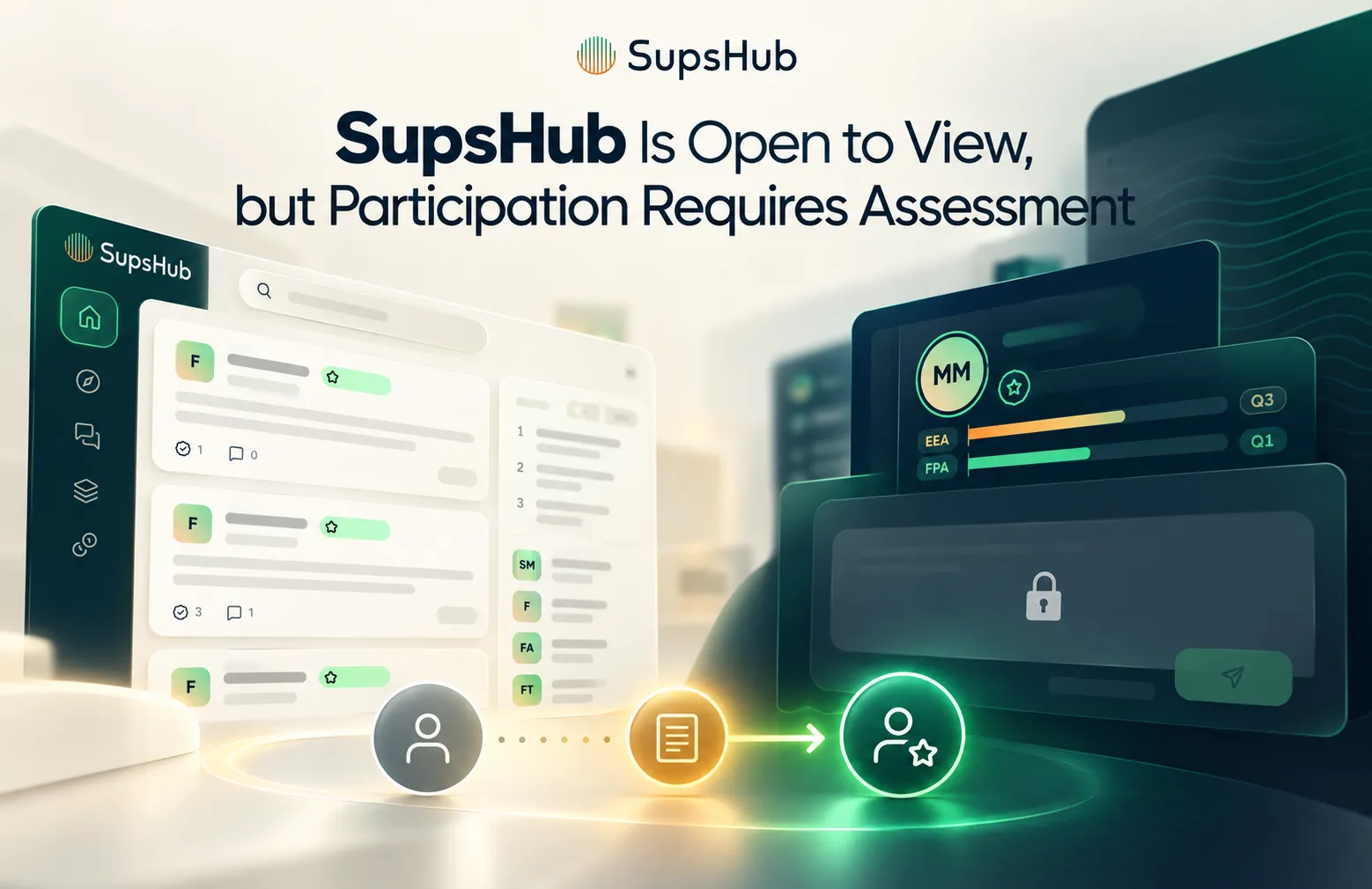
One of the most important distinctions in the SupsHub model is the difference between public visibility and community participation.
SupsHub is designed to make its publicly accessible discussions available to everyone, including people who have not completed a Supsindex assessment.
Visitors will be able to explore public community content and learn about the kinds of entrepreneurial challenges discussed within the platform.
However, viewing the community does not automatically grant participation privileges.
For founders, completing at least one qualifying Supsindex assessment is required to become an active Community Member.
This requirement connects discussion participation to the broader Supsindex founder-readiness framework.
The access model can be summarized as follows:
| User category | Eligibility | Access and privileges |
|---|---|---|
| Public Visitor | No assessment required | View publicly available SupsHub content and discussions |
| Community Member | Complete at least one FPA, GEB, or EEA assessment | View content, publish questions, participate through voting, and share relevant discussion materials |
| Starred Member | Achieve Q1 in at least one qualifying assessment | Community Member privileges plus Reply Capability |
| Faculty Member | Approved scientific or academic contributor | Community participation and Reply Capability through authorized Faculty status |
| Ecosystem Ambassador | Approved regional or industry partner | Community participation and Reply Capability through an authorized Ambassador role |
Faculty Members and Ambassadors have separate role-based authorization because their participation is connected to formal responsibilities within Supsindex.
For founders following the standard membership pathway, completing an assessment is the gateway to active participation.
Importantly, founders do not need to achieve a high result simply to ask questions.
A founder receiving a Q2, Q3, or Q4 result can still become a Community Member after completing the assessment.
This allows the community to support founders who are actively working to improve their capabilities rather than limiting participation to those who already perform at the highest level.
What Is a Starred Member?
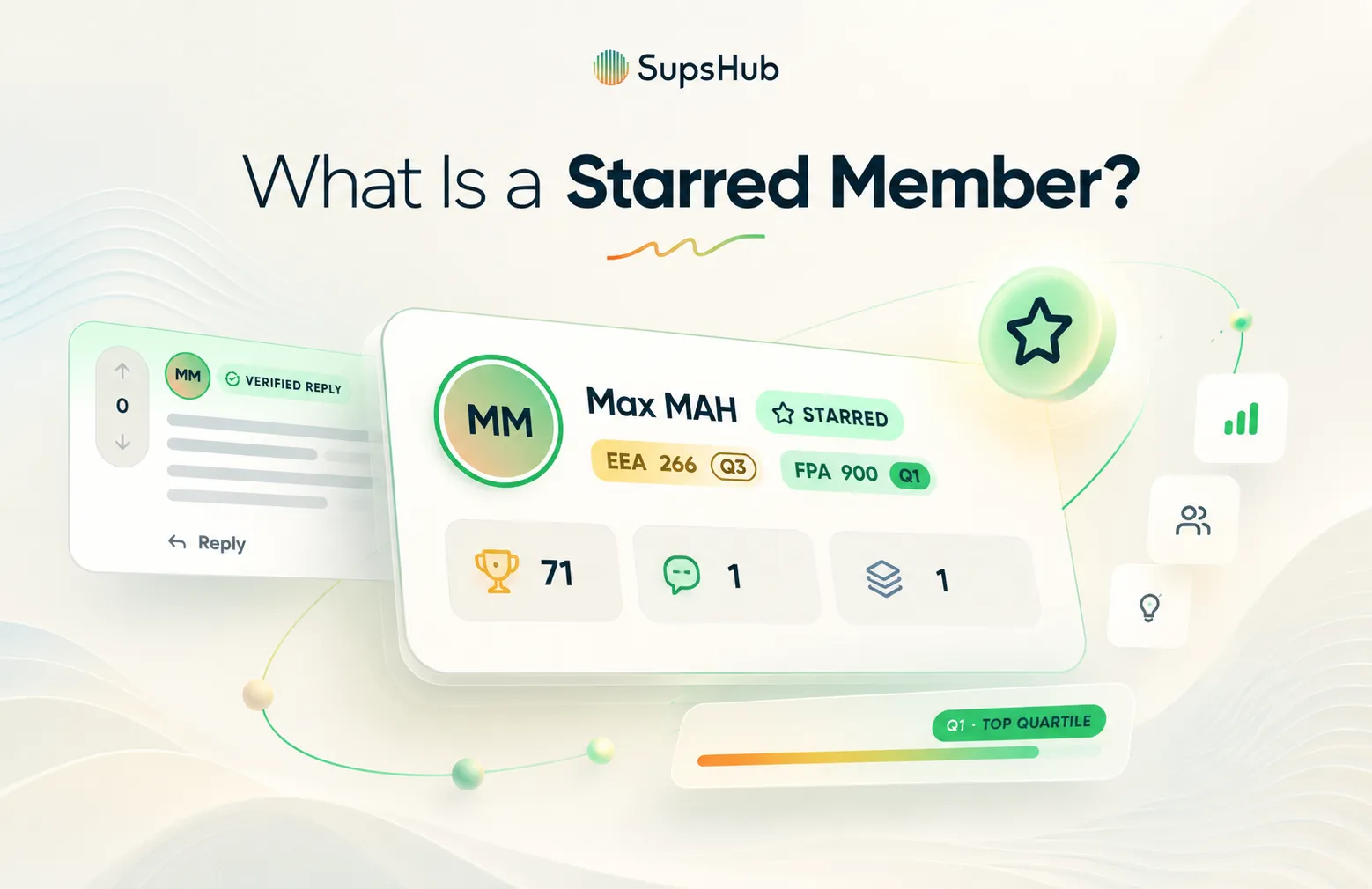
Starred Member status is one of SupsHub’s defining recognition mechanisms.
Within the Supsindex framework, founders are placed into performance quartiles based on their assessment results and applicable scoring methodology.
Q1 represents the highest performance quartile, corresponding to the top 25% of the relevant comparison group.
A founder who achieves Q1 in at least one qualifying FPA, GEB, or EEA assessment becomes eligible for Starred Member status.
This status unlocks an additional participation privilege known as Reply Capability.
While standard Community Members can publish questions and interact through voting, Starred Members can respond to discussions and provide guidance.
The requirement is intended to distinguish between those seeking support and those authorized to contribute answers.
Starred Member status should also be distinguished from Leaderboard recognition.
A Q1 result establishes eligibility for Starred Member privileges, while recognition within the highest-performing segment of the public Leaderboard is a separate achievement.
Not every Starred Member necessarily appears among the most highly ranked founders on the Leaderboard.
Supsindex also uses assessment-validity periods and recognition rules intended to keep achievement status connected to current capability.
For founders, continued Reply Capability depends on maintaining the applicable qualification. Faculty Members and Ambassadors receive access according to their formal roles.
The purpose is to establish a community in which contributing advice carries an identifiable basis of qualification.
Why Does SupsHub Restrict Reply Capability?
Open online forums can provide valuable advice, but they can also create considerable informational noise.
A founder asking an important financial or strategic question may receive recommendations from users with very different levels of expertise.
SupsHub introduces a participation structure designed to reduce that uncertainty.
Instead of allowing unrestricted replies from every visitor, Reply Capability is assigned to eligible Starred Members, Faculty Members, and Ambassadors.
This provides an initial qualification layer around who can respond.
However, Supsindex does not treat a strong assessment result as universal expertise.
Someone who achieves Q1 in entrepreneurial behavioral judgment does not automatically become qualified to offer legal advice. A founder with excellent financial knowledge may still lack experience in a particular regional ecosystem.
Member profiles and relevant assessment recognition are therefore important elements of community transparency.
Founders should consider the respondent’s relevant background, qualifications, and reasoning when evaluating an answer.
The goal is not to replace independent judgment with authority.
It is to provide better information about the source of that authority.
What Can Founders Do Inside SupsHub?
SupsHub is designed around specific entrepreneurial challenges rather than general conversation alone.
A founder may be trying to interpret an assessment result, improve a weak competency, understand a market constraint, or navigate a difficult leadership decision.
The community provides a structured environment for bringing those questions to qualified contributors.
Several practical examples illustrate how the platform is intended to support founder learning.
1. Turn an Assessment Result Into an Action Plan
Imagine a first-time SaaS founder who completes the FPA assessment and receives a report identifying weaknesses in cash runway, burn-rate calculations, and unit economics.
The founder understands that the results point to a meaningful development need but is uncertain how to translate the findings into operational changes.
Inside SupsHub, they could publish a question accompanied by an anonymized excerpt from their assessment report:
My FPA report identifies cash runway management as a major knowledge gap. What operating routines helped you improve financial discipline, and how would you structure a practical 90-day development plan?
Eligible contributors could describe approaches such as weekly financial reviews, cash-flow dashboards, spending-approval rules, or working with a fractional CFO.
A Faculty Member with relevant expertise might explain the underlying financial competency and suggest resources for developing it.
The founder can evaluate those recommendations and decide which interventions are appropriate for their company.
In this way, SupsHub helps connect diagnostic findings with practical founder development.
2. Explore Co-Founder Disagreements
Founding teams frequently face disagreements over decision ownership, operating pace, strategic priorities, and leadership responsibilities.
A CEO may believe that their involvement in every major product decision is necessary for quality control. A technical co-founder may experience the same behavior as micromanagement that slows execution.
Rather than asking the community who is right, the founder can focus on the underlying operational challenge.
A question might be:
Our founding team is struggling to distinguish strategic decisions that require joint approval from routine decisions that functional leads should own. What delegation frameworks have worked for other teams?
Qualified members could discuss approaches such as distinguishing reversible decisions from high-risk commitments or using clearly documented decision rights.
These examples provide useful perspectives without replacing the responsibility of co-founders to resolve their own differences.
SupsHub is designed to support better-informed conversations, not make decisions on behalf of founding teams.
3. Evaluate Customer Discovery Evidence
Customer discovery is another area where founders frequently struggle to separate genuine market evidence from encouraging opinions.
Consider a founder who conducts twelve interviews with prospective customers.
Several participants describe the proposed product as interesting, while others suggest features they might use.
The founder now needs to determine whether the interviews demonstrate meaningful demand.
A SupsHub discussion could ask:
We completed twelve customer interviews, but most positive responses were hypothetical. How can we distinguish real purchasing intent from polite encouragement before committing to an MVP?
Starred Members with relevant experience might recommend examining past customer behavior, existing workarounds, budget allocation, willingness to participate in paid pilots, or actual purchasing commitments.
They may also suggest conducting additional discovery interviews using neutral questions rather than asking prospects whether they like the original idea.
This process helps the founder investigate the evidence rather than simply collect reassurance.
4. Understand a New Entrepreneurial Ecosystem
Startup success depends partly on the environment in which a venture operates.
Regulatory requirements, investor expectations, purchasing practices, institutional processes, and industry-specific norms can differ substantially across markets.
Imagine an EdTech founder in Europe preparing to expand into the United States.
After completing an EEA assessment, the founder identifies gaps in their knowledge of the target ecosystem.
They could publish a discussion under an appropriate ecosystem topic:
We’re preparing for US expansion. Which institutional, regulatory, and investor expectations should European EdTech founders investigate before beginning market-entry activities?
Regional Ambassadors, qualified founders, and contributors familiar with the target ecosystem may share relevant experiences.
Their responses could help the founder identify issues requiring further investigation, such as procurement practices, investor communication norms, or market-specific requirements.
Such discussions are intended to complement—not replace—formal professional advice where legal, financial, or regulatory expertise is required.
Conversation Hashtags: Organizing Knowledge Around Real Problems
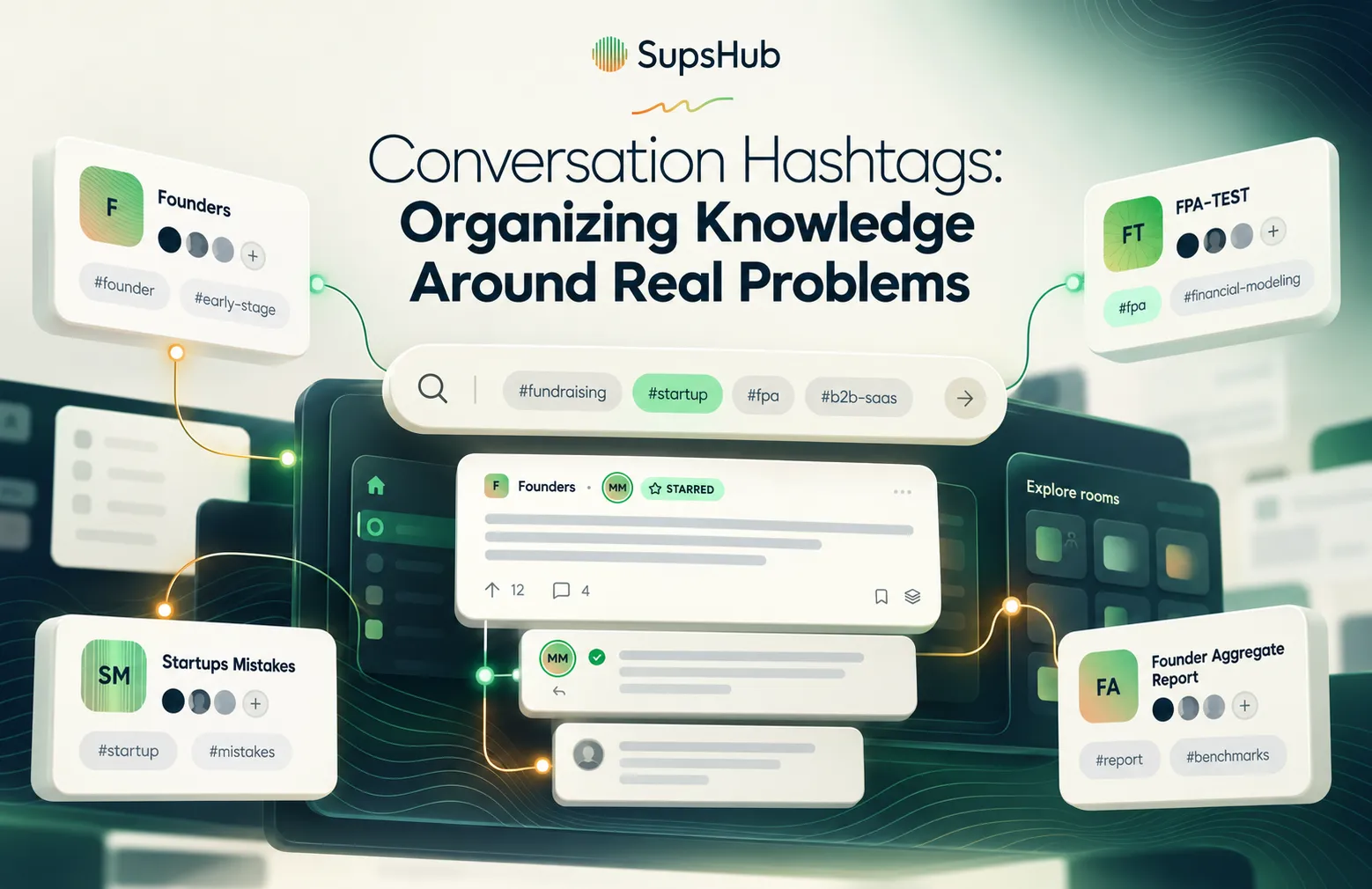
As a founder community grows, information can become harder to navigate.
Useful answers may disappear beneath newer discussions, similar questions may be repeated, and unrelated topics can become difficult to separate.
SupsHub addresses this through Conversation Hashtags.
These organize discussions into focused subject areas connected to entrepreneurial capabilities, operational challenges, assessment findings, and startup ecosystems.
A founder may be interested in financial readiness, customer discovery, team dynamics, market entry, or another specialized topic.
Conversation Hashtags help organize these discussions and make related content easier to discover.
Under the community model, new hashtags can be proposed by eligible Starred Members and require administrative approval.
This structure is intended to prevent unnecessary topic fragmentation while allowing the community’s knowledge areas to expand over time.
The result should be a more purposeful discussion environment in which founders can find existing insights before posting new questions.
Helpfulness Rate: Recognizing Valuable Contributions
Assessment performance is one form of recognition within SupsHub.
Another comes from the quality of participation.
The platform’s reputation model includes Helpfulness Rate, which reflects community feedback through upvotes and downvotes.
The calculation is straightforward:
Helpfulness Rate = Upvotes − Downvotes
A member who consistently provides useful responses may develop a stronger community reputation.
This introduces a distinction between simply participating and contributing information other members consider valuable.
The metric is intended to support recognition for helpfulness rather than posting volume alone.
However, voting is not equivalent to scientific verification.
An answer can be popular without being universally accurate. A specialized response may receive limited engagement despite being technically valuable.
Helpfulness Rate should therefore be interpreted alongside a contributor’s verified qualifications, relevant experience, and the evidence supporting their recommendations.
The broader goal is to make constructive knowledge sharing more visible within the community.
Verified Profiles, Badges, and Recognition
SupsHub is also designed to connect with Supsindex’s assessment recognition system.
Founder profiles may display relevant achievements associated with assessment performance and the wider Supsindex ecosystem.
These include quartile distinctions, seasonal achievements, and other recognition categories.
A Q1 result reflects high performance within the applicable assessment framework.
Leaderboard achievements represent a separate layer of recognition based on the relevant ranking criteria.
Community reputation, meanwhile, reflects how other members evaluate contributions.
These indicators should not be treated as interchangeable.
Assessment performance does not guarantee that someone gives helpful advice, and community popularity does not establish domain expertise.
Together, however, they can provide useful context about a contributor’s achievements and participation history.
SupsHub is intended to use this transparency to help founders make more informed decisions about whose guidance deserves attention.
Sharing Assessment Reports Safely
One of SupsHub’s planned practical advantages is the ability to discuss assessment findings directly with other members.
An FPA report may reveal knowledge gaps. A GEB report may highlight relevant behavioral tendencies. An EEA report may identify weaknesses in understanding a particular startup ecosystem.
These findings can become starting points for focused community discussions.
However, assessment reports may contain personal, business-sensitive, or proprietary information.
For this reason, Supsindex recommends sharing selected, anonymized findings rather than uploading complete, unredacted reports into community discussions.
A founder asking about delegation may need to share only the relevant competency result and a description of the operational challenge.
A founder seeking help with financial management can explain the capability gap without disclosing detailed cash balances, confidential company projections, or private investor information.
Participants should also avoid exposing identifiable information about employees, customers, co-founders, or other third parties without appropriate authorization.
The important distinction is between the information needed to ask a useful question and the broader information contained in the original report.
Founders should share only what is relevant to the discussion.
Community learning should not require unnecessary disclosure of sensitive data.
Community Moderation and Trust
A qualification-based participation system can reduce some forms of low-quality interaction, but it cannot eliminate the need for moderation.
Even experienced contributors may misunderstand questions, provide misleading recommendations, or behave inappropriately.
SupsHub’s community framework therefore includes content reporting and moderation mechanisms.
Participants can flag content they believe to be harmful, misleading, or in violation of community standards.
Authorized Supsindex personnel are responsible for reviewing relevant reports and taking appropriate action according to platform policies.
Community voting and moderation serve different purposes.
Voting helps indicate which responses members consider useful, while moderation addresses conduct and content that may undermine the safety or integrity of discussions.
These mechanisms are designed to support constructive exchanges without implying that every answer has been formally verified by Supsindex.
Members remain responsible for evaluating recommendations and obtaining professional advice when a decision involves specialized legal, financial, or regulatory requirements.
Faculty Members and Ambassadors: Connecting Different Forms of Expertise
SupsHub is not intended to depend exclusively on founders who perform well in assessments.
The wider community also includes contributors with scientific, academic, regional, and operational responsibilities.
Faculty Members
The Supsindex Faculty Program brings together academic experts and specialists involved in assessment development, scientific review, and methodological evaluation.
Approved Faculty Members receive participation privileges according to their role within the ecosystem.
Their involvement can introduce additional scientific and technical perspectives into relevant discussions.
For example, a founder trying to understand a behavioral construct may benefit from a contributor familiar with the research and assessment methodology behind it.
Faculty participation also reflects Supsindex’s broader objective of connecting entrepreneurial practice with structured scientific knowledge.
Ecosystem Ambassadors
The Supsindex Ambassador Program connects regional and industry-specific entrepreneurial networks.
Ambassadors work across relevant startup ecosystems, supporting relationships with founders, universities, accelerators, investors, and other institutions.
Within SupsHub, approved Ambassadors can contribute practical knowledge about regional startup environments and help support relevant community engagement.
This is particularly useful when a founder’s challenge depends on local market conditions rather than universally applicable business principles.
The wider community model also envisions Ambassador-led MeetUps and other approved activities that connect digital discussions with in-person ecosystem participation.
SupsHub and Continuous Founder Development
The relationship between SupsHub and Supsindex becomes most meaningful when assessment results lead to real behavioral or operational changes.
A founder assessment can identify a weakness.
A Test Explanatory Report can provide context and recommendations.
But improvement often requires additional learning, expert guidance, repeated practice, and accountability.
SupsHub is designed to provide a community layer connecting these stages.
A founder who receives a weak delegation score may ask how others structured decision ownership.
A founder struggling with financial knowledge may learn how experienced operators established consistent cash reviews.
Someone who discovers gaps in ecosystem awareness may identify more relevant questions to investigate before entering a new market.
As founders apply what they learn, their own experiences may eventually become valuable to others.
This creates the possibility of moving from seeking advice to contributing it.
Within the Supsindex model, qualification-based participation and continuous development are intended to support that progression over time.
The objective is not simply to create discussions.
It is to help founders convert information into improved judgment and execution.
The Future of SupsHub: Supex and the Contribution Economy
SupsHub is also part of Supsindex’s wider vision for contribution-based recognition.
This includes Supex, the utility token being developed for the Supsindex ecosystem.
Under the planned Supex model, verified contributions may become eligible for token rewards, connecting valuable activity with designated services and benefits.
Within SupsHub, the community’s Helpfulness Rate and contribution history are intended to play a role in the future incentive structure.
For example, a qualified member who consistently provides valuable answers may become eligible for recognition through the token-based reward system once that functionality is introduced.
However, Supex integration is a future feature, not part of the initial public viewing and assessment-based discussion access requirements.
The existing participation model and planned token economy should be understood separately.
SupsHub’s primary purpose remains knowledge sharing and founder development, regardless of whether token rewards are available.
Planned Connections With Other Supsindex Services
SupsHub is intended to become part of a broader ecosystem connecting founder assessments with learning, networking, and practical execution resources.
Future integrations include Supsnetwork, focused on data-informed founder and co-founder networking; Supsups, designed around personalized learning paths informed by assessment results; and Supstool, an envisioned environment for startup execution tools.
The broader vision also includes selected community activities connected with Supsindex recognition and awards.
These developments form part of the ecosystem roadmap and should not be confused with the community capabilities being prepared for the initial SupsHub release.
Their strategic relationship is clear: founders need more than diagnostic information.
They need access to people, learning opportunities, relevant tools, and support that helps them apply what they have learned.
SupsHub is intended to become a central connection point between these needs.
How to Access and Participate in SupsHub
SupsHub is in its finalization stage and is expected to become available soon through the official Supsindex ecosystem.
Once available, its access model will provide two main pathways.
For Visitors: Explore SupsHub Without an Assessment
Anyone will be able to view publicly accessible SupsHub discussions without completing an assessment.
This allows prospective founders, researchers, ecosystem participants, and other interested visitors to explore the community and understand its knowledge-sharing approach before becoming active participants.
Public viewing does not include permission to create posts, vote, or participate in discussions.
For Founders: Complete an Assessment to Participate
Founders who want to become active Community Members can follow a simple process.
First, register through the official Supsindex website and access the Founder Dashboard.
Next, complete at least one qualifying assessment: FPA, GEB, or EEA.
Once the community is available and the assessment requirement is satisfied, eligible founders can access SupsHub through the SupsHub tab in their Founder Dashboard.
They can then explore relevant Conversation Hashtags, publish questions, share appropriate assessment findings, and participate through voting.
Founders who achieve Q1 in a qualifying assessment can receive Starred Member privileges, including Reply Capability, subject to the relevant eligibility rules.
Approved Faculty Members and Ambassadors can participate through their respective authorized roles.
Founders may also explore the current assessment offers and referral opportunities published by Supsindex when preparing to join.
The important distinction is that viewing SupsHub does not require an assessment, while active founder participation does.
How to Ask Better Questions in SupsHub
The usefulness of community advice depends partly on how clearly a founder explains the problem.
A general question such as “How can I become a better founder?” gives contributors limited information about what the founder is trying to achieve.
A more effective question identifies the context, the operational challenge, and the type of insight needed.
For example, a founder might explain that their assessment revealed weak financial literacy and ask how others established a reliable cash-monitoring routine.
Another might describe a disagreement over delegation and request examples of how teams distribute responsibility between founders and functional leaders.
The question should include enough information to make the challenge understandable without unnecessarily exposing private company data.
Founders should also treat responses as inputs for decision-making rather than instructions that must automatically be followed.
Even relevant advice can depend on assumptions that do not apply to every startup.
SupsHub is designed to connect founders with qualified perspectives, but each founder remains responsible for evaluating those perspectives and deciding how to act.
Why SupsHub Matters to the Supsindex Ecosystem
SupsHub introduces a community dimension to a platform primarily associated with measuring founder readiness.
The assessment process provides structured insights.
The community creates opportunities to discuss those insights.
Practical learning can then support operational changes, which may create new experiences and knowledge for the founder to share.
Over time, this relationship can form a continuous development cycle:
Assessment → Insight → Community Learning → Operational Action → Development → Contribution
The value of this model does not depend solely on the number of discussions or registered members.
A more meaningful measure is whether founders can identify relevant expertise, evaluate feedback more critically, and translate assessment findings into practical improvements.
That is the difference between building a popular discussion platform and building a community focused on entrepreneurial development.
SupsHub is intended to pursue the latter.
Frequently Asked Questions About SupsHub
What is SupsHub?
SupsHub is the Supsindex founder community designed to connect entrepreneurial assessment, qualified peer guidance, structured discussions, and practical founder development.
Is SupsHub available now?
SupsHub is currently in its finalization stage and will become publicly available soon. Its participation model and planned community capabilities are being prepared for release.
Can anyone view SupsHub?
Yes. Once available, SupsHub will be open for everyone to view. Visitors will be able to access publicly visible discussions without completing an assessment.
Do I need to complete an assessment to participate?
Yes. Founders must complete at least one qualifying Supsindex assessment—FPA, GEB, or EEA—to participate actively in the community, publish questions, or interact through voting. Approved Faculty Members and Ambassadors have separate role-based authorization.
Do I need a Q1 score to join?
No. Any founder who completes a qualifying assessment can become a Community Member, regardless of whether the result is Q1, Q2, Q3, or Q4.
Who can reply to discussions?
Reply Capability is reserved for qualifying Q1 Starred Members, approved Faculty Members, and authorized Ecosystem Ambassadors.
What is a Starred Member?
A Starred Member is a founder who achieves Q1 in at least one qualifying Supsindex assessment and receives elevated community participation privileges.
What is Helpfulness Rate?
Helpfulness Rate is SupsHub’s planned community-reputation metric, calculated through net upvotes and downvotes on community contributions.
Can I share my assessment findings?
SupsHub is designed to support discussion of relevant assessment findings and selected report excerpts. Founders should anonymize materials and avoid sharing unnecessary personal or confidential business information.
Will SupsHub include Supex rewards?
Supex-based rewards are part of the future ecosystem roadmap. They are separate from the initial community access and participation requirements.
How will I access SupsHub?
Once the community becomes available, visitors will be able to explore its publicly accessible content. Eligible founders will be able to participate through the SupsHub tab in their authenticated Founder Dashboard at supsindex.com.
Conclusion: A Founder Community Designed Around Learning and Verified Capability
Founders do not need another environment where visibility is confused with expertise or where every confident opinion receives equal attention.
They need better ways to identify relevant knowledge, discuss difficult decisions, and learn from people whose qualifications and experience can be evaluated.
SupsHub introduces a structured approach to that challenge.
Its community model combines public access to knowledge with assessment-based participation, qualification-based Reply Capability, subject-focused discussions, and reputation mechanisms intended to recognize valuable contributions.
The platform is designed to remain open for everyone to view, allowing visitors to explore public discussions without completing an assessment. For founders who wish to participate actively, completing at least one Supsindex assessment establishes the starting point.
From there, founders can ask questions, learn from qualified contributors, discuss development needs, and apply relevant insights to their entrepreneurial decisions.
Faculty Members and Ambassadors contribute additional scientific and ecosystem perspectives, while future integrations are intended to connect community learning with wider opportunities across the Supsindex platform.
As SupsHub approaches public availability, its central ambition remains clear:
Turn founder assessment from an isolated evaluation into the beginning of a more connected learning experience.
SupsHub is currently being finalized and will be available soon.
To prepare for participation, visit Supsindex, create your founder account, and explore the FPA, GEB, and EEA assessments.
Stop guessing. Start measuring. Keep learning.
More Information
For an overview of the community model, explore the official SupsHub page and What Access to SupsHub Provides.
To learn more about qualification-based participation, read Becoming a Starred Member in SupsHub.
Additional information about entrepreneurial assessment, community development, and future ecosystem integrations is available through the Supsindex website.
