


Overconfidence can help founders act under uncertainty, but founder overconfidence becomes dangerous when conviction stops responding to evidence, risk is miscalibrated, and contradictory information can no longer change the strategy.
Founder Overconfidence: When Conviction Becomes a Startup Liability
Every startup begins with a degree of irrationality. A founder has to believe that an uncertain future can be created despite incomplete information, limited resources, skeptical customers, established competitors, and statistics that provide little reassurance. Without confidence, many ventures would never move beyond an idea. The ability to act before certainty arrives is therefore not a psychological defect in entrepreneurship; it is often part of the job.
The difficulty begins when confidence stops responding to evidence. A founder can be deeply committed to a vision while still updating assumptions about how that vision should be achieved. Founder overconfidence appears when that updating mechanism begins to fail: confidence in judgment becomes stronger than the evidence supporting it, contradictory information is discounted, uncertainty is underestimated, and persistence becomes increasingly difficult to distinguish from refusal to change course.
This distinction matters because academic research does not suggest that overconfidence is simply bad for entrepreneurship. A major 2022 meta-analysis in the Journal of Business Venturing, synthesizing 62 primary studies, found that different forms of overconfidence can encourage opportunity assessment, entrepreneurial entry, and innovation, while tending to impair venture performance at later stages. The same psychological mechanism that helps someone cross the threshold into entrepreneurship can therefore create problems once the company requires disciplined execution and continuous recalibration.
Supsindex treats this transition as a measurable founder-risk problem. Within its behavioral framework, overconfidence is particularly dangerous because it does not merely create another weakness. It can prevent a founder from recognizing other weaknesses at all.
Why entrepreneurship rewards confidence in the first place
Building a startup requires repeated action under ambiguity. Founders hire before they know exactly how quickly the company will grow, develop products before demand is fully established, enter markets with incomplete information, and persuade investors and employees to commit resources to outcomes that do not yet exist. Some degree of self-belief is therefore functionally useful.
Research on entrepreneurial self-efficacy reinforces this point. Self-efficacy refers to a person’s belief in their ability to perform difficult tasks and persist through adversity, and research published in Small Business Economics has examined its relationship with startup performance. Confidence can support persistence and action when founders face situations in which outcomes cannot be guaranteed in advance.
The danger is confusing self-efficacy with calibration. A founder can reasonably believe, “I am capable of solving difficult problems,” without concluding, “My current interpretation of this problem must be correct.” The first belief supports resilience. The second can suppress learning.
This is why healthy conviction and founder overconfidence can look almost identical from the outside. Both founders may speak confidently, tolerate uncertainty, defend an unpopular thesis, and continue working despite rejection. The difference becomes visible only when reality begins pushing back.
The well-calibrated founder asks what the new evidence means.
The overconfident founder increasingly asks why the evidence is wrong.
Overconfidence is not one thing
The academic literature makes another useful distinction. Researchers commonly separate overconfidence into overestimation, overplacement, and overprecision.
Overestimation occurs when people believe their ability or performance is better than it actually is. Overplacement describes the belief that they are better than others to a greater extent than evidence supports. Overprecision occurs when people express excessive certainty that their beliefs, estimates, or forecasts are accurate.
For founders, all three can matter. A founder may overestimate their ability to execute a complex market expansion, overplace themselves relative to competitors, or become excessively certain about a forecast despite substantial uncertainty.
The 2022 Journal of Business Venturing meta-analysis found that these forms of overconfidence do not produce identical effects. Particularly noteworthy was the finding that overprecision appeared especially detrimental to entrepreneurial performance.
This has an important implication for investors and founders. The problem is not necessarily someone believing they are talented. The more dangerous signal may be someone becoming too certain that their interpretation of the future is correct.
Startups operate in environments where probability distributions are unstable, customer behavior changes, competitors respond, capital conditions move, and seemingly strong hypotheses regularly fail. Excessive certainty is therefore particularly expensive.
From conviction to “visionary blindness”

Supsindex describes one advanced form of overconfidence as visionary blindness. The original vision that once helped the founder persist gradually becomes psychologically protected from contradiction.
This transition can be subtle. Early in the company, outsiders may repeatedly doubt the founder and be wrong. The product may initially look strange, investors may reject the first pitch, experienced operators may say the market is too difficult, and customers may take time to understand something genuinely novel. Surviving these moments teaches founders an important lesson: consensus is not always correct.
The problem emerges when the founder learns a much more dangerous lesson: disagreement itself is evidence that everyone else simply fails to understand the vision.
Customer churn can then be explained away as the wrong customer segment. Weak unit economics become a temporary inconvenience. Employee objections become resistance to change. Investor concerns become short-term thinking. Missed forecasts become execution problems rather than reasons to reconsider the underlying assumptions.
At that point, the founder is no longer using conviction to survive uncertainty. Conviction is being used to defend the founder from information.
Supsindex’s own public founder-readiness material highlights this progression. It describes how productive risk-taking can evolve into reckless “bet-the-house” decisions when overconfidence combines with capital availability and weak feedback systems, leading founders to pursue growth while neglecting unit economics or adequate diligence.
The Reckless Visionary problem
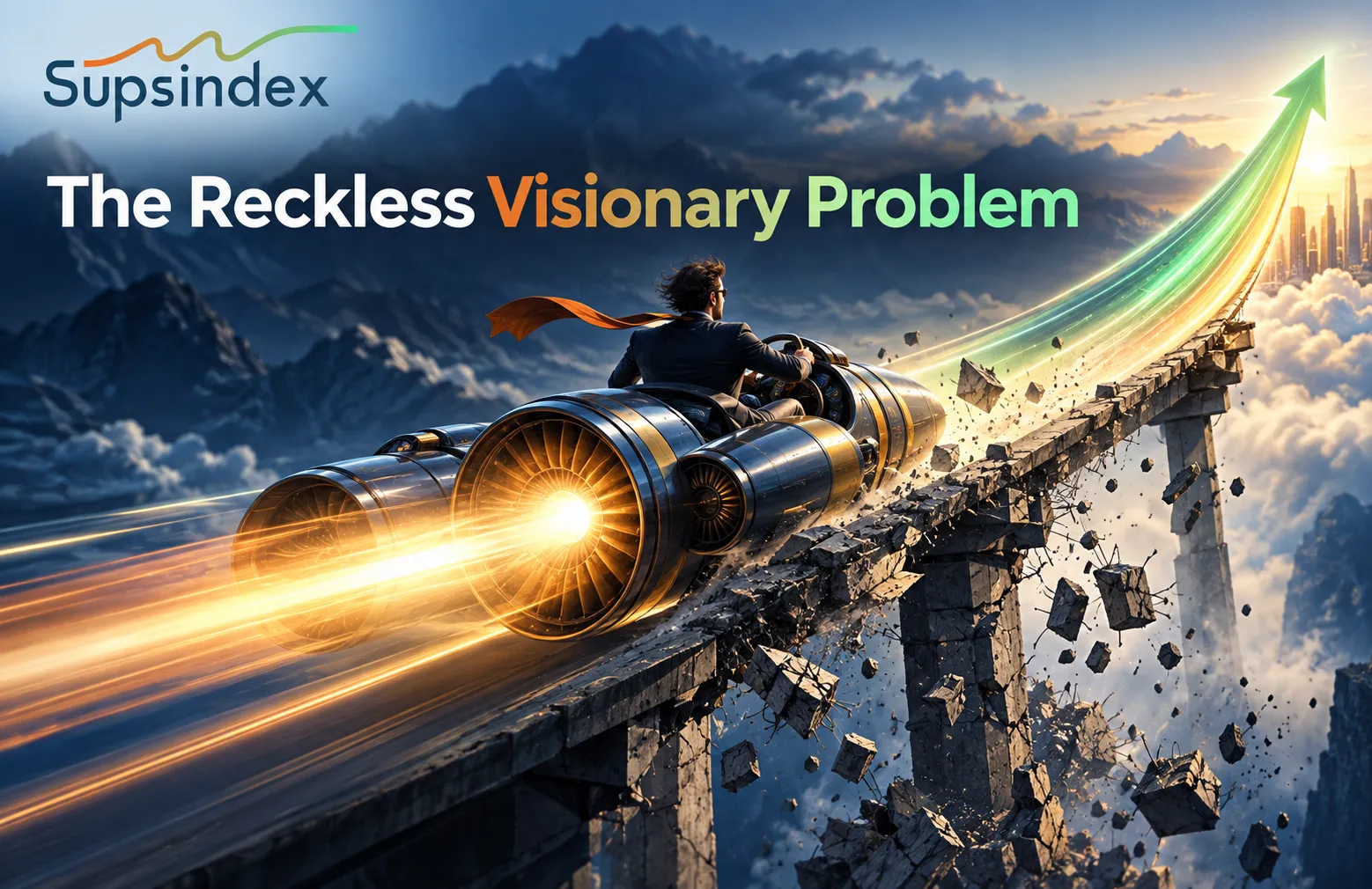
Within the Supsindex behavioral framework, one particularly dangerous pattern occurs when high achievement drive and strong risk comfort combine with insufficiently controlled overconfidence. Supsindex refers to this configuration as the Reckless Visionary.
None of the components is inherently negative. Ambition can drive exceptional performance, and risk tolerance is necessary when building something that has no guaranteed outcome. But behavioral strengths do not operate independently. Their interaction determines whether they remain strengths.
A founder who possesses high ambition, high risk tolerance, and strong intellectual humility may pursue bold opportunities while continuously checking the evidence. A founder with the same ambition and risk tolerance but substantial overconfidence may interpret every obstacle as a reason to accelerate.
One consequence is premature scaling. The founder raises capital and interprets the funding itself as validation of the operating model. Hiring accelerates, customer acquisition spending increases, markets are added, and infrastructure expands before product-market fit or unit economics are sufficiently robust.
The company may look increasingly successful because activity is increasing everywhere. Yet motion and validation are not the same thing.
This distinction matters even more in venture-backed companies because capital can temporarily hide judgment errors. A bootstrapped founder receives immediate feedback when an inefficient strategy consumes scarce cash. A heavily funded startup may continue executing a flawed assumption for considerably longer.
Overconfidence does not always cause the original mistake. It can determine how long the company continues financing it.
Why sunk costs become psychologically difficult
Founder overconfidence frequently interacts with another cognitive bias: escalation of commitment.
Once founders have publicly committed to an idea, hired people around it, raised money on the thesis, built a reputation around it, and spent several years defending it, changing direction becomes psychologically expensive. The decision is no longer only about whether the strategy is working. It becomes entangled with identity and reputation.
Experimental research outside the specific startup context has found that overconfidence can interact with public commitment and reputational concerns to influence escalation decisions. In some conditions, people who had publicly committed themselves were more likely to continue investing in previous decisions as confidence became tied to reputation.
Entrepreneurship makes this mechanism particularly relevant because founders are repeatedly encouraged to communicate certainty. They tell employees why the company will win, explain the thesis to investors, defend the roadmap publicly, and often become personally associated with the company’s worldview.
Changing course can therefore feel psychologically similar to admitting that the founder was wrong.
Intellectual humility breaks this connection.
A founder can say, “Our evidence no longer supports this strategy,” without concluding, “I am a bad founder.”
That separation between the person and the hypothesis may be one of the most important defenses against overconfidence.
The Ostrich Effect: when founders stop looking at the numbers
Overconfidence does not always appear as aggressive action. Sometimes it appears as information avoidance.
Supsindex describes one such pattern as the Ostrich Effect, particularly when high self-belief coexists with weak financial fluency. The founder may remain confident that the company is progressing while gradually avoiding metrics that threaten that interpretation.
The avoidance may initially be minor. Financial reviews become less frequent. Runway calculations use optimistic revenue assumptions. Customer acquisition costs are explained as temporary. Retention cohorts receive less attention than gross signups. The founder spends more time discussing future partnerships than current contribution margins.
Eventually, a peculiar information structure forms in which the founder technically has access to the data but does not allow the most uncomfortable data to alter the narrative.
This is why Supsindex places such emphasis on the distinction between signal and noise. Its FPA framework evaluates whether founders can recognize commercially meaningful information among distracting or superficially impressive signals. Supsindex’s public material specifically contrasts important indicators such as retention against vanity metrics such as press attention.
For an overconfident founder, the danger is not lack of data.
It is selective attention to data that preserves confidence.
The broader research supports a complicated picture
It would be inaccurate to suggest that every confident founder performs poorly. The research is substantially more complicated.
A separate meta-analysis examining CEO overconfidence across 199 studies found that overconfidence could, on average, be associated with improved firm performance through greater strategic risk-taking under some conditions. The authors explicitly challenged the assumption that managerial overconfidence is universally destructive.
Other entrepreneurship research, however, shows meaningful downside. A study examining financial forecasting among 203 small firms found overconfidence associated with overly optimistic forecasts and potentially non-optimal outcomes. Research on entrepreneurial optimism has likewise found circumstances where excessive optimism was negatively associated with venture growth.
The apparent contradiction is useful rather than inconvenient.
Overconfidence can sometimes encourage precisely the risk-taking and persistence necessary for innovation. The problem is not maximum confidence versus minimum confidence. The problem is calibration.
A founder who is insufficiently confident may abandon good opportunities too early. A founder who is excessively confident may continue financing a bad opportunity too long.
The challenge is preserving enough conviction to act while maintaining enough epistemic humility to update.
Why founders are difficult to assess through self-report alone
Overconfidence creates a peculiar measurement problem because the founder may sincerely believe an inaccurate assessment of their own capabilities.
This is one reason Supsindex does not rely solely on conventional self-report personality questionnaires for behavioral evaluation. Asking someone whether they listen to feedback, make rational decisions, or remain open-minded is unlikely to reveal much if the person genuinely believes that they do.
Founder-managers have, in fact, been found to exhibit higher levels of overconfidence than managers of new ventures who did not found the business, suggesting that founder status and context may interact with cognitive bias.
The popular Dunning–Kruger explanation is sometimes applied too casually to entrepreneurship, but research has specifically examined the relationship between entrepreneurial experience, self-efficacy, and Dunning–Kruger-type dynamics. The broader point is less about attaching a label to founders and more about recognizing that subjective confidence is not a reliable substitute for demonstrated competence.
Supsindex therefore attempts to infer behavior through decisions and trade-offs rather than asking founders to provide flattering descriptions of themselves.
How GEB attempts to expose hidden overconfidence
The General Entrepreneurial Behavior (GEB) assessment uses forced-choice Situational Judgment Tests in which founders are placed inside realistic entrepreneurial scenarios and required to identify more and less effective responses.
The distinction is important because many poor leadership decisions sound reasonable when described attractively. Micromanagement can be presented as “staying close to the team.” Reckless risk-taking can be described as “bold leadership.” Ignoring criticism can be reframed as “protecting the vision.”
Supsindex deliberately uses plausible, socially desirable distractors to test whether founders recognize the difference between something that sounds like good leadership and something that is operationally effective.
Its public documentation describes GEB as using 75 situational judgment scenarios and Thurstonian Item Response Theory to evaluate latent behavioral characteristics while reducing problems associated with straightforward self-report measurement.
The assessment then separates positive behavioral capability from susceptibility to cognitive derailers. This dual perspective matters because the same founder can simultaneously possess exceptional strengths and dangerous vulnerabilities.
High grit does not eliminate confirmation bias.
High achievement drive does not eliminate sunk-cost behavior.
High resilience does not guarantee that the founder knows when persistence has stopped being rational.
Why signal detection matters for overconfident founders
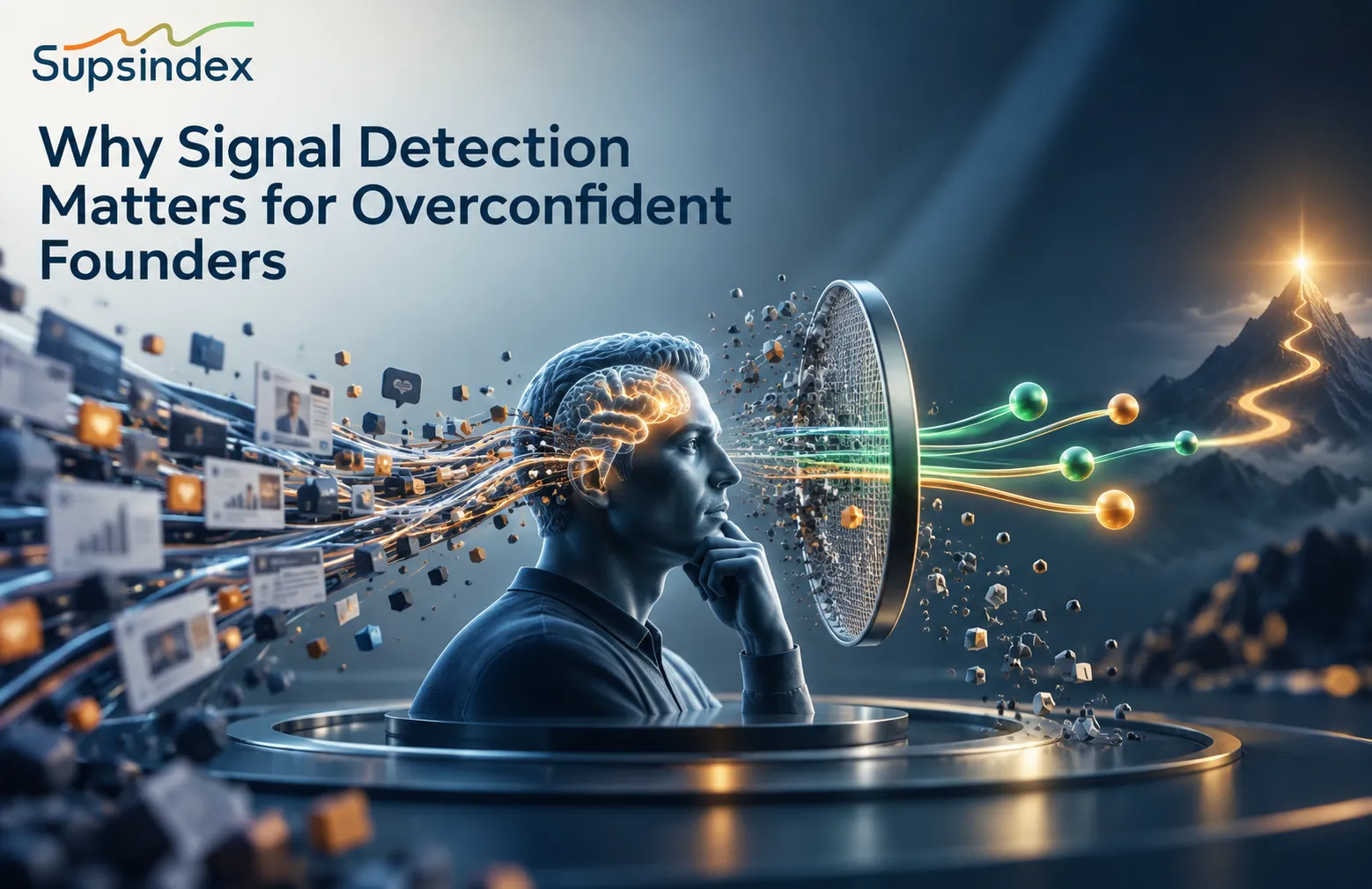
Another diagnostic layer comes from the concept of signal detection.
A startup founder operates inside an extraordinary amount of information. Customer requests, investor opinions, social metrics, competitive announcements, employee concerns, press coverage, sales forecasts, macroeconomic changes, and industry trends compete for attention simultaneously.
The problem is not simply knowing more. It is correctly distinguishing information that should alter a decision from information that should not.
Supsindex incorporates signal-detection logic into FPA to distinguish meaningful hits from false alarms. A founder with strong signal discrimination should be able to recognize a genuinely important strategic problem without repeatedly becoming distracted by technically impressive but commercially irrelevant information.
Overconfidence can interfere with this process in two directions. Founders may dismiss important negative signals because those signals contradict the thesis, or they may overinterpret weak positive signals because those signals confirm it.
A spike in website traffic becomes proof of product-market fit.
A well-known investor taking a meeting becomes validation of the business model.
An enthusiastic pilot customer becomes evidence of scalable demand.
None of those observations is meaningless. The mistake lies in assigning them more certainty than the evidence supports.
What happens when confidence is tested under real pressure?
Questionnaires and behavioral scenarios can identify predispositions, but some decision problems become visible only when pressure increases.
This is the logic behind Supsindex’s Founder Decision Excellence (FDE) framework and its Leadership Flight Simulator. The founder is placed inside simulated startup shocks involving conditions such as liquidity pressure, competitive threats, budget constraints, or internal conflict, and their decisions are observed as the situation evolves.
Supsindex’s model also uses a Personalized Digital Clone, described in its glossary as an AI representation built from the founder’s assessment data that models an optimal, stress-free decision profile. The gap between the founder’s decisions during the simulation and the comparison profile is used to expose possible biases, blind spots, and development areas.
According to Supsindex pilot data provided for this analysis, a study involving approximately 300 founders found that participants whose decision divergence exceeded one standard deviation were 2.4 times more likely to commit serious strategic errors in practice, including delayed pivots and continued resource allocation toward poorly validated initiatives.
This finding should be treated as Supsindex pilot evidence rather than a universal entrepreneurship statistic, but it illustrates an important principle: confidence should ultimately be evaluated through decision behavior, particularly when the founder is operating under conditions that make bias more likely.
The earliest warning signs are usually behavioral
Founder overconfidence rarely announces itself through a founder saying, “I no longer care about evidence.” The early indicators are much smaller.
One sign is asymmetric interpretation of feedback. Positive feedback is treated as strong evidence while negative feedback is dismissed as anecdotal, poorly informed, or unrepresentative.
Another is continually moving the criteria for success. If the original metric fails to validate the thesis, the founder begins emphasizing another metric without explicitly acknowledging that the evidentiary standard has changed.
A third is persistent externalization. Poor results are repeatedly attributed to employees, investors, the economy, customers, timing, competitors, or inadequate marketing without meaningful examination of whether the founder’s own assumptions contributed.
Premature scaling can provide another warning. Instead of waiting for retention, unit economics, or repeatable customer acquisition to improve, the founder attempts to solve uncertainty by increasing volume.
Leadership behavior may also change. A founder who becomes increasingly certain that only they understand the business can begin checking every decision, restricting autonomy, and interpreting dissent as incompetence. What initially appears to be quality control gradually becomes a Controlling Architect problem in which the founder themselves becomes the organization’s principal bottleneck.
These behaviors have something in common: they reduce the amount of corrective information capable of reaching the founder.
The solution is not to make founders less confident
Trying to eliminate founder confidence would create a different problem.
Entrepreneurs routinely need to continue when evidence remains incomplete. They need to recruit before outcomes are guaranteed, pitch investors after rejection, withstand failed experiments, and maintain organizational morale during periods of genuine uncertainty.
A founder who revises the strategy after every negative signal is not necessarily intellectually humble. They may simply lack conviction.
The objective should therefore be calibrated confidence: strong belief in the founder’s capacity to solve the problem combined with conditional belief in the current solution.
This distinction can be expressed simply:
“I believe we can solve this” is conviction.
“Therefore, my current strategy must be right” is where overconfidence begins.
Forcing functions make humility operational
Intellectual humility sounds like a personality virtue, but relying on founders to “be more humble” is not a particularly strong risk-management strategy.
A better approach is to build systems that make recalibration unavoidable.
Supsindex describes these mechanisms as forcing functions. If a founder has a tendency toward impulsive capital allocation, a company might require a 24-hour cooling-off period before a major discretionary commitment. If confirmation bias is the concern, strategic proposals can include an explicit section documenting disconfirming evidence. If runway avoidance is the pattern, standardized financial reviews can occur on a fixed cadence regardless of whether performance feels positive.
Predefined evidence thresholds can be particularly useful. Before launching an initiative, the team agrees on what evidence would justify continued investment, further testing, or termination. This prevents the criteria from being rewritten after significant resources have already been committed.
Decision journals can serve a similar function. Instead of reconstructing the logic behind a decision six months later, founders document the original assumptions, probabilities, expected outcomes, and reasons for acting. When the result becomes visible, the founder can compare the original forecast with reality.
The purpose is not bureaucracy.
It is preventing memory, ego, and narrative reconstruction from rewriting what the founder genuinely believed at the time.
Investors should test calibration, not charisma
Overconfidence presents a particular problem for investors because fundraising disproportionately rewards confident communication.
A founder who speaks with certainty, answers questions rapidly, communicates an enormous vision, and refuses to appear intimidated can create an extremely positive impression. Yet none of those qualities establishes whether their confidence is calibrated.
Investors should therefore examine how founders update, not merely how strongly they believe.
What important assumption has the founder changed during the last year? What evidence caused the change? When was the last time a team member successfully changed the founder’s mind? Which current assumption would most damage the company if it proved false? What specific evidence would trigger a pivot? Which forecast has the founder recently missed, and what did they learn from it?
The quality of these answers can reveal substantially more than asking founders whether they are coachable.
Investors can also create governance around identified risks rather than treating assessment as a selection mechanism only. If the founder is unusually ambitious and risk-tolerant but vulnerable to overconfidence, the solution may not be rejection. It may be stronger capital-allocation controls, independent board challenge, milestone-based funding decisions, or deliberate financial oversight.
This is consistent with Supsindex’s Penalty for Bottleneck philosophy: exceptional strengths should not be allowed to mathematically or psychologically conceal a critical weakness.
Accelerators should depersonalize difficult feedback
Founder overconfidence creates an equally difficult challenge for accelerators and mentors.
The very founder who most needs corrective feedback may be the person most likely to experience that feedback as evidence that the mentor “doesn’t understand the business.”
One solution is to depersonalize the conversation.
Instead of saying, “You are overconfident,” an accelerator can point to a measurable discrepancy between perceived and demonstrated capability. Instead of arguing that the founder is financially weak, the program can show where decision-making or applied knowledge falls relative to the relevant benchmark.
This changes the conversation from identity to evidence.
Assessment can also guide mentor matching. A founder who has strong commercial skills but weak operational discipline does not necessarily need another general startup mentor. They may need someone capable of creating execution systems and challenging assumptions around scaling.
Over time, the important variable becomes whether those gaps close. Supsindex’s broader Founder Continuous Growth approach is designed around this principle: founder readiness should be treated as something that evolves rather than as a fixed psychological label.
Conviction should survive disagreement; beliefs should not be immune to it
The best founders are often unusually difficult to discourage. That characteristic matters because entrepreneurship produces long periods when external validation is scarce.
But there is an important distinction between refusing to surrender the mission and refusing to revise the model.
Healthy conviction survives criticism because the founder believes in solving the underlying problem.
Overconfidence resists criticism because changing the solution feels like losing.
The difference becomes visible in language. A calibrated founder can defend a thesis intensely while still describing what evidence would falsify it. They can acknowledge uncertainty without becoming indecisive. They can explain why a strategy is currently preferable while accepting that new information may change that conclusion.
Perhaps most importantly, they can say, “I was wrong,” without the organization’s confidence in them collapsing.
That is not weakness.
It is evidence that confidence is attached to the founder’s ability to learn rather than their need to always have been correct.
Conclusion: The problem is not conviction, but uncorrected conviction
Overconfidence occupies an unusual position in entrepreneurship because some of the psychological qualities that encourage people to start ambitious companies can later undermine those companies.
The research reflects this duality. Overconfidence can stimulate entrepreneurial action and innovation, yet evidence also connects particular forms of overconfidence with weaker performance, unrealistic forecasts, poor calibration, and persistence in flawed decisions.
Supsindex’s perspective is therefore not that founders should become less ambitious, less persistent, or less willing to take risks. It is that these characteristics should be accompanied by systems capable of detecting when they have crossed their useful range.
That means measuring susceptibility to cognitive derailers rather than asking founders whether they possess them. It means testing decisions under pressure rather than relying entirely on pitch behavior. It means distinguishing meaningful signals from information that merely confirms the existing narrative. It means creating financial, governance, and decision-making mechanisms that continue functioning when the founder’s own judgment becomes temporarily distorted.
Most importantly, it requires intellectual humility.
The founder does not need to lose confidence in their ability to build something important.
They need to preserve the ability to lose confidence in an assumption.
For a startup, that difference can determine whether conviction remains an asset or becomes the liability that ultimately consumes the company.
