


The Supsindex Faculty Program is a decentralized expert-validation network that helps protect the scientific quality, cultural relevance, and methodological rigor of Supsindex founder assessment.
What Is a Faculty Program? Inside the Supsindex Faculty Program
A faculty program can mean different things depending on the organization. In the context of Supsindex, it is not a university department, a ceremonial advisory board, or a group of experts whose names simply appear beside a product. The Supsindex Faculty Program is an active validation network that helps maintain the scientific quality of the platform’s founder assessment infrastructure.
The program brings together around 300 academics, industrial psychologists, psychometricians, venture capitalists, and experienced entrepreneurs from around the world. Collectively, they serve as the scientific backbone behind Supsindex assessments, reviewing the questions, criteria, methodologies, and scoring logic used to measure founder capabilities.
Within the Supsindex ecosystem, Faculty members are classified as Operational Partners. Their role is not to consume assessment results, evaluate individual founders, or make investment decisions. Their role is to help ensure that the measurement system itself remains scientifically sound, culturally relevant, logically defensible, and aligned with the realities founders face across different industries and entrepreneurial ecosystems.
What Is the Supsindex Faculty Program?
The Supsindex Faculty Program is a decentralized expert-validation system designed to introduce independent scientific and practical scrutiny into founder assessment.
Rather than allowing a single internal team to determine what founders should be asked, how questions should be interpreted, or which assumptions should form part of an assessment, Supsindex distributes parts of that validation process across a global network of specialists.
This distinction matters because measuring entrepreneurial capability is fundamentally different from building a conventional online quiz. Founder readiness can involve knowledge, behavioral judgment, decision-making under uncertainty, industry conditions, cultural context, and ecosystem-specific constraints. A question that appears reasonable in one market may be misleading in another. A behavioral scenario that seems realistic to an academic researcher may look very different to an entrepreneur who has faced the same decision in practice.
The Faculty Program exists to expose those assumptions to expert review before they become part of the live assessment infrastructure.
In simple terms, Supsindex builds the measurement system, while the Faculty helps continuously challenge, validate, and refine what that system measures.
Who Is Part of the Supsindex Faculty?
The Supsindex Faculty brings together specialists from academic research and real-world entrepreneurial environments. Its approximately 300 members represent different disciplines, industries, professional backgrounds, and geographic ecosystems, allowing the assessment architecture to be reviewed from perspectives that would be difficult to reproduce within a single internal research team.
Faculty members include researchers and academics such as Dr. Mahdi Vesal, a researcher and senior lecturer, as well as contributors such as Zeeshan Sabri, based in Masqaţ, Oman. Their participation reflects the broader objective of the Faculty Program: bringing different forms of expertise into a shared validation architecture rather than relying on one discipline, institution, or geographic perspective.
The diversity of the network is particularly important because founder assessment sits at the intersection of psychology, entrepreneurship, business judgment, market context, and human behavior. Different experts can therefore contribute different forms of scrutiny depending on the questions and models being evaluated.
Why Does Founder Assessment Need a Faculty Program?

Every assessment system begins with assumptions.
Someone must decide which capabilities matter. Someone must design the questions. Someone must determine what constitutes a stronger or weaker response. Someone must establish scoring rules and decide how observed responses should be translated into an estimate of underlying capability.
If those decisions remain inside a small centralized team, the assessment can inherit the same team’s blind spots.
This becomes particularly important for Supsindex because its assessment architecture operates across 55+ industries and 15+ geographic ecosystems. Entrepreneurship in biotechnology does not operate under exactly the same constraints as entrepreneurship in digital media. A founder building in one regulatory environment may face very different pressures from a founder building in another.
No single psychologist, entrepreneur, investor, or internal research team can realistically represent all of those contexts.
The Faculty Program addresses this problem through distributed expertise. Instead of treating scientific validity as something established once at the beginning of product development, Supsindex treats validation as an ongoing process in which relevant specialists repeatedly examine individual parts of the assessment engine.
That makes the Faculty less like an advisory committee and more like a distributed quality-control layer for founder science.
How Does the Supsindex Faculty Program Work?
Faculty participation is organized around structured micro-tasks rather than unrestricted access to the entire assessment system.
A Faculty member logs into a restricted Question Review Dashboard, where a small set of items is assigned according to the member’s relevant expertise. The reviewer does not simply read a question and state whether they like it. The review involves examining the item itself, its expected answer or scoring logic, and the underlying criterion the item is intended to measure.
The reviewer then makes one of three decisions.
Approve means the Faculty member considers the item scientifically valid, logically sound, and appropriate for the intended assessment criterion.
Improve means the underlying concept is acceptable, but some part of the item requires refinement. This may involve the wording, clarity, scenario construction, answer options, distractors, cultural assumptions, or another element that could affect how the question functions. An Improve decision requires feedback explaining what should change.
Reject is used when the problem is more fundamental. An item may be rejected because it is obsolete, theoretically weak, culturally biased, misleading, or otherwise unsuitable for the assessment. Rejection also requires a justification, creating a documented reason why the item should not enter the live question bank.
The result is a review process built around traceable decisions rather than informal expert opinion.
One Expert Is Not Enough: The Multi-Rater Consensus Model
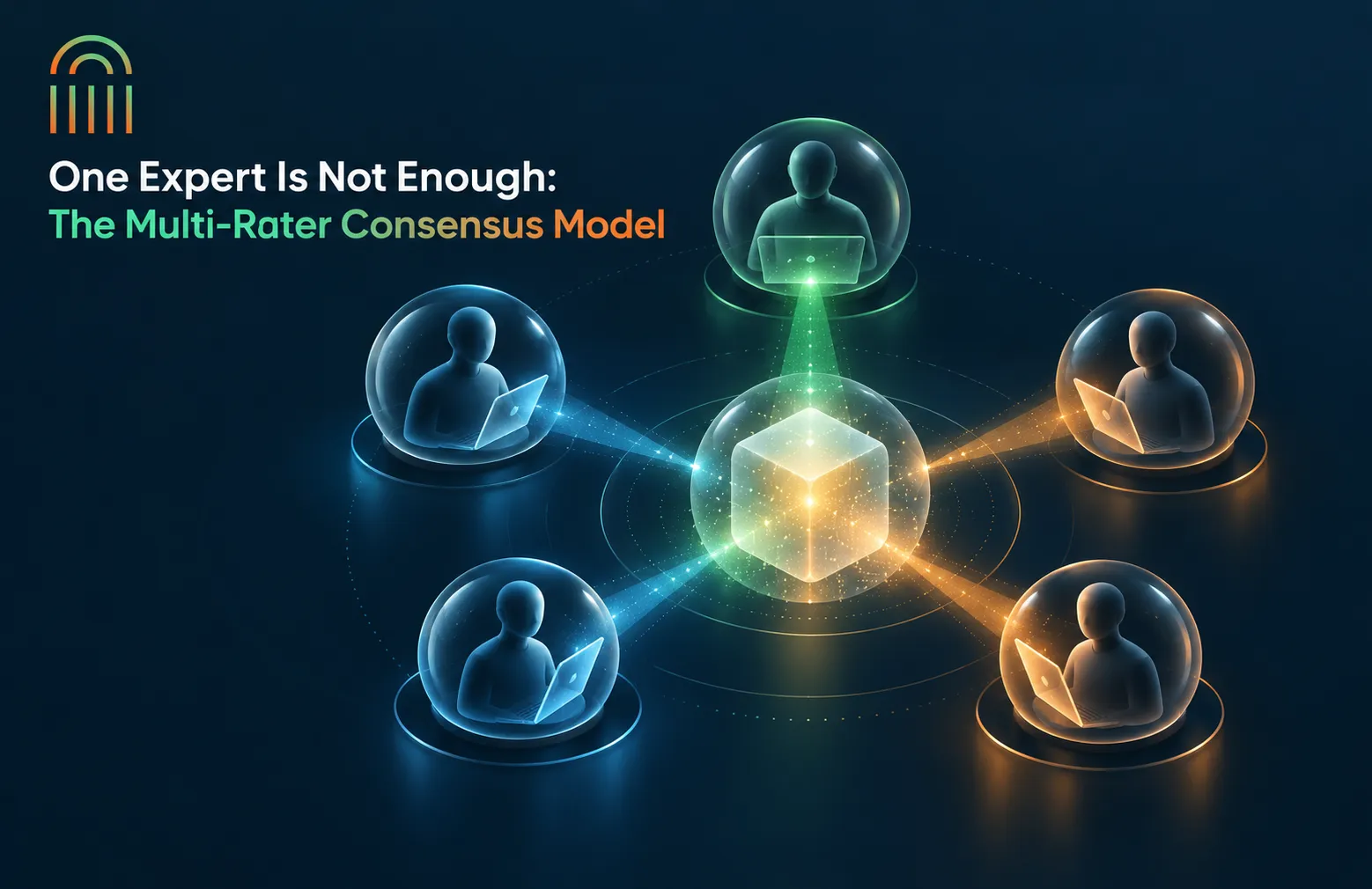
Independent review becomes significantly more useful when an assessment is not dependent on one expert’s interpretation.
For this reason, every question must undergo blind review by at least three independent Faculty members before it can enter the live Supsindex question bank.
The reviewers do not need to coordinate their answers with one another. Each evaluates the assigned item independently, allowing Supsindex to compare judgments rather than asking experts to negotiate a shared opinion in advance.
This multi-rater architecture serves an important purpose. Expertise does not eliminate subjectivity. Academics can disagree. Investors can interpret risk differently. Entrepreneurs may have different experiences within the same industry. Psychometricians may identify measurement problems that subject-matter experts overlook, while operators may identify real-world problems that are less visible in theoretical models.
The objective is therefore not to find one person whose judgment is assumed to be perfect. It is to construct a system in which multiple forms of expertise can challenge the same assessment assumption independently.
Consensus becomes part of the validation architecture.
What Do Faculty Members Actually Validate?
Question review is the most visible part of the Faculty Program, but its purpose is broader than proofreading assessment items.
Faculty expertise contributes to the ongoing validation of the question banks, underlying assessment criteria, scoring logic, and algorithmic assumptions used by Supsindex. Different members can therefore contribute at different layers depending on their background.
A psychometrician may examine whether the relationship between an item and the construct being measured is defensible. An industrial psychologist may identify problems in behavioral interpretation. An academic may challenge whether a question reflects current research. An experienced founder may recognize that a theoretically reasonable scenario does not reflect how a decision actually occurs inside a startup. An investor may contribute practical understanding of patterns repeatedly observed across founder and venture outcomes.
These perspectives are not interchangeable, and that is precisely the point.
The Faculty Program combines them rather than treating one professional discipline as sufficient to explain entrepreneurship on its own.
Quality Control Without Rubber-Stamping
Supsindex maintains a Faculty quality target in which less than 10% of proposed items are rejected.
That number should not be interpreted to mean that Faculty members are expected to approve almost everything. The purpose of the metric is different.
A healthy validation system should identify flawed material, but a system in which reviewers must discard a large proportion of every incoming question set would indicate a problem earlier in the drafting process. The less-than-10% rejection target therefore acts as a quality-control signal for the system that produces items before Faculty review.
Faculty scrutiny remains strict. The target is for the initial drafting process to become strong enough that fundamentally defective questions are relatively uncommon.
At the same time, the Improve pathway allows Faculty members to correct questions that have a valid underlying concept without unnecessarily discarding potentially useful assessment material.
This creates a more informative quality model than a simple approve-or-reject mechanism.
Privacy by Architecture: Faculty Members Do Not Evaluate Founders
The scientific role of the Faculty requires access to assessment content. It does not require access to the private lives or business data of the people taking those assessments.
Faculty members are therefore kept blind to founder profiles, platform business metrics, financial information, and other data that is not required for the validation task.
This separation is important both scientifically and operationally.
A reviewer evaluating whether a question properly measures a particular criterion should not need to know who answered the assessment, what company that founder operates, how much funding the company has raised, or what score the founder ultimately receives.
Faculty members validate the measurement infrastructure rather than the individuals being measured.
This creates a clear boundary between scientific validation and assessment participation.
Distributed Question Security
A global Faculty network creates another challenge: protecting the assessment itself.
Giving hundreds of external experts access to a complete question bank would undermine the security advantages of having a distributed validation model in the first place. Supsindex therefore applies the same principle of decentralization to information access.
Questions are distributed in small, targeted batches, and a Faculty member receives no more than 100 items per year.
No individual Faculty member is given the complete question bank.
This means an expert can contribute enough knowledge to validate the areas relevant to their expertise without obtaining a complete map of the assessment.
The architecture therefore separates scientific participation from unrestricted content access.
In practice, decentralization serves two functions simultaneously: it broadens the range of expertise involved in validation while reducing the amount of sensitive assessment material available to any one person.
How Is the Supsindex Faculty Different From a Traditional Advisory Board?
Traditional advisory boards can provide valuable strategic guidance, but their involvement is often periodic and high-level. An advisor might comment on company direction, scientific strategy, market positioning, or long-term priorities without participating directly in everyday product validation.
The Supsindex Faculty operates differently.
Faculty membership is based on contribution to the assessment infrastructure itself. Members receive specific validation tasks, examine individual components of the measurement system, submit structured decisions, and become part of an ongoing review process.
Their contribution is therefore granular rather than symbolic.
They are not being asked merely whether Supsindex appears scientifically credible. They participate in the work required to make individual parts of the system more credible.
This distinction is central to the Faculty model. Scientific rigor is not treated as an endorsement that can be added to a platform from the outside. It is treated as a process that must be repeatedly performed inside the assessment lifecycle.
Why Decentralized Expertise Matters Across 55+ Industries and 15+ Ecosystems

Founder capability is contextual.
Some entrepreneurial capabilities may be broadly relevant, but the conditions in which founders apply those capabilities vary significantly by industry and geography.
A founder operating in financial technology encounters different regulatory, capital, security, and market constraints from someone building a consumer marketplace. A founder entering a new geographic ecosystem must understand institutional rules, cultural expectations, financing structures, labor conditions, and market behaviors that may not transfer directly from another country.
That makes centralized validation especially risky.
The broader an assessment becomes, the easier it is for a generalist framework to mistake universality for accuracy.
Supsindex addresses this by assigning questions to Faculty members whose expertise is relevant to the subject being examined. Instead of expecting every Faculty member to validate everything, the program uses the network to route specific questions toward specific expertise.
A distributed network therefore makes specialization scalable.
The aim is not to create one universal expert. It is to build an architecture capable of drawing from around 300 specialized Faculty members when different forms of knowledge are required.
The Faculty as Part of the Supsindex Operational Partner Network
Within the broader Supsindex ecosystem, Faculty members are classified as Operational Partners.
This classification separates them from stakeholders who primarily use Supsindex outputs. Faculty members help produce, examine, and refine the infrastructure from which those outputs are generated.
Their role sits alongside the other operational functions required to maintain and grow the ecosystem, but with a specifically scientific responsibility: protecting the quality of the assessment architecture.
This is why describing the Faculty as the “scientific backbone” of Supsindex is more than branding. Founder assessments ultimately depend on the validity of the assumptions underneath them. If those assumptions cannot withstand expert criticism, sophisticated scoring models cannot compensate for the problem.
The Faculty operates at that foundational layer.
How Are Supsindex Faculty Members Compensated?
During the pre-commercial phase, Faculty members participate as independent collaborators rather than salaried employees.
The value exchange is designed around both economic participation and professional contribution to founder research.
One component is Supex, the utility token within the Supsindex ecosystem. Faculty contribution activities such as reviewing questions, supporting validation work, and completing eligible assessment micro-tasks form part of the Supex reward model.
Faculty members also receive priority opportunities through the Supsindex Data Grant Program, which provides access to anonymized, high-fidelity founder datasets for eligible research. The purpose is to help researchers examine real entrepreneurial behavior and support peer-reviewed academic work using data that can be difficult to obtain through conventional research environments.
Faculty members receive automatic access to SupsHub, where they participate as recognized scientific guides alongside high-performing founders and other verified contributors.
Their role can also extend into ecosystem governance and recognition. Faculty members may hold voting rights on jury panels connected to the annual Supsindex Grand Awards and receive priority invitations to participate in the Supsindex Academic Council.
The relationship is therefore structured as an exchange of expertise, research opportunity, ecosystem participation, recognition, and economic incentives rather than a conventional employment arrangement.
From Academic Knowledge to Operational Founder Science

One of the deeper purposes of the Supsindex Faculty Program is to reduce the distance between entrepreneurship research and the systems founders encounter in practice.
Academic research can identify important patterns in cognition, behavior, leadership, decision-making, psychology, and entrepreneurial performance. Experienced entrepreneurs and investors, meanwhile, encounter those patterns under the constraints of actual companies, markets, teams, fundraising processes, and failures.
Neither perspective is sufficient on its own.
Research without operational context can struggle to translate into useful assessment. Practical experience without rigorous measurement can become anecdotal.
A Faculty network containing academics, industrial psychologists, psychometricians, investors, and entrepreneurs creates a bridge between those worlds.
That bridge is especially important if founder assessment is expected to evolve beyond intuition. Turning founder science into usable measurement requires more than publishing research or collecting founder stories. It requires translating knowledge into criteria, questions, scoring systems, testing procedures, and continuously validated models.
The Faculty Program is one mechanism through which that translation occurs.
Does Faculty Validation Guarantee That an Assessment Is Perfect?
No scientific assessment system should make that claim.
Entrepreneurial environments change. Industries evolve. New technologies alter operating assumptions. Cultural and regulatory conditions shift. Research produces new evidence. Behavioral measurement itself contains uncertainty.
The purpose of Faculty validation is therefore not to declare an assessment permanently correct.
Its purpose is to make the assessment more challengeable, reviewable, distributed, and continuously improvable.
A question that is appropriate today may eventually require revision. A scoring assumption that performs well across one population may need recalibration as the dataset grows. A scenario that accurately represents one ecosystem may not transfer cleanly to another.
A Faculty architecture allows those limitations to become part of the design process rather than something the assessment system attempts to ignore.
Scientific rigor, in this model, is not the absence of uncertainty. It is the presence of mechanisms for detecting and responding to it.
Why the Faculty Program Matters for Supsindex
Supsindex is attempting to measure aspects of entrepreneurship that have historically been difficult to quantify reliably.
That creates a responsibility to scrutinize not only the founders taking an assessment, but also the system doing the measuring.
The Supsindex Faculty Program provides one layer of that scrutiny.
Around 300 specialists contribute different combinations of scientific, behavioral, investment, industry, and entrepreneurial expertise. Individual questions are reviewed independently by multiple Faculty members. Sensitive assessment information is distributed rather than centralized. Faculty reviewers remain separated from founder profiles and private business information. Feedback can lead to approval, improvement, or rejection instead of being reduced to a binary endorsement.
Together, these mechanisms create a Faculty model built around continuous validation rather than one-time approval.
The result is not a traditional advisory board standing beside the assessment engine.
It is a distributed scientific network working inside it.
Frequently Asked Questions About the Supsindex Faculty Program
What is the Supsindex Faculty Program?
The Supsindex Faculty Program is a global decentralized network of around 300 academics, industrial psychologists, psychometricians, venture capitalists, experienced entrepreneurs, and other specialists who help validate Supsindex assessment questions, criteria, methodologies, and scoring systems.
What does a Supsindex Faculty member do?
Faculty members complete targeted validation micro-tasks through a restricted review environment. They examine assigned assessment items and can approve them, recommend improvements with supporting feedback, or reject them when they identify scientific, logical, cultural, or theoretical problems.
How many Faculty members review each Supsindex question?
Each question undergoes blind peer review by at least three independent Faculty members before it can enter the live question bank.
Can Faculty members see founder profiles or assessment results?
Faculty members are kept blind to founder profiles, platform financial information, business metrics, and other information that is unnecessary for scientific validation. Their role is to validate the assessment system rather than evaluate individual founders.
Can Faculty members access the entire Supsindex question bank?
No. Assessment content is distributed in small, expertise-specific batches, and no Faculty member receives access to the complete question bank. Individual members review no more than 100 items per year.
Why does Supsindex use a decentralized Faculty model?
Founder assessment spans different scientific disciplines, industries, cultures, and entrepreneurial ecosystems. A decentralized model allows relevant experts to challenge assessment assumptions independently while also limiting the amount of confidential assessment content available to any one person.
How are Faculty members rewarded?
During the pre-commercial phase, Faculty members participate as independent collaborators. The value exchange can include Supex utility-token rewards, priority access to research opportunities through the Supsindex Data Grant Program, automatic SupsHub access, participation in Supsindex Grand Awards governance, and priority opportunities connected to the Supsindex Academic Council.
Building Assessment Through Collective Scrutiny
A founder assessment is only as credible as the assumptions underneath it.
Algorithms, dashboards, scores, and reports may be the visible parts of an assessment platform, but the deeper scientific question is whether the concepts being measured—and the methods used to measure them—can survive informed criticism.
The Supsindex Faculty Program is designed around that challenge.
By distributing validation across around 300 specialists, requiring independent multi-rater review, separating validators from founder data, limiting access to assessment content, and creating structured pathways to approve, improve, or reject individual items, Supsindex treats scientific validation as an operating system rather than a final checkpoint.
For Faculty members, that means contributing expertise to a growing field of measurable founder science.
For Supsindex, it means ensuring that the assessment engine is not built by one perspective alone.
