


A dynamic rating system helps Supsindex measure founder readiness relative to changing industries, ecosystems, stages, and entrepreneurial benchmarks.
From Chess Ratings to Founder Readiness: Why Supsindex Built a Dynamic Rating System for a Changing Entrepreneurial World
There was a time when deciding who was the strongest chess player in the world was almost as political as deciding who had the best startup idea at a networking event.
Everyone had opinions. Everyone had favorites. Some trusted tournament victories. Some trusted reputation. Some trusted style. Some trusted national pride. And, of course, everyone had that one genius they believed was “obviously the best,” usually with enough emotional conviction to compensate for the absence of measurement.
Chess had legends long before it had a reliable rating system. The game had Paul Morphy, José Raúl Capablanca, Alexander Alekhine, Mikhail Botvinnik, Mikhail Tal, Bobby Fischer, Anatoly Karpov, Garry Kasparov, and many others whose names became almost mythological. But mythology is not measurement. Admiration is not calibration. And reputation, no matter how elegant, is a dangerous substitute for statistical comparison.
This was the old problem of chess: how do you compare players across tournaments, countries, generations, and competitive environments?
A player might dominate one country but rarely compete internationally. Another might produce brilliant games but lose consistency. Another might defeat top opponents but avoid risky tournaments. Some players were feared because of style, others respected because of discipline, and others worshipped because they produced games that looked less like sport and more like controlled hallucination. Mikhail Tal, for example, did not merely attack; he seemed to invite chaos to dinner and then checkmate it before dessert.
But chess needed more than stories. It needed a system.
That system eventually came through the Elo rating model, developed by Arpad Elo. Its genius was not that it gave chess a perfect measure of absolute human intelligence. It did something more practical and more powerful: it created a dynamic, comparative, continuously updating measure of competitive strength.
A chess rating was no longer just a badge. It became a living number.
And this idea matters far beyond chess.
At Supsindex, we face a similar problem in the world of entrepreneurship. Founders, like chess players, are not operating in a fixed universe. The founder ecosystem changes. Industries mature. Investor expectations evolve. Technologies accelerate. Regional ecosystems become more sophisticated. The behaviors that once made a founder exceptional may later become only average. And the skills that were once considered advanced may eventually become basic survival tools.
This raises a critical question:
How can we assess founders fairly in a world where the meaning of “readiness” keeps changing?
That is the problem Supsindex’s dynamic rating system is designed to solve.
The Chess Problem: Static Reputation in a Dynamic Game

Before modern rating systems, chess rankings depended heavily on tournament results, match outcomes, expert judgment, and reputation. These were useful, but incomplete. A player’s strength was not always obvious from titles alone.
Imagine trying to compare two chess players who never played each other, competed in different decades, faced different opponents, and trained under completely different conditions. One studied with printed books and adjournment analysis. Another grew up with databases, engines, online blitz, global tournaments, computer-assisted preparation, and millions of games available instantly.
Now ask a deceptively simple question:
Who is stronger?
The honest answer is: it depends what we mean by “stronger.”
Bobby Fischer in 1972 was not just another world champion. He was a force of nature. His dominance over the candidates’ cycle and his victory over Boris Spassky became one of the defining moments in chess history. Garry Kasparov, later, ruled the chess world with a level of competitive intensity and preparation that made him the symbol of modern professional chess. Mikhail Tal, although his peak rating was not comparable to the later rating heights of Fischer, Kasparov, or Magnus Carlsen, remains one of the greatest examples of creative genius the game has ever seen.
But if we place these legends into a modern chess environment, the question changes.
They would not be competing only against human memory. They would be competing against an ecosystem transformed by engines, databases, tablebases, opening theory, online practice, global talent pipelines, and brutal statistical preparation. Today’s elite chess players do not merely know openings; they inherit the accumulated analysis of generations and test it with machines that have no ego, no fatigue, and no mercy.
That changes the meaning of strength.
A player rated 2700 decades ago and a player rated 2700 today may share a number, but they do not necessarily represent the same competitive reality. The number is not a time machine. It does not politely transport a player from one era to another, hand them a laptop, update their opening files, teach them engine discipline, and say, “Good luck, legend.”
The modern ecosystem has evolved.
This does not mean older champions were “less brilliant.” In many cases, they were more original precisely because they had fewer tools. Fischer’s depth, Kasparov’s preparation, and Tal’s imagination remain extraordinary. But the environment around chess has changed so much that comparing rating numbers across eras requires caution.
The same rating can mean different things in different eras because the population has changed.
That is the essence of the dynamic rating problem.
What Elo Changed
The Elo system introduced a powerful idea: a rating should be based on expected performance against other rated players.
If a player defeats a much stronger opponent, the system treats that result as highly informative. If a player defeats a much weaker opponent, the result matters less. If a strong player loses to a weaker player, the system updates accordingly. In other words, Elo does not merely count wins and losses. It asks: what result should we have expected, and what actually happened?
That difference between expectation and outcome is where the rating moves.
This was revolutionary because it made chess measurement dynamic. The system did not need to declare someone permanently strong because of reputation. Strength had to be continuously demonstrated in relation to the current competitive field.
This is why Elo-style thinking became so influential beyond chess. It has been adapted in sports, online games, matchmaking systems, competitive ranking platforms, and decision models. Its core insight is simple but profound:
A score is meaningful only when it is relative to a changing population.
That is exactly the problem Supsindex addresses in founder assessment.
The Founder Assessment Problem
The startup world has its own version of the old chess problem.
For years, founders have been assessed through highly subjective signals:
They are charismatic.
They studied at a strong university.
They worked at a famous company.
They speak confidently.
They know the right vocabulary.
They have an impressive pitch deck.
They have a warm introduction.
They look like what investors expect a founder to look like.
These signals are not useless. Some of them can matter. But they are dangerously incomplete.
A confident founder is not necessarily a resilient founder.
A polished speaker is not necessarily a disciplined decision-maker.
A strong pitch deck is not necessarily a strong company.
A founder who understands startup vocabulary may still misunderstand market reality.
A founder who sounds “visionary” may simply be allergic to evidence.
This creates a serious assessment problem. In entrepreneurship, the cost of false positives is high. A founder may appear highly capable while hiding a catastrophic bottleneck: poor ethical judgment, weak financial discipline, low adaptability, inability to process rejection, inability to distinguish signal from noise, or complete blindness to ecosystem constraints.
The cost of false negatives is also high. A founder may lack polish but possess deep resilience, sharp market judgment, strong learning velocity, and the ability to operate under uncertainty. Traditional assessment methods may overlook them because they do not match the dominant aesthetic of “fundable founder.”
In other words, founder assessment has suffered from the same basic weakness that chess once faced:
Too much reputation.
Too much narrative.
Too little calibrated measurement.
And just as chess had to move from myth to rating, founder assessment must move from impression to dynamic capability measurement.
Why Static Founder Scores Fail
A static founder score may look scientific, but it can quickly become misleading.
Suppose a founder receives a score of 780 out of 1000 in 2026. That sounds strong. But strong compared to whom?
Compared to all founders globally?
Compared to fintech founders?
Compared to pre-seed founders?
Compared to founders in the same region?
Compared to founders from five years ago?
Compared to founders facing similar regulatory pressure?
Compared to founders in a mature venture ecosystem?
Compared to founders in an emerging one?
Without context, a score is only a decorated number. It looks authoritative, but it may not be meaningful.
The problem becomes even more serious over time. Founder norms evolve. Ten years ago, knowing basic startup terminology might have signaled above-average entrepreneurial awareness in some ecosystems. Today, in many startup communities, those same terms are everywhere. Everyone can say “MVP,” “PMF,” “unit economics,” “CAC,” and “retention.” Some can even say them in the wrong order with great confidence.
The vocabulary became common, but true understanding did not always follow.
This is why Supsindex does not treat founder capability as a fixed checklist. A founder cannot be assessed only against a frozen standard. The system must understand the founder’s field, stage, geography, ecosystem maturity, and historical period.
A fintech founder in a highly regulated market needs different ecosystem awareness from a consumer app founder in a fast-moving social media category. A deeptech founder needs a different capital and commercialization logic from a creator economy founder. An edtech founder operating in an institutional environment faces different adoption barriers from a SaaS founder selling to small businesses.
The same founder behavior can be strong in one context and insufficient in another.
That is why founder assessment must be dynamic.
Supsindex’s Answer: A Dynamic Rating System for Founder Readiness
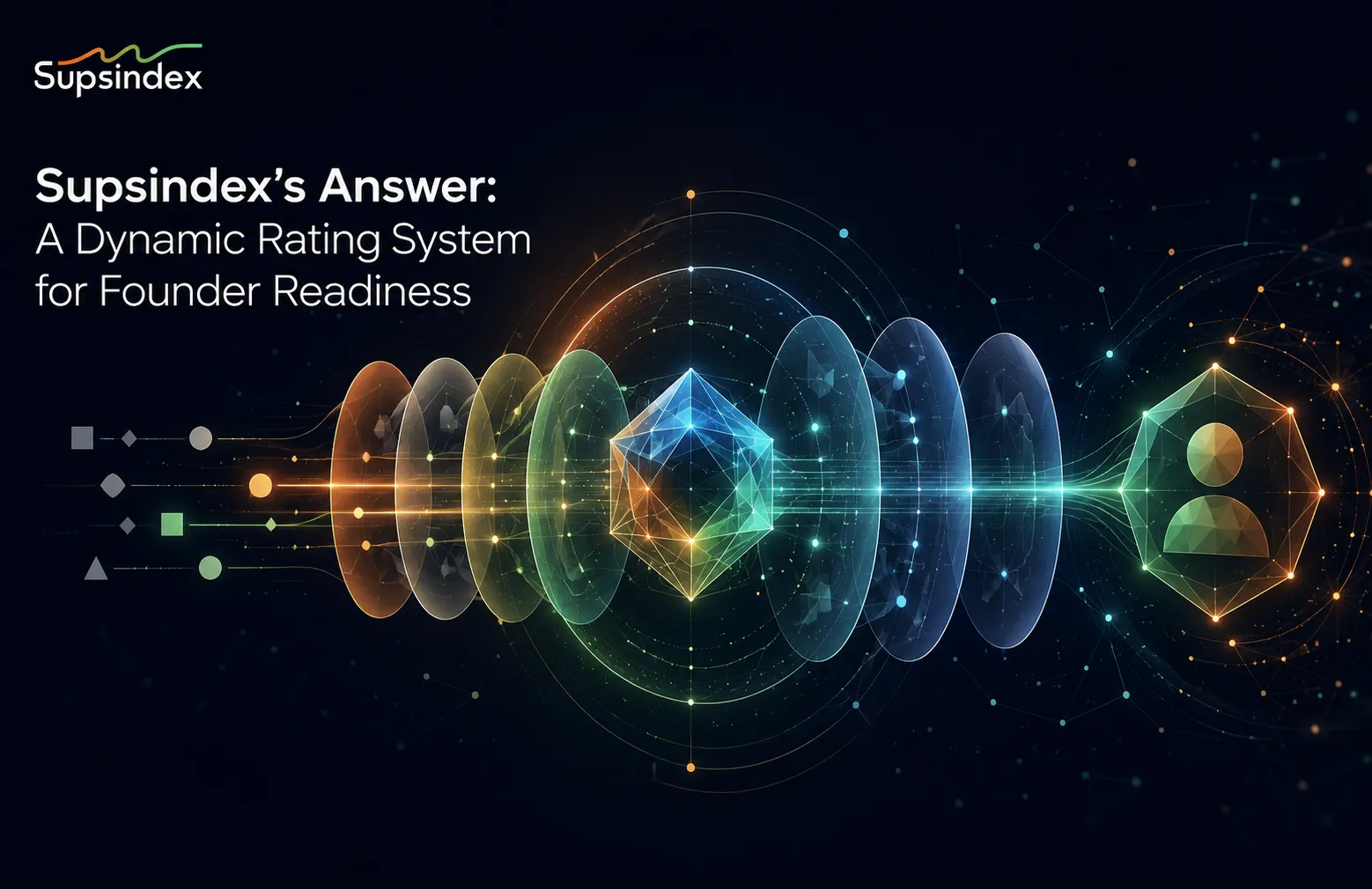
Supsindex was built around a central belief: founder readiness should not be measured as a static personality label.
It should be measured as a dynamic, contextual, evidence-based capability profile.
This is why Supsindex’s rating system is designed to move beyond simple arithmetic scoring. It does not merely add up answers. It evaluates the quality, difficulty, context, and diagnostic power of the evidence.
In chess, not every win means the same thing. Defeating the world number one is not the same as defeating a beginner who learned the Sicilian Defense yesterday and now believes they are dangerous.
In Supsindex, not every answer means the same thing either.
Answering a simple definition does not carry the same value as solving a complex strategic judgment problem. Choosing the socially attractive answer in a crisis scenario does not mean the founder has strong judgment. Recognizing real market constraints matters more than repeating fashionable startup language. Understanding an ecosystem’s actual difficulty matters more than giving a universal textbook answer.
This is where Supsindex’s system becomes powerful.
It uses multiple dynamic layers to estimate founder readiness: psychometric modeling, behavioral assessment, bottleneck detection, signal detection, ecosystem fairness, contextual benchmarking, and time-based validity.
Together, these layers create a rating system designed not for a static world, but for the living ecosystem of entrepreneurship.
1. Dynamic Question Weighting: Not Every Question Deserves Equal Power
One of the most important parts of the Supsindex system is its use of probabilistic psychometric modeling.
In simple scoring systems, every question may be treated equally. This is easy, but not intelligent. If a test gives the same weight to a trivial question and a difficult strategic question, the test may become numerically clean but intellectually weak.
Supsindex avoids this by using models such as 2-Parameter Logistic Item Response Theory in the Founder Public Awareness index.
This allows the system to estimate two important qualities for each question:
Difficulty: how hard the question is relative to the founder population.
Discrimination: how well the question separates stronger founders from weaker founders.
This matters because a question that everyone answers correctly tells us very little. A question that only high-awareness founders answer correctly tells us much more. Similarly, a question may be difficult but still not useful if it does not reliably distinguish levels of ability.
This is very similar in spirit to chess ratings.
In chess, defeating a strong opponent gives more information than defeating a weak opponent. In Supsindex, correctly handling a difficult, high-discrimination item gives more information than answering a basic item.
This allows Supsindex to measure not only what a founder knows, but the level at which their understanding operates.
A founder who knows startup vocabulary may score well on basic awareness. But a founder who can distinguish vanity metrics from real traction, understand market timing, identify regulatory friction, detect weak unit economics, and evaluate ecosystem constraints is operating at a different level.
The system must be able to see that difference.
That is why dynamic question weighting matters.
2. Behavioral Modeling: Measuring What Founders Might Prefer to Hide
Founder assessment cannot rely only on knowledge questions. Founders are not textbooks. They are decision-makers under uncertainty, pressure, ego, fear, ambition, and incomplete information.
This is why Supsindex’s General Entrepreneurial Behavior index uses behavioral modeling, including forced-choice methods and Thurstonian Item Response Theory.
This is especially important because direct self-report questions are easy to fake.
Ask a founder, “Are you resilient?” and almost everyone will say yes. Ask, “Do you make ethical decisions under pressure?” and very few will say, “Only when convenient.” Ask, “Can you adapt to evidence?” and almost everyone will describe themselves as flexible, data-driven, and humble, usually right before ignoring the next piece of evidence.
The issue is not that founders are dishonest. It is that people are often poor judges of their own behavior. Self-image is not the same as capability.
So Supsindex uses scenario-based and forced-choice designs that make faking harder. Instead of asking founders to declare virtues, it places them into structured decision situations and evaluates how they prioritize actions.
For example, in a crisis scenario, a founder may have to choose the most effective and least effective responses. Some options may sound emotionally appealing but reveal poor judgment. Others may sound humble but hide avoidance. Others may sound decisive but reveal recklessness.
This allows the system to estimate hidden behavioral traits such as resilience, adaptability, ethical judgment, emotional regulation, and decision discipline.
This is not Elo in the narrow chess sense. But it is dynamic in a deeper psychometric sense: it does not treat the founder’s words at face value. It estimates the latent capability behind the response pattern.
In founder assessment, that distinction is essential.
Because the startup world is full of people who can describe good judgment beautifully. The hard part is finding out whether they can practice it when the room is burning and the investor is asking why the numbers are wrong.
3. Bottleneck Penalty: Why One Fatal Weakness Can Matter More Than Ten Strengths
One of the most dangerous mistakes in founder assessment is averaging everything.
A founder may have high charisma, strong storytelling, good industry knowledge, and impressive ambition. But if they have a severe weakness in financial integrity, ethical judgment, emotional control, or evidence processing, the overall risk may be much higher than the average score suggests.
Traditional scoring systems can hide this.
A founder might score very high in some areas and catastrophically low in one critical area, but still appear “above average” when everything is averaged together. This is how false positives are created.
Supsindex addresses this through the Penalty for Bottleneck methodology.
The logic is straightforward: a founder’s overall readiness can be constrained by the weakest critical capability. In complex systems, the weakest link often determines failure. A chain does not care about its average strength. It breaks where it is weakest.
Entrepreneurship works the same way.
A founder can be brilliant in vision but weak in discipline.
They can be persuasive but unethical.
They can be resilient but blind to the market.
They can be analytical but unable to lead people.
They can be creative but incapable of execution.
They can be confident but allergic to reality.
The bottleneck matters because some weaknesses are not “development areas.” They are structural risks.
This gives Supsindex an important advantage over simple scoring systems. It can avoid praising a founder’s strengths while ignoring the one weakness that may destroy the company.
In chess, a player may have beautiful attacking instincts but lose because of one tactical blind spot. In startups, the equivalent may be a founder who can inspire a room but cannot handle cash discipline. The board may look promising. The king is still exposed.
4. Signal Detection: Separating Real Founder Awareness from Attractive Noise
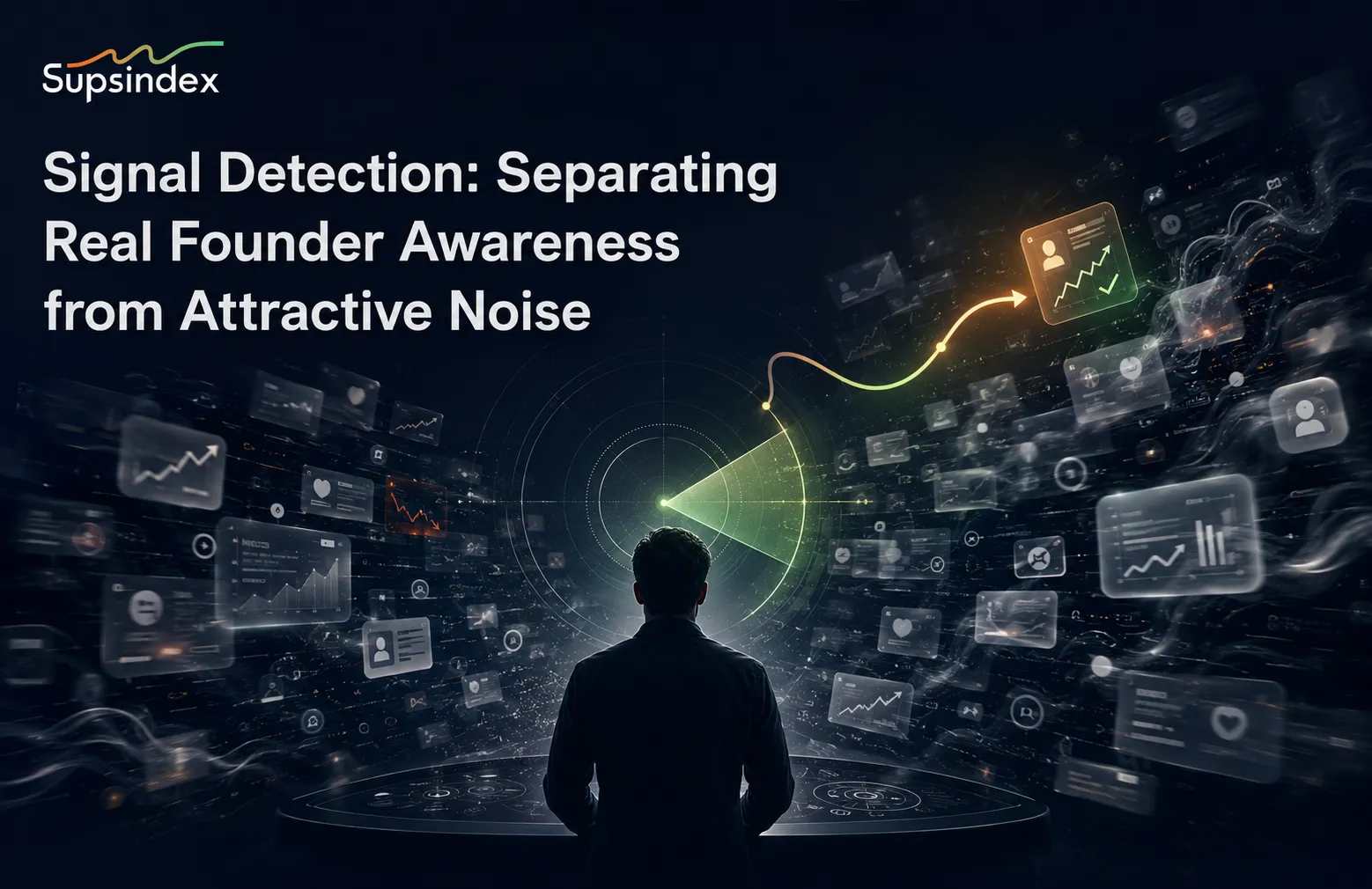
Entrepreneurship is noisy.
Founders are surrounded by advice, frameworks, trends, jargon, investor preferences, social media narratives, and success stories that often hide more than they reveal. A founder’s ability to distinguish signal from noise is one of the most underrated predictors of readiness.
This is why Supsindex uses signal detection methods and distractor engineering.
The system intentionally includes information that may sound important but is not. It can also include socially desirable traps: answers that appear virtuous, energetic, or founder-like, but actually reveal poor judgment.
For example, micromanagement may be disguised as “supportive checking-in.” Avoidance may be disguised as “giving the team freedom.” Recklessness may be disguised as “bold execution.” Lack of focus may be disguised as “exploring multiple opportunities.”
Novice founders often fall for these traps because the language feels right. Experienced founders are more likely to recognize the underlying risk.
This is crucial because startup failure is often not caused by lack of information. It is caused by poor filtering.
A founder who treats every data point as equally important cannot make good decisions. A founder who follows every trend cannot build a clear strategy. A founder who chases every signal from investors, customers, mentors, and competitors eventually stops leading and starts vibrating.
Supsindex’s signal detection layer helps measure whether a founder can identify what actually matters.
This makes the assessment more realistic. Real founders do not operate in clean exam conditions. They operate in ambiguity. The system must measure how well they navigate that ambiguity.
5. Ecosystem Fairness: Why Context Changes the Meaning of Performance
One of the most important challenges in founder assessment is cross-ecosystem fairness.
A raw score can be misleading when founders operate under different levels of ecosystem difficulty.
Consider two founders with similar capability. One is building in a mature ecosystem with abundant capital, experienced mentors, deep talent pools, clear legal infrastructure, and familiar investor categories. Another is building in an emerging ecosystem with regulatory uncertainty, limited funding access, weak infrastructure, lower trust, fewer experienced operators, and fragmented distribution channels.
If both founders receive the same raw score, are they equally ready? Maybe. Maybe not.
If one founder achieves the same level of performance under harder ecosystem conditions, that performance may represent greater underlying capability.
This is why Supsindex uses anchor item equating in the Ecosystem Environmental Awareness index.
Anchor items are shared across contexts. They allow the system to statistically compare performance across different versions, regions, or difficulty environments. In simple terms, they act as bridges between ecosystems.
This helps Supsindex avoid unfair comparisons. A founder operating in a “hard” ecosystem should not be punished simply because the environment is more complex. At the same time, a founder in an easier ecosystem should not be overpraised for performance that may be easier to produce there.
This is one of the areas where Supsindex can become more nuanced than chess.
Chess has a relatively standardized board. Entrepreneurship does not. A knight moves the same way in Norway, Iran, Singapore, and Brazil. A fintech startup does not.
The founder’s ecosystem matters.
So the rating system must understand context.
6. Contextual Benchmarking: Founders Should Be Compared to the Right Population
A founder’s score should not float in the air.
It should be interpreted relative to a specific comparison group: industry, stage, geography, and ecosystem context.
This is where Supsindex’s contextual benchmarking becomes essential.
A pre-seed fintech founder should not be compared in exactly the same way as a growth-stage SaaS founder or an edtech founder operating in a heavily institutional market. Their required capabilities overlap, but they are not identical. Their risk profiles are different. Their ecosystem pressures are different. Their market realities are different.
Supsindex’s contextual buckets allow a founder’s score to be interpreted more fairly and more meaningfully.
This makes the score more like Elo.
In chess, a player’s rating is meaningful because it reflects performance relative to the active rating pool. In Supsindex, a founder’s rating becomes meaningful because it reflects performance relative to the relevant founder population.
A score of 800 does not simply mean “good.” It means good relative to a defined benchmark.
For example:
A founder may be in the top quartile of early-stage founders globally, but only average among fintech founders in highly regulated ecosystems.
Another founder may be average in general entrepreneurial awareness but exceptional in ecosystem awareness for their region.
Another may appear strong compared with novice founders but weak compared with founders at the same startup stage.
This is exactly what a serious rating system should reveal.
Because readiness is not abstract. Readiness is contextual.
7. Score Decay: Old Evidence Should Not Live Forever
In chess, an inactive rating can become misleading. In founder assessment, the problem is even more serious.
An assessment score is evidence from a moment in time. It should not be treated as permanent truth.
Industries change at different speeds. AI evolves rapidly. Fintech regulation can shift quickly. Consumer behavior changes with platform dynamics. Construction may change more slowly. Deeptech may be shaped by longer research and commercialization cycles.
Therefore, Supsindex uses time-to-live logic and score decay.
This means a score has a validity window. The faster the industry changes, the shorter the useful life of the score. A founder assessed in AI three years ago may not have the same current readiness if the field has transformed dramatically. A founder assessed in a slower-changing industry may retain score validity for a longer period.
This is not a punishment. It is epistemic hygiene.
Old evidence is not worthless. It is simply less reliable.
The leaderboard coefficient follows this logic as well. Scores that are more recent should carry more weight in rankings. Older scores gradually lose force, encouraging reassessment and keeping the system current.
This solves one of the hidden weaknesses of many certification and assessment systems: they treat past performance as if the world stopped moving after the certificate was issued.
The world did not stop. The market kept going. The founder ecosystem kept evolving. The score must respect that.
Even a brilliant founder cannot be permanently certified against yesterday’s market.
The future has a strict no-lifetime-pass policy.
The Deeper Parallel: Elo and Supsindex Both Measure Relative Strength
The most important parallel between chess and Supsindex is philosophical.
Elo understands that strength is relative to a competitive population.
Supsindex understands that founder readiness is relative to a living entrepreneurial ecosystem.
This is the key.
A founder is not ready in a vacuum. A founder is ready relative to the demands of a particular market, industry, stage, geography, and historical moment.
In 2010, a founder who understood basic online acquisition might have had a major advantage in many markets. Today, that knowledge may be assumed. In 2015, AI literacy meant something different from what it means today. In 2020, remote team leadership meant something different from what it means now. In fintech, regulatory awareness has become more central as markets mature. In edtech, distribution and institutional trust can matter more than product enthusiasm. In deeptech, technical invention is not enough without commercialization pathways and capital alignment.
Founder norms evolve.
Therefore, founder ratings must evolve.
This is where Supsindex’s dynamic system becomes essential. If the average founder becomes more aware, the benchmark rises. If an industry becomes more complex, the expectations shift. If a region’s ecosystem matures, the comparison group changes. If certain questions become too easy or too obvious, their diagnostic value decreases. If new risks emerge, the question bank must evolve. If old evidence expires, reassessment becomes necessary.
That is dynamic founder measurement.
Why This Is Not Just “Testing”
Supsindex is not trying to build another entrepreneurship quiz.
The world has enough quizzes. Many of them can already tell a founder they are “visionary,” “strategic,” or “resilient” with the scientific seriousness of a horoscope wearing a blazer.
The point of Supsindex is different.
It is to turn founder soft power into measurable, comparable, context-sensitive indices.
This requires a deeper architecture than ordinary scoring. It requires models that can detect difficulty, discrimination, behavioral patterns, bottlenecks, signal sensitivity, ecosystem fairness, contextual position, and score freshness.
That is why the rating system matters.
The output should not merely say:
“You scored 780.”
It should help explain:
780 compared with whom?
In what industry?
At what stage?
In which ecosystem?
Against which difficulty level?
Based on which evidence?
How recent is the evidence?
Which capabilities are strong?
Which bottlenecks create risk?
Which parts of the score are stable?
Which parts need reassessment?
This is the difference between a score and an index.
A score reports performance.
An index interprets capability.
Supsindex is building the second.
A Practical Example: The Founder Equivalent of Cross-Era Chess
Imagine a founder assessed in 2026. They perform well on startup terminology, basic validation concepts, early fundraising logic, and general founder behavior. They receive a strong score.
Now imagine the founder ecosystem evolves. Three years later, the average founder in that same industry has become more sophisticated. More founders understand customer discovery. More founders use AI tools. More founders know investor logic. More founders understand market sizing, retention, distribution, and unit economics. The baseline has risen.
If the founder takes the same assessment again and performs the same way, should they receive the same rating?
A static system would say yes.
A dynamic system says no.
Because the founder has not improved relative to the ecosystem. The world moved. The benchmark moved. The meaning of the same performance changed.
This is exactly the chess problem.
A rating only matters inside the environment that produced it.
The purpose of Supsindex’s dynamic rating system is to ensure that founder readiness is not frozen against outdated assumptions.
It keeps the founder’s score attached to the current entrepreneurial reality.
Why This Matters for Investors, Accelerators, and Founders
For investors, a dynamic rating system can reduce false confidence. It helps identify founders who are not merely impressive in conversation, but structurally ready relative to their context.
For accelerators, it can improve selection, cohort design, mentoring priorities, and progress tracking. A founder’s profile can show not only overall readiness, but bottlenecks and developmental gaps.
For ecosystem builders, it can reveal broader trends. Are founders in a region improving in market awareness but declining in execution discipline? Are fintech founders becoming stronger in regulatory awareness but weaker in resilience? Are early-stage founders becoming better at language but not better at judgment?
For founders, the value is even more direct.
A dynamic rating system gives them a mirror that moves with reality.
It does not simply flatter them. It does not merely label them. It shows where they stand now, against the current demands of their field.
That is valuable because founders do not need motivational fog. They need calibrated clarity.
A founder who knows they are strong in behavior but weak in ecosystem awareness can improve more intelligently. A founder who knows they are above average locally but below global industry benchmarks can understand what kind of gap they must close. A founder who sees their score decay over time is reminded that readiness is not a trophy. It is a maintained capability.
The Magnus Carlsen Lesson
Magnus Carlsen represents the modern chess ecosystem at its highest level: deep preparation, extraordinary intuition, endgame mastery, psychological endurance, global competitive exposure, and the ability to squeeze winning chances from positions that many grandmasters would politely declare equal and go home.
Comparing Carlsen with Fischer, Kasparov, or Tal is always difficult. Each belonged to a different world. Fischer was a revolutionary. Kasparov was a machine before machines became the main training partners. Tal was a magician who made complications feel like weather.
But the comparison reveals something important.
Greatness is not only individual. It is also ecological.
Carlsen is not strong merely because he is naturally gifted. He is strong because he developed inside a modern chess ecosystem that absorbed the knowledge of previous generations and added new tools, methods, and competitive intensity.
He stands on a mountain built by history.
This does not diminish the old champions. It honors them properly. Fischer, Kasparov, Tal, and others helped build the world that made Carlsen possible.
But if we want to measure strength today, we must measure it against today’s world.
The same is true for founders.
A founder does not operate against the market of ten years ago. They operate against today’s investors, today’s customers, today’s tools, today’s competitors, today’s regulations, today’s talent markets, and today’s expectations.
A founder rating system must understand that.
Otherwise, it becomes a museum label pretending to be a live dashboard.
Supsindex and the Future of Founder Measurement
The next generation of founder assessment cannot rely only on interviews, pitch decks, personality impressions, or static test scores.
The entrepreneurial world is too complex for that.
We need founder measurement systems that are dynamic, contextual, psychometrically grounded, and resistant to manipulation. We need systems that understand both individual capability and ecosystem reality. We need systems that can distinguish polish from readiness, confidence from judgment, storytelling from execution capacity, and fashionable language from real understanding.
That is what Supsindex is building.
Its dynamic rating system is designed to make founder readiness measurable without reducing it to a simplistic number. It uses calibrated assessment methods to estimate hidden capability. It adjusts for difficulty. It detects bottlenecks. It tests signal sensitivity. It accounts for ecosystem differences. It benchmarks founders against relevant populations. It allows scores to decay when the world changes.
This is not merely a technical feature. It is a philosophical position.
Supsindex is saying that founder capability is real, but it must be measured carefully. It is saying that soft power can be assessed, but not through shallow scoring. It is saying that fairness requires context. It is saying that readiness is not permanent. It is saying that the founder ecosystem evolves, and the benchmark must evolve with it.
Chess learned this lesson through rating systems.
Entrepreneurship is learning it now.
Conclusion: A Living Index for a Living Ecosystem
The Elo system helped chess solve a fundamental problem: how to measure competitive strength in a way that updates with performance and remains meaningful inside a changing player population.
Supsindex applies the same deeper logic to entrepreneurship, but in a more complex environment.
Chess has two players, one board, and a clear result. Entrepreneurship has industries, ecosystems, stages, cultures, regulations, investor expectations, psychological pressures, behavioral risks, and time-sensitive knowledge. The founder world is not a chessboard. It is a moving board where the pieces occasionally change names, the investors ask for new rules, and the market may decide the game was actually Go.
This is why founder assessment requires more than a static score.
It requires a dynamic index.
A founder’s readiness must be measured relative to the current entrepreneurial world, not against outdated assumptions. A strong founder today is not simply someone who sounds capable. It is someone whose behavior, awareness, judgment, and ecosystem understanding remain strong against the evolving standards of their field.
That is the purpose of Supsindex’s dynamic rating system.
Not to turn founders into numbers.
But to make the invisible measurable, the subjective comparable, and the changing world visible inside the score.
