


Thurstonian Item Response Theory is revolutionizing entrepreneurial testing by combining the anti-faking benefits of forced-choice formats with the precision of normative measurement.
The Fundamental Problem When Asking Founders to Rate Themselves
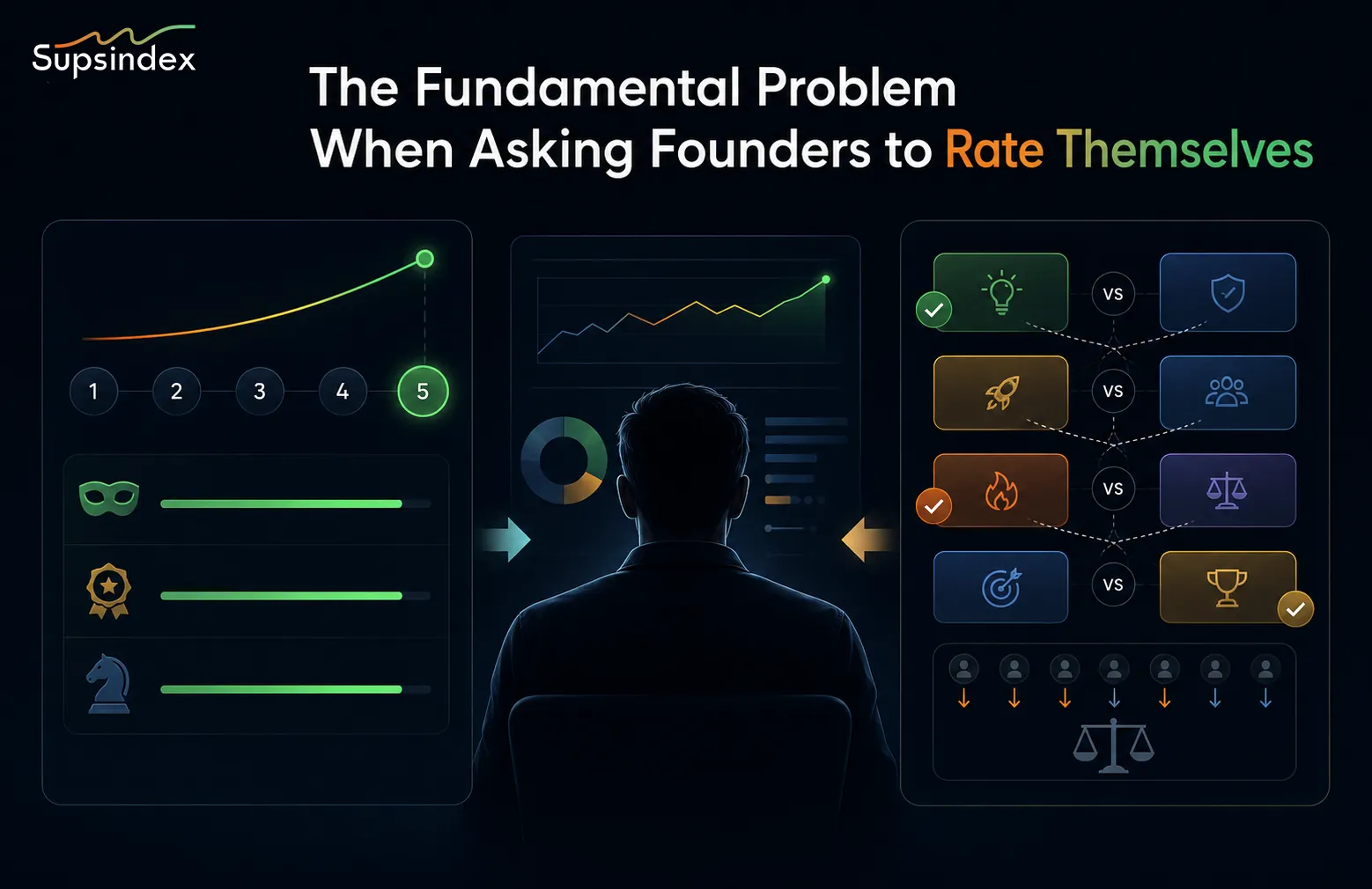
Imagine asking a startup founder to rate their agreement with the statement “I remain composed under pressure” on a 5-point Likert scale. In a low-stakes environment, they might answer honestly. But in a high-stakes context — seeking investment, applying to an accelerator, or recruiting a co-founder — incentives shift. Ambition does not obligate full transparency. The founder knows which answer makes them look like a better investment risk. The result: intentional response distortion (faking), arguably the most persistent threat to validity in entrepreneurial assessment.
This is not a theoretical concern. Forced-choice (FC) questionnaires — where test takers compare equally attractive statements and select which is “most like me” and which is “least like me” — were originally developed precisely to reduce this vulnerability. By making all options comparably desirable, the strategic advantage of impression management is diminished, and attention shifts toward genuine behavioral preferences.
However, this protection against distortion comes at a cost: ipsative data. Ipsativity means that a person’s scores are internally constrained — choosing one option artificially suppresses the others. The sum of scores across traits within each block is forced to be constant, creating negative correlations between traits that are not necessarily present in the population. For example, a founder who strongly endorses both “high adaptability” and “strong principles” might appear less principled in a forced-choice block simply because adaptability was ranked first.
When Ipsative Data Paralyzes Assessment Without Thurstonian IRT
Ipsative data creates three serious problems:
- Interindividual comparison becomes impossible — you cannot meaningfully say how much more resilient Founder A is compared to Founder B, because each founder’s scores are locked inside their own internal tradeoffs.
- Construct validity collapses — covariances between scales (the foundation of factor analysis, internal consistency, and predictive validity) become unreliable due to these artificial negative correlations.
- Conventional statistical analyses — such as Cronbach’s alpha, intraclass correlation coefficients, and confirmatory factor analysis — become invalid because these methods assume independence of observations and between-person scores.
In other words, the forced-choice format improves resistance to faking but sacrifices statistical validity.
The question becomes: Can we enjoy the benefits of reduced distortion while escaping the constraints of ipsative data?
The answer is yes: Thurstonian Item Response Theory (Thurstonian IRT).
Thurstonian IRT: The Core Idea
Louis Leon Thurstone, a pioneering psychometrician, developed a method for scaling comparative judgments in the early 20th century. The basic insight: when a person compares two options and states a preference, that choice arises from a latent utility for each option. The difference between these utilities, plus random error, determines the probability of choice.
Thurstonian IRT brings this idea into the modern Item Response Theory framework and builds a model for forced-choice data that estimates absolute (normative) values for each trait on a continuous scale — not just within-person rankings.
Simplified: Suppose a founder faces three statements (a real scenario from Supsindex’s GEB index):
- Option A: “I make quick decisions under pressure, even with incomplete information.”
- Option B: “I systematically gather the team’s input before making a decision.”
- Option C: “I delay difficult decisions to preserve relationships.”
The founder must select the most effective and the least effective action. Instead of merely saying “this founder chose A, therefore B and C are suppressed,” Thurstonian IRT estimates a latent utility value for each option (aligned with desirable entrepreneurial behavior). Choosing A as “most effective” means that the estimated utility of A is higher than that of B and C. By repeating such comparisons across multiple blocks, the model can produce for each founder absolute normative scores for each trait (e.g., resilience, ethical judgment, adaptability) on a common scale (mean = 0, SD = 1).
These scores are no longer ipsative and are comparable across individuals.
Practical Advantages of Thurstonian IRT on the Supsindex Platform

1. Escape from the Ipsative Trap
Unlike traditional scoring methods for forced-choice questionnaires (which forced each person’s scores to sum to a constant), Thurstonian IRT estimates absolute values. Therefore we can directly say: “Founder A’s resilience is one standard deviation above the mean, and Founder B’s resilience is half a standard deviation below the mean.” This is the foundation of every investment, mentoring, or accelerator admission decision.
2. Elimination of Artificial Self-Censorship
Under ipsative methods, a founder who is high on both creativity and discipline is forced to sacrifice one. Thurstonian IRT removes this coercion. The model allows a person to score high on multiple traits simultaneously — which matches the reality of successful entrepreneurship.
3. Reduction of Cultural Response Style Effects
In some cultures, individuals tend to endorse all items at the maximum (extreme response style) or always choose the middle option (avoidance of extremes). The forced-choice format neutralizes these styles by forcing comparisons, and Thurstonian IRT estimates pure trait scores free from such biases.
4. Improved Predictive Validity
Empirical research in industrial and organizational psychology has shown that Thurstonian IRT, compared to traditional forced-choice scoring (e.g., simple sum or constant-weight ranking), produces higher correlations with actual job performance. For Supsindex, this means that GEB scores (entrepreneurial behavior) will be better predictors of startup success over time.
How Supsindex Implements Thurstonian IRT
The GEB (General Entrepreneurial Behavior) Index at Supsindex is fully built on Thurstonian IRT:
- 75 situational judgment scenarios (SJTs), each describing a realistic entrepreneurial crisis (e.g., aggressive competition, product failure, team conflict, cash flow pressure).
- For each scenario, the founder must select the most effective and the least effective action from 3 to 4 options (forced-choice format).
- The Thurstonian IRT model, using maximum likelihood estimation (MLE) and Bayesian approaches, estimates latent utilities for 15 behavioral constructs (resilience, ethical judgment, adaptability, risk management, etc.).
- Final scores are transformed to a T-scale (mean = 50, SD = 10) and reported as percentiles relative to global peers.
Additionally, Supsindex monitors absolute and relative fit indices such as RMSEA, CFI, and SRMR to ensure model quality. Instead of Cronbach’s alpha (invalid for forced-choice data), we report marginal reliability coefficients.
A Concrete Example: Traditional Approach vs. Thurstonian IRT
- Traditional approach (Likert scoring or simple forced-choice scoring): Founder responds to 20 items; each construct score is the sum of its item scores; standard error is assumed equal for everyone; between-person comparison is difficult due to ipsative constraints.
- Thurstonian IRT approach at Supsindex: 75 pairwise comparisons are made; the model computes an information function for each construct, showing at which ability levels measurement is most precise; each founder’s score is reported with a confidence interval (e.g., 50 ± 3); we can meaningfully say “Founder A is significantly higher in resilience than Founder B (difference > twice the standard error).”
Why Thurstonian IRT Matters for the Entrepreneurial Ecosystem
The startup ecosystem loses hundreds of billions of dollars annually due to founder-driven human error. Much of this error stems from emotional decisions, cognitive biases, and team conflicts — precisely what traditional questionnaires fail to measure accurately. Thurstonian IRT enables Supsindex to:
- Identify behavioral blind spots before they become crises.
- Predict co-founder complementarity based on absolute trait values.
- Quantify resilience under pressure in a way that is comparable across individuals.
As a result, investors can decide with greater confidence, accelerators can improve selection, and founders gain deeper self-awareness.
Summary
Thurstonian Item Response Theory (IRT) is a statistical method for analyzing data from forced-choice questionnaires that, unlike traditional approaches, produces normative (between-person) and absolute scores, not constrained ipsative scores. Its advantages include:
- Escape from the ipsative trap, enabling meaningful between-person comparisons.
- Improved predictive validity (more accurate forecasting of startup success).
- Reduction of cultural and social response-style effects.
- Retention of the forced-choice advantage of reduced intentional distortion.
Supsindex uses Thurstonian IRT in its GEB Index to measure entrepreneurial behavior with unprecedented precision, providing founders, investors, and the innovation ecosystem with a scientific tool for better decision-making.
