

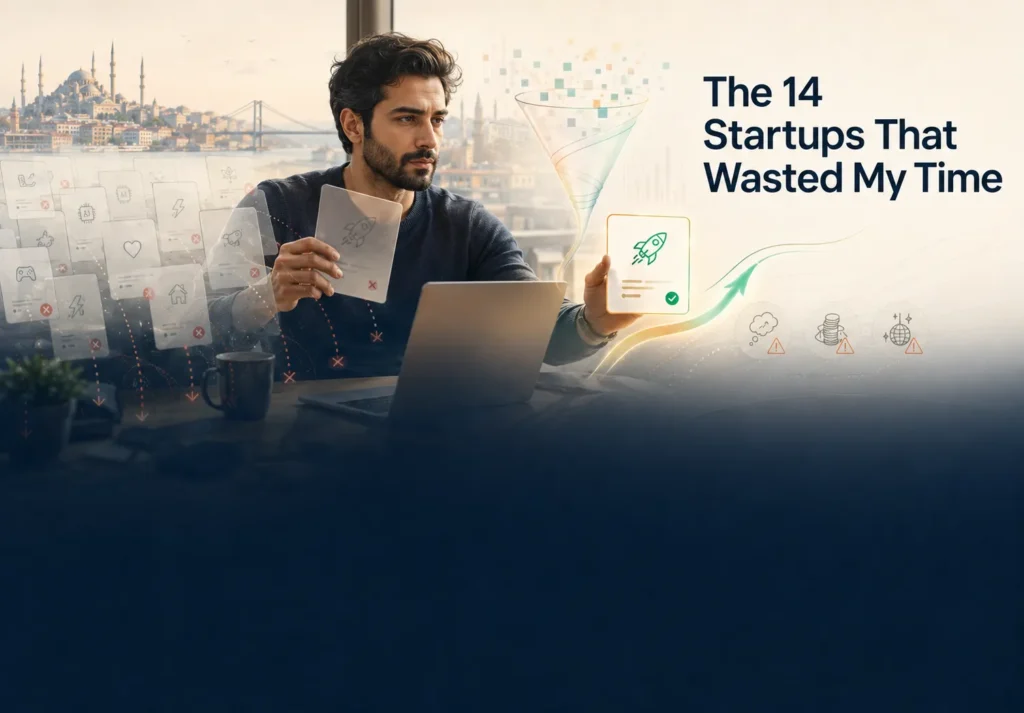
The Sunk Cost Fallacy is a dangerous cognitive trap that causes startup facilitators and investors to waste critical time on doomed ventures.
How Supsindex Stopped Me From Chasing My Own Sunk Cost
By Shayan S.,
Founder of Startup E… Partners (Istanbul)
Let me paint you a picture.
I run a facilitation startup in Istanbul. We help Middle Eastern startups get ready for international capital.
We check their documents, fix their processes, train their teams, and then—after 3 to 6 months of blood, sweat, and Zoom calls—we introduce them to investors.
We don’t charge upfront. We take a small percentage of equity after they close. No win, no fee.
Sounds fair, right?
Except… in 2024, we took on 14 teams. By mid-2025, only 5 had raised anything. The rest? Ghosts.
Dead ends. Hours of our work down the drain.
In 2025, we started with 17 teams. By early 2026, only 6 had succeeded.
I was burning runway. My team was exhausted. And I kept asking myself: “Why am I so bad at picking winners?”
The Real Problem: The Trust Gap and the Sunk Cost Fallacy
Everyone talks about “product-market fit.” But for Middle Eastern founders trying to raise from European VCs, there’s a bigger hurdle: trust gap.
A startup born in Berlin starts with a 60% credibility score. A startup from Tehran, Istanbul, or Cairo? Maybe 20%.
They have to work twice as hard to prove they’re not a fluke.
And many of them… weren’t ready. Not because their idea was bad. Because they were wired wrong.
I didn’t see it at first. I just saw polished pitch decks and passionate founders.
But passion doesn’t close term sheets.
The Test That Changed Everything for My Sunk Cost Fallacy
In Q3 2025, a friend mentioned Supsindex. I had 6 teams on my desk, ready to sign contracts.
Instead of saying yes to all of them, I asked them to take the FPA, EEA and GEB tests.
Send me the reports.
Three of them ghosted me immediately.
The other three sent reports. I read them. And then I did something painful: I said no to two of them.
The third? A small AI logistics team from Ankara. Their reports weren’t perfect, but they were clean.
No major red flags. I took a chance.
Four months later, they closed their first round.
Meanwhile, the two I rejected? One pivoted three times in six weeks.
The other burned through their savings on a marketing channel that wasn’t converting. Exactly what the reports predicted.
The Three Biases That Kept Killing Me (Including Sunk Cost Fallacy)
When I looked back at the reports of the teams that had failed in 2024 and 2025, I saw the same patterns over and over.
1. Optimism Bias “My product will just work.” High risk tolerance. Max resilience. But zero knowledge of technical infrastructure.
These founders assumed scaling was magic. They under-budgeted for technical debt. Launched without QA.
Then wondered why their platform crashed during investor demos.
2. Sunk Cost Fallacy “We’ve worked too hard to stop.”
They kept pouring money into failing strategies because they couldn’t admit it wasn’t working. A marketing channel with zero ROI?
Let’s double down. A zombie feature no one uses? Can’t kill it—we already built it.
3. Neophilia (Shiny Object Syndrome) “Ooh, a new trend!” Curiosity maxed out. Operations? Zero.
These founders changed their roadmap every week based on the latest article they read. Their teams were confused.
Their product had no focus. And they wondered why investors ran away.
I saw these patterns in my failed teams. I just didn’t have the language—or the data—to name them.
What I Do Now to Avoid the Sunk Cost Fallacy (And Why I Sleep Better)
It’s 2026. I don’t sign a single team without seeing their Supsindex reports first. No exceptions.
If the reports show dangerous biases, I say no. Politely. But firmly.
I’ve learned that a “no” today saves me six months of pain tomorrow.
And the teams I do accept? They know themselves better. They understand their blind spots.
They actually listen when I tell them to fix their operations before chasing a new feature.
My success rate isn’t perfect. But it’s climbing. And for the first time, I’m not gambling—I’m choosing.
If You Run an Incubator, Accelerator, or Facilitator: Stop the Sunk Cost Fallacy
Stop trusting your gut. Your gut once told you a guy who showed up late to three meetings was “just passionate.”
Use the data. Use the tests.
You’ll lose some applicants—the ones who were never serious anyway. And the ones who stay?
They might just make you look like a genius.
Supsindex Note: Shayan S. is the founder of Startup E… Partners, an Istanbul-based facilitation firm helping Middle Eastern startups raise international capital.
He now requires Supsindex assessments for all potential clients. His team’s burnout rate has dropped 60%.
His coffee intake remains unchanged.
