


Dynamic Validity and Time-to-Live (TTL) question management are fundamentally reshaping how we measure expertise in a rapidly accelerating world.
Dynamic Validity & Time-to-Live (TTL) Question Management
Why Entrepreneurial Assessment Must Evolve with the Acceleration of Knowledge
Part I: The Obsolescence of Static Assessment in Dynamic Validity
The pace of human knowledge accumulation has fundamentally altered the relationship between expertise and time. Futurist projections estimate that human knowledge today doubles approximately every year, a staggering acceleration from the century-long doubling cycles of the pre-1900 era. In fields such as artificial intelligence, cybersecurity, software engineering, and cloud computing, the half-life of technical skills has compressed to as little as 2.5 to 5 years. A cybersecurity professional who completed training in 2021 would find most of that content already obsolete within two years. An engineering degree carries a half-life of between 2.5 and 5 years, meaning that within that window, half of what was learned has become outdated.
If knowledge itself is decaying at such velocity, what does this imply for the assessment instruments meant to measure that knowledge? A test bank designed three years ago, in a field undergoing fundamental transformation, is no longer an accurate gauge of present capability. The individual who was an expert in 2023 but has not updated their competencies since is not an expert today. This is not a question of effort or intent; it is a mathematical consequence of the information explosion.
The implication cascades upward. If knowledge expires, then assessments that do not expire are—by definition—measuring something other than current, actionable capability. They measure historical possession, not present readiness. For an entrepreneurial assessment platform to claim predictive validity, it must therefore align its instruments with the actual half-life of the knowledge domains it purports to evaluate. Time-to-Live (TTL) emerges as a non-negotiable requirement for assessments in the twenty-first century, particularly in technology-intensive domains. An assessment protocol frozen in time is a protocol that has already begun to decay.
Part II: The Hybrid Solution for Dynamic Validity—Where AI Accelerates and Experts Validate
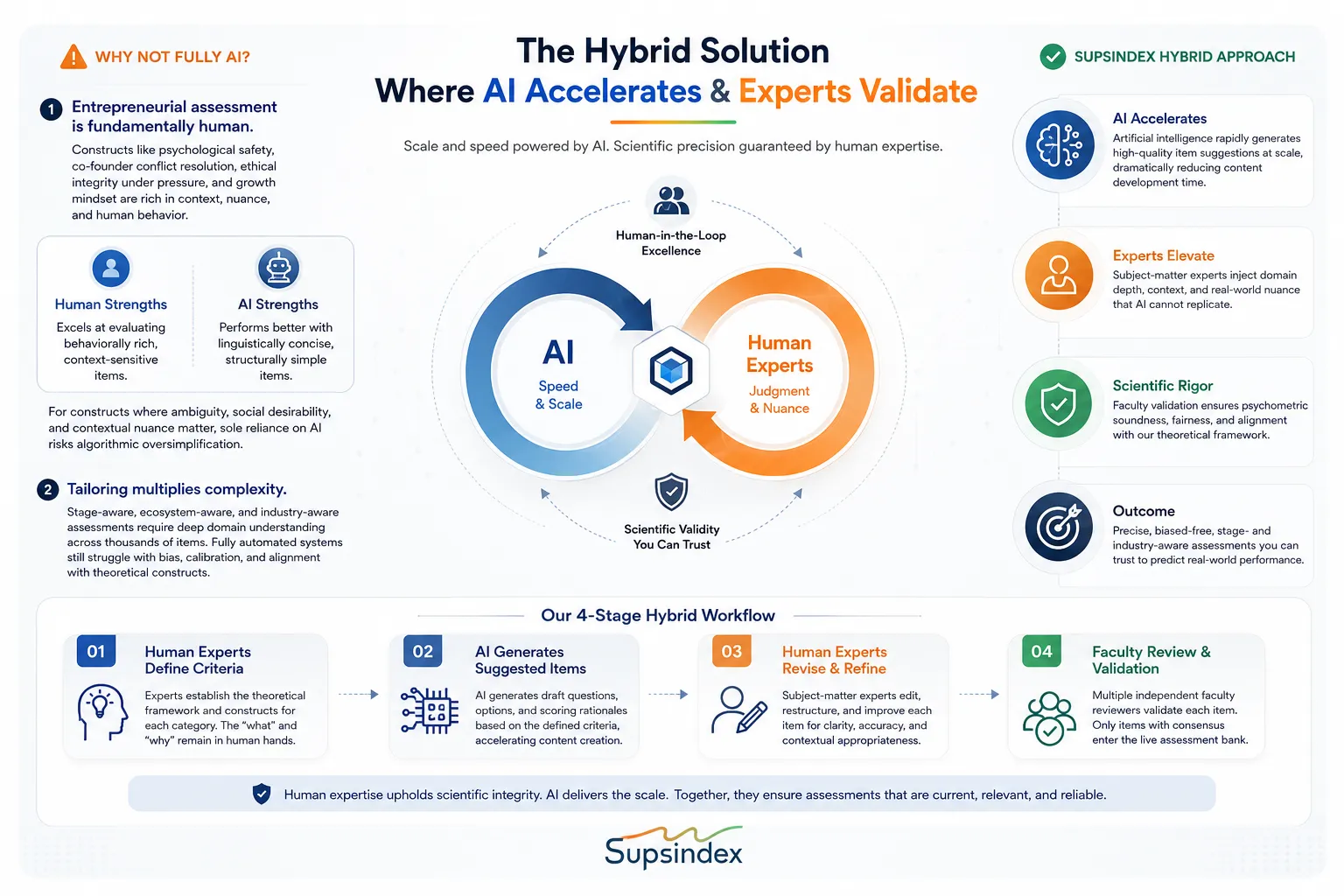
The initial impulse to address the scale and velocity of content renewal is automation. Why not deploy artificial intelligence to continuously rewrite and regenerate assessment items, eliminating the bottleneck of human labor? Supsindex examined this proposition carefully. Over six months of internal deliberation, the founders concluded that a fully AI-driven approach would be incompatible with the scientific mission of the platform. The reasoning rests on two observations.
First, the subject matter of entrepreneurial assessment is not purely technical. It is fundamentally human. Constructs such as psychological safety, co-founder conflict resolution, ethical integrity under pressure, and growth mindset cannot be reduced to the pattern recognition capabilities of large language models without introducing subtle but consequential distortions. Recent psychometric research confirms that human experts and AI systems exhibit distinct strengths and limitations in content validity assessment: human validators excel at evaluating behaviorally rich, context-sensitive items, while AI performs better with linguistically concise, structurally simple items. For constructs where social desirability, ambiguity, and contextual nuance matter—precisely the territory of entrepreneurial behavior—sole reliance on AI risks algorithmic oversimplification.
Second, the requirement for stage-aware, ecosystem-aware, and industry-aware tailoring multiplies the complexity. Supsindex assessments are not generic. They adapt to the test taker’s stage (pre-seed, seed, early stage, growth stage), ecosystem (fifteen operational countries, expanding to thirty), and industry (fifty-five distinct verticals). A fully automated system capable of maintaining this level of specificity across thousands of items, while avoiding systemic bias and preserving psychometric properties, does not yet exist. Research on transformer-based automatic item generation continues to identify unresolved challenges related to difficulty calibration, bias detection, and alignment with theoretical constructs. Supsindex arrived at a hybrid solution that balances scale with precision:
- Step 1: Human experts define criteria for each category. The theoretical scaffolding—what should be measured and why—remains under expert control. No algorithm determines the epistemological structure of an index.
- Step 2: Artificial intelligence generates suggested items. Given the criteria, the AI produces a draft set of questions, options, and scoring rationales. This phase dramatically accelerates content development while maintaining alignment with the defined constructs.
- Step 3: Human experts revise and refine. The AI-generated items are not accepted uncritically. Human subject-matter experts—with deep domain knowledge in the relevant industry and ecosystem—edit, restructure, and improve each item, eliminating ambiguity, correcting false assumptions, and ensuring cultural and contextual appropriateness.
- Step 4: Faculty members review, reject, or approve. The revised items enter the Faculty validation workflow, where multiple independent experts adjudicate scientific validity. An item only enters the live bank after securing consensus among its reviewers.
This workflow, known as a human-in-the-loop (HITL) framework, is precisely the architecture recommended for high-stakes assessment contexts where errors carry significant consequences. Human expertise is deployed to validate and challenge the model’s reasoning, while AI handles scale and acceleration. The cost in expert human resources is substantial; but the cost in precision, credibility, and trust would be far higher under a fully automated regime.
Part III: Anchoring TTL in Empirical Reality
If assessments must expire, how long should they live? There is no universal answer that applies across all entrepreneurial domains. The half-life of knowledge in legalTech differs from that in quantum computing; the pace of regulatory change in FinTech differs from that in consumer hardware. Supsindex has undertaken the necessary empirical grounding. Through extensive research across the fifty-five industries covered by the platform, the team has developed a taxonomy of knowledge decay rates, categorizing each sector according to its characteristic velocity of transformation. This taxonomy yields three TTL tiers:
| TTL Tier | Validity Period | Sectors |
|---|---|---|
| Rapid Growth | 2 years | Artificial Intelligence, Cybersecurity, Web3 & Blockchain, Digital Identity, Gaming & eSports, Data & Analytics, Developer Tools, Creator Economy, AdTech & MarTech, Digital Media, Voice & Audio Tech, Productivity Tools |
| Normal Growth | 3 years | SaaS, IoT, Cloud Computing, Consumer Electronics, HealthTech, Mental Health, FemTech, Payments & Banking, InsurTech, WealthTech, E-commerce, Retail Tech, PropTech, Marketplaces, AR/VR, Communications Tech, Circular Economy, AgTech, FoodTech, Supply Chain & Logistics, EdTech, HR Tech, LegalTech, RegTech, SalesTech, Travel & Hospitality, Pet Tech |
| Slow Growth | 5 years | Semiconductors & Quantum Computing, Robotics & Automation, Aerospace & Space Tech, Drones & Autonomous Vehicles, Advanced Manufacturing & 3D Printing, ConstructionTech, Biotechnology, Neurotech, Medical Devices & Diagnostics, Longevity & Anti-Aging, Clean Energy & Renewables, Carbon Capture & Sequestration, GovTech & CivicTech, Mobility & Transportation Tech |
This taxonomy is not static. As industries accelerate or stabilize, the TTL assignment is reviewed and adjusted. The system is designed to be as dynamic as the domains it measures. As of April 2026, Supsindex has designed and validated over 23,000 questions across these fifty-five industries and fifteen ecosystems. Each item carries metadata indicating its TTL expiration, and the platform maintains a scheduled review pipeline that systematically processes each bank before its expiration date, cycling through the four-stage hybrid workflow described above.
Part IV: Certificates as Time-Bound Credentials to Ensure Dynamic Validity

The logical consequence of TTL question management is the expiration of certificates. If the assessment renews, the credential must renew in parallel. A certificate that purports to represent current capability but carries no expiration date is, by definition, making a claim that cannot be substantiated. Supsindex certificates therefore carry explicit validity periods aligned with the TTL of the underlying assessment. A certificate earned in Generative AI expires after two years. A certificate earned in Advanced Manufacturing expires after five years. The General Entrepreneurial Behavior (GEB) certificate, which measures stable psychological constructs rather than rapidly decaying knowledge, follows a fixed five-year validity period.
This policy serves multiple constituencies:
- For founders: An expiring certificate creates a structured incentive for continuous learning. It is not punitive; it is a roadmap for staying current. The certificate holder knows exactly when to reassess and refresh their credentials, transforming ongoing professional development from an ambiguous obligation into a calendared event.
- For investors and partners: An unexpired certificate provides temporal confidence. It signifies that the founder’s demonstrated knowledge has been validated within a timeframe relevant to current market conditions. An expired certificate signals that reassessment is required before capital allocation decisions.
- For the ecosystem as a whole: Time-bound credentials elevate the standard of verification. They shift the baseline from “this person once knew this material” to “this person knows this material now.”
The alternative—perpetually valid certificates in fields where knowledge decays within years—is not merely imprecise. It is actively misleading.
Part V: A Competitive Distinction Driven by Dynamic Validity
No other entrepreneurial assessment platform currently operates with this level of temporal rigor. Competitors rely on static test banks, often built years ago and infrequently updated. Certificates are issued without expiration dates, implicitly claiming perpetual validity. The gap between assessment and reality widens with each passing quarter.
Supsindex has made the deliberate, resource-intensive choice to align with the actual half-life of entrepreneurial knowledge. The hybrid AI-human workflow, the fifty-five-industry TTL taxonomy, the Faculty validation system, and the expiring certificate policy are not features added to a finished product. They are the architecture itself—responding to the central fact that in an era of accelerating knowledge, static assessment is not merely outdated but systematically unreliable.
The era of assessing entrepreneurs with questionnaires that never change and certificates that never expire is ending. The scientific alternative is dynamic validity. And that alternative begins with a single, defensible principle: what cannot expire cannot be trusted to remain true.
Supsindex | Stop Guessing, Start Measuring.
