


Over the last 30 years, there has been a quiet change in how the world chooses people for important roles. Instead of trusting gut feelings or impressive resumes, fields like special forces, airline pilots, and brain surgeons now use careful testing to choose the right people. Instead, they use careful psychometric testing, just like we do for startup founders. These fields have learned that in complex systems, hiring someone who seems good but can’t really handle the job is a big and very expensive mistake. To mitigate this, international standards have been established by organizations such as the Society for Industrial and Organizational Psychology (SIOP) and the European Federation of Psychologists’ Associations (EFPA), ensuring that assessments are not merely “quizzes,” but scientifically validated instruments of precision.
This evolution has been driven by a shift in mathematical modeling. The industry has largely moved away from Classical Test Theory (CCT)—where every question is weighted equally—to the more sophisticated Item Response Theory (IRT). IRT allows for the measurement of “latent traits,” calculating the difficulty and discrimination of every item to determine a candidate’s true ability with mathematical certainty. Yet, strangely, the world of venture capital (VC) has remained a holdout. While a building’s electrician must undergo theoretical and practical licensing, the founder of a multi-million-dollar tech venture is often judged on a pitch deck and personal charisma. Because there’s no clear way to measure if founders are ready, more than 60% of startups fail due to people problems, not technology.
The capital market now desperately needs the leverage provided by Startup founder psychometric profiling to increase capital efficiency and prevent the squandering of human energy. Supsindex turns decision‑makers’ soft skills into clear numbers you can measure.
Cognitive Test for Startup Founders: The Core of Psychometric Profiling
When we discuss the cognitive requirements of a founder, we are not simply talking about IQ. We are talking about Entrepreneurial Literacy and the ability to process signals within a noisy environment. The Supsindex Cognitive Test in our Founder Potential Assessment (FPA) is a smart test that changes based on where the founder is in their journey.
The Architecture of Entrepreneurial Intelligence
Unlike normal tests, our test changes its questions based on the startup’s stage and industry. It checks 10 important skills that startup founders need including:
- Market & Customer Discovery: making sure a real problem exists before creating a solution for it.
- Finance & Fundraising: Runway mathematics, dilution logic, and cap-table hygiene.
- Legal & Compliance: Understanding IP assignment, GDPR, and investable legal structures.
The Science of Signal Detection
A CEO’s primary job is filtering noise. To measure this, our test uses Signal Detection Theory to see how well founders can notice important signals and ignore distractions. We intentionally embed “distractor” items—information that sounds academic or technical (like specific font ligatures or ergonomics) but is statistically irrelevant to business success. We measure the founder’s Hit Rate (identifying real problems) versus their False Alarm Rate (ignoring real threats or falling for trivia). This calculates a founder’s D-Prime Sensitivity, distinguishing between a discerning leader and one who is merely cynical or guessing.
The Result: Precision Readiness
By using a 2-Parameter Logistic (2PL) IRT Model, we derive a “Difficulty Parameter” and a “Discrimination Parameter” for every question. This ensures that a founder who solves a problem that stumps 90% of their peers is rewarded for depth, not just lucky guessing. This cognitive profiling leads to:
- Reduced Preventable Errors: Identifying gaps in legal or financial hygiene before they become fatal.
- Faster Product-Market Fit: Ensuring the founder understands empirical discovery loops.
- Objective Diligence: Providing investors with a “Score out of 1000” and a Confidence Interval (CI), acknowledging the standard error of measurement rather than providing a false single number.
Entrepreneurial Behavior Assessment in Startup Founder Psychometric Profiling
Knowledge is a prerequisite, but it is not a predictor of performance under stress. The Supsindex Entrepreneurial Behavior assessment, localized in our General Entrepreneur Behavior (GEB) engine, moves beyond what a founder knows to how a founder acts when the stakes are high.
The Problem of Ipsative Bias
Traditional personality tests (like DISC or Myers-Briggs) suffer from “Ipsative Bias”. If a founder rates themselves 5/5 on every positive trait, the test cannot differentiate their true strengths from their self-perception. Furthermore, forced-choice tests often create artificial negative correlations—making a founder look low in “Adaptability” simply because they prioritized “Integrity”.
The Solution: Thurstonian IRT Modeling
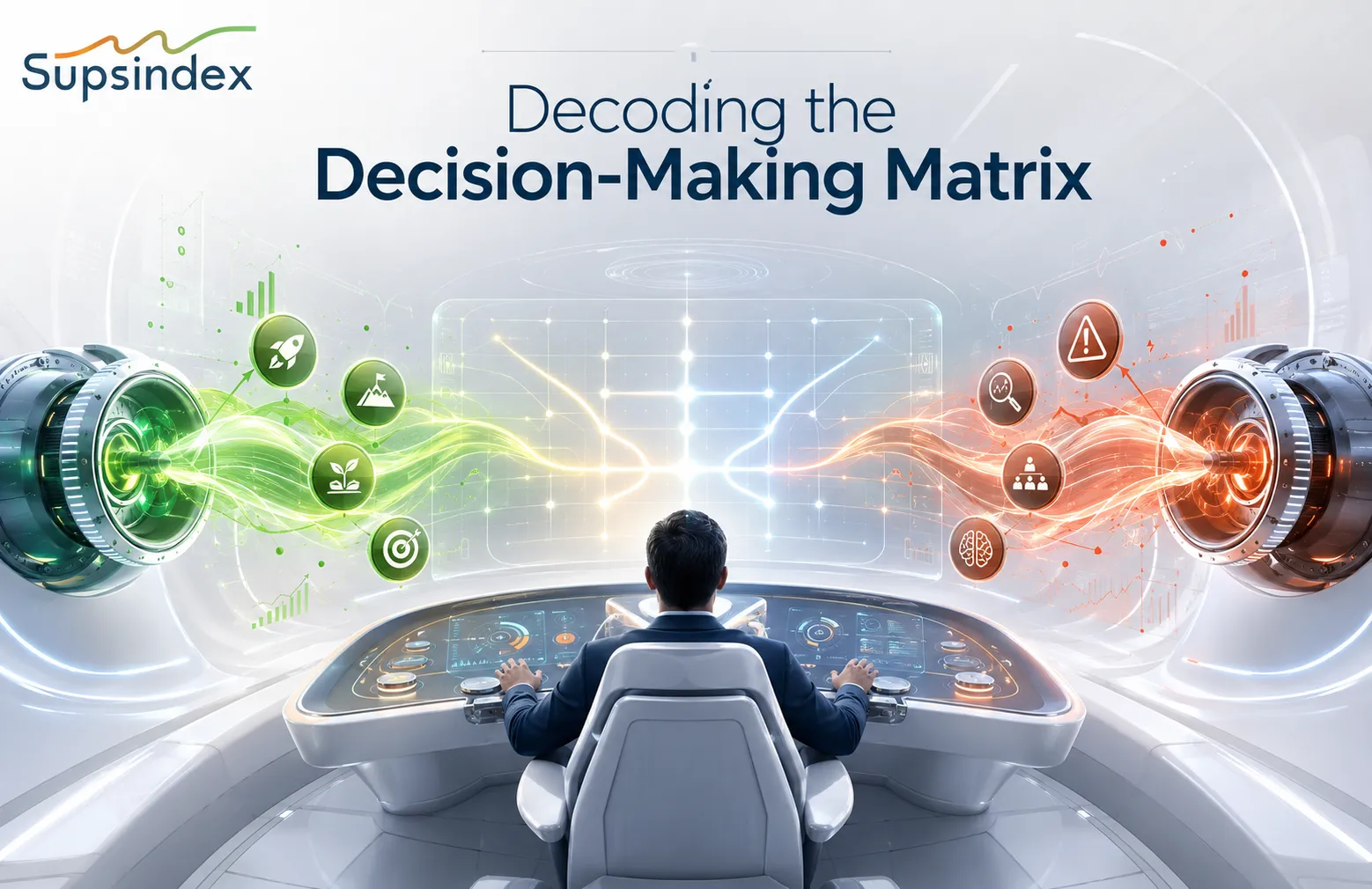
To solve this, our Entrepreneurial Behavior assessment utilizes Thurstonian Item Response Theory. We place the founder in a “Leadership Flight Simulator”—a high-fidelity cockpit of market shocks. In each scenario, they must choose the “Most Effective” and “Least Effective” actions. Our engine recovers their “Latent Utility” values, mathematically proving that a founder can be both highly adaptable and highly principled without forcing an artificial trade-off.
The Dual-Engine Analysis
The assessment simultaneously runs two diagnostic processes:
- The Strength Engine: Measures 19 positive constructs like Grit, Opportunity Recognition, and Recombination (the ability to combine resources in novel ways).
- The Risk Engine (Bias Detection): Identifies susceptibility to 20 cognitive derailers, such as Rash Decision Making, Wilful Blindness, and Micromanagement.
Our “wrong” answers are engineered to be delightful to be accurate. Micromanaging might sound like “Supportive Checking-In”. Expert founders avoid it cause it ruins autonomy while newbies do it cause it “sounds nice”. This lets us relate Startup founder psychometric profiling to real-world outcomes, predicting how a team will handle a crisis before it occurs.
General Entrepreneurial Behavior Traits: Map of the Thought Model
The final layer of Startup founder psychometric profiling involves identifying the specific General Entrepreneurial Behavior traits that determine long-term sustainability. At Supsindex, we view these traits not as static labels, but as a “Thought Model” that extends into behavioral patterns.
Our GEB framework measures 15 main categories and 19 positive traits. Here are the key traits we watch for in general entrepreneur behavior:
- Resilience: being able to bounce back when things go wrong and learn from mistakes.
- Opportunity Recognition: spotting a good chance before others see it.
- Strategic Adaptability: being willing to change direction when the data shows you should, while keeping your main vision. It helps avoid the “fixed mindset” belief that skills and intelligence can’t grow.
- Recombination: when an entrepreneur mixes different resources, experiences, and skills in a new way to create something new or change a market.
- Ethical Integrity: A non-negotiable cornerstone. We look at whether the founder makes choices that help people and follow simple moral rules. Taking shortcuts with ethics may seem helpful at first, but it often leads to serious problems, like the Theranos scandal.
The Threat of the “Founder Effect”
Without self-awareness about these General Entrepreneurial Behavior traits, founders may suffer from “founder effects”. This paradox suggests that the traits needed to launch a company can become liabilities if they evolve into too much confidence, autocratic management, or family favoritism in hiring as the company scales.
The path of entrepreneurship is inherently exhausting. Navigating this “dark forest” without a map of behavioral vulnerabilities is a recipe for burnout and failure. Startup founder psychometric profiling is the map, that allows founders to identify their potential value and build teams that complement their blind spots.
Conclusion: The Future of Startup Founder Psychometric Profiling
By 2030, we envision an entrepreneurial ecosystem where human potential is the most measurable asset. The era of assessing startups based on “gut feeling” is ending. Through the integration of Cognitive test for startup founders and comprehensive Entrepreneurial Behavior assessment, we are building a future where trial and error is replaced by informed, data-driven decisions.
If you are a founder seeking to benchmark your readiness or an investor looking to de-risk your next high stakes bet, we invite you to explore our suite of Startup founder psychometric profiling tools. Whether through our FPA, GEB, or the EEA (Ecosystem Evaluation Assessment), Supsindex provides the objective clarity needed to turn human energy into global impact.
Explore your profile at Supsindex and take the first step toward evidence-based growth.
