


The Supsindex Intelligence Hub is being developed to connect founder assessment evidence with cohort needs, market benchmarks, and ecosystem insights, helping partners decide where founder support is needed.
Supsindex Intelligence Hub for Founder and Ecosystem Insights
A founder assessment helps a mentor understand one person’s strengths and development needs. An accelerator director has a broader question: what does the whole cohort need, and where should the program invest its time? A university or ecosystem builder may need to understand how those patterns compare across a wider population.
Supsindex is developing the Intelligence Hub to help partners answer these questions. The Hub will bring assessment-based reports into one place, connecting individual founder insights with intelligence about cohorts, markets, and startup ecosystems. Its purpose is to help the people supporting founders make better-informed decisions about the support they provide.
The Hub is being designed for both individual and organizational partners, including mentors, accelerators, universities, and investment programs. Through their signed-in partner accounts, they will be able to explore reports, understand the data each requires, and follow a clear route to obtaining them. Individual founder reports will continue through the existing assessment experience; the Hub adds a broader view for partners.
Understanding the founders you support
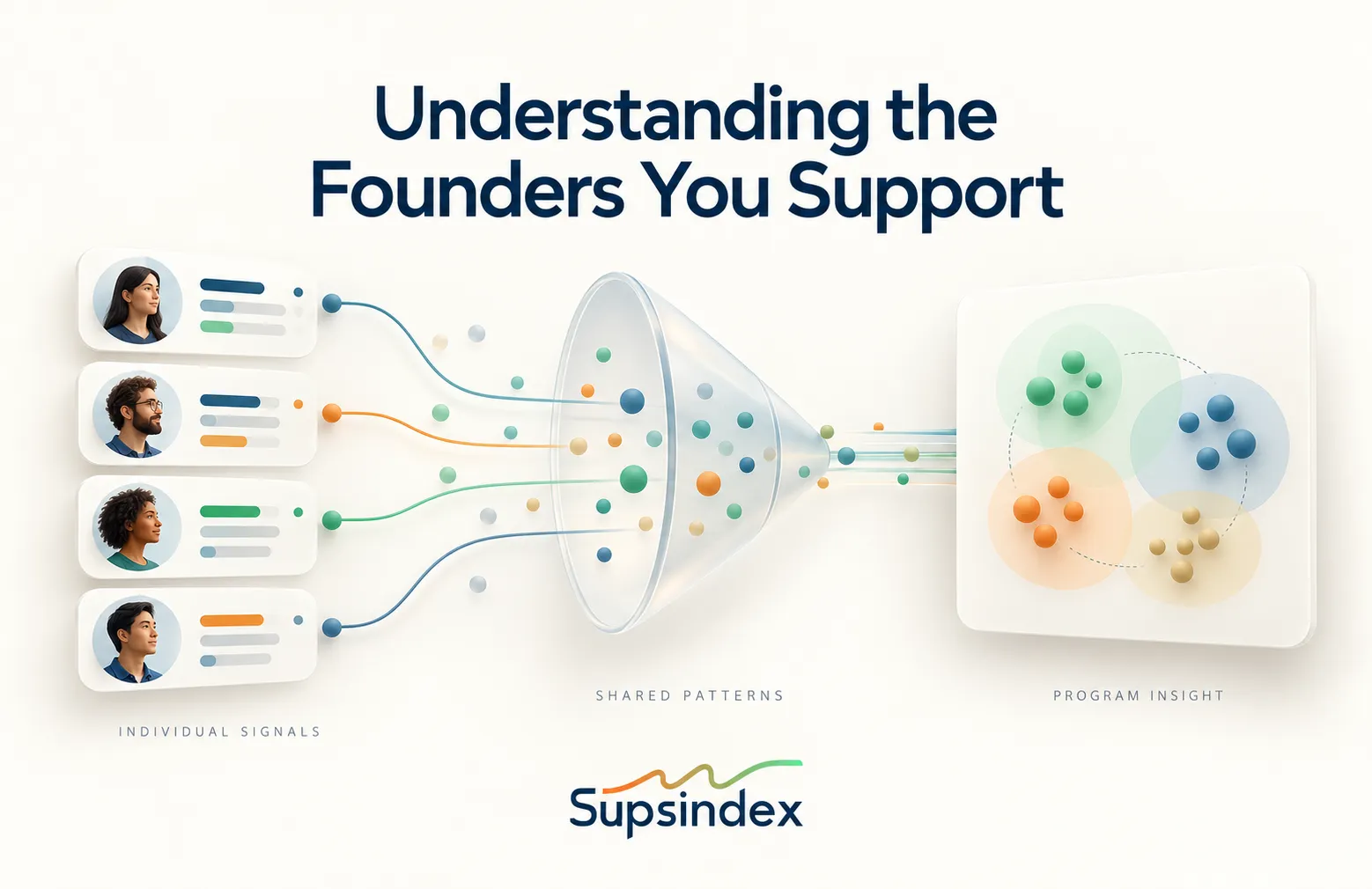
The first area, Your founders, will focus on assessment data connected to a partner’s own founders through its affiliation codes. It will help partners move from reading separate assessment results to identifying patterns across the people they support.
An Aggregated Founder Readiness report could give a program team a clearer picture of its cohort. A Cohort Capability Gap report could help it identify where additional learning or mentoring would be useful. These are different questions, and the catalog will explain what each report is intended to answer.
The planned portfolio also includes reports covering founder archetypes, cohort risk patterns, selection and admissions, program impact, and portfolio human capital. Availability will depend on whether the relevant data and report methodology are ready. A report’s presence in the catalog will make its status clear.
For partners, the practical opportunity is to connect evidence with program design. If assessment results reveal a shared capability gap, a team can investigate it and consider a focused workshop or mentoring intervention. Individual guidance remains valuable, while the aggregate view helps explain which needs deserve attention across the cohort.
Consider an accelerator planning its next month of support. Its team may know which founders need individual help, yet lack a picture of the cohort’s shared needs. Once sufficient assessment data is available, a capability gap report could help the team identify a recurring weakness and decide whether to organize a group session. Mentors could use individual results to adapt their follow-up. The report would give that planning discussion a common evidence base, helping the program explain why it chose a particular intervention and what further information it needs. That evidence can also help it communicate priorities to its mentors.
Placing your cohort in a wider context

Your market will cover intelligence drawn from broader groups, including industry capability benchmarks and comparisons across participating partners. This area is intended to help users understand their founders’ results alongside a relevant reference group, where sufficient comparable data exists.
A program serving founders in a particular industry may want to explore whether a capability gap is common across that industry. An investor may want a broader view of founder capabilities within a sector. Such comparisons can help frame further investigation, provided the report explains who was assessed and how the comparison was made.
The ecosystem will extend the view to platform-wide and ecosystem intelligence. Planned topics include ecosystem human capital, capability gaps, development priorities, and changes over time. These reports may be relevant to government agencies, policymakers, investors, and organizations working on entrepreneurship development.
The distinction between these areas will remain visible throughout the Hub. Partners should be able to understand whether a report concerns their own founders, a wider market, or a broader ecosystem before deciding how to use it. Each scope supports a different kind of decision.
Clear ways to obtain intelligence
Partners will have three main routes to reports. Some reports will be available free of charge without an assessment-volume requirement. The planned Quarterly Pulse Report is an example of a dated edition intended for signed-in partners.
Other free reports will become available when a partner reaches the required number of valid completed assessments. The Hub is designed to show progress toward these requirements, helping partners understand their eligibility. Report-specific thresholds will depend on the data requirements for producing meaningful aggregate intelligence.
This approach connects participation with partner value. As more affiliated founders complete valid assessments, partners can become eligible for reports that require a larger dataset. The requirement concerns usable completed assessments; simply inviting a founder does not produce a result that can contribute to an aggregate report.
Reports offered by quote will begin with a conversation. Partners will explain what they want to learn, share relevant supporting files where appropriate, and book an online meeting with the Supsindex team. The team will review the request, discuss feasibility and scope, and provide a quote after the meeting.
The initial Hub will use this process for paid reports, with pricing agreed through the quote conversation. Reports that cannot yet be produced will be marked as coming soon. Partners can register interest without booking a meeting or paying for an unavailable report.
In the initial release, Supsindex will handle report fulfillment through its team. Reports prepared on request will use current data at fulfillment. Existing editions will remain dated snapshots, with their generation dates clearly shown.
Knowing what a report can answer
A useful catalog must give partners enough information to judge whether a report fits their needs. Each report is planned to have a detailed explanation covering its purpose, the questions it answers, its contents, and its intended users.
The report information will also describe how it is made, its format and length, and its data requirements. For reports offered by quote, delivery expectations will be explained once confirmed. Dated editions will display their generation date so readers can understand when the underlying snapshot was produced.
Sample reports and preview images will help partners assess the presentation before requesting the real analysis. These examples will use clearly labeled fabricated data. They will illustrate a report’s structure without exposing another founder’s or partner’s information.
Report explanations will also address what the analysis cannot tell the reader. This matters when interpreting founder readiness, comparing groups, or considering program impact. A useful result depends on understanding the question, the available data, and the limits of the method.
Requesting a report around your own question
Some partner needs will fall outside the standard catalog. The Hub will therefore include a route to request a custom report, starting with the question the partner wants answered.
A partner could describe the founders or market involved, provide useful background, and indicate when the analysis is needed. An online meeting will help the team establish whether the available information supports the request and what a suitable report would involve. A quote will follow that discussion.
This service concerns analysis and reporting. Partners seeking a custom assessment will be directed to the existing Custom Index Request process. Making that distinction clear will help each request reach the appropriate team.
Keeping reports and requests together
My Intelligence will give partners a central place to find delivered files and follow open requests. They will be able to see the current stage of a quoted report, including meeting, quote, invoice, payment, and delivery status.
A planned partner analytics panel will also show assessment activity from the partner’s own affiliated founders. Its intended charts cover assessment volume, valid versus in-progress assessments, and progress toward report eligibility. The panel will provide a practical overview of participation, helping partners track assessments and report eligibility.
Together, these features are intended to make the Hub useful between report requests. Partners can follow assessment participation, understand what intelligence may become available, and return to completed reports when planning their next program activity.
Building useful intelligence responsibly
Aggregate reporting needs appropriate data safeguards. The Hub’s report process will apply minimum group requirements and suppression where necessary to protect privacy. Broader benchmarks will provide aggregate context, while the partner analytics panel will focus on the partner’s own assessment activity without displaying identifiable founder information.
Data volume also affects what can reasonably be concluded. A small or uneven sample can limit a comparison, and a change between assessments does not by itself establish that a program caused it. Report methods and explanations will need to make these limits understandable.
Helping partners set their next priorities
The Intelligence Hub is being developed around a practical goal: helping partners understand their founders well enough to choose useful next actions. Those actions might involve reviewing a cohort’s mentoring needs, investigating an industry capability gap, or identifying a question that needs deeper analysis.
As the Hub develops, partner interest will help Supsindex understand which reports and unanswered questions matter most. If you support founders or shape entrepreneurship programs, contact the Supsindex team and tell us what you want to learn about your founders, your market, or your ecosystem.
