


Founder coachability means taking feedback seriously without turning every recommendation into a command. Learn how to evaluate advice, test assumptions, and strengthen independent founder judgment.
Founder Coachability: How to Evaluate Feedback Without Losing Independent Judgment
Every founder eventually receives advice that challenges something they believe deeply about their company. An investor questions the go-to-market strategy. A mentor recommends abandoning a feature that took months to develop. A co-founder suggests that the CEO’s leadership style is slowing the team down. A customer says the product is solving the wrong problem.
The founder now faces a difficult decision: should they listen, defend their original thinking, or change direction?
Startup culture often treats coachability as the willingness to accept feedback. Investors praise coachable founders, accelerators encourage openness to mentorship, and leadership programs emphasize the importance of learning from criticism.
But this definition is incomplete.
A founder who immediately follows every recommendation may appear receptive while demonstrating little independent judgment. They may change pricing because one investor dislikes the current model, rebuild the product because a mentor prefers another approach, and shift customer segments because the latest advisor has a compelling story.
The opposite founder creates a different problem. They reject criticism because they believe conviction requires defending every original decision. Negative customer data becomes evidence that the market is not ready. Concerns from employees are interpreted as resistance. Investor questions become personal challenges to the founder’s authority.
Neither behavior represents healthy coachability.
Founder coachability is the ability to receive challenging information, evaluate it without excessive defensiveness, and incorporate what is useful without surrendering responsibility for the decision.
Within Supsindex’s scientific framework, this capability is closely connected to metacognitive awareness, intellectual humility, strategic adaptability, and the ability to distinguish meaningful evidence from distracting opinions.
The important question is not whether a founder agrees with advice.
It is whether the founder can turn feedback into better judgment.
Why Founder Coachability Matters More Than Agreeableness

Founders face a unique learning problem. They must develop a company while simultaneously developing the capabilities required to lead it.
The initial strategy is almost never complete. Customers reveal unexpected purchasing barriers. New hires expose organizational weaknesses. Investors challenge financing assumptions. Market conditions change, and operational complexity increases faster than the founder’s previous experience can accommodate.
Learning from others is therefore unavoidable.
Yet advice introduces its own risks because the person providing it rarely possesses complete information about the startup.
An investor may understand capital allocation extremely well but have limited experience with the company’s regulatory environment. An experienced executive may possess an effective playbook for a mature enterprise while misunderstanding the constraints of a pre-seed startup. A customer may accurately describe a problem while offering an impractical solution.
This means founders need two capabilities that can appear contradictory: openness to external information and the independence to evaluate it critically.
Entrepreneurship research supports treating coachability as a multidimensional capability rather than simple compliance.
A study published in the Journal of Business Venturing, using 656 founder–coach dyads, examined coachability as the degree to which entrepreneurs seek, consider, and integrate feedback. The researchers connected coachability with the ability to make better use of prior knowledge in product innovation.
A separate study published in Business Horizons examined mentoring relationships across entrepreneurial support organizations and found that higher coachability was associated with better progress during entrepreneurship programs and greater satisfaction with mentorship.
More recently, a 2025 study in Cogent Economics & Finance examined coachability competencies relevant to investor decisions. The research highlighted feedback reception, critical reflection, relationship management, flexibility, and implementation while also recognizing that excessive flexibility can suggest weak strategic commitment.
The combined implication is important: coachability requires active interpretation, not automatic agreement.
What Supsindex Means by Entrepreneurial Coachability
Supsindex conceptualizes Entrepreneurial Coachability as the capacity to integrate uncomfortable or disconfirming information into strategic thinking without allowing ego-driven defensiveness to dominate the response.
The framework focuses on what happens between receiving feedback and deciding how to act.
Imagine a founder hearing that customer retention is significantly weaker than expected.
One reaction is immediate self-defense. The founder explains why the customer sample is unrepresentative, why the product needs more marketing, or why competitors face the same problems.
Another reaction is immediate surrender. The founder announces a complete product pivot without investigating whether the feedback reveals a structural problem or a temporary execution issue.
A more coachable reaction begins with curiosity.
What exactly does the evidence show? Which assumption does it challenge? Is the information reliable? Does it reveal something previously overlooked? What would need to be true for the current strategy to remain viable?
Supsindex refers to this capacity as epistemic agility: the ability to update beliefs when credible evidence changes, while maintaining a coherent decision process.
This does not require founders to eliminate emotion. Criticism can be uncomfortable, especially when substantial personal investment is involved. The goal is to prevent that initial emotional response from becoming the final strategic decision.
The framework also builds on intellectual humility, which separates personal worth from the accuracy of a particular belief.
A founder can acknowledge that their pricing model was wrong without concluding that they are incapable of building a company.
That separation makes learning easier because new information no longer threatens the founder’s entire identity.
The Two Extremes: Blind Obedience and Defensive Rigidity
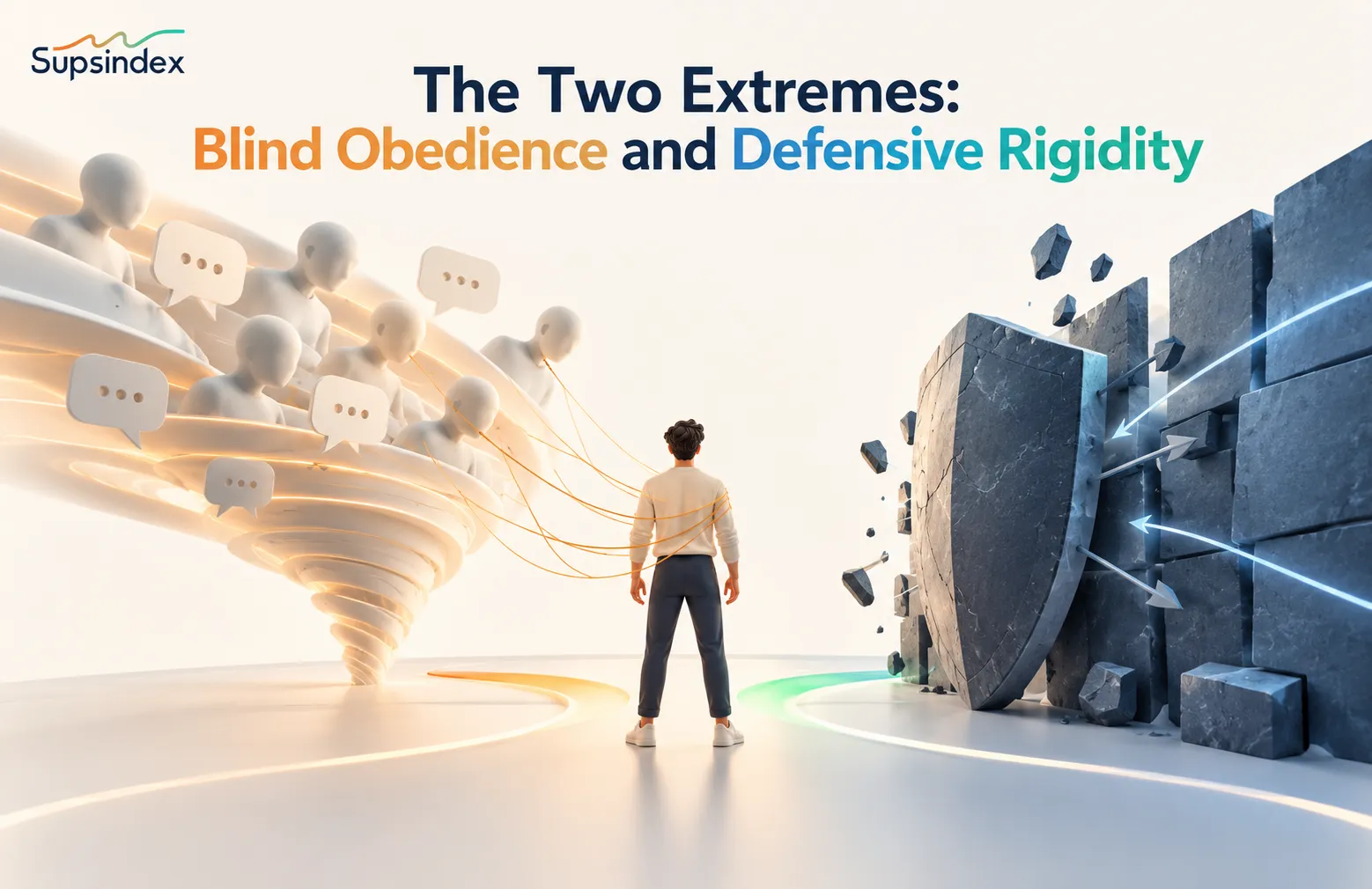
A useful way to understand founder coachability is to examine the two behavioral extremes it must avoid.
The first is uncritical compliance.
This founder wants to appear receptive. During mentor sessions, they agree enthusiastically, promise to implement recommendations, and frequently change their plans after meeting influential people.
The behavior initially looks positive, but the founder may be confusing advice with authority.
Instead of analyzing recommendations against customer evidence, financial constraints, or business objectives, they allow the source’s reputation to substitute for their own judgment.
Supsindex associates this risk with people-pleasing, excessive impression management, and decision-making patterns that prioritize appearing cooperative over making appropriate trade-offs.
The second extreme is defensive rigidity.
This founder interprets disagreement as a challenge to their competence. They become increasingly selective about which feedback they accept and may surround themselves with people who reinforce their existing assumptions.
Strong persistence can become dangerous when combined with confirmation bias or the sunk-cost fallacy.
Supsindex describes one version of this behavioral profile as the Stubborn Genius: a founder whose resilience becomes a mechanism for defending an invalidated strategy.
The founder who follows everything and the founder who rejects everything appear different, but both have a common weakness.
Neither is evaluating evidence independently.
The coachable founder does something more demanding: they retain ownership of the decision while remaining willing to change their mind.
Coachability Begins With Self-Awareness
Supsindex’s existing research on self-awareness tools for startup founders distinguishes between internal self-awareness—understanding one’s own tendencies and motivations—and external self-awareness—understanding how one’s behavior is perceived by others.
The distinction is particularly relevant to coachability.
A CEO may believe their frequent involvement in product decisions demonstrates commitment to quality. Employees may experience the same behavior as micromanagement that prevents them from taking responsibility.
Both perspectives describe parts of the same situation.
The founder’s internal explanation does not necessarily capture the operational consequences of their behavior.
Feedback can reveal this difference, but only when the founder is willing to consider the possibility that their intentions and their impact are not identical.
This is why self-awareness tools, behavioral assessments, and external observations become much more useful when connected to practical feedback review.
The assessment may identify a potential blind spot.
Feedback can provide examples of how it appears in daily operations.
The founder must then determine whether those observations justify a behavioral change.
Self-awareness identifies the question. Coachability determines what happens next.
How Supsindex Examines Coachability Through Founder Assessment
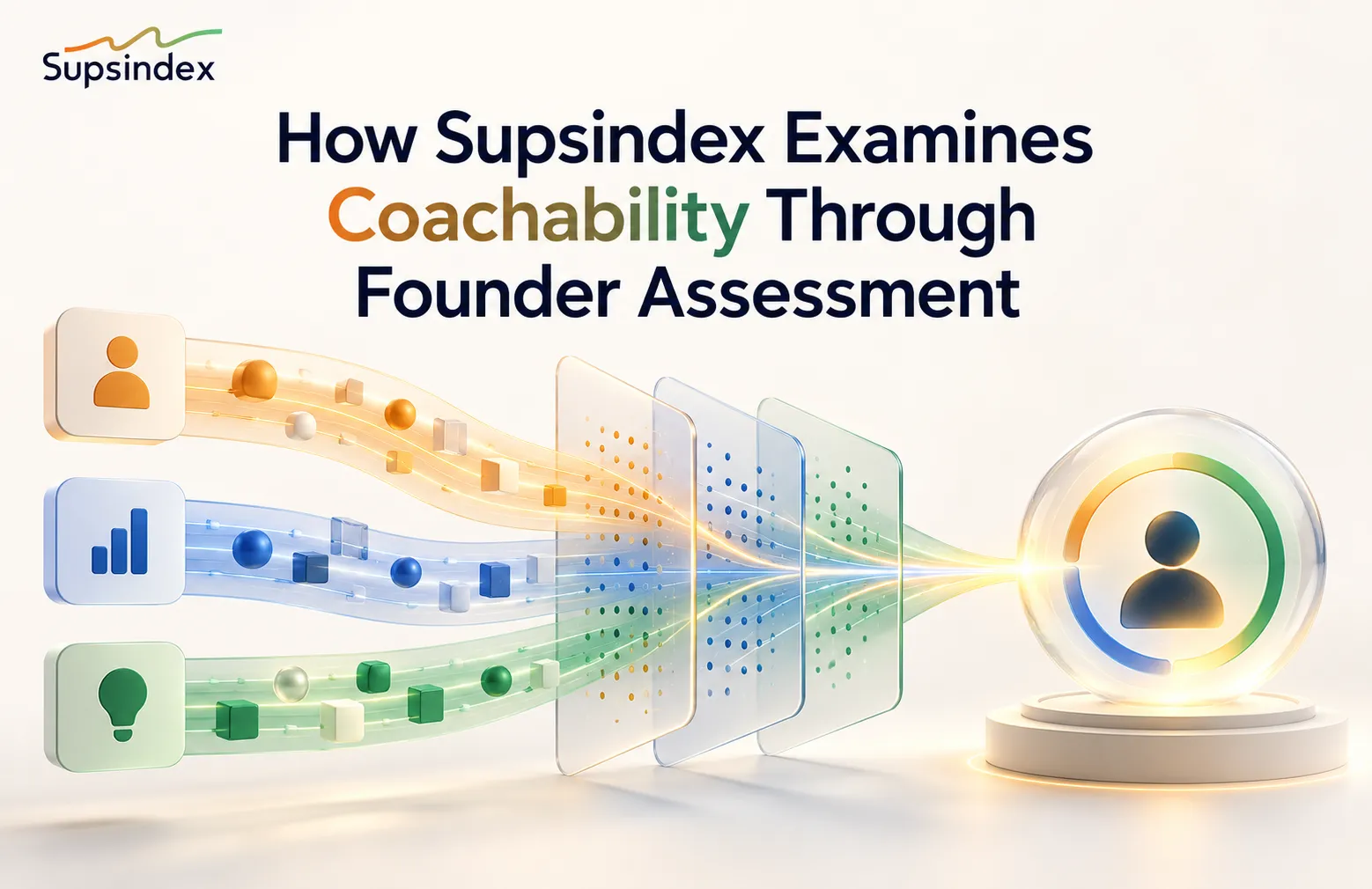
Supsindex does not need to reduce coachability to a simple personality label.
Its broader assessment architecture examines related capabilities through several complementary methods.
GEB: Behavioral Judgment and Cognitive Derailers
The General Entrepreneurial Behavior (GEB) index uses 75 forced-choice Situational Judgment Tests, analyzed through Thurstonian Item Response Theory, to examine behavioral judgment under entrepreneurial pressure.
Rather than relying exclusively on direct questions such as “Are you open to feedback?”, the assessment presents scenarios that require choices between competing actions.
This approach is relevant because most founders know that appearing coachable is socially desirable.
A direct questionnaire may therefore measure how founders want to describe themselves rather than how they would prioritize competing demands.
Within Supsindex’s proposed dual-engine interpretation, constructive behavioral patterns include adaptability, metacognitive awareness, resilience, and learning from conflict. Risk patterns include overconfidence, confirmation bias, information avoidance, sunk-cost escalation, and resistance to adaptation.
The GEB framework also includes socially desirable distractors: responses that sound cooperative or virtuous but may conceal poor operational judgment.
For example, a response that describes micromanagement as supportive involvement could sound responsible while preserving an unhealthy dependency on the CEO.
The objective is to examine decision patterns rather than reward agreeable language.
FPA: Separating Relevant Evidence From Noise
The Founder Public Awareness (FPA) index approaches the issue from a cognitive perspective.
A founder may receive several types of feedback simultaneously: customer complaints, investor preferences, competitor announcements, employee concerns, and commercial performance data.
These inputs do not carry equal informational value.
Supsindex incorporates Signal Detection Theory concepts, including (d’) sensitivity, into its cognitive assessment framework to examine how effectively founders distinguish relevant signals from distractors.
Consider a product receiving ten positive comments about its interface alongside evidence that customers repeatedly abandon a critical onboarding step.
A founder who focuses entirely on compliments may be missing the more consequential signal.
Strong judgment requires recognizing that feedback quality depends on what the information demonstrates, not simply how positively or negatively it is expressed.
FDE: Decision-Making Under Simulated Pressure
Supsindex’s Founder Decision Excellence (FDE) framework extends the assessment of judgment into simulated crises through its Leadership Flight Simulator.
In the proposed simulation environment, founders may face contradictory advice, deteriorating financial metrics, customer losses, or strategic pressure from investors.
The system is designed to compare founder decisions with a personalized AI-generated reference profile and identify divergence under pressure.
These simulations can provide additional diagnostic information about behavioral consistency, but modeled decisions are not equivalent to guaranteed real-world outcomes.
Their developmental value lies in helping founders examine whether their reasoning changes when uncertainty, authority pressure, or emotional stakes increase.
FCG: Evaluating Whether Coachability Improves
The Founder Continuous Growth (FCG) framework provides the longitudinal layer.
Rather than treating feedback responsiveness as a permanent personality characteristic, Supsindex approaches it as a capability that can develop through repeated practice, operational changes, and assessment.
A founder who initially reacts defensively may learn to ask better questions, test advice systematically, and become more comfortable documenting when their original assumptions were wrong.
The important result is not simply a more flattering assessment profile.
It is a more reliable process for making decisions.
The Five Filters for Evaluating Founder Feedback
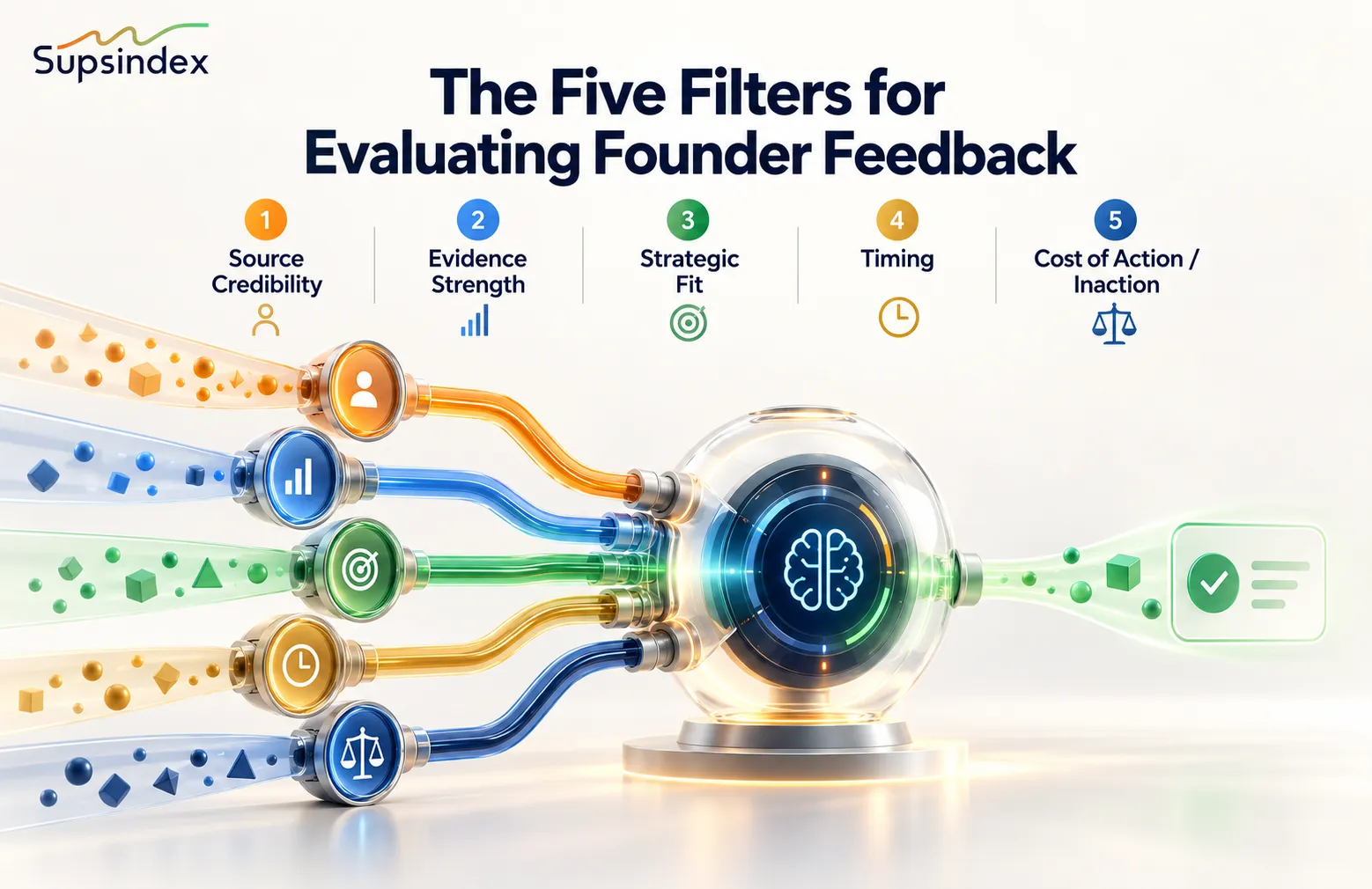
Not all feedback deserves the same attention, and not every source possesses equal expertise in every context.
Supsindex recommends examining feedback through five complementary filters before integrating it into a business decision.
1. Domain Expertise: Does the Source Understand the Problem?
The first question concerns the source’s relevant competence.
A mentor who has successfully scaled an enterprise SaaS business may offer valuable advice about building sales organizations or managing recurring revenue.
That experience does not automatically make them an expert in medical-device regulation, pharmaceutical development, or government procurement.
The founder should therefore examine the relationship between the advice and the source’s demonstrated expertise.
The most useful questions are specific: Has this person dealt with comparable decisions? Do they understand the regulatory or commercial constraints? Are their recommendations based on recent operational experience or broad principles?
Credentials can help establish context, but they are not a substitute for relevant evidence.
2. Lifecycle and Context: Does the Advice Fit This Startup?
Startup strategy changes as the company develops.
An approach appropriate for a Growth-stage company may be dangerous at Pre-Seed.
For example, an investor may recommend rapid expansion into multiple markets because that strategy worked for another portfolio company. But if the current startup has not validated retention, multiplying acquisition expenditure may accelerate losses rather than growth.
Context also includes industry, business model, geography, customer behavior, and the resources currently available.
A recommendation should be evaluated within those constraints rather than adopted simply because it succeeded elsewhere.
3. Evidence Quality: What Actually Supports the Advice?
The third filter asks whether the recommendation rests on demonstrable evidence.
An investor may say the company should abandon a market because its sales cycle appears too long.
That observation could be accurate, but the founder needs to examine actual pipeline data, contract value, acquisition cost, sales-cycle duration, and customer lifetime economics.
Likewise, a customer may recommend a feature that sounds valuable but has never been associated with measurable purchasing or retention behavior.
The founder should distinguish facts, assumptions, personal preferences, and predictions.
This is where the same disciplines used in customer discovery become valuable: historical behavior, observable outcomes, and testable hypotheses generally provide a stronger basis for decision-making than unsupported enthusiasm.
4. Incentive Alignment: What Does the Advisor Stand to Gain?
Feedback can be sincere while still reflecting incentives that differ from the startup’s priorities.
An investor may favor aggressive growth because the potential upside fits the economics of a venture portfolio. That strategy may also expose an individual startup to greater failure risk.
A consultant may recommend a sophisticated operational system because implementing that system is their area of expertise.
A customer may request customization that benefits their organization while making the product less attractive to the broader target market.
These incentives do not automatically invalidate the recommendation.
They simply need to be understood.
A coachable founder can respect another person’s perspective without assuming that the person’s incentives are identical to those of the company.
5. Bottleneck Relevance: Does This Address the Most Important Problem?
The final filter connects feedback to the Penalty for Bottleneck (PFB) principle.
Supsindex uses this concept to emphasize that serious weaknesses in critical capabilities can constrain the performance of the entire venture.
Suppose a startup has only three weeks of cash runway.
A mentor’s suggestion to improve branding may be thoughtful, but it is unlikely to deserve priority over resolving the company’s immediate liquidity problem.
Alternatively, a startup with severe customer churn may receive advice to increase marketing. Unless acquisition spending addresses the retention problem, the recommendation may simply increase the speed at which the company loses money.
The relevant question is not whether the feedback is useful in general.
It is whether acting on it addresses the company’s most consequential constraint at this moment.
The Six-Step Founder Feedback Review Framework
The five filters help determine feedback quality. Founders also need a repeatable operating process that connects receiving advice with making a decision.
Supsindex’s approach can be organized into six stages:
Receive → Classify → Evaluate → Test → Decide → Review
Each stage creates a deliberate separation between the emotional experience of receiving feedback and the operational decision that follows.
Step 1: Receive Without Immediately Defending
The first requirement is to capture the feedback accurately.
When someone challenges a founder’s strategy, the natural reaction may be to explain why the current approach makes sense.
That explanation may eventually be appropriate, but immediate defense can prevent the founder from understanding what the other person actually means.
A useful response is to ask for the specific observation behind the recommendation.
If a co-founder says the CEO is micromanaging, ask which decisions were delayed, what consequences followed, and whether the pattern is recurring.
The objective is not to agree.
It is to ensure that the advice has been understood before being judged.
Step 2: Classify the Feedback
The second stage separates the type of claim being made.
A statement such as “Your churn increased last month” is a factual claim that can be checked.
“Your product is too expensive” may be an interpretation that requires evidence.
“You should pursue enterprise customers” is a strategic recommendation based on assumptions about the market.
“You become defensive during board meetings” is a behavioral observation that may need corroboration.
These statements should not be evaluated in the same way.
Facts require verification. Assumptions require testing. Preferences require contextual interpretation. Behavioral observations require examination across situations.
Classification prevents founders from treating every recommendation as either unquestionably true or entirely subjective.
Step 3: Evaluate the Source and the Evidence
Now apply the five credibility filters.
Does the person understand the domain? Is the recommendation suitable for the company’s stage? What evidence supports it? Are there important incentive differences? Does the advice address the current bottleneck?
A recommendation may be reasonable yet poorly timed.
Another may come from someone with limited prestige but exceptional direct knowledge of the problem.
The purpose is to evaluate the substance rather than simply the status of the person delivering it.
Step 4: Test the Underlying Assumption
When the recommendation depends on uncertain assumptions, the founder should identify a low-cost way to test them.
Supsindex recommends Riskiest Assumption Testing (RAT) for this purpose.
Imagine two mentors disagreeing about whether a B2B startup should prioritize enterprise sales or product-led growth.
Rather than resolving the disagreement through debate, the founder can identify the assumptions behind each strategy and test them through targeted customer research, a limited acquisition experiment, or a controlled pilot.
The test should be designed to produce evidence capable of changing the decision.
For particularly high-stakes choices, simulation and scenario analysis may provide additional information, but a simulation should not replace actual market validation.
Step 5: Make and Document the Decision
After reviewing the evidence, the founder chooses one of four actions:
Accept the recommendation because the evidence and context support it.
Adapt the recommendation because part of the advice is useful but requires modification.
Test the recommendation further because uncertainty remains consequential.
Reject the recommendation because the available evidence does not justify implementing it.
Rejecting feedback does not mean the founder was uncoachable.
If the decision follows a serious review and the reasoning is documented, rejection can demonstrate independent judgment.
Likewise, accepting feedback is not inherently evidence of coachability if the founder never examined the recommendation.
What matters is the quality of the reasoning.
Step 6: Review What Actually Happened
The final stage closes the loop.
After an agreed period, the founder compares the original recommendation, the decision made, and the results.
Was the underlying assumption correct?
Did the intervention improve the relevant outcome?
Was important contradictory evidence overlooked?
Did the founder reject useful feedback because it was uncomfortable, or accept weak advice because the source was influential?
This review converts feedback into organizational learning.
Without it, even carefully documented decisions can become forgotten narratives.
The Founder Feedback Decision Log
A practical way to implement this process is to maintain a Feedback Decision Log, sometimes described within the Supsindex framework as an Advice Audit Ledger.
The log ensures that important recommendations do not disappear into informal conversations or become distorted by selective memory.
It also reduces hindsight bias by preserving the reasoning that existed before the outcome was known.
Reusable Nine-Field Template
| Field | What the founder records |
|---|---|
| 1. Entry ID & Date | Unique record and the date feedback was received |
| 2. Source & Role | Investor, customer, mentor, employee, co-founder, or assessment |
| 3. Verbatim Recommendation | Exact wording, separated from interpretation |
| 4. Feedback Classification | Fact, assumption, preference, or behavioral observation |
| 5. Source Fit & Incentive Audit | Relevant expertise, stage fit, and potential conflicts |
| 6. Bottleneck Relevance | Whether the feedback addresses the company’s main current constraint |
| 7. Disconfirming Evidence | Information that challenges the recommendation or its assumptions |
| 8. Operational Decision | Accept, adapt, test, or reject, with documented reasoning |
| 9. Review Date & Outcome | When the decision will be evaluated and what happened |
The most important design choice is keeping the original recommendation separate from the founder’s interpretation.
Consider a hypothetical investor recommending that a company abandon its existing enterprise sales strategy and shift entirely toward self-service product-led growth.
The founder might initially interpret this as a demand to restructure the company.
But the actual concern may be that enterprise acquisition costs are too high.
Once those two issues are separated, the founder can investigate the economics without automatically accepting the proposed solution.
Example Feedback Decision Log Entry
| Field | Example |
|---|---|
| Entry ID | ADV-2026-10-11-01 |
| Source | Lead investor, B2B SaaS background |
| Recommendation | “Reduce go-to-market spending and move toward a product-led growth model.” |
| Classification | Strategic recommendation based on an assumption about acquisition efficiency |
| Source fit | Strong SaaS background; limited experience in regulated HealthTech |
| Bottleneck relevance | High: CAC payback and sales-cycle efficiency require improvement |
| Disconfirming evidence | Current enterprise buyers require implementation support; initial self-service tests showed weak conversion |
| Decision | Test a limited self-service onboarding flow before restructuring the main sales model |
| Review | Evaluate conversion, qualified pipeline, acquisition cost, and support requirements after 30 days |
This example does not prove that enterprise sales is the better strategy.
It shows how the founder can translate an influential recommendation into an evidence-based decision without surrendering control of the company.
When Multiple Experts Disagree
Conflicting expert advice can be particularly difficult because each recommendation may sound persuasive.
Suppose one experienced advisor recommends high-touch enterprise sales while another recommends self-service growth.
A founder who simply follows the last advisor spoken to is not learning. They are transferring decision authority to whichever person currently sounds most convincing.
Supsindex recommends decomposing competing recommendations into their underlying assumptions.
Perhaps the enterprise-sales advisor believes high contract values justify longer acquisition cycles, while the product-led-growth advisor believes low-friction onboarding can create cheaper customer acquisition.
Both hypotheses may be plausible under different conditions.
A founder can test them through a controlled experiment, compare the economics, and decide which model fits the actual business.
For especially consequential decisions, seeking additional independent perspectives can reduce the influence of any single advisor. This principle resembles Supsindex’s use of multiple independent reviewers in scientific item validation, although a business decision does not need to follow the same formal scientific-review procedure.
The objective is triangulation, not majority voting.
Three mentors repeating the same unsupported opinion do not automatically outweigh one person presenting decisive evidence.
Five Situations That Reveal Whether a Founder Is Truly Coachable
The distinction between openness and obedience becomes most visible in difficult situations.
Scenario 1: An Investor Pushes for Premature Scaling
A venture investor encourages the founder to double the sales team and substantially increase paid acquisition spending ahead of the next fundraising round.
The recommendation is understandable: faster growth could strengthen the company’s fundraising position.
However, the founder knows that customer retention remains unstable and CAC payback has not been sufficiently validated.
An uncritically compliant founder expands immediately.
A defensively rigid founder dismisses the investor as interfering with the business.
A coachable founder investigates the underlying growth thesis.
They review customer cohorts, acquisition economics, sales efficiency, runway, and the opportunity cost of delaying expansion. They may then propose a controlled, capped-budget acquisition experiment before committing to permanent headcount growth.
The founder is not rejecting growth.
They are establishing which evidence would justify it.
Scenario 2: A Co-Founder Accuses the CEO of Micromanagement
A technical co-founder explains that engineering decisions are repeatedly delayed because the CEO insists on reviewing routine details.
The CEO believes their involvement is necessary to maintain quality.
An excessively compliant reaction would remove all oversight immediately, even for irreversible technical or financial decisions.
A defensive reaction would insist that the CEO’s standards are the reason the company has achieved its current quality.
A coachable founder examines decision logs, sprint delays, approval dependencies, and team feedback.
The team can then introduce a Two-Way Door Delegation Protocol.
Low-risk, reversible decisions move to designated functional owners, while decisions with substantial irreversible consequences retain appropriate executive oversight.
The founder establishes outcome-based accountability rather than daily task control.
The goal is not to become less involved for its own sake.
It is to determine where involvement creates value and where it creates a bottleneck.
Scenario 3: Customers Criticize a Core Product Feature
Several early customers complain that the company’s central feature is too complicated.
The founder considers the feature essential to the product’s differentiation.
An uncritically compliant founder removes it.
A defensive founder dismisses the complaints as evidence that customers do not understand the innovation.
A coachable founder examines the relationship between stated complaints and actual behavior.
Are customers abandoning the feature? Are they using it frequently despite finding the interface difficult? Are complaints coming from the intended target segment or from users whose needs differ from the company’s strategy?
The team can conduct neutral customer-discovery interviews and test a simplified experience against the current version, using meaningful behavioral outcomes rather than subjective preference alone.
The best response depends on what the evidence shows.
Customer criticism deserves investigation, not automatic obedience.
Scenario 4: Two Mentors Recommend Opposite Strategies
An experienced enterprise executive recommends building a high-touch sales organization.
A SaaS founder recommends eliminating sales friction through product-led growth.
Both advisors possess credible experience.
The coachable founder does not choose based on charisma, seniority, or the most recent conversation.
Instead, the founder examines customer purchasing behavior, contract values, implementation requirements, sales-cycle length, and acquisition economics.
The recommendations become competing hypotheses.
A limited test might compare self-service onboarding with direct outreach to qualified enterprise buyers.
The result may support one approach, reveal a hybrid model, or show that the company needs additional evidence.
The founder has used both mentors without handing control to either.
Scenario 5: A Founder Disagrees With Their Assessment Report
A founder receives a Supsindex report identifying weak financial knowledge and possible information-avoidance behavior.
They disagree. Their self-image is that of a confident and capable operator who understands the company better than anyone else.
A defensive founder dismisses the report.
An excessively compliant founder accepts the result as a permanent judgment on their competence.
A coachable founder treats the assessment as a diagnostic hypothesis.
They examine the relevant report categories, review the limits of the measurement, and compare the findings with their own financial-management behavior.
Are cash forecasts updated regularly? Can they independently explain monthly burn and runway? Have important financial decisions been delayed because the numbers were uncomfortable?
If the operational evidence supports the concern, the founder can establish weekly financial reviews, work with an advisor, and track whether financial decisions improve.
If it does not, the founder can investigate the discrepancy without assuming either that the report is infallible or that their self-perception must be correct.
That is precisely what evidence-based coachability requires.
How to Develop Coachability Over 90 Days
Coachability should not remain a vague leadership aspiration.
Founders can develop a repeatable process for receiving, interpreting, testing, and acting on feedback.
Supsindex’s 90-day development approach combines behavioral awareness with operational forcing functions and longitudinal review.
Days 1–30: Diagnose the Pattern and Build the System
The first month focuses on understanding how the founder currently responds to feedback.
A baseline assessment can identify relevant behavioral tendencies and cognitive risks, while discussions with co-founders, mentors, or employees provide examples from daily operations.
The founder should then create the Feedback Decision Log and use it for meaningful recommendations.
Two forcing functions can help.
The first is a short pause before responding to emotionally charged criticism. A fifteen-minute break can prevent an immediate defensive reaction from becoming a team conflict.
The second is a pre-committed review period before major discretionary strategy changes. A 24-hour cooling-off rule may be appropriate for non-urgent pivots or significant capital-allocation decisions, with explicit exceptions for safety, legal, or time-critical situations.
By Day 30, the founder should have a documented feedback baseline and evidence that the new review process is being used consistently.
Days 31–60: Test Feedback Through Real Decisions
The second month moves from reflection into experimentation.
The founder selects two meaningful recommendations that involve uncertain strategic assumptions.
Instead of immediately implementing or rejecting them, the founder designs low-cost tests where feasible.
One recommendation may concern customer acquisition. Another may involve delegation, team communication, or a product feature.
Each test should define what evidence would support or contradict the recommendation.
Where available and appropriate, FDE simulation can provide additional opportunities to examine decisions under pressure.
At Day 60, the founder reviews the decision log.
Have feedback entries been completed accurately? Were contradictory observations recorded? Did the founder change direction simply to satisfy authority figures? Were reasonable concerns dismissed without examination?
The goal is to identify whether the review process is becoming more independent and consistent.
Days 61–90: Reinforce Behavior and Reassess
The final month focuses on applying the same process to increasingly consequential decisions.
A founder working on defensiveness might practice structured conversations with critical stakeholders. Someone prone to excessive compliance might concentrate on explaining the evidence behind their decisions rather than immediately agreeing.
Another founder may need to address a particular bottleneck, such as delegation or financial avoidance, through repeated operational practice.
At the end of the cycle, the founder reviews changes in observable behavior, stakeholder feedback, decision quality, and relevant assessment findings.
Where reassessment is appropriate, GEB or other Supsindex measures can provide another perspective on the development trajectory.
The founder can then use FCG tracking, as available, to organize continued progress across subsequent cycles.
The central question is whether the founder has become more capable of responding constructively to important information.
A higher assessment score may support that conclusion, but the actual quality of decisions matters most.
What Counts as Evidence of Improved Coachability?
Improvement should be evaluated through several complementary observations rather than simply counting how much advice a founder accepts.
A founder may become more coachable by asking clearer questions when challenged, recording contradictory feedback, testing assumptions before committing resources, and explaining the reasons for accepting or rejecting recommendations.
Other useful indicators include reduced defensiveness during team discussions, fewer impulsive strategy changes following mentor meetings, more consistent delegation, and a better record of revisiting prior decisions.
Stakeholder observations can provide additional context, although they should be evaluated carefully. An investor who wants the founder to follow their advice may consider disagreement uncoachable even when the founder’s reasoning is sound.
Assessment-derived evidence adds another layer. GEB results may help examine changes in relevant behavioral patterns, while repeated simulations can support reflection on decisions made under pressure.
Supsindex also describes longitudinal recognition mechanisms for founders who demonstrate substantial assessment improvement, including a proposed Zero to One growth credential associated with movement from Q4 to Q1.
Such recognition can acknowledge development, but it should not replace the underlying operational evidence.
The goal is better judgment, not higher agreement rates.
What Investors, Accelerators, and Boards Should Do Differently
Coachability is frequently evaluated by investors, yet stakeholders can unintentionally create conditions that reward obedience rather than learning.
If an investor describes every disagreement as founder stubbornness, the founder may learn to appear agreeable instead of presenting genuine concerns.
Likewise, an accelerator that introduces founders to numerous mentors without helping them reconcile conflicting advice may create strategic confusion rather than development.
A healthier environment treats recommendations as propositions that can be questioned and tested.
Boards should explain the assumptions behind important strategic advice and identify the evidence that would change their own position.
Accelerators should help founders distinguish mentor expertise, context, and relevance rather than treating every recommendation as equally authoritative.
Mentors should encourage founders to describe why they accepted, adapted, or rejected advice.
And founders should be expected to demonstrate learning through decisions and execution, not simply through polite participation in meetings.
Psychological safety is relevant here. Research reviewed by Amy Edmondson and Derrick Bransby in the Annual Review of Organizational Psychology and Organizational Behavior emphasizes the importance of environments in which people can engage in learning behaviors and interpersonal risk-taking.
For a founding team, that means making it possible to challenge the CEO, question a mentor’s recommendation, or raise uncomfortable customer evidence without the disagreement automatically becoming a relationship problem.
The strongest feedback cultures protect both candor and accountability.
Coachability Is Not the Same as Being Easy to Manage
This distinction is particularly important for investors.
An easy-to-manage founder may agree quickly, avoid disagreement, and implement recommendations without resistance.
A coachable founder may disagree respectfully, request more evidence, propose another experiment, or explain why a recommendation conflicts with observed customer behavior.
The second founder can be harder to persuade.
That does not necessarily make them harder to work with.
In fact, independent judgment becomes increasingly important as the startup grows and decisions become more consequential.
Investors can contribute experience and perspective, but they do not possess complete knowledge of the venture. Founders must integrate external advice with the information available inside the company.
If the founder outsources every difficult decision to advisors, the company becomes dependent on the judgment of people who may not bear the full consequences of their recommendations.
Coachability should improve the founder’s decision-making capacity rather than replace it.
A Practical Coachability Checklist
Before implementing an important piece of advice, a founder should be able to answer six questions:
- What exactly was recommended, and what problem is it intended to solve?
- Does the source have relevant expertise and an accurate understanding of our context?
- What evidence supports the recommendation, and what evidence challenges it?
- Does this address our current operational bottleneck or distract from a more urgent problem?
- What is the lowest-cost way to test the underlying assumption before making an irreversible commitment?
- What decision will we make, who owns it, and when will we review the outcome?
The checklist does not eliminate uncertainty.
It establishes a repeatable method for dealing with uncertainty without allowing authority, ego, or emotional discomfort to dominate the decision.
Frequently Asked Questions About Founder Coachability
What is founder coachability?
Founder coachability is the ability to seek, consider, evaluate, and appropriately integrate feedback into entrepreneurial decisions. It involves intellectual humility, critical reflection, adaptability, and independent judgment rather than simply agreeing with advice.
How can investors evaluate founder coachability?
Investors can examine how founders respond to difficult questions, whether they investigate contradictory evidence, how they explain decisions, and whether previous feedback has resulted in meaningful learning or operational change. Agreement alone is an insufficient indicator.
Can a founder be too coachable?
A founder can become excessively compliant when they frequently change direction to satisfy mentors or investors without independently evaluating the evidence. This behavior may appear cooperative while undermining strategic consistency.
How is coachability different from adaptability?
Adaptability concerns the capacity to adjust to changing conditions. Coachability specifically concerns how a person receives, evaluates, and incorporates feedback. A founder may be adaptable to market changes but resistant to interpersonal criticism, or receptive to advice while changing strategy too frequently.
What should founders do when mentors disagree?
They should examine each mentor’s expertise and assumptions, identify the evidence needed to evaluate the recommendations, and conduct appropriately scoped experiments where possible. The decision should reflect the startup’s context rather than the authority of the advisor.
Can founder coachability improve over time?
Yes. Founders can develop more reliable feedback habits through structured reflection, decision logs, controlled experiments, operational forcing functions, stakeholder conversations, and repeated review of outcomes.
Conclusion: Listen Closely, Think Independently, and Let Evidence Change Your Mind
Founders need enough confidence to build companies under uncertainty.
They also need enough humility to recognize that some of their assumptions will be wrong.
Coachability sits between those requirements.
A founder who rejects every challenge can become trapped by their original ideas. A founder who follows every recommendation can lose strategic coherence and personal accountability.
Neither extreme produces dependable judgment.
Supsindex’s approach to Entrepreneurial Coachability emphasizes the psychological and operational processes that connect receiving feedback with making decisions. Its assessment framework examines relevant knowledge and behavioral tendencies, while its development philosophy encourages founders to convert identified weaknesses into concrete operational changes.
The practical solution is to create distance between hearing advice and acting on it.
Capture the recommendation accurately. Understand the source. Examine the evidence. Identify the relevant business constraint. Test uncertain assumptions. Document the decision and review what happened afterward.
Sometimes that process will confirm that a mentor was right.
Sometimes it will reveal that an investor’s recommendation does not fit the company’s circumstances.
And sometimes the founder will discover that the most uncomfortable criticism was the information they needed most.
A coachable founder does not surrender independent judgment. They make that judgment stronger by allowing it to be challenged, tested, and improved.
More Information and Further Reading
To explore the connection between coachability and founder self-awareness, read Self Awareness Tools for Start-up Founders. For a deeper examination of overconfidence, defensive decision-making, and cognitive derailers, see Founder Overconfidence: The Hidden Startup Risk Behind Conviction.
Founders interested in examining behavioral judgment can explore the General Entrepreneurial Behavior (GEB) assessment, while the Supsindex assessment report guide explains how diagnostic findings can be interpreted and converted into development priorities. SupsHub provides another route for structured peer guidance from eligible community members.
External research relevant to founder coachability includes:
- Escaping the Knowledge Corridor: How Founder Human Capital and Founder Coachability Impacts Product Innovation in New Ventures — Journal of Business Venturing, 2020.
- Insights on the Mentorship and Coachability of Entrepreneurs — Business Horizons, 2021.
- Founder’s Assessment: Insights into Coachability and Competencies Crucial for Investors’ Decisions — Cogent Economics & Finance, 2025.
- Psychological Safety Comes of Age: Observed Themes in an Established Literature — Annual Review of Organizational Psychology and Organizational Behavior, 2023.
