

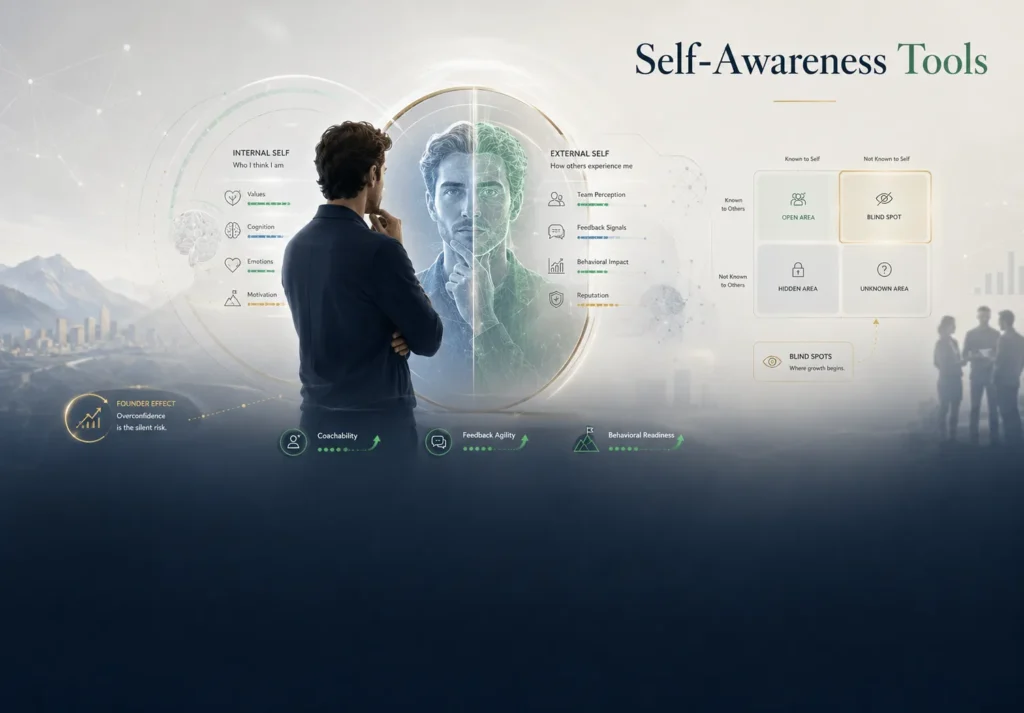
Understanding and implementing startup founder self awareness tools is the critical missing ingredient that separates resilient ventures from early-stage failures.
Self Awareness Tools for Start-up Founders
The current climate for entrepreneurship features countless examples of promising startups which have failed despite having revolutionary ideas, large amounts of money, and great technology, missing one important ingredient—self awareness tools for start-up founders. Whereas previous practices focused on due diligence regarding product-market fit, the business community is starting to recognize that more than 60 percent of failures within the first year of startup creation can be attributed to the “people problem,” namely lack of judgment and behavioral toughness. This kind of self-awareness is crucial for a start-up founder because it represents an invisible metric of success or failure.
An all-encompassing synthesis of this area can be described as follows: there exist five categories within which startup founder self awareness tools are classified, namely academic/cognitive, social/interpersonal, psychological, founder-specific, and developmental. Self awareness itself is theoretically split into two separate skills: Internal self awareness, referring to being aware of your own values and vision, and External self awareness, meaning knowing how others perceive you. The founders are usually proficient in one of them but extremely vulnerable regarding the other. For mapping purposes, tools such as Johari Window are used to recognize “Blind Spots,” traits visible to the team members and unknown to the founder. Lastly, a prerequisite in using any of the above methods lies in having Coachability Theory fulfilled, an approach measuring the founders’ ability to receive feedback without getting emotional. This has recently proved to be an important attribute among the factors determining investment by venture capitalists. Lacking that capacity, even the most modern tools will not yield any result as the founder falls victim of the “Founder Effect,” thus displaying excessive confidence and unwillingness to listen.
Assessing Founder Coachability Metrics
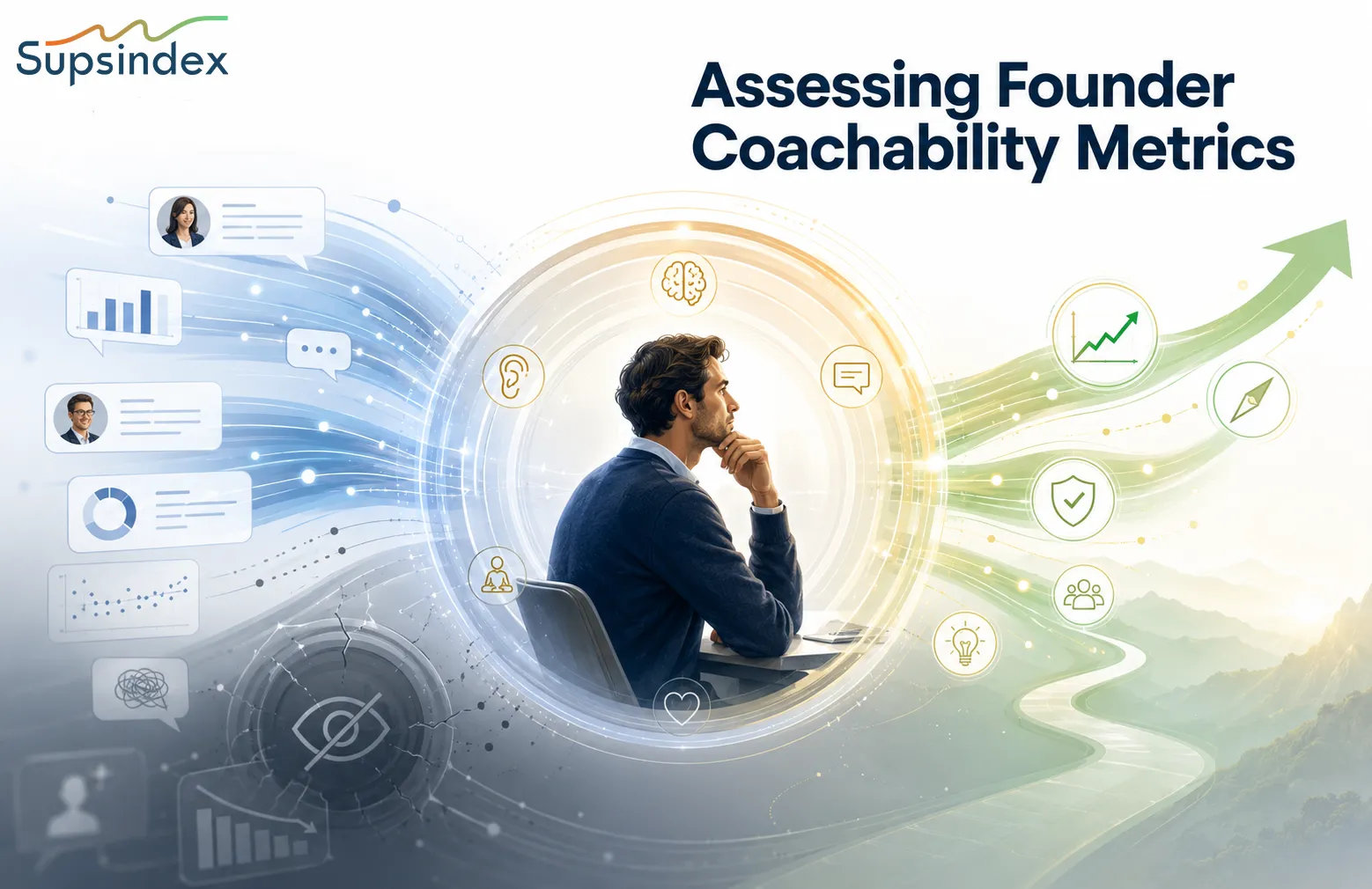
Limitations on the effectiveness of any testing instrument come from the openness of the subject to suggestion. In the case of entrepreneur self-awareness tools, no matter how advanced the psychometric information, it is useless unless the subject is “coachable.” Assessing founder coachability metrics is now a specialized discipline within entrepreneurial science, focusing on the “Entrepreneurial Coachability” construct. In regard to diagnostic tools, the degree to which they will be effective is limited by how receptive the person being analyzed is. Speaking about the application of self-awareness tools to founders of startups, even the most complicated psychometric information would be useless if the individual being assessed cannot be coached. This is defined as the psychological space that exists between obtaining information and reacting to it.
Unless the founders are generally approachable, there would be no use in any help from mentors and tools to them. If an individual is holding on to the fixed mind frame that one’s intelligence and talents are fixed qualities, then it will automatically be difficult for him to learn from his mistakes. On the other hand, a person with a growth mind set sees problems as puzzles and learns to evolve using feedback. For evaluating founder coachability metrics, it would be imperative to identify the ability of the individual to counteract “self-serving bias” whereby the individual uses information in the way it suits him alone. Founder with lower scores of coachability would always suffer from “willful blindness.” In such cases, the “penalty for bottleneck” would remain a mystery to the founder despite being an alarm to prevent their startup from dying out.
Founder Emotional Intelligence Metrics
While cognitive power answers “Can you solve the problem?”, founder emotional intelligence metrics answer “Can you lead the people who solve the problem?” Emotional Intelligence (EQ) in the startup context is less about “niceness” and more about Interpersonal Effectiveness and Stress Management. Professional assessments like the EQ-i 2.0 provide a validated framework for founders to see how their emotional regulation impacts their team’s “Growth and Expansion Behavior.”
Founder emotional intelligence metrics are particularly critical in managing the “Founder Effect.” The same decisive leadership required to launch a company can devolve into an autocratic management style that erodes trust and saps team motivation. Sophisticated startup founder self awareness tools now use Situational Judgment Tests (SJTs) to measure EQ in context. For example, a scenario might test a founder’s response to a key employee leaving for a competitor; a high-EQ response involves a thorough exit interview and legal review, whereas a low-EQ response might involve rash, emotional access restrictions. Ultimately, founder emotional intelligence metrics serve as a barometer for team synergy, which is vital because founding teams statistically deliver better results than solo founders—provided their interpersonal composition is not fragile.
Startup Founder Psychological Report
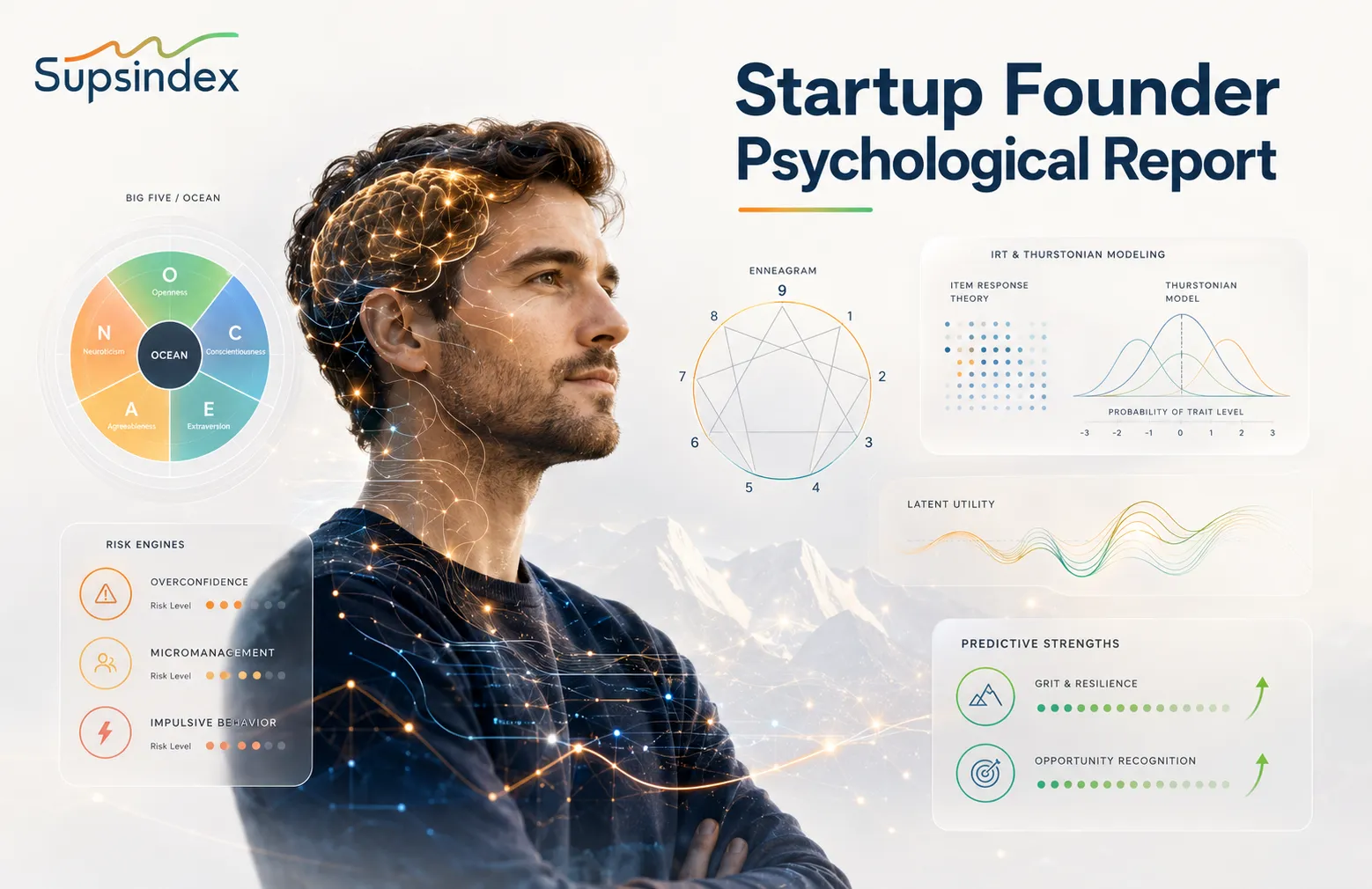
For a more detailed startup founder psychological assessment report, an evolution needs to happen from the personality questionnaires that are typical of lifestyle magazines into something along the lines of Item Response Theory (IRT) and Thurstonian Modeling, which will help uncover the “Latent Utility” of true traits hidden behind what founders feel is “socially desirable.” The most common tools for founders would be the Big Five personality test (OCEAN) and the Enneagram test.
But for a real psychological report for startup founders, it is vital to recognize the “Risk Engines,” which can cause company failure. This will involve testing vulnerability to the pitfalls of overconfidence, micromanagement, and impulsive behavior. For example, the Entrepreneurial Mindset Profile (EMP) assesses an entrepreneur’s profile compared to other executives and successful entrepreneurs. This reveals some of these psychological weaknesses. When using tools for self-awareness for startup founders based on 19 positive psychological constructs like Grit and Opportunity Recognition, a psychological report turns into a predictive tool.
Identifying Gaps and Responding to Them
Current Startup Founder Self-Awareness Tools Are Highly Fragmented, From Scientifically Rigorous Psychological Constructs to VC Private Tools. To Get an Understanding of the Market Status Quo, It Is Important to Examine the Consensus and Detailing of Existing Frameworks:
Analysis: Universal Acceptance vs. Gaps
| Category | Tool / Framework | International Consensus | Specifically for Founders? |
|---|---|---|---|
| Psychological | The Big Five (OCEAN) | High (Universal) | No (General Purpose) |
| Psychological | MBTI | Low (Pseudo-science) | No (General Purpose) |
| Aptitude | BP10 (Gallup) | Medium (Business focused) | Yes |
| Interpersonal | Johari Window | High (Foundational) | No (General Purpose) |
| Interpersonal | 360-Degree Feedback | High (Gold Standard) | No (General Purpose) |
| Mindset | EMP (Entrepreneurial Mindset Profile) | Medium (Academic) | Yes |
| Cognitive | EQ-i 2.0 | High (Validated) | No (General Purpose) |
| Interpersonal | Coachability Assessment | Emerging (Investor led) | Yes |
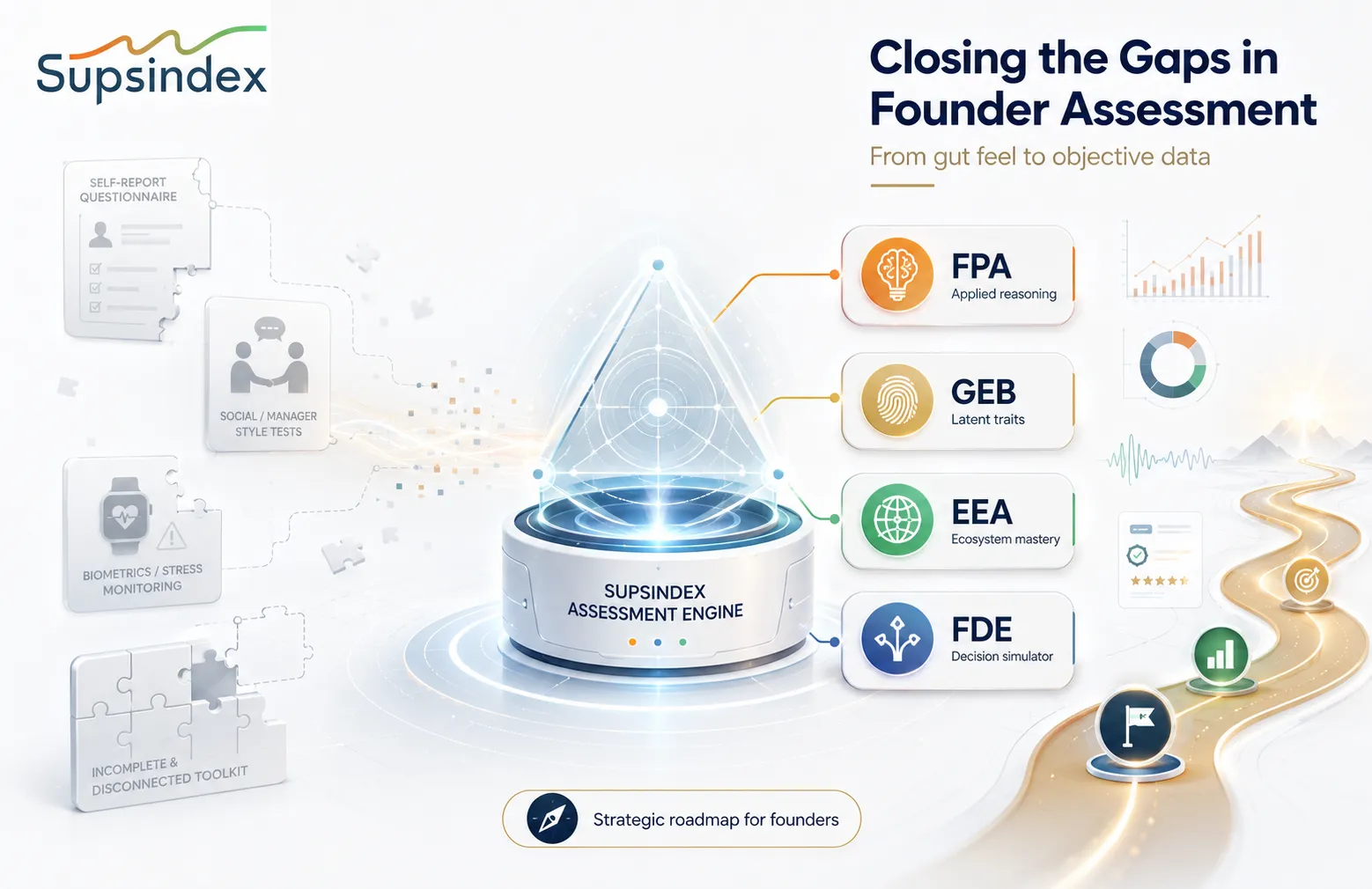
When identifying gaps and responding to them, several critical absences in the global toolkit become apparent. Most social skill tests are designed for corporate managers, leaving a lack of tools for fundraising persuasion or pivoting. There is also a lack of real-time awareness tools that track a founder’s stress via biometrics during high-stakes board meetings.
Responding to these gaps requires a shift toward triangulated assessment engines that simulate reality rather than just asking for self-reports. Supsindex addresses these specific shortcomings through a multi-tiered approach:
- The FPA (Founder Potential Assessment) covers the gap in Academic/Cognitive ability for non-linear tasks by measuring applied reasoning and domain-specific fluency across 55 industries.
- The GEB (General Entrepreneur Behavior) responds to the need for a startup founder psychological report by using Thurstonian IRT to recover latent traits like Resilience and Ethical Integrity, while engineering “distractors” to bypass social desirability bias.
- The EEA (Ecosystem Environment Awareness) fills the gap in Ecosystem Mastery, measuring “street smarts” and hyper-localization, ensuring a founder understands the specific regulatory and capital landscape of their country.
- The FDE (Founders’ Decision Excellence) acts as a Leadership Flight Simulator, providing the missing link of real-time behavioral data under simulated market shocks.
By utilizing these startup founder self awareness tools, founders can finally replace “gut feel” with objective data, ensuring that every venture capital dollar and joule of human energy is deployed with maximum impact. If you are ready to illuminate your blind spots and de-risk your venture’s future, explore how our indices can provide your strategic roadmap.
