


In the high-stakes theater of global entrepreneurship, we often obsess over external metrics. We track customer acquisition costs, burn rates, churn, and monthly recurring revenue with religious fervor. We build dashboards to monitor server uptime and marketing funnels. Yet, the single most critical variable in the startup equation—the founder—often operates in a “dark forest,” unmeasured and unmonitored without a clear gauge of founder soft power.
It is a paradox of the innovation economy: we use advanced data to optimize our products, but we rely on gut feeling to optimize ourselves.
This guide explores the rigorous science of self-assessment. It is not about vanity or reassurance; it is about survival. We will dissect the psychology of those who seek the truth about themselves, analyze why the lack of this trait is the leading cause of startup mortality, and introduce the world’s first scientifically grounded ecosystem for measuring founder soft power: Supsindex.
Part 1: The Psychology of the Self-Assessor
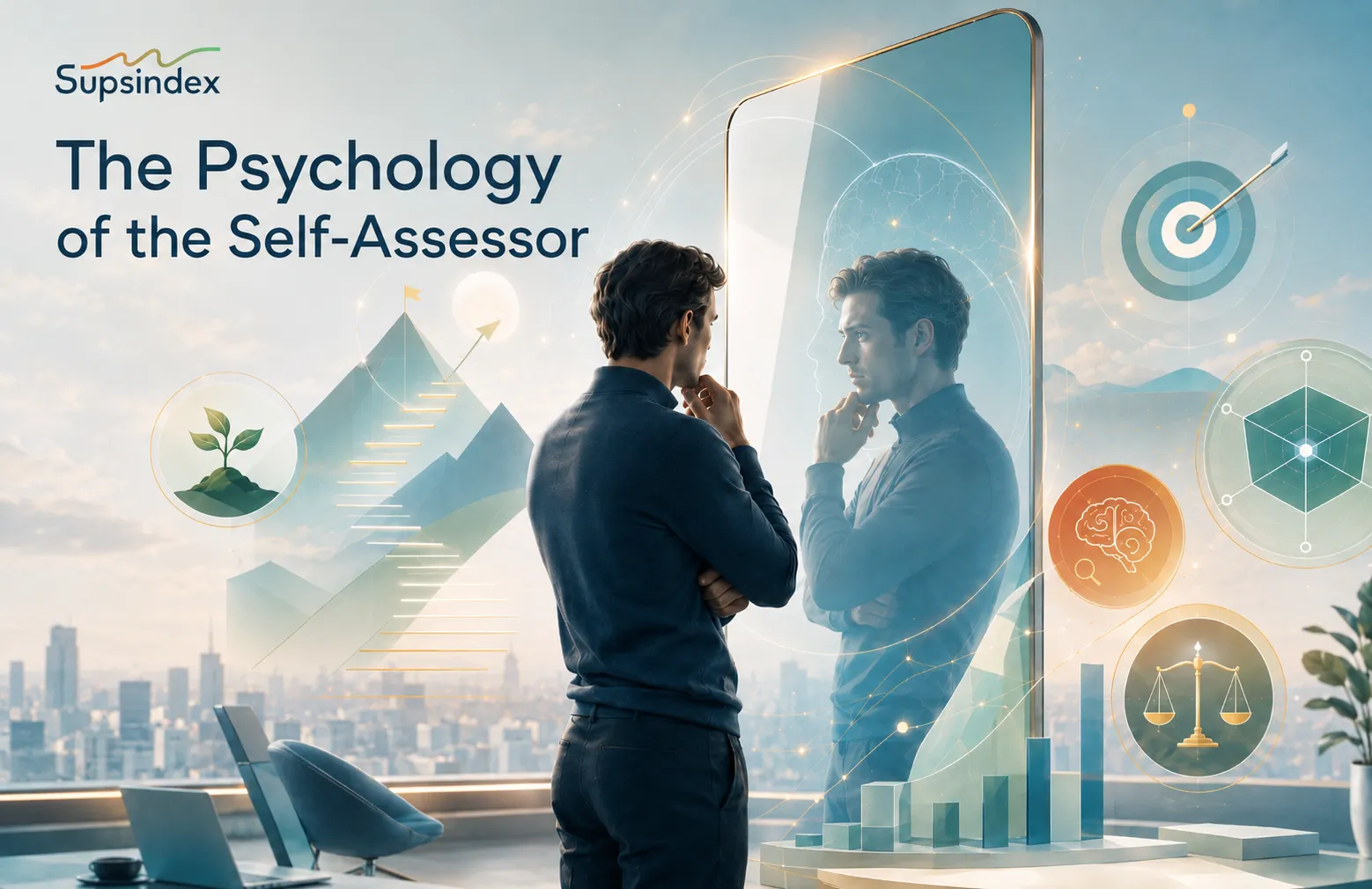
Who Looks in the Mirror, and Why?
Self-assessment is not a passive activity. It is an aggressive pursuit of reality. Through decades of psychological research and the analysis of successful leadership profiles, we have identified that the impulse to self-assess is not evenly distributed among the population. It belongs to a specific psychological archetype. Understanding this archetype is the first step in determining whether you possess the raw materials and founder soft power for exponential growth.
1. The Growth Mindset Adopters
The most fundamental predictor of self-assessment is the possession of a Growth Mindset. Popularized by psychologist Carol Dweck, this is the belief that intelligence, talent, and ability are not fixed assets but muscles that can be developed through dedication.
For the Fixed Mindset individual, a self-assessment that reveals a weakness is a verdict. It says, “You are not good at this, and you never will be.” Therefore, they avoid assessment to protect their ego.
For the Growth Mindset adopter—the ideal entrepreneurial candidate—self-assessment is merely navigational data. If a Supsindex report indicates a deficit in financial negotiation, they do not view it as a character flaw; they view it as a signal to acquire a new skill. In the volatile environment of a startup, where the product and market change rapidly, this trait is non-negotiable. Founders with a growth mindset view a failed sales pitch not as proof they are “bad at sales,” but as data indicating they need to refine their pitch.
2. The High “nAch” Personality
Psychologist David McClelland identified the “Need for Achievement” (nAch) as a distinct personality driver. People high in nAch have a compulsive desire to accomplish difficult tasks and meet high standards of excellence.
Why do they self-assess? Because they crave the scorecard. A high-nAch founder cannot sleep soundly unless they know exactly where they stand. They cannot improve efficiency if they cannot measure current performance. While “visionaries” may be content with dreaming, high-nAch individuals are pragmatic operators. They constantly tweak their business models—and their own behavioral patterns—to maximize results. For them, self-assessment is the feedback loop that fuels their ambition.
3. The Intellectually Humble
There is a misconception that successful founders must be arrogant. The data suggests otherwise. The most resilient founders possess Intellectual Humility. This is not low self-esteem; it is the cognitive ability to decouple one’s ego from one’s ideas.
The intellectually humble founder can say, “I was wrong,” without feeling diminished as a human being. They engage in self-assessment because they are naturally curious about their own blind spots. They actively hunt for cognitive biases, such as confirmation bias, within their own thinking. This trait is the antidote to the “sunk cost fallacy.” When a product feature isn’t working, the intellectually humble founder admits the mistake and pivots, whereas the arrogant founder burns through capital trying to prove the market wrong.
4. The Metacognitive Masters
Metacognition is “thinking about thinking.” Individuals with high metacognitive ability have a third-party observer in their brain. They can step outside themselves during a heated co-founder dispute and observe their own anger, their own defensive mechanisms, and their own decision-making process.
For these individuals, self-assessment is their default state. They monitor their attention, memory, and learning strategies in real-time. A founder with high metacognition might realize, “I am procrastinating on this financial report not because I am busy, but because I am anxious about the burn rate.” This insight allows them to address the root cause (anxiety) rather than the symptom (procrastination).
The Moral Architecture of Assessment
Beyond cognitive traits, those comfortable with self-assessment share a specific moral profile defining their founder soft power:
- Epistemic Curiosity: A drive to know the truth, even if it is unpleasant. They value accuracy over comfort.
- Cognitive Flexibility: The ability to hold two opposing views of themselves (“I am a visionary leader” and “I handled that meeting poorly”) without collapsing under cognitive dissonance.
- Courage: It is emotionally safer to blame the economy, the investors, or the employees. Looking inward requires the moral courage to face one’s own inadequacy.
- Integrity: At its core, self-assessment is an act of honesty. People with high integrity cannot abide the dissonance of pretending to be better than they are.
Part 2: The Entrepreneurial Imperative
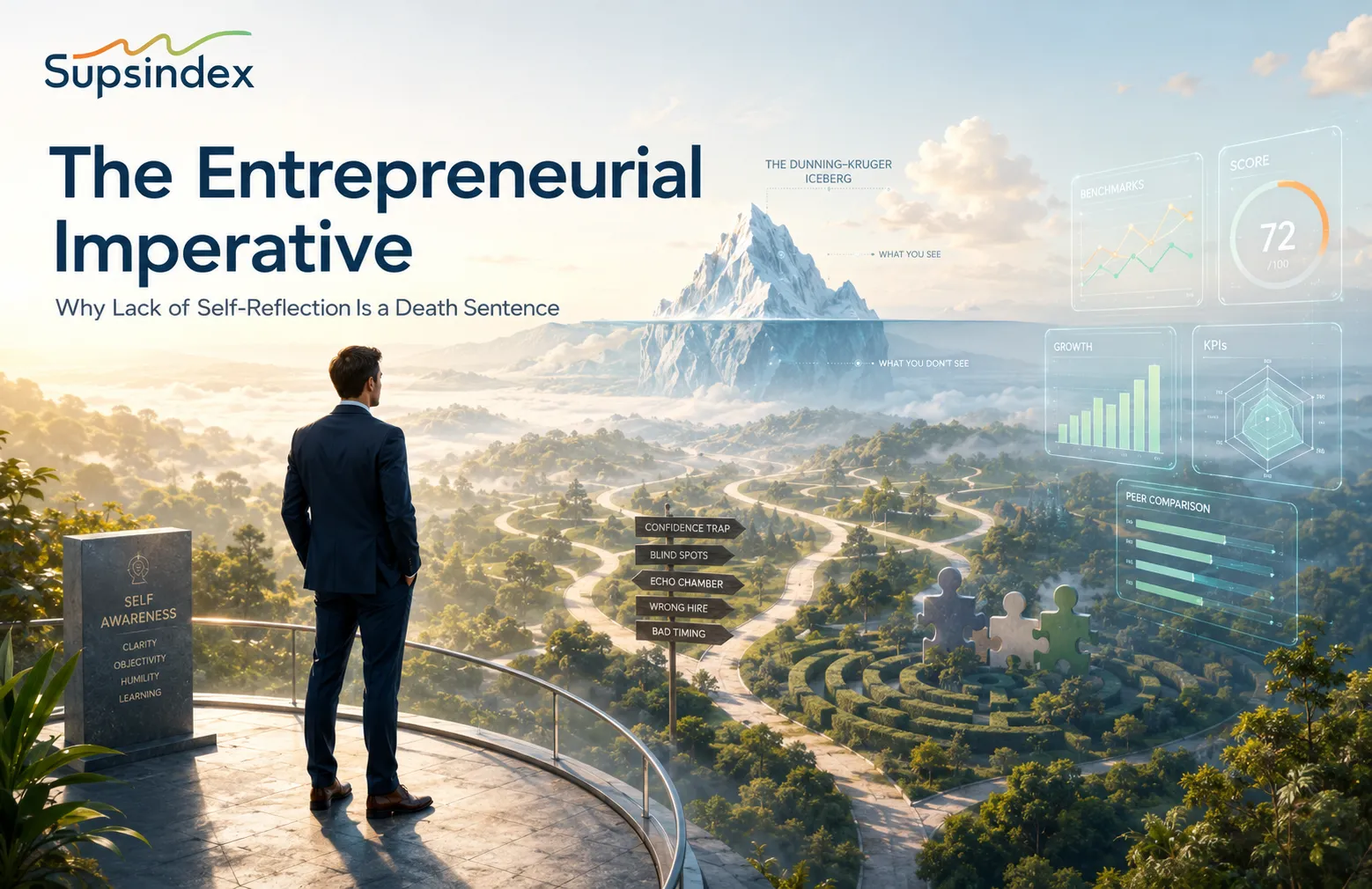
Why Lack of Self-Reflection is a Death Sentence
In the corporate world, there are safety nets. There are performance reviews, HR departments, and managers who provide feedback. In the world of entrepreneurship, you are the safety net. There is no one above you to correct your course until the market does so—usually by bankrupting you.
The “Dark Forest” of Entrepreneurship
Founders navigate their journey in what we call a “dark forest.” Without standardized indices to serve as objective benchmarks, they are unable to see their true strengths, their blind spots, or their stage readiness.
This lack of visibility is expensive. From 2019 to 2024, the global venture capital market deployed $1.7 trillion. Approximately $1.2 trillion of that capital was lost. Research indicates that 60–70% of these failures are attributable not to technology or market size, but to founder-related decisions, team dynamics, and a lack of founder soft power.
The Dunning-Kruger Trap
The greatest threat to a startup is not a competitor; it is the founder’s own delusion. The Dunning-Kruger Effect describes a cognitive bias where people with low ability at a task overestimate their ability.
Incompetent entrepreneurs often lack the very skills needed to recognize their incompetence. They do not self-assess because they genuinely believe they are already experts. They perceive failure as “bad luck” or “investor shortsightedness.” This is the founder who leads the ship into an iceberg while insisting the map is wrong.
The Fragility of Team Composition
Even when an individual founder is capable, the collective organism of the “Founding Team” is often fragile. Co-founder conflict is a leading cause of startup death. Why? Because teams are often assembled based on friendship or technical convenience rather than behavioral complementarity.
Without self-assessment, a founder cannot know their own behavioral gaps. If you don’t know you are risk-averse, you might partner with another risk-averse co-founder, creating a paralyzed company. If you don’t know you are dominant and aggressive, you might partner with another dominant personality, ensuring a power struggle that tears the company apart. You cannot build a balanced team if you do not know the weight of the pieces you are building with.
The Innovation Ecosystem’s Blind Spot
The current ecosystem is designed to measure the venture, not the venturer. We have indices for market cap, indices for GDP, and indices for healthcare quality. But for the most critical layer of the innovation ecosystem—the people building it—we rely on intuition instead of quantifying founder soft power.
Investors evaluate founders based on gut feeling, résumés, and “warm intros.” This subjective approach is prone to bias and error. It results in a high churn rate for VCs and a discouraging environment for founders. The ecosystem has become demotivating, deterring capable individuals from entering entrepreneurship because the path to success feels random rather than meritocratic.
To survive, the modern founder must move beyond intuition. They must embrace the belief that what cannot be measured objectively will continue to be decided subjectively—and fail systematically.
Part 3: The Supsindex Solution to Measure Founder Soft Power
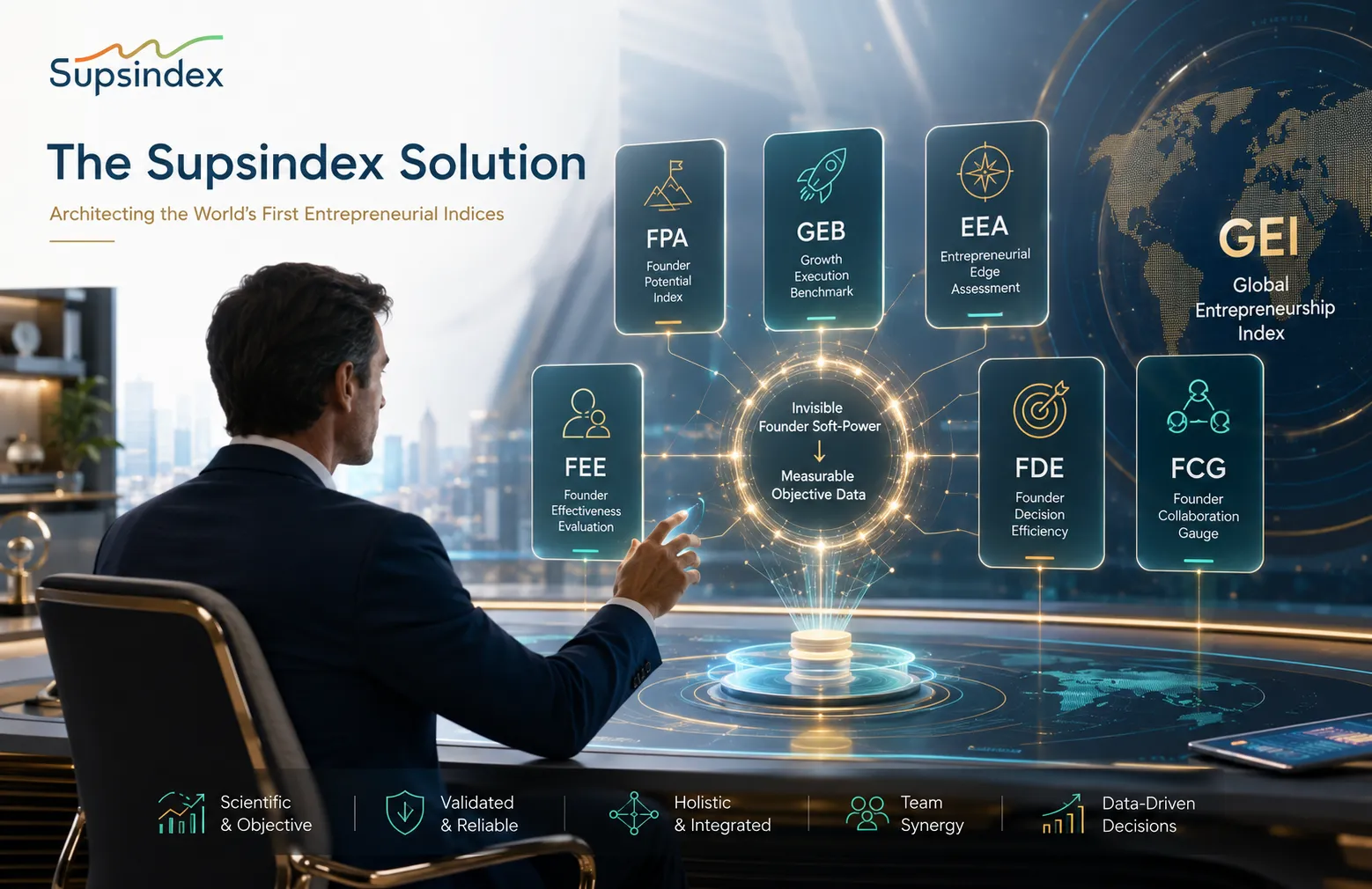
Architecting the World’s First Entrepreneurial Indices
If you accept that self-assessment is vital, the next question is: How?
Until now, founders had to rely on generic personality tests like Myers-Briggs (which are not designed for business) or static IQ tests (which do not measure grit or risk tolerance).
Supsindex has architected the world’s first comprehensive suite of scientifically grounded entrepreneurial indices. We do not just measure personality; we quantify founder soft power. We transform invisible human factors into objective, comparable data.
Our solution is not a quiz; it is a Leadership Flight Simulator. Just as a pilot trains in a simulator to handle engine failure, Supsindex allows founders to test their decision-making capabilities before they burn real capital.
Here is how the Supsindex suite covers every blind spot in the entrepreneurial DNA:
- 1. FPA Index (Founder Public Awareness) – The Reality Check: Many founders live in a bubble. The FPA measures your realistic understanding of entrepreneurial realities, market dynamics, and public-facing expectations. What it solves: It identifies if you are hallucinating about the market demand or if you are grounded in reality. It is the baseline for “Epistemic Curiosity.”
- 2. GEB Index (General Entrepreneurial Behavior) – The Engine Room: This index analyzes your core mindset, resilience, ethical framework, and adaptive beliefs. What it solves: It answers the question, “Do I have the grit to survive?” It identifies if you possess the Growth Mindset and the High nAch required to push through the “Valley of Death.”
- 3. EEA Index (Ecosystem Environmental Awareness) – The Map: Behaviors and norms are unique in each startup ecosystem. A strategy that works in Silicon Valley might fail in Berlin or Singapore. The EEA assesses your familiarity and strategic fit with target markets, regulatory environments, and cultural contexts. What it solves: It prevents “cultural mismatch.” It ensures you are not just a good founder, but the right founder for this specific environment.
- 4. FEE Index (Founders Engagement Efficiency) – The Team Synergy: This is our predictive engine for co-founder dynamics. It predicts synergy, compatibility, and complementary strengths. What it solves: It moves team building from “gut feeling” to “chemical engineering.” It predicts potential conflicts before they destroy the company, ensuring you have the right mix of risk-takers and stabilizers.
- 5. FDE Index (Founder Decision Excellence) – The Flight Simulator: This is our flagship innovation to gauge founder soft power. The FDE evaluates judgment, composure, and strategic clarity under pressure through an AI-powered simulation. Alongside the real founder sits a Personalized Digital Clone—an AI twin built from your own data that represents optimal decision-making. What it solves: It tracks the divergence between your human reaction and the optimal AI reaction. It reveals exactly where your judgment falters under stress—whether you panic, freeze, or become reckless.
- 6. FCG Index (Founder Continuous Growth) – The Long Game: Entrepreneurship is not a static state; it is a trajectory. The FCG tracks your ability to learn, adapt to emerging trends, and evolve your decision-making capacity over time. What it solves: It combats stagnation. It ensures that as your company grows from Seed to Series A, you are growing from a Founder to a CEO.
The Global Entrepreneurship Index (GEI)
Supsindex is not just building tests; we are building a global standard. Just as the HDI measures a nation’s well-being, our Global Entrepreneurship Index (GEI) will serve as the gold standard for measuring entrepreneurial health. By aggregating these scores, we empower you to compare yourself not just against a theoretical ideal, but against the top 1% of founders globally.
Why There Is No Alternative to Measuring Founder Soft Power
There are other tests, but there is no other ecosystem.
- Competitors offer static personality quizzes. Supsindex offers dynamic simulations.
- Competitors assess you in a vacuum. Supsindex assesses you within the context of your specific industry (55+ industries covered) and ecosystem.
- Competitors give you a PDF. Supsindex gives you a Digital Twin and a path to continuous growth.
The era of assessing startups based on gut feeling is over. The “Self-Assessor” is the survivor. The founder who can rapidly assess their performance, admit a deficit, and acquire the missing skill is the founder who wins.
Don’t fly blind. Don’t let the market be the first one to tell you that you weren’t ready. Step into the simulator.
Ready to see the invisible? Discover your founder soft power score today and join the top 1% of data-driven founders.
