

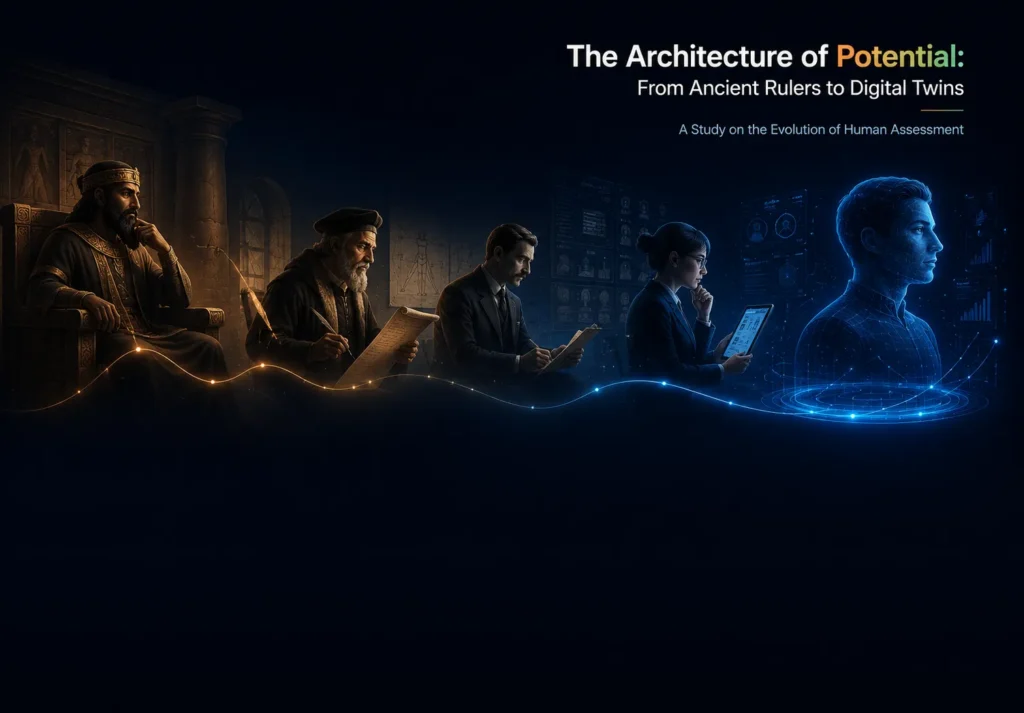
Understanding The Architecture of Potential requires tracing the evolution of human assessment from ancient empirical tests to the predictive power of modern digital twins.
The Architecture of Potential: From Ancient Rulers to Digital Twins
A Study on the Evolution of Human Assessment
Part One: Origins

Since the dawn of consciousness, humanity has been obsessed with the question of capability. In the earliest epochs, “testing” was not a formal event but a matter of survival. The assessment of a hunter was binary and brutal: did they return with food, or did they not? The validation of a shelter builder was equally empirical: did the roof collapse during the storm?
In these physical domains, assessment is inherently transparent. A carpentry joint is either flush, or it is not. A butchered cut is either clean, or it is wasted. The feedback loop in physical skills is immediate and undeniable. However, as society complexified, the need arose to measure the intangible—the “dark forest” of the human mind. We needed to assess leadership, loyalty, cognitive capacity, and foresight. Unlike a wooden chair, the human psyche does not easily reveal its structural integrity until it is put under load.
The first systematic attempt to measure these invisible traits appeared in Imperial China around 206 BCE. The Imperial Examination system was a revolutionary meritocracy designed to select government officials based on intellect and moral character rather than lineage. It was the grandfather of all standardized testing [1].
However, the scientific era of psychometrics—the measurement of the mind—truly began in the late 19th century. Sir Francis Galton established the Anthropometric Laboratory, attempting to measure intelligence through physical and sensory acuity [2]. Though his methods were flawed, his ambition laid the groundwork for Alfred Binet, who later developed the first practical intelligence test to identify students needing educational assistance [3].
Part Two: The Illusion of Type
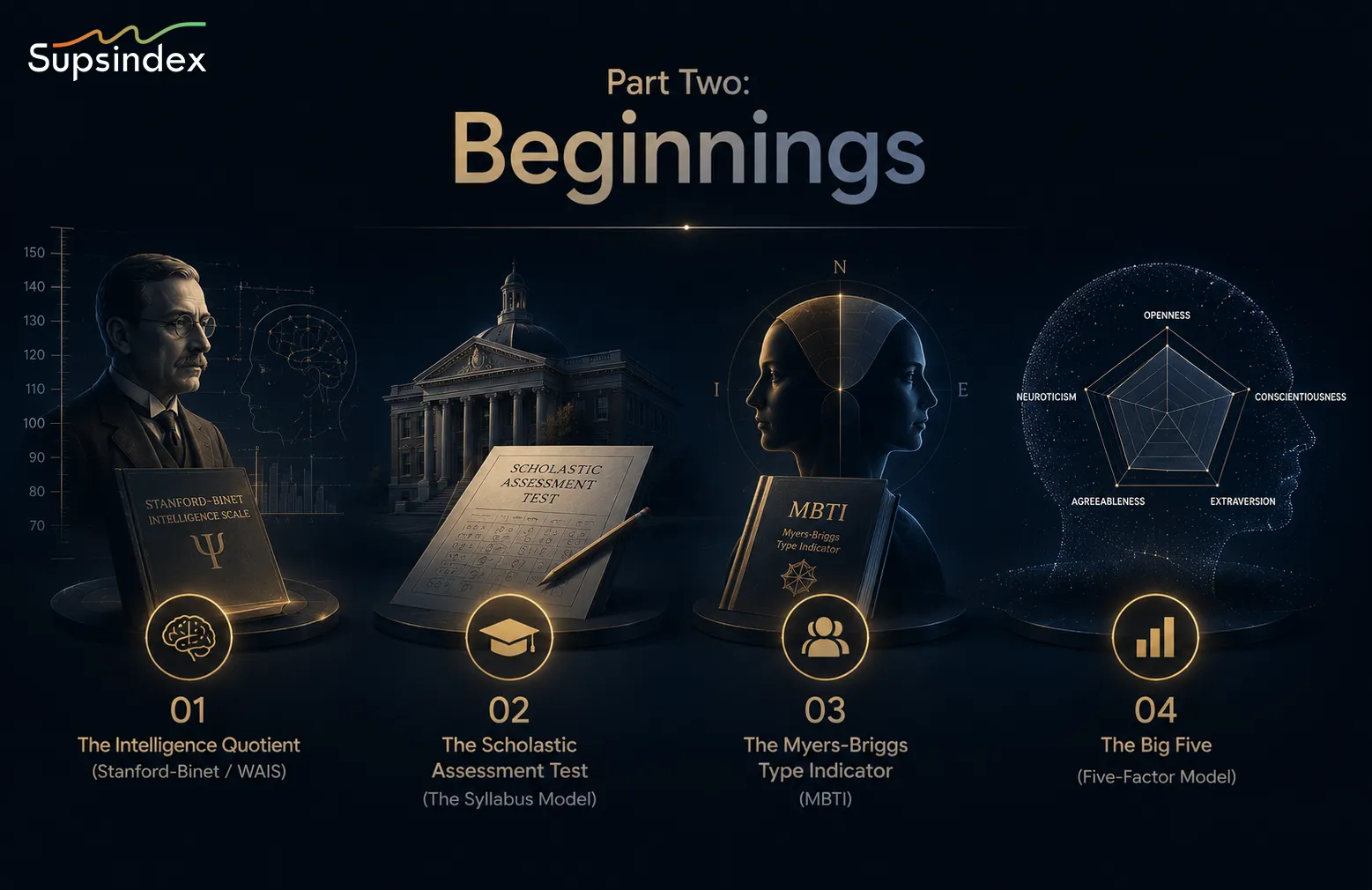
As the 20th century progressed, the need to categorize human potential expanded into the industrial and military spheres. The Army Alpha and Beta tests were deployed during World War I to rapidly classify millions of recruits [4]. This era birthed the modern obsession with standardized testing and meritocracy, profoundly shaping educational and corporate landscapes [5].
Concurrently, the desire to categorize personality led to the creation of the Myers-Briggs Type Indicator (MBTI). Despite its immense popularity, the MBTI relies on rigid binaries that fail to capture the fluid nature of human behavior [6]. Modern psychology has largely moved toward trait-based models, such as the Big Five, which offer more empirical validity [7]. Yet, the corporate world remains addicted to the illusion of “type,” often relying on outdated instruments to make critical talent decisions [8].
Part Three: The Crisis of the Knowledge Economy
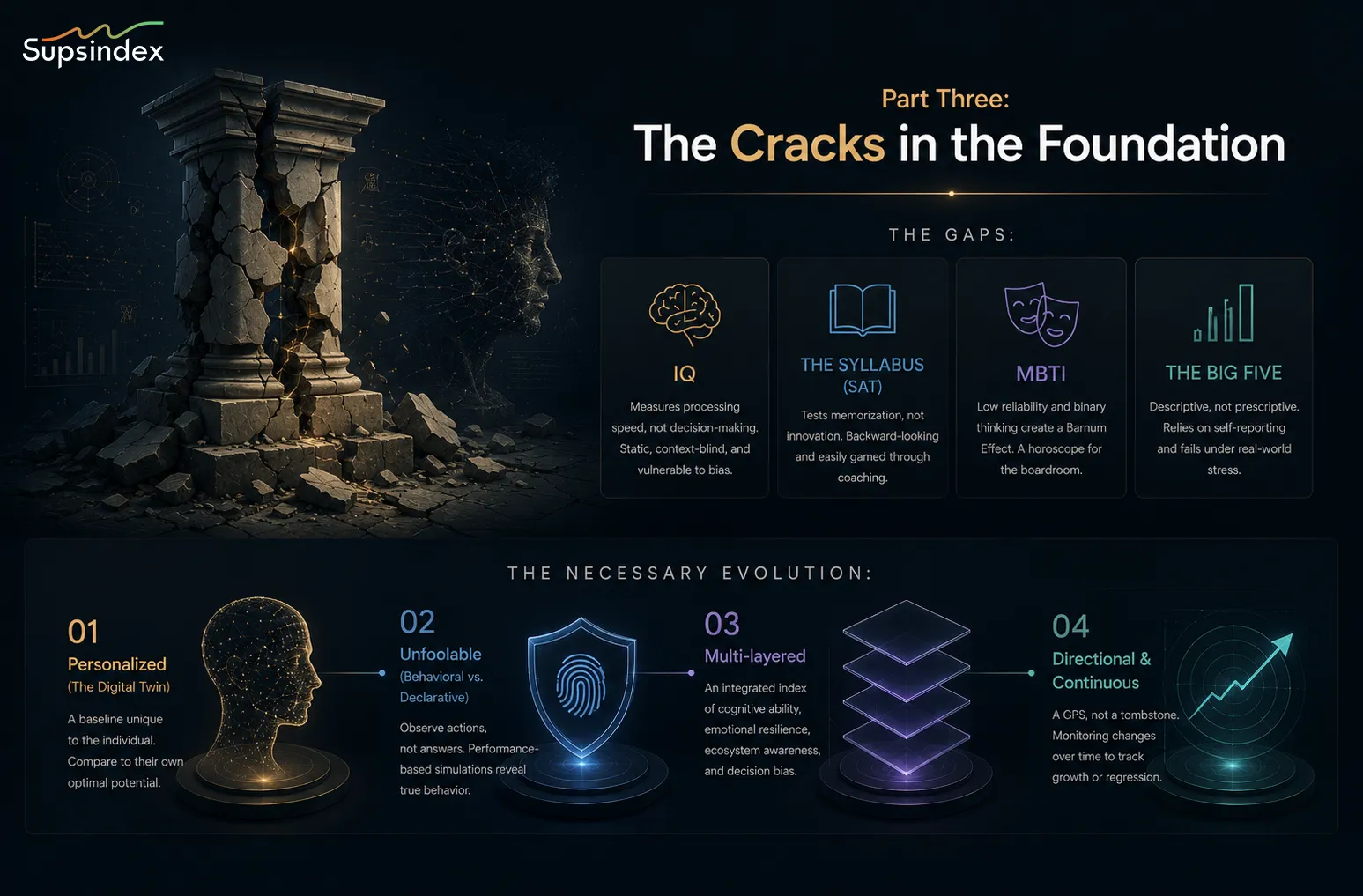
In the contemporary knowledge economy, the limitations of these static assessments have become glaringly apparent. We are no longer selecting assembly-line workers; we are attempting to identify visionary founders, agile executives, and resilient teams. Traditional psychometrics struggle to evaluate performance under the extreme ambiguity and stress characteristic of modern ventures.
They measure a static snapshot of traits but fail to capture dynamic decision-making processes. This assessment gap results in trillions of dollars of misallocated venture capital and countless brilliant minds overlooked because they did not fit the archaic templates of the past.
Part Four: The Dawn of the Digital Twin
The future belongs to those who can bridge this gap—who can move from measuring what a person knows to measuring how a person decides. We must acknowledge that triumphs and setbacks are wrought by human agency. Therefore, to illuminate humanity with scientific rigor and the latest technology is not just progress; it is a prerequisite for survival in the next era of innovation.
References:
[1] Elman, B. A. (2000). A Cultural History of Civil Examinations in Late Imperial China. University of California Press.
[2] Galton, F. (1884). “On the Anthropometric Laboratory at the Late International Health Exhibition”. The Journal of the Anthropological Institute of Great Britain and Ireland.
[3] Nicolas, S., & Levine, Z. (2012). “Alfred Binet and the Birth of Intelligence Testing”. Assessment.
[4] Gould, S. J. (1996). The Mismeasure of Man. W. W. Norton & Company. (Reference to Army Alpha/Beta tests).
[5] Lemann, N. (1999). The Big Test: The Secret History of the American Meritocracy. Farrar, Straus and Giroux.
[6] Emre, M. (2018). The Personality Brokers: The Strange History of Myers-Briggs and the Birth of Personality Testing. Doubleday.
[7] McCrae, R. R., & Costa, P. T. (1987). “Validation of the five-factor model of personality across instruments and observers”. Journal of Personality and Social Psychology.
[8] Grant, A. (2013). “Goodbye to MBTI, the Fad That Won’t Die”.
