


To eliminate capital waste in venture diligence, the industry must recognize the epistemic flaw of static baselines in founder assessment and transition to a decentralized, evolutionary alternative.
The Epistemic Flaw of Static Baselines in Founder Assessment: A Decentralized, Evolutionary Alternative
Abstract
Traditional founder readiness and entrepreneurial mindset assessments rely heavily on a foundational claim: benchmarking test-takers against a historical dataset of “successful entrepreneurs” yields an optimal predictive model. This paper challenges that assumption, exposing structural flaws when static empirical baselines are applied to high-velocity innovation ecosystems. We analyze how reliance on legacy datasets creates systemic vulnerabilities across three core entrepreneurial dimensions: Knowledge, Behavior, and Ecosystem Awareness.
By deconstructing the limitations of historical baselines through four critical vectors—Time, Ecosystem Breadth, Definitions of Success, and Environment Dynamics—we demonstrate that rigid benchmarking distorts predictive accuracy. Finally, we introduce the alternative paradigm developed by Supsindex: a baseline-independent, decentralized architecture powered by an active human-in-development loop. This methodology replaces static historical data with continuous peer-expert consensus, offering a self-correcting engine for mapping true founder capacity.
1. Introduction: The Baseline Delusion in Venture Diligence
In the field of psychometric and behavioral assessment for venture-backed entrepreneurs, a dominant design has emerged among legacy providers: the utilization of a fixed empirical baseline. To establish market authority and predictability, they benchmark new founders against a static dataset of past successes. However, this approach ignores the fluid nature of startup ecosystems.
2. The Misalignment in Knowledge and Ecosystem Awareness
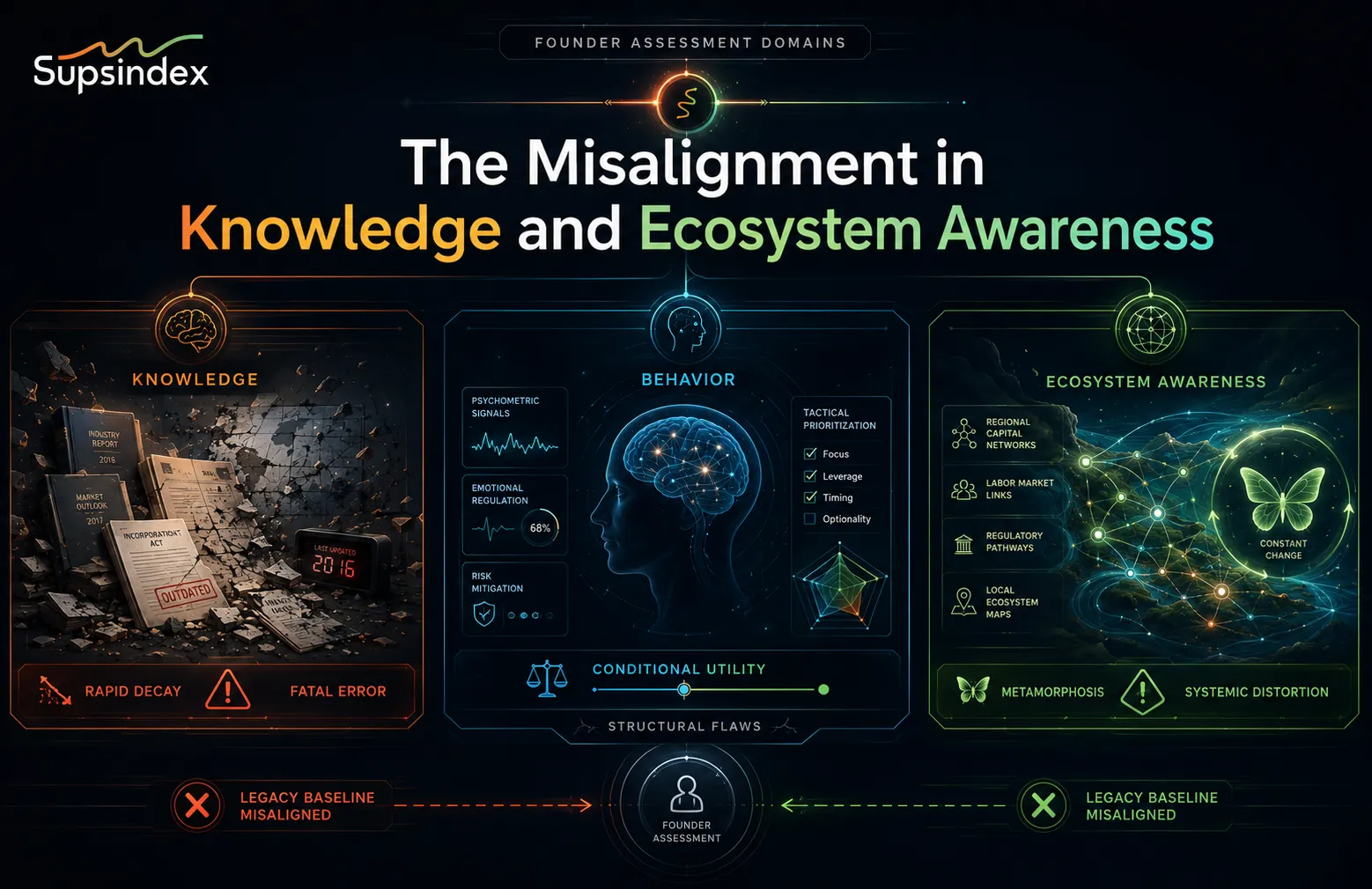
Knowledge in the innovation economy is not static; it decays and evolves rapidly. Assessing a founder’s ecosystem awareness based on baselines established five years ago is a fundamental epistemic flaw. What worked in the zero-interest-rate environment of the past is often irrelevant or even destructive today. Static baselines misalign founder capabilities with the current market reality, providing a false sense of security.
3. Deconstructing the Behavioral Baseline: The Four Flawed Metrics

When evaluating behavioral traits such as resilience, risk tolerance, and decision-making under uncertainty, legacy systems rely on four flawed metrics: outdated time horizons, narrow ecosystem breadth, subjective definitions of success, and a failure to account for environment dynamics. Deconstructing these vectors reveals that static behavioral baselines consistently fail to predict how a founder will react to unprecedented market shocks or novel competitive threats.
4. The Supsindex Alternative: Decentralized, Baseline-Independent Consensus

To correct this systemic vulnerability, the industry requires an evolutionary alternative. A baseline-independent, decentralized architecture powered by an active human-in-development loop replaces rigid historical data with continuous peer-expert consensus. This methodology ensures that the assessment framework adapts in real-time to the shifting realities of global venture creation.
By leveraging this decentralized intelligence, Supsindex creates adaptive validation loops, driving the accuracy of the platform forward while shaping the future of venture analytics.
Ultimately, this evolutionary model delivers a repeatable mechanism that de-risks capital allocation while providing a more precise, real-time mirror for global founder talent.
