


By Kara-B, Founder of HO.. (Health Tech / Dataset Generation)
Liverpool, UK
January 2026. My MVP was finally live. After twelve months of grinding—four in pre-seed, eight in seed—I had done it. A B2B health tech platform that generates synthetic datasets for research. My go-to-market strategy, built with my mentor from LYVA Labs, was actually working. The CAC rate? Lower than we predicted. Conversion from leads to contracts? Higher.
By every objective metric, I was winning.
So why did I feel like I was losing my mind?
The Success That Didn’t Feel Like Success Before My FPA Report
Something shifted the moment we launched. The slow, methodical pace of building—where I could touch every line of code, review every decision, approve every email—was gone. Now I had to trust a B2B partnership manager we’d hired four months ago. A brilliant guy. We’d been perfectly coordinated during the quiet phase.
But twenty days after launch, I found myself snapping at him in a meeting. Over something trivial. The next day, I woke up with a headache that didn’t go away.
My mentors kept telling me I was on the right track. The data agreed. But inside, I felt like a fraud waiting to be exposed. Everything was scaling, and I hated it.
A friend mentioned Supsindex was offering initial calibration assessments. I rolled my eyes—more tests?—but booked one anyway. What did I have to lose except another night of staring at my ceiling?
What the FPA Report Showed Me About Founder Delegation
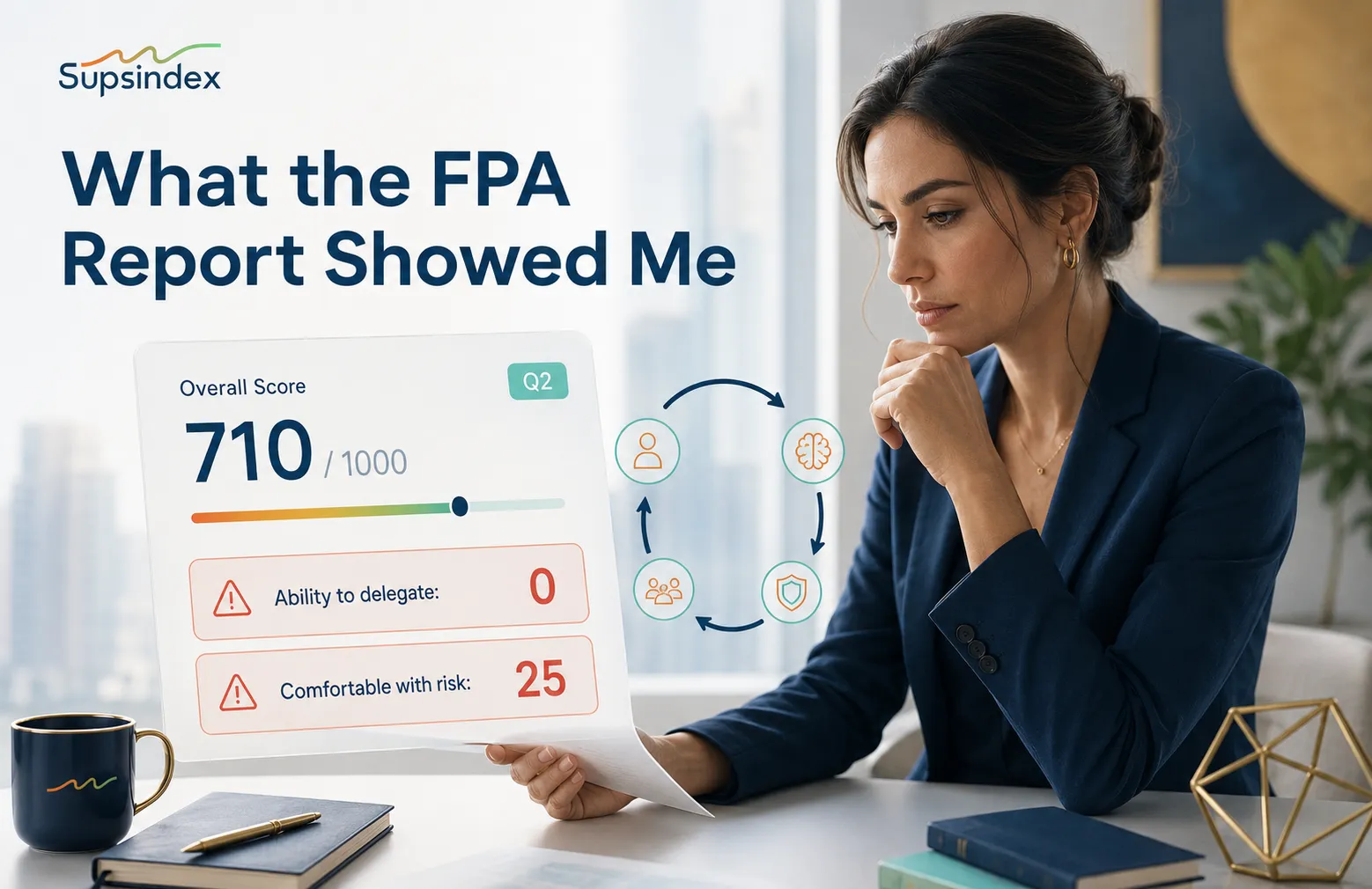
The test took about 105 minutes. Questions about markets, finance, team dynamics, decision-making under pressure. I answered honestly, maybe too honestly.
A few days later, my report arrived.
Overall score: 710 out of 1000. That placed me in Q2—literally 40 points away from the top quartile. Not terrible. But not the validation I’d hoped for.
Then I saw the breakdown.
Two scores jumped off the page like red flags:
| Competency | My Score (out of 100) |
|---|---|
| Ability to delegate | 0 |
| Comfortable with risk | 25 |
Zero. I scored zero on delegation.
I sat there for a long minute, re-reading that line. Then I looked at the seven questions I’d missed. They weren’t random. Every single one revealed the same pattern: I refuse to let go because I’m terrified of what might happen if someone else makes a mistake. And because I’m terrified, I take fewer risks. And because I take fewer risks, I trust others even less.
A loop. A trap. My own personal feedback loop from hell.
The Missing Pieces in My FPA Report
The report didn’t just throw numbers at me. It showed me exactly which knowledge areas I’d bombed. They formed a perfect map of my problem:
- Scalability (how to grow without breaking)
- Build vs. Buy (when to stop doing everything myself)
- Process & Automation (systems that don’t need me)
- Engines of Growth (reliable, repeatable expansion)
- Growth Mindset (believing I could learn to let go)
- Culture Setting (building a team that shares the load)
I read those six categories and felt like someone had been living inside my head. Of course I scored low on scalability—I’d been terrified of scaling. Of course I missed every question about culture—I hadn’t built one. I’d built a solo project dressed up as a startup.
The Real-World Proof Validated by the FPA Report
The hardest part was admitting the report was right.
Back in pre-seed, when decisions moved slowly, I was fine. I could check every box, review every detail, sleep soundly knowing I’d touched everything. But the moment we launched and things had to move faster—the moment I actually had to trust someone else—I fell apart.
I wasn’t frustrated with my B2B partner. I was frustrated with myself for not trusting him. And that frustration came out sideways.
The report named it: low risk tolerance + zero delegation = a founder who chokes at the exact moment she should be celebrating.
What I’m Doing About It Since My FPA Report
That was three months ago. I’m still not “cured.” But I’m different.
My mentor and I built a 90-day plan specifically around those six missing categories. Every week, I deliberately delegate one small thing—something that wouldn’t sink the company if it went wrong. Every week, I practice saying “I don’t know how this will turn out, but let’s try.”
I’ve also started reading about growth mindset (Carol Dweck, if you’re wondering). Turns out, believing you can change is the first step to actually changing.
Will I ever score 100 on delegation? Probably not. But I’ve moved from 0 to 35. And last week, I watched my partnership manager close a deal without my input. He did it better than I could have.
That’s not failure. That’s growth.
If You’re Feeling What I Felt: Get an FPA Report
You don’t need a test to tell you you’re struggling. Your body already knows—the headaches, the irritability, the dread that creeps in just when things should feel good.
But the test did tell me exactly where to look. Not “you’re a bad leader.” Not “you’re not cut out for this.” Just: here are the cracks. Here’s why they connect. Here’s where to start.
If you’re a solo founder who built everything yourself, and now you’re supposed to let others in? Take the FPA. Be ready for a low score on delegation. Be ready to feel exposed.
Then be ready to fix it.
Kara-B is the founder of HO.., a Liverpool-based Health Tech startup focused on synthetic dataset generation for medical research. She is currently working with her LYVA Labs mentor to rebuild her delegation muscles—one small step at a time.
Supsindex Note: Our editor has summarized the above text for use on the website. The final text has been approved by Kara B.
